HCPCS Code J1110: Dihydroergotamine mesylate injection billing guide
HCPCS Code J1110: Official descriptor and drug overview HCPCS Code J1110 is the ...

Last Updated: Oct 29, 2026
59821 is the CPT code for treatment of missed abortion, completed surgically, in the second trimester. It covers surgical evacuation, usually dilation and evacuation (D&E), after fetal demise without expulsion at about 14 to 27 weeks.
The diagnosis is O02.1 alone, with no Z3A gestational age code, because the official guidelines exclude Z3A for abortive outcomes. Most denials trace back to three errors: billing 59820 for a second-trimester case, missing prior authorization, and unbundling components the code already includes.
Let Pabau's smart automation suggest the right codes, reduce claim denials, and keep your practice compliant—effortlessly.
Automate repetitive tasks and focus on what matters most—your patients.
Reduce coding errors and ensure compliance with the latest regulations.
Clean claims, fewer denials, and faster reimbursements.
Powerful insights and reporting to help your practice thrive.
HIPAA compliant SOC 2 certified GDPR-compliant Trusted by 4,000+ clinics worldwide

CPT 59821 covers surgical treatment of missed abortion in the second trimester (about 14 to 27 weeks), while first-trimester cases take CPT 59820.
O02.1 (missed abortion) is the diagnosis, and no Z3A gestational age code goes with it, because the official guidelines exclude Z3A for abortive outcomes.
Most 59821 denials come from three errors: the wrong trimester code, missing prior authorization, and unbundling components the code already includes.
CPT 59821 carries a 90-day global period on the Medicare Physician Fee Schedule, so related post-operative visits are not billed separately.
CPT code 59821 sits in the Surgery section of the AMA CPT code set. It falls within the Maternity Care and Delivery subsection, in the abortion procedures range (59812-59857). The official descriptor reads: Treatment of missed abortion, completed surgically; second trimester.
A missed abortion, also called a missed miscarriage, occurs when the fetus has died but the uterus has not expelled it. When the pregnancy is in the second trimester and the clinician elects surgical management, 59821 is the correct reporting code. Using this code outside that trimester boundary is one of the leading causes of payer downcoding to 59820.
CPT code 59821 covers the complete surgical management of a second-trimester missed abortion, typically by dilation and evacuation (D&E) or suction curettage. The code is a global procedure code, meaning several components are bundled into it by convention and cannot be billed separately for the same encounter.
Bundled (not separately reportable):
Potentially separately reportable (subject to NCCI bundling edits and payer policy):
For the medical billing team, verifying NCCI edits before submitting companion codes with 59821 prevents automatic bundling denials. The National Correct Coding Initiative (NCCI) edits published by CMS define which code pairs trigger an edit. Payer-specific policies may be more restrictive than NCCI defaults.
The 598xx obstetrical code family is a frequent source of miscoding. Its deciding factors, trimester and diagnosis type, are easy to overlook in a busy OB/GYN practice. The table below captures the three codes most commonly confused and the criteria that distinguish them.
The critical clinical distinction between 59821 and 59812 is the diagnosis, not the procedure. Missed abortion means the fetus has died but no expulsion has started. Incomplete abortion means expulsion began but was not complete. A D&E performed on retained products of conception after spontaneous expulsion started is 59812, regardless of gestational age.
OB/GYN practices should build a coding decision tree for the 598xx range, as in the diagram below. The tree routes coders by ultrasound findings and operative notes, not just by the procedure performed.
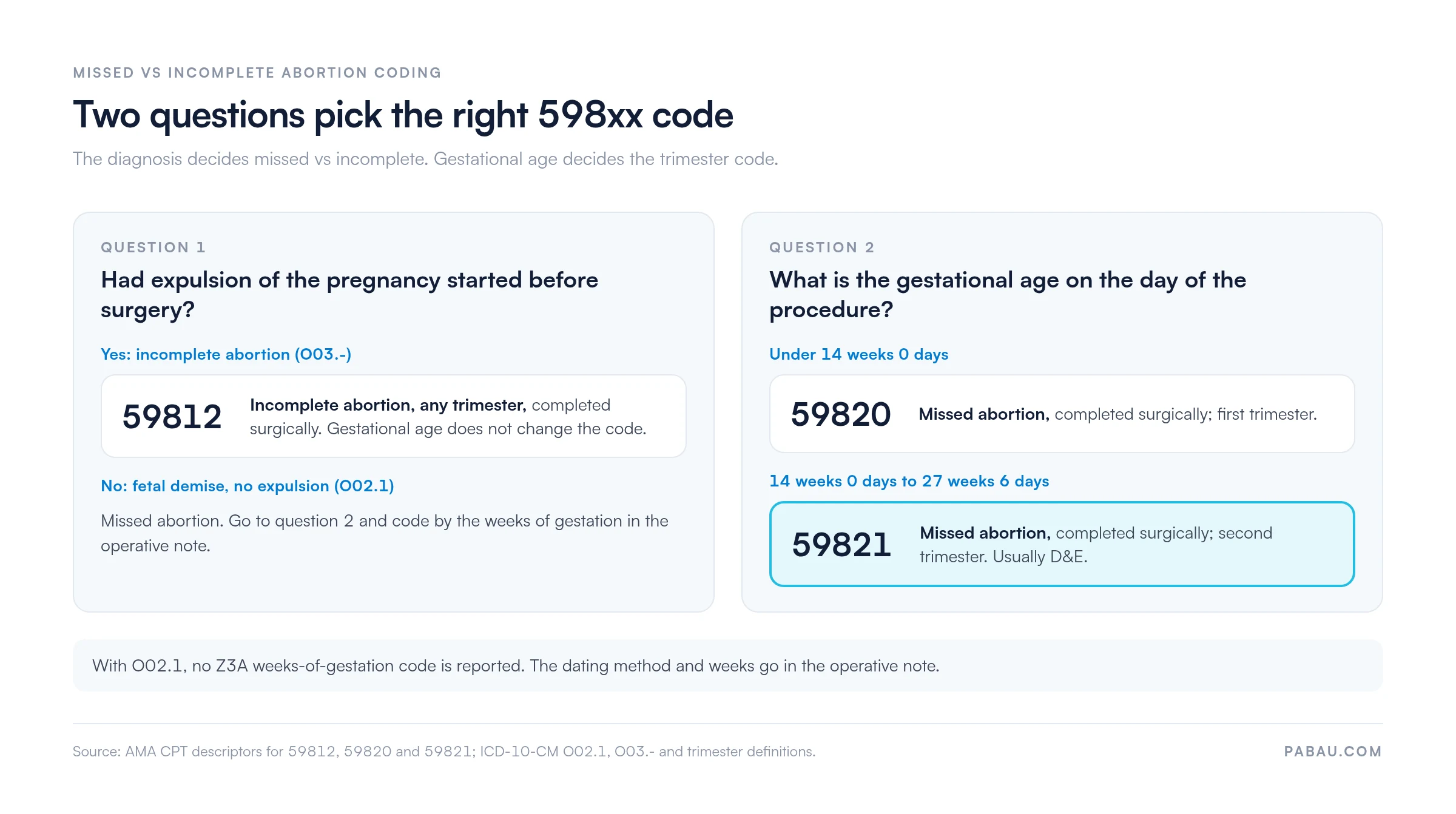
Build a one-page coding guide for your OB billing team that maps each operative note finding to the correct 598xx code. It should read, for example, ‘fetal demise, no expulsion, 14+ weeks = 59821’ and ‘retained products after partial expulsion = 59812 any trimester.’ Laminate it and post it near the coding workstation to reduce routing errors during high-volume periods.
CPT code 59821 pairs with one diagnosis code: O02.1, missed abortion. Payers cross-check the procedure code against that diagnosis to validate medical necessity. The trimester itself is proven by the operative note and ultrasound report, not by a second diagnosis code.
Sequencing rule: O02.1 is the first-listed diagnosis on the claim, and no Z3A weeks-of-gestation code follows it. The FY2026 ICD-10-CM Official Guidelines (Section I.C.21) say Z3A codes should not be assigned for pregnancies with abortive outcomes (categories O00-O08). O02.1 sits in that range.
Record the weeks of gestation in the operative note instead, where they support the choice of 59821 over 59820.
Do not use O03.4 (incomplete spontaneous abortion without complication) with CPT 59821. That ICD-10 code belongs to incomplete abortion, which maps to 59812, not 59821. Mixing these two pairs on a claim invites a medical-necessity denial.
Payers reviewing 59821 claims look for documentation of three facts: (1) fetal demise, (2) gestational age in the second trimester, and (3) the surgical approach. Incomplete documentation is the fastest path to a medical-necessity denial or post-payment audit. A superbill tied to a complete operative note is the minimum submission package.
The operative note and supporting documentation should confirm all of the following:
Thin documentation of fetal demise or gestational age is the denial that hurts most on appeal, because it can’t be fixed by recoding. Write the dating method and the weeks of gestation into the operative note on the day of the procedure. A payer reviewer then sees the second-trimester basis for 59821 without requesting records.
For practices building documentation checklists, clean claim best practices outline the field-level requirements that keep OB claims out of the denial queue.
Three rules decide whether a 59821 claim survives payer review: the post-operative global period, the place of service, and the modifiers on the line.
CPT 59821 carries a 090 global period on the Medicare Physician Fee Schedule (MPFS), the 90-day window CMS assigns to major surgery. It covers the day before the procedure, the day of service, and the 90 days that follow.
CMS can change assignments in its annual update, so verify this one each year in the CMS Medicare Physician Fee Schedule lookup tool. Post-operative visits within the global period are bundled and cannot be billed separately without modifier 24.
CPT 59821 can be performed in a facility or in the office. Facility place-of-service codes include 21 (inpatient hospital), 22 (on-campus outpatient hospital), and 24 (ambulatory surgical center).
An office procedure is reported with POS 11 and pays at the higher non-facility rate, because the practice carries the practice expense. In a facility, the physician bills 59821 under their NPI and the facility files its own claim for facility services.
Modifiers affect payment and claim processing. The table below covers the modifiers most applicable to 59821 encounters.
The 2026 Medicare Physician Fee Schedule (MPFS) reimbursement rate for CPT code 59821 varies by geographic locality. The payment amount is derived from the work, practice expense, and malpractice RVUs multiplied by the annual conversion factor. Practices should look up the specific rate for their locality using the CMS Physician Fee Schedule search tool.
For a broader RVU breakdown including work, practice expense, and malpractice components, use the FastRVU 2026 RVU lookup.
Coverage caveats: Federal limits on abortion coverage, such as the Hyde Amendment, apply to induced abortion. Treatment of a missed abortion is miscarriage care, which Medicaid and commercial plans generally cover. Few 59821 patients are Medicare beneficiaries, so most claims go to commercial payers and state Medicaid programs.
California’s Medi-Cal program, for example, sets specific billing requirements for abortion-related CPT codes in DHCS provider bulletins. Check them with the California Department of Health Care Services before submitting 59821 claims under Medi-Cal.
Commercial payer rates typically deviate from the MPFS national average. Contracted rates depend on the practice’s payer agreements.
Prior authorization (PA) requirements for CPT code 59821 vary significantly by payer and state. Many commercial payers classify 59821 as a surgical procedure that triggers a PA requirement, while federal Medicaid rules and state programs differ. Always verify the specific payer’s requirements before scheduling the procedure.
Documentation typically required in a PA request:
PA decisions for urgent or emergent situations may be handled under expedited review timelines. For non-urgent cases, plan for standard review periods of 3-5 business days with most commercial payers, though this varies. When PA is denied, an appeal generally cites ACOG clinical guidelines that support surgical management of second-trimester missed abortion.
Denials on CPT code 59821 cluster around three errors: the wrong trimester code, missing prior authorization, and unbundling. Thin documentation of fetal demise and gestational age turns each of them into a harder appeal. Tracking denial codes by CARC (Claim Adjustment Reason Code) lets billing teams fix root causes instead of resubmitting the same claim.
Effective denial management in healthcare on OB claims starts with a denial log that categorizes each 59821 rejection by reason before any appeal is filed.
Three checks before submission prevent most of these denials. Confirm the weeks of gestation against the trimester code, attach the authorization number, and run every companion code through the NCCI edits.
Run a 90-day audit of every 59821 denial your practice received and categorize each by CARC code. If more than 30% share one root cause (wrong trimester code, missing prior authorization, or unbundling), that category points to a workflow problem. Fix the intake or documentation step that lets it through, then rework the individual claims.
Unbundling is the third common 59821 denial, so companion codes need a check before every submission. The table below lists codes that can be reported separately in the right circumstances, and codes that are bundled into 59821.
Check each companion code against the NCCI procedure-to-procedure edits before you submit it with 59821. A pair with a modifier indicator of 0 can’t be reported together, even with modifier 59. A pair with an indicator of 1 needs a distinct, documented service before a modifier applies.
A 59821 claim passes through several hands before it is paid. The scheduler confirms coverage, the surgeon dictates the operative note, and the biller picks the code and submits it. When those steps live in separate systems, a missing authorization number or an undated note slips through.
Pabau, the practice management platform we build for OB/GYN practices, keeps the record and the claim together. Its claims management software submits claims electronically through the Claim.MD clearinghouse. Eligibility verification runs before the procedure date, while there is still time to request authorization.
Claim status tracking shows where each submission stands once it leaves the practice. Payments arrive as electronic remittance advice (ERA), which Pabau posts against the claim. A denied 59821 claim then shows its CARC code in one place. Your team can match it to the trimester, authorization, or bundling fix above.

Pabau’s claims management submits CPT 59821 claims through Claim.MD and verifies patient eligibility before the visit. Claim status tracking and ERA posting show where every OB/GYN claim stands.

Claims for CPT 59821 rarely fail on the procedure. They fail when the code, the authorization, or the companion codes don’t match what the record shows.
So settle those questions before the claim goes out. Code the trimester the operative note documents, report O02.1 without a Z3A code, and confirm prior authorization at scheduling. Then check every companion code against the NCCI edits. That work takes minutes per case and costs far less than a denied claim.
Pabau handles the submission side, with electronic claims through Claim.MD, eligibility verification before the procedure date, claim status tracking, and ERA posting in one place. Book a demo to see how Pabau keeps OB/GYN claims for codes like 59821 moving from submission to payment.

Need to understand how clearinghouses validate OB/GYN claims before payer submission? Medical claims clearinghouse overview explains the pre-submission scrubbing process that catches ICD-10 pairing errors on codes like 59821.
Billing a second OB/GYN procedure in the same session? 837 electronic claim file guide covers how multiple procedure codes are sequenced correctly in an EDI transaction to avoid NCCI conflicts.
Want to verify ERA remittance reason codes after a 59821 denial? Electronic remittance advice (ERA) guide explains how to read CARC and RARC codes on the 835 remittance to identify the exact denial reason.
CPT code 59821 covers surgical treatment of a missed abortion in the second trimester, usually by dilation and evacuation (D&E) or suction curettage. It applies when fetal demise has occurred at about 14 to 27 weeks without spontaneous expulsion. The code bundles cervical dilation, uterine evacuation, and standard intraoperative monitoring into a single reportable unit.
CPT 59820 covers surgical treatment of missed abortion in the first trimester, up to about 13 weeks 6 days. CPT 59821 covers the same procedure when the gestational age is in the second trimester, about 14 weeks and beyond. The procedure may be identical, but the trimester boundary determines which code is correct. Using 59820 when the operative note documents 14+ weeks is a miscoding error that leads to payer downcode or denial. The operative note carries the weeks of gestation, since no Z3A code is reported with O02.1.
The diagnosis for CPT 59821 is O02.1 (missed abortion), sequenced first on the claim. No Z3A gestational age code is added. The ICD-10-CM Official Guidelines (Section I.C.21) bar Z3A codes for abortive outcomes in categories O00-O08. Document the weeks of gestation in the operative note instead.
Intraoperative ultrasound guidance (CPT 76998) may be separately reportable with 59821 when it is performed and separately documented. The code pair must also be free of an NCCI bundling edit. Verify the current NCCI edit status and the specific payer’s policy before billing 76998 alongside 59821. Some payers require modifier 59 on 76998 to bypass the NCCI edit when documentation supports a distinct service.