CCSD code F4810: Facial surgery billing guide for UK private practice
CCSD code F4810: definition and chapter context CCSD code F4810 is a billable pr...

Last Updated: Oct 5, 2026
CPT code 76998 covers ultrasonic guidance used during surgery, and it is billed once per operative session. The code sits in the Radiology section of the CPT set, beside the other imaging guidance codes. One rule drives most of its denials.
Payers want two records on file. The first is a stored image, and the second is a signed written interpretation. Without both, the claim comes back, and appeals rarely succeed.
Getting 76998 right protects payment on surgery your team has already delivered. Below, we cover the descriptor, modifier rules, Medicare pricing, and the errors that cost most.

CPT code 76998 covers ultrasonic guidance during surgery, billed once per session rather than per image.
A stored image and a signed written interpretation must both sit in the chart.
Modifier 26 covers the physician’s interpretation, while modifier TC covers the facility’s equipment and staff.
Medicare leaves 76998 and 76998-TC carrier priced, so your MAC sets the payment amount.
Practice management software like Pabau links imaging records to the claim before it leaves your practice.
The American Medical Association (AMA) defines CPT code 76998 as “Ultrasonic guidance, intraoperative.” It sits in the Radiology section, under Diagnostic Ultrasound, in the “Other” category. Billed without a modifier, it is a global code covering both the equipment and the physician’s reading.
One unit covers the session. Capture three images or 30, and the count stays the same. That per-session rule comes from the AMA’s parenthetical notes, and it explains the unit limit further down.
The setting separates them. 76998 applies when ultrasound guides work inside the operating room. 76942 applies when ultrasound guides a needle, catheter, or similar device somewhere else.
Both codes describe live imaging, so the descriptors read alike at a glance. Context is what decides. A coder who bills 76942 for an OR resection has picked the wrong code, however the operative note reads.
A quick test settles most cases. If the patient is draped and surgery is under way, 76998 is the code.
76998 shows up across several specialties, and the pattern is consistent. Ultrasound has to guide the operation while it happens. A scan taken before the incision, or after closure, does not count.
A physician must perform or directly supervise the scan, then read it. A technician-only scan will not support 76998, however good the images are.
Two records are mandatory. The chart needs a permanent image and a formal written interpretation, both in place when the claim goes out. Missing either one is the leading denial trigger on this code, and appeals go nowhere without the file.
Wording matters more than length. “Intraoperative ultrasound was used” gives a reviewer no findings to check. Compare that with a line naming the probe, the structure imaged, the finding, and the decision it changed. The second version survives a records request, which is where medical billing compliance is won or lost.
Own the equipment, and you bill the global code. In a hospital or ASC, the facility owns the machine, so the code splits. You bill 76998-26 for the interpretation, and the facility bills 76998-TC.
The chart below walks the two questions that pick the code and the modifier.
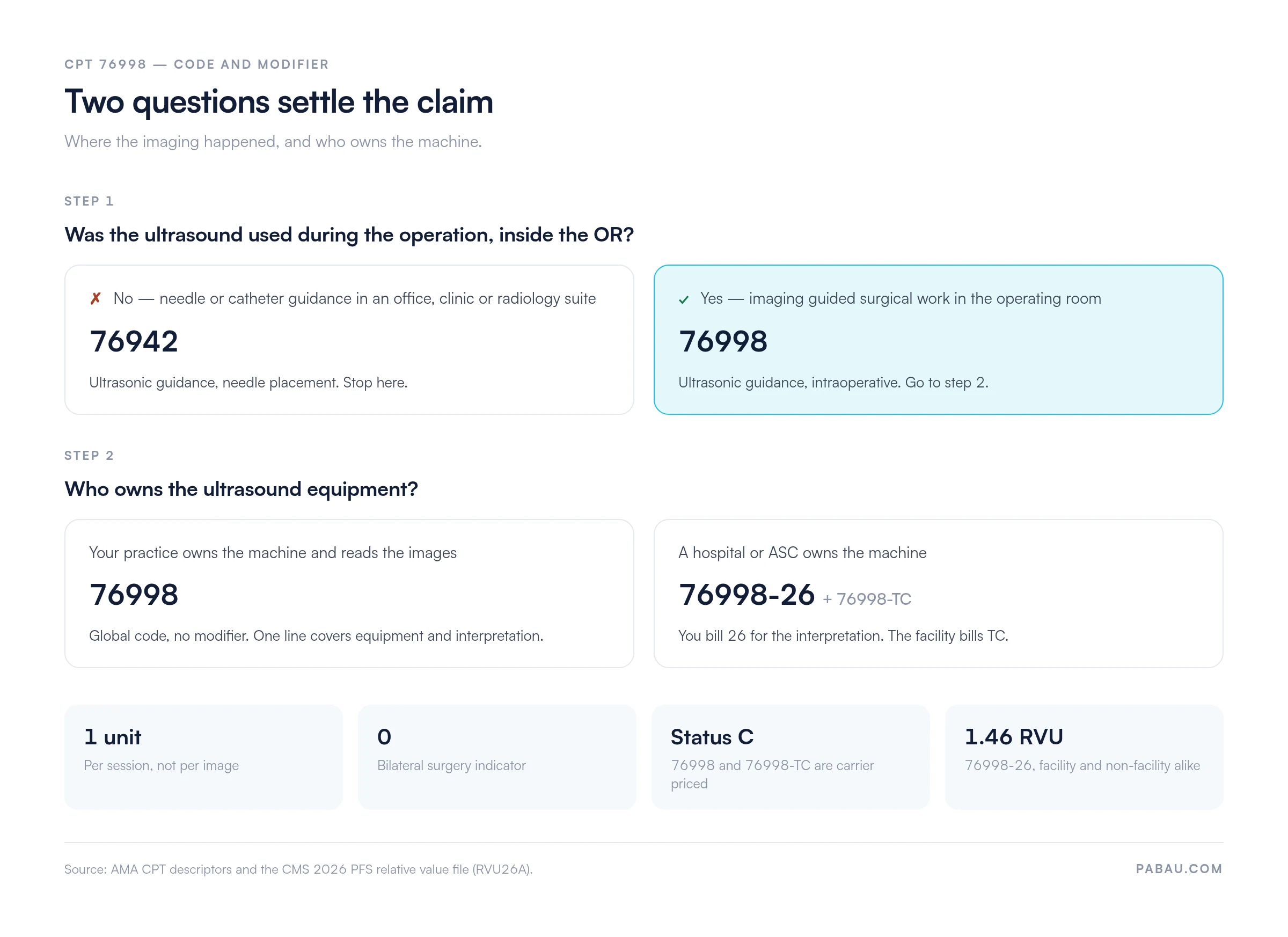
Here is how one case looks on paper. A general surgeon uses hospital ultrasound to map a liver lesion during resection. She dictates a separate interpretive report and signs it.
The hospital bills 76998-TC on its claim, and she bills 76998-26 on hers. Billing the global code instead would collide with the facility’s line and read as a duplicate.
Modifier 59 answers a different question. NCCI edits bundle 76998 with certain surgical codes, and 59 unbundles a genuinely separate service. Check the current table first, because those pairings change every quarter.
Before billing 76998 with modifier 59, run the code pair through the current NCCI table on the CMS website. Those edits update quarterly. A 59 that was valid last quarter may not apply today, and a wrong one invites an audit.
No national rate exists for 76998. In the 2026 Physician Fee Schedule file, the global code and 76998-TC both carry status indicator C, which means carrier priced. Your Medicare Administrative Contractor (MAC) then sets the amount.
Only 76998-26 carries published relative value units (RVUs). Run the code through the CMS Physician Fee Schedule search tool before quoting a figure. Locality adjustments apply on top of that.
The split people expect is not there. For 76998-26, the non-facility and facility totals are identical at 1.46 RVUs each. The global code and 76998-TC have no published RVUs at all, so there is no pair of rates to compare.
Place of service still matters. It must match where the surgery happened, since a mismatch invites review on its own.
The Medically Unlikely Edit (MUE) for 76998 typically sits at one unit per date of service. That follows from the per-session rule. Units beyond the limit get denied automatically unless you document and appeal them. Verify the current value in the CMS MUE table, which is refreshed quarterly.
The bilateral indicator for 76998 is 0. Bilateral surgery rules do not apply, so no bilateral payment adjustment is made. Assistant surgeon and co-surgeon values should be checked against current CMS data, since they move with each annual update.
Denials on 76998 cluster into a handful of repeat offenders. Each one starts upstream of the billing office, in code selection or documentation. Fix the process and the denial stops recurring.
Run this short list before the claim leaves the practice.
Audit your 76998 denials by reason code each quarter. CO-4 (inconsistent modifier) or CO-97 (bundled service) points upstream to modifier selection and NCCI edits. CO-18 (duplicate) usually means the global code went out from inside a facility.
The diagnosis on the claim describes the condition that put the patient in surgery. It never describes the imaging. Accepted pairings vary by specialty and payer, so treat the examples below as a starting point.
MAC policy sits on top of the CPT rules. Some contractors publish Local Coverage Determinations (LCDs) naming the diagnoses that support 76998 in a given specialty. Read yours before billing the code in a new surgical context.
Guidance codes look interchangeable in a lookup tool, and two of them are not billable on their own. Both 76937 and 77001 are add-on codes, so each must ride with a primary procedure code on the same claim.
Knowing which is which prevents underbilling and the compliance risk of a code that cannot stand by itself. The AAPC Codify CPT lookup carries the descriptor and coding tips for each.
Most 76998 denials trace back to split systems. The operative note lives in one system and the image in another. The claim then gets keyed by hand in a third. Details drop out at each handoff.
Pabau, practice management software for healthcare practices, keeps those pieces on one record. The CPT code attached to the service lands on the charge line.
ICD-10 slots are seeded from the client’s recorded problem list. Imaging files and the signed interpretation attach to the same record, so supporting paperwork travels with the claim.
Built-in lookup libraries cover ICD-10-CM and CPT/HCPCS, refreshed with each official release, so coders search without leaving the record.
Required claim fields are checked for completeness before the send button unlocks. US practices submit through Claim.MD, and eligibility checks, claim status, and ERA posting return to the same screen.
Pabau puts claims management without re-entry in the same workflow as the chart. The code and its evidence stay together.

Pabau links the imaging report and interpretation to the record that carries the CPT code. US claims then go out through Claim.MD. Your coders stop re-keying between systems.

76998 is a simple code with an unforgiving paper trail. Get the image stored, the interpretation signed, the modifier matched to the setting, and the diagnosis pointed at the surgery. Those four habits remove most of the denial risk on this code.
The trade-off worth remembering is timing. Each of those four items is cheap to capture in the operating room and expensive to reconstruct months later. Build the capture into the case, and the claim looks after itself.
Want the imaging record and the charge line to sit on the same file? Book a demo to see how Pabau handles 76998 documentation and claim submission for surgical practices.

Need the path a claim takes to the payer? How a medical claims clearinghouse works explains the route from 837P submission through adjudication and ERA return.
Curious which clearinghouse handles US claims in Pabau? Claim.MD clearinghouse overview covers how Pabau submits electronic claims and runs eligibility checks for US practices.
Want less rework across your billing team? Best medical billing software for US practices compares platforms by claim scrubbing, modifier support, and clearinghouse depth.
Whoever performs the scan, interprets it, and signs the report bills the professional component. That is often the operating surgeon, though a radiologist does it in some hospitals. Only one provider bills 76998-26 per session, so agree the arrangement before the case.
Use POS 21 for hospital inpatient and POS 22 for hospital outpatient. An ambulatory surgical center takes POS 24. The code must match where the surgery happened, since a mismatch triggers review.
Prior authorization usually attaches to the primary surgical procedure rather than the guidance code. Some commercial plans list imaging guidance separately, so check the payer’s policy before the case. Traditional Medicare has no prior authorization program covering 76998, though Medicare Advantage plans set their own rules.
Yes, but only for two genuinely separate services. Each needs its own session, its own stored image, and its own interpretation. Run the pair through the current NCCI table first, because an edit may still bundle them.
Yes. The descriptor covers intraoperative ultrasound during open and minimally invasive surgery, robotic cases included. The documentation bar stays the same, so a stored image and a signed interpretation are still required.