CPT code 63081: Vertebral corpectomy, cervical spine
CPT code 63081: official descriptor and procedure overview CPT code 63081 descri...

Last Updated: Oct 6, 2026
58670 is the CPT code for laparoscopy, surgical; with fulguration of oviducts (with or without transection). It covers laparoscopic sterilization in which the surgeon cauterizes both fallopian tubes, and may cut them, without removing them.
When the tubes are excised instead, the correct code is 58661. Medicaid pays for 58670 only with a CMS-116 consent form signed 30 to 180 days before surgery. Medicare doesn't cover it when the purpose is contraception.
Let Pabau's smart automation suggest the right codes, reduce claim denials, and keep your practice compliant—effortlessly.
Automate repetitive tasks and focus on what matters most—your patients.
Reduce coding errors and ensure compliance with the latest regulations.
Clean claims, fewer denials, and faster reimbursements.
Powerful insights and reporting to help your practice thrive.
HIPAA compliant SOC 2 certified GDPR-compliant Trusted by 4,000+ clinics worldwide

CPT 58670 covers laparoscopic fulguration of both fallopian tubes, with or without transection, when the tubes are cauterized but not removed.
Code by technique: salpingectomy is 58661, tubal ligation at cesarean is 58611, and lesion fulguration for endometriosis is 58662.
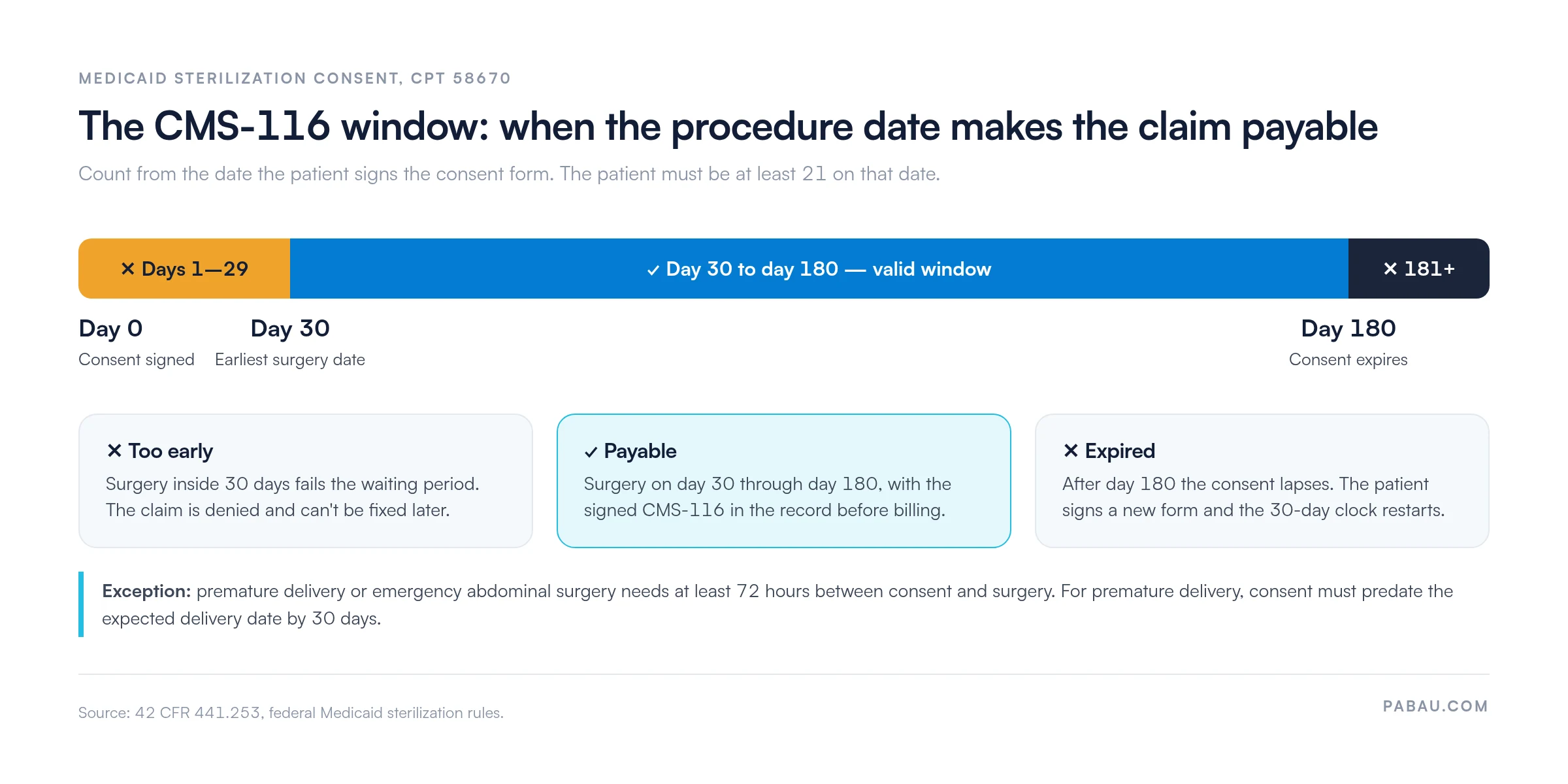
Medicaid pays only if the patient, aged 21 or over, signed a CMS-116 consent form 30 to 180 days before surgery.
Age and eligibility aren’t the test for Medicare: NCD 230.3 excludes elective sterilization outright, so 58670 billed with Z30.2 is essentially never payable.
Pabau, the practice management platform we build, keeps signed consent forms on the patient record and submits claims electronically through Claim.MD.
CPT Code 58670 describes laparoscopy with fulguration of oviducts (with or without transection). In this electrosurgical sterilization technique, the surgeon cauterizes both fallopian tubes and may also cut them.
The American Medical Association places it in the oviduct/ovary subsection (58600–58770) of the female genital system surgery codes, as the AAPC’s CPT code ranges show.
Fulguration uses high-frequency electrical current to destroy tissue. The surgeon applies bipolar or monopolar electrosurgery to a segment of each tube until the tissue is coagulated and blood flow stops. Mechanical occlusion with clips or rings is reported with 58671, and excision (salpingectomy) with 58661. Each technique has its own CPT code.
The procedure is nearly always performed in an outpatient hospital or ambulatory surgical center (ASC) under general or regional anesthesia. Bilateral fulguration is the standard. Unilateral fulguration is uncommon, but it happens when one tube was already removed or ligated.
The AMA’s CPT coding resources include the annual codebook update summaries, which flag descriptor changes to 58670 and its neighboring codes. Review them each January, before the new code set takes effect.
Documentation must confirm laparoscopic access, identification of both tubes, and electrosurgical fulguration of each tube. A note that says “tubal ligation” without naming the technique is insufficient and invites a coding query or audit.
The operative note should capture these elements to support CPT Code 58670 on audit:
Practice software with custom note templates can prompt surgeons for each of these elements before the note is signed.
These four codes are the most frequently confused in OB/GYN sterilization billing. The operative note decides which one applies: what the surgeon did to the tubes, and whether it happened during a cesarean.
Common selection error: reporting 58661 when the surgeon fulgurated the tubes without removing them. Salpingectomy requires documentation that the tube was excised and sent to pathology. Fulguration with transection stays 58670, because the segment is coagulated and severed but never removed as a specimen.
Request the operative report before finalizing code selection. If the note says ‘tubes fulgurated and transected’ without a pathology specimen, bill 58670. If a specimen was submitted, confirm 58661. A technique that doesn’t match the code is a common trigger for sterilization claim audits.
Z30.2 (Encounter for sterilization) is the primary ICD-10-CM diagnosis code for CPT Code 58670 in elective sterilization cases. Confirm the exact code for the applicable fiscal year in the CDC ICD-10-CM web tool before submission.
Add secondary diagnoses when a co-existing condition influenced the clinical decision or was managed during the same encounter. A secondary code can’t be the only diagnosis on a 58670 claim, and Z30.2 must be listed first. Knowing the full medical billing workflow for sterilization claims helps prevent sequencing errors.
Medicare excludes elective sterilization under National Coverage Determination (NCD) 230.3, whatever the beneficiary’s age. It pays for 58670 only when sterilization is a medically necessary part of treating an illness or injury, and never when the purpose is contraception. A 58670 claim paired with Z30.2 is therefore denied as a non-covered service.
In the rare covered case, the Medicare Physician Fee Schedule (MPFS) sets the professional payment. Use the CMS MPFS lookup tool to pull current facility and non-facility rates for your locality. Rates change every year, so dollar amounts published elsewhere may be out of date.
This rate structure only applies in the rare case Medicare covers the procedure, meaning a medically necessary, non-elective sterilization. Medicare then pays two different rates for 58670, depending on where it was performed. The facility rate (POS 22 outpatient hospital or POS 24 ASC) is lower because Medicare pays the facility separately.
The non-facility rate (POS 11 office) is higher because the practice absorbs the overhead. Sterilization in a physician’s office is unusual, but the non-facility rate applies when it happens.
Federal Medicaid sterilization requirements under 42 CFR Part 441 Subpart F are among the strictest in ambulatory billing. Missing any one of them makes the claim non-payable, and it can’t be corrected retroactively. Good medical billing compliance processes capture these requirements before the surgical date.
Together, these rules give every consent form a fixed window, and the surgery date has to land inside it.
State Medicaid fee schedules for CPT Code 58670 vary considerably. Rates depend on each state’s conversion factor and geographic adjusters. Each state Medicaid agency publishes its own rate table, so check the current one before estimating revenue for a sterilization procedure.
Modifier selection for CPT Code 58670 depends on whether the procedure was reduced, performed alongside other services, or caught by an NCCI bundling edit. Attaching the wrong modifier, or leaving off a required one, is a fast path to denial or a post-payment audit. Effective claims management software applies modifier logic based on the procedure and setting.
NCCI edits may bundle diagnostic laparoscopy, reported as 49320, into 58670 when both fall on the same date. The National Correct Coding Initiative treats diagnostic laparoscopy as part of surgical laparoscopy, because 58670 already includes laparoscopic access.
Billing both for the same encounter usually gets 49320 denied. The exception is a modifier 59 backed by documentation of a separate session or a distinct diagnostic purpose. CMS updates the edit pairs quarterly, so check the current NCCI table before submitting.
Pull the current NCCI Procedure-to-Procedure edits table from the CMS website each quarter before updating your claim scrubber rules. An NCCI edit that allowed modifier override in Q1 may become a hard edit in Q2. Out-of-date scrubber rules are one of the most preventable sources of duplicate claim denials.
Most 58670 denials fall into one of six categories. The claim adjustment reason code (CARC) on the remittance advice tells you whether to appeal, send a corrected claim, or resubmit. Our guide to denial codes explains what each one means.
Systematic denial management cuts write-offs by catching these errors while the claim is being built, before adjudication.
Submitting a clean claim the first time is still the most cost-effective way to prevent denials. Verify insurance eligibility, confirm the consent form is complete, and run the claim through an NCCI scrubber before the date of service.
Sterilization denials usually start well before the claim. The CMS-116 sits in a paper chart, nobody checks the surgery date against the consent window, and the biller finds out at remittance.
Pabau’s claims and billing software keeps the signed consent form on the patient record as a digital form, next to the appointment for the procedure. Your team can see the signing date and the surgery date side by side before the patient is booked in.
When the claim is ready, Pabau sends it electronically through Claim.MD, its US clearinghouse connection. Your billers can run eligibility checks before surgery, follow each claim’s status, and post the electronic remittance when it arrives. The result is fewer non-payable Medicaid claims and less time chasing paperwork after the date of service.

Pabau keeps signed consent forms on the patient record and submits claims electronically through Claim.MD. Your 58670 claims go out with the paperwork payers check.

Two checks decide whether a 58670 claim pays. Before you code, confirm from the operative note that the tubes were fulgurated and not excised. Before you schedule, confirm the payer will cover the procedure at all.
For a Medicaid patient, that means a CMS-116 signed 30 to 180 days before surgery. For a Medicare patient, it means telling them while the surgery is still being planned that elective sterilization isn’t covered.
An appeal can’t repair either one, so the work belongs at scheduling. Book a demo to see how Pabau keeps consent forms and claims on one patient record for OB/GYN practices.

Need to understand how clearinghouse claims submission works? Medical claims clearinghouse guide explains how electronic claim routing reduces rejection rates and speeds payment for surgical procedures.
Dealing with repeated 837 file errors on OB/GYN claims? 837 file billing guide walks through the transaction set structure and the most common format errors that cause claim rejections.
Building superbills for surgical cases? Superbill guide covers how to structure superbills for surgical cases, including diagnosis sequencing and modifier fields.
Performing the sterilization during a cesarean? CPT code 58611 covers tubal ligation or transection at the time of cesarean delivery.
Treating endometriosis during the same laparoscopy? CPT code 58662 explains how to code fulguration or excision of pelvic lesions.
CPT Code 58670 is the procedure code for laparoscopic fulguration of the oviducts (fallopian tubes), with or without transection. It bills laparoscopic sterilization done by electrosurgical cautery rather than excision or mechanical occlusion.
58670 covers fulguration (cauterization) of the fallopian tubes, which stay in place. 58661 covers laparoscopic salpingectomy, where the tube is removed. If no specimen was sent to pathology, 58661 isn’t supported and 58670 is correct.
Yes. Medicaid requires a CMS-116 Consent to Sterilization form signed at least 30 days and no more than 180 days before the procedure. The patient must be at least 21 years old and mentally competent when signing. Claims without a valid consent form on file can’t be paid or appealed retroactively.
The laparoscopic salpingectomy CPT code is 58661, which applies when the fallopian tube is removed rather than cauterized. CPT 58670 applies when fulguration (cautery) was the sterilization technique, even if the tube was also transected after burning.
No, not for contraception. Medicare NCD 230.3 excludes elective sterilization for every beneficiary, whatever their age. Medicare pays for 58670 only when sterilization is a medically necessary part of treating an illness or injury.
On Medicaid claims, the most common is a missing or expired CMS-116 consent form. Next come incorrect ICD-10 sequencing, with Z30.2 not listed first, and Medicare’s exclusion of elective sterilization under NCD 230.3. NCCI bundling with CPT 49320, missed timely filing limits, and a wrong place of service complete the list. Medicaid consent denials can’t be appealed when the problem predates the procedure.