

CCSD Code D1010: Radical mastoidectomy including meatoplasty
CCSD Code D1010: Definition and clinical scope CCSD Code D1010 is the UK private...

Last Updated: Nov 25, 2026
52276 is the CPT code for cystourethroscopy with direct vision internal urethrotomy.
Where most cystoscopy codes describe a diagnostic examination, 52276 describes an operative intervention. The urologist passes a cystoscope into the urethra, visualizes the stricture under direct endoscopic view and incises it with a cold knife, laser or electrocautery. That direct-vision technique separates 52276 from 52270 and 52275, and confusing the three can trigger denials.
Let Pabau's smart automation suggest the right codes, reduce claim denials, and keep your practice compliant—effortlessly.
Automate repetitive tasks and focus on what matters most—your patients.
Reduce coding errors and ensure compliance with the latest regulations.
Clean claims, fewer denials, and faster reimbursements.
Powerful insights and reporting to help your practice thrive.
HIPAA compliant SOC 2 certified GDPR-compliant Trusted by 4,000+ clinics worldwide

CPT code 52276 describes cystourethroscopy with direct vision internal urethrotomy, a surgical treatment for urethral stricture rather than a diagnostic cystoscopy.
Choose 52276 when the operative note documents direct-vision urethrotomy, whatever the patient’s sex. Codes 52270 (female) and 52275 (male) describe internal urethrotomy without the direct-vision descriptor.
Missing direct-vision documentation can trigger a denial, so the operative note must confirm endoscopic visualization and name the incision technique used.
Pabau, a practice management platform with insurance billing, records 52276 on the superbill, sends the claim through Claim.MD and posts the ERA remittance.
CPT code 52276 is the American Medical Association’s designated code for cystourethroscopy with direct vision internal urethrotomy. The surgeon passes a cystoscope through the urethra, confirms the stricture under endoscopic visualization and incises it under direct sight, as AAPC’s procedure summary describes.
The phrase “direct vision” is what separates 52276 from the other urethrotomy codes, 52270 and 52275. If the operative note does not confirm that the incision was made under endoscopic view, payers can reclassify or deny the claim.
The procedure sits in the cystoscopy, urethroscopy and cystourethroscopy subsection of the AMA’s CPT code set, which covers codes 52000 to 52700. Within that range, 52276 is a surgical endoscopy code.
The National Correct Coding Initiative (NCCI) bundles diagnostic cystoscopy, 52000, into 52276, because a surgical endoscopy includes the diagnostic examination. Billing 52000 and 52276 together on the same date without a valid modifier is a classic unbundling error. The UK CCSD schedule takes the same view. Litholapaxy with its cystoscopy is billed as one procedure under CCSD code M4410.
The primary indication for 52276 is urethral stricture causing obstructive voiding symptoms. The stricture must be documented as the reason for the procedure, not an incidental finding encountered during diagnostic cystoscopy. Payers expect the record to show symptoms consistent with stricture disease, and that conservative options were considered or attempted before DVIU.
ICD-10-CM codes from the N35 category are the standard diagnosis codes paired with 52276. Subcategory selection depends on etiology and anatomic site, and specificity matters: Vague or unspecified codes draw more scrutiny in medical necessity reviews.
The 52270 to 52285 range covers cystourethroscopy procedures involving urethrotomy and dilation. CPT code 52276 sits in this group alongside 52270 and 52275, and all three describe internal urethrotomy. What sets 52276 apart is the direct-vision technique documented in the operative note. Coders who do not distinguish between them risk the wrong code, which triggers audits and sometimes overpayment demand letters.
Confirm the current descriptors for 52270, 52275 and 52276 in the AMA CPT codebook before assigning any of them. The deciding fact sits in the operative note: whether the surgeon documented that the incision was made under direct endoscopic vision.
Choose the code from the documented technique. Report 52276 when the operative report documents direct endoscopic visualization of the stricture before the incision, whatever the patient’s sex. Codes 52270 (female) and 52275 (male) describe internal urethrotomy without the direct-vision descriptor.
When the note is ambiguous about technique, query the surgeon before coding. The decision below turns on that one question, then lists the six note elements that support 52276.
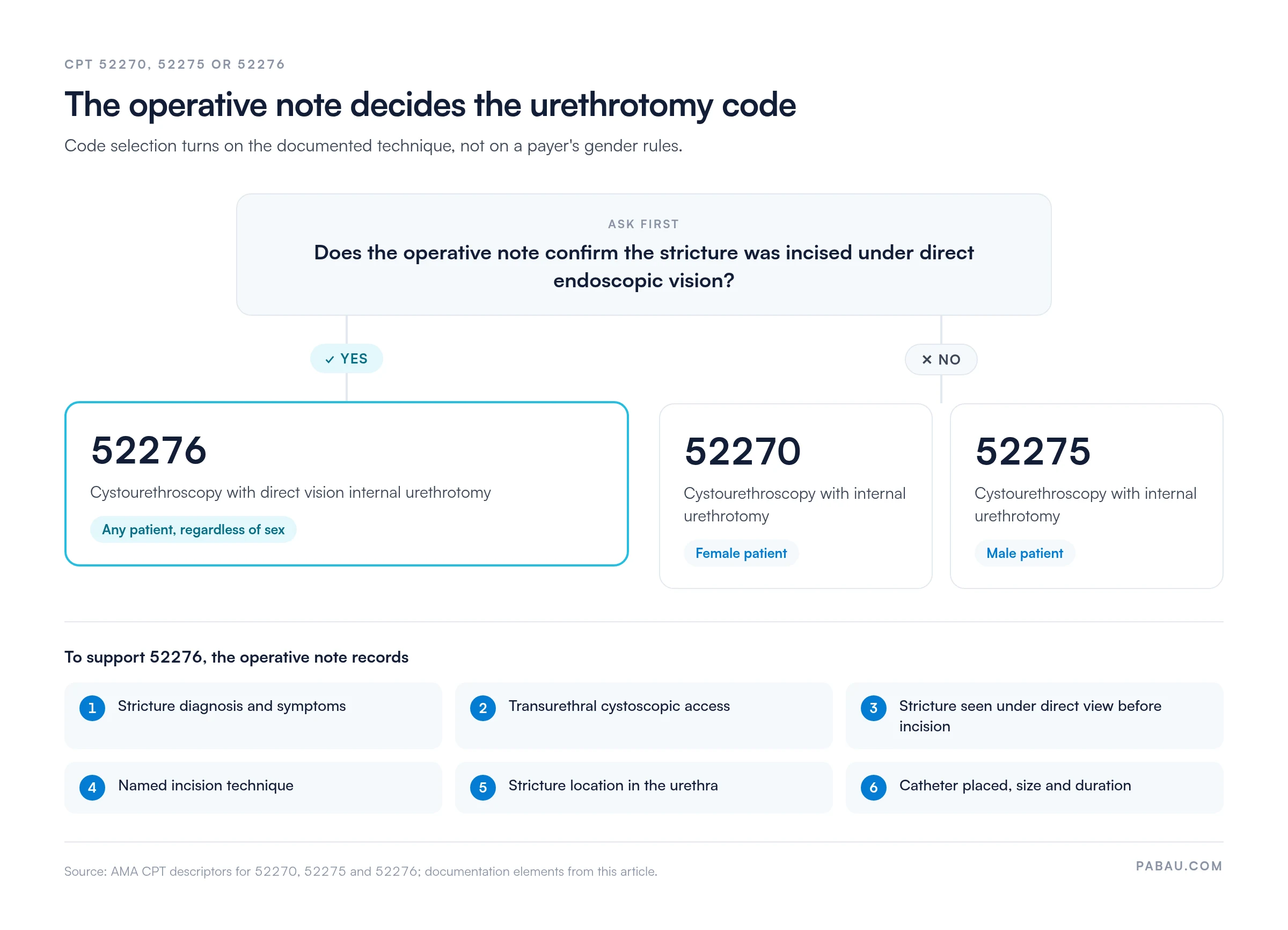
The operative note for 52276 must contain six elements to support the claim. Missing any one of them gives a payer grounds for denial or downcoding. A clean claim submission for a surgical cystourethroscopy starts with a complete operative report, not with the claim form itself.
A complete note also protects the practice when a payer audits the claim. For practices using EHR templates, pre-build a cystourethroscopy operative note template that prompts for each of these six elements before the note is signed.
Build a structured operative note template specifically for 52276 that includes mandatory fields for incision technique and direct-vision confirmation. Flag notes with blank technique fields before they reach billing. Reworking one denied claim takes longer than building the template.
The CMS Medicare Physician Fee Schedule (MPFS) sets the payment benchmark for CPT code 52276. RVU values are updated annually on January 1, and geographic practice cost indices (GPCI) adjust the final reimbursement by region. The figures below reflect the structure of the fee schedule, so verify current-year values before submitting claims or producing financial projections.
Setting matters for CPT code 52276. The procedure is almost always performed in a hospital outpatient department (HOPD) or ambulatory surgery center (ASC), not an office. The physician bills the professional component, and the facility bills separately for its overhead.
The physician’s practice expense RVU drops substantially in a facility setting because the facility absorbs the overhead costs. Using the non-facility PE rate for an HOPD or ASC case overstates the physician’s reimbursement and can trigger a repayment demand. Submit 52276 with the correct place-of-service code: 22 for HOPD, 24 for ASC.
Modifiers are where 52276 billing gets complicated. Incorrect modifier use is both an audit risk and a common reason for systematic underpayment. The table below covers the four modifiers coders meet most often with this code. Each follows the medical billing compliance framework that governs modifier use across surgical codes.
The -51 scenario with 52214 deserves attention because it surfaces regularly in coder Q&A forums. Code 52214 covers cystourethroscopy with fulguration of the trigone, bladder neck, prostatic fossa, urethra or periurethral glands. When it and an internal urethrotomy (52276) happen in the same session, report 52214 as primary and 52276-51 as secondary. The -51 reduction applies to the secondary code at 50% of its allowable rate under Medicare and most commercial contracts.
The National Correct Coding Initiative (NCCI) maintains column 1/column 2 edit tables that govern which codes can and cannot be billed together. For CPT code 52276, the most common edit pair involves diagnostic cystoscopy (52000). It is bundled as a column 2 code into 52276, the column 1 surgical endoscopy. This reflects the standard NCCI principle: A surgical endoscopy includes the diagnostic examination of the same anatomic site.
NCCI edit tables are updated quarterly. Confirm current column assignments in the CMS NCCI edit files before citing a specific edit in an appeal or compliance review.
Prior authorization requirements for CPT code 52276 vary by payer and plan year. Traditional Medicare fee-for-service does not require prior auth for most surgical cystourethroscopy procedures. Medicare Advantage plans, by contrast, routinely require it for outpatient surgical codes.
Commercial payers increasingly require documentation of conservative treatment failure before approving DVIU. Understanding revenue cycle management for surgical urology codes means building a PA intake process before the case is booked, not after the claim is denied.
Denials on CPT code 52276 cluster around a predictable set of documentation and coding errors. The denial codes in medical billing that appear most often on 52276 claims map directly to the seven causes below, each with a one-step fix.
Tracking denial patterns by code and reason code across your urology practice is the fastest way to identify systemic issues. A denial management workflow that connects the billing team with the clinical documentation team cuts repeat denials faster than claim scrubbing alone.
Run a 90-day lookback on all 52276 claims and sort denials by CARC code. If CO-4 (procedure inconsistent with modifier) or CO-97 (bundled service) appears repeatedly, fix the operative note or modifier assignment, not the appeal letter.
Urology practices billing CPT code 52276 manage a 90-day global period, quarterly NCCI edit updates, payer-specific modifier rules and prior authorization checks. Pabau’s claims management software keeps that work on one patient record, from the superbill to the remittance.
The superbill captures the CPT and ICD-10 codes at the point of documentation, so the codes on the claim match the operative note. Pabau sends US claims to payers through Claim.MD, runs eligibility checks before the procedure, and posts ERA remittances when payment arrives.
Prior authorizations are tracked on the patient’s case, with the auth code, dates and sessions recorded. Pabau warns staff when an authorization is missing, so they can chase it before the surgery date.

Pabau links the superbill, Claim.MD claim submission and ERA posting for CPT 52276 and the rest of the cystourethroscopy family. See how urology practices keep codes, claims and remittances in one place.

CPT code 52276 is a direct-vision urethrotomy code, and the operative note is where its claim is won or lost. Before coding, confirm the note shows the stricture under direct endoscopic view and names the incision technique.
With those two lines in place, the remaining checks are routine. They cover the N35 diagnosis, the facility place-of-service code, NCCI bundling with 52000, and prior authorization where the payer asks for it. Skip the note check, and every later step rests on a code an auditor can overturn.
If your practice is seeing repeat 52276 denials, book a demo to see how Pabau carries codes from the superbill to Claim.MD.

Need a framework for reducing surgical code denials? Denial management in healthcare covers the end-to-end workflow for identifying, appealing, and preventing claim denials across surgical specialties.
Want to understand how claims flow from submission to payment? What is medical billing explains the full revenue cycle from CPT coding through ERA posting.
Billing multiple CPT codes in a single session? Clean claim submission outlines the documentation and modifier rules that keep multi-procedure urology claims out of the denial queue.
CPT code 52276 is cystourethroscopy with direct vision internal urethrotomy, a surgical procedure for urethral stricture. The urologist passes a cystoscope into the urethra and identifies the stricture under direct endoscopic view. The stricture is then incised with a cold knife, holmium laser, or electrocautery. It is a surgical code, not a diagnostic one, and it carries a 90-day global period under Medicare.
Use 52276 when the operative report documents direct vision internal urethrotomy, whatever the patient’s sex. Codes 52270 (female) and 52275 (male) describe internal urethrotomy without the direct-vision descriptor. Select the code from the documented technique, not from a payer’s gender rules.
Yes, 52276 can be billed alongside 52214 in the same operative session. Code 52214 covers cystourethroscopy with fulguration of the trigone, bladder neck, prostatic fossa, urethra or periurethral glands. Report the higher-RVU procedure first without a modifier, then append modifier -51 to 52276 as the secondary code. The -51 modifier signals a multiple-procedure reduction, which Medicare and most commercial payers apply at 50% of the allowable for the secondary code.
RVU values and Medicare payment rates for CPT code 52276 are set in the annual CMS Physician Fee Schedule and updated each January 1. The total RVU combines work RVU, practice expense RVU (facility or non-facility), and malpractice RVU, multiplied by the conversion factor and local GPCI. Use the CMS MPFS lookup tool or FastRVU to retrieve current-year figures by locality.
Prior auth requirements vary by payer and plan year. Medicare Advantage plans commonly require PA for outpatient surgical cystourethroscopy. Most commercial payers also require documentation of conservative treatment failure (prior dilation attempts, voiding studies) before approving DVIU. Verify PA requirements with each payer at the time of scheduling, not after the procedure is performed.
Yes. The most significant NCCI edit pairs diagnostic cystoscopy (52000) as a column 2 code bundled into 52276. Billing both on the same date without documentation of a distinct separate service and a valid X-modifier triggers an automatic edit denial. Check the current NCCI edit tables at AAPC Codify for the full list of codes that bundle with 52276.




