CCSD code D1510: Myringotomy and tube insertion billing guide
What Is CCSD Code D1510? CCSD code D1510 is the procedure code assigned to myrin...

Last Updated: Oct 5, 2026
50543 is the CPT code for laparoscopy, surgical; partial nephrectomy. It covers removal of part of the kidney through laparoscopic ports, robotic-assisted cases included, while the rest of the kidney stays in place.
The code can be confused with 50545, laparoscopic radical nephrectomy, which removes the whole kidney. If the code on the claim does not match the extent of resection in the operative note, expect a denial or an audit.
Let Pabau's smart automation suggest the right codes, reduce claim denials, and keep your practice compliant—effortlessly.
Automate repetitive tasks and focus on what matters most—your patients.
Reduce coding errors and ensure compliance with the latest regulations.
Clean claims, fewer denials, and faster reimbursements.
Powerful insights and reporting to help your practice thrive.
HIPAA compliant SOC 2 certified GDPR-compliant Trusted by 4,000+ clinics worldwide

CPT code 50543 describes laparoscopic partial nephrectomy, in which part of the kidney is removed and the rest is preserved.
Robotic-assisted partial nephrectomy is billed under CPT 50543: The robot is a surgical tool, so CPT surgical guidelines give it no separate code.
Confusing 50543 (partial) with 50545 (radical) is a common denial trigger, so the operative note must name the partial nephrectomy explicitly.
Open partial nephrectomy is a different code, 50240, so the approach on the claim has to match the operative note.
Pabau’s claims management software flags 50543 claim errors before submission, which cuts modifier and documentation denials in urology billing.
CPT code 50543 is defined by the American Medical Association as “Laparoscopy, surgical; partial nephrectomy.” The procedure involves the laparoscopic removal of a discrete portion of the kidney, typically a tumor-bearing segment, while preserving the remaining functional renal parenchyma. The surgeon accesses the retroperitoneal space through small port incisions and uses laparoscopic instruments to isolate and excise the target tissue. The surgeon then achieves hemostasis and closes the collecting system if it was entered.
This code sits in the Surgery section of the CPT codebook, under Urinary System, in the kidney laparoscopy subsection (CPT 50541-50549). The defining clinical characteristic is preservation of the kidney: If the entire organ is removed, 50543 does not apply.
CPT 50543 bundles several components of the partial nephrectomy procedure into a single reportable service. Understanding what is and is not included prevents unbundling errors that payers flag through the Correct Coding Initiative (CCI).
Included in the global surgical package:
Separately billable services (not bundled):
When the surgeon maps the tumor with intraoperative ultrasound, report it under 76998 only when the operative note documents it separately.
Check your CCI edit pairs before billing intraoperative ultrasound alongside CPT 50543. Some payers bundle 76998 into the surgical package and deny it as a separate line. Confirm payer policy before submitting.
CPT code 50543 applies to both standard laparoscopic and robotic-assisted laparoscopic partial nephrectomy. The CPT codebook’s surgical guidelines treat the robot as a surgical tool, so robotic assistance is not reported separately. The approach does not change the code selection.
Where coders run into trouble is with payer documentation requirements. Some commercial plans and Medicare Advantage organizations ask the operative note to confirm the robotic platform used, such as the da Vinci system. They may also ask for warm ischemia time, which is clinically relevant for robotic partial nephrectomy. Failing to include this detail does not change the correct code, but it can trigger a documentation-based denial.
Nephrectomy codes split on two variables, the extent of resection and the surgical approach. CPT code 50543 is partial and laparoscopic, and a change in either variable changes the code. The decision path below answers both questions in order.
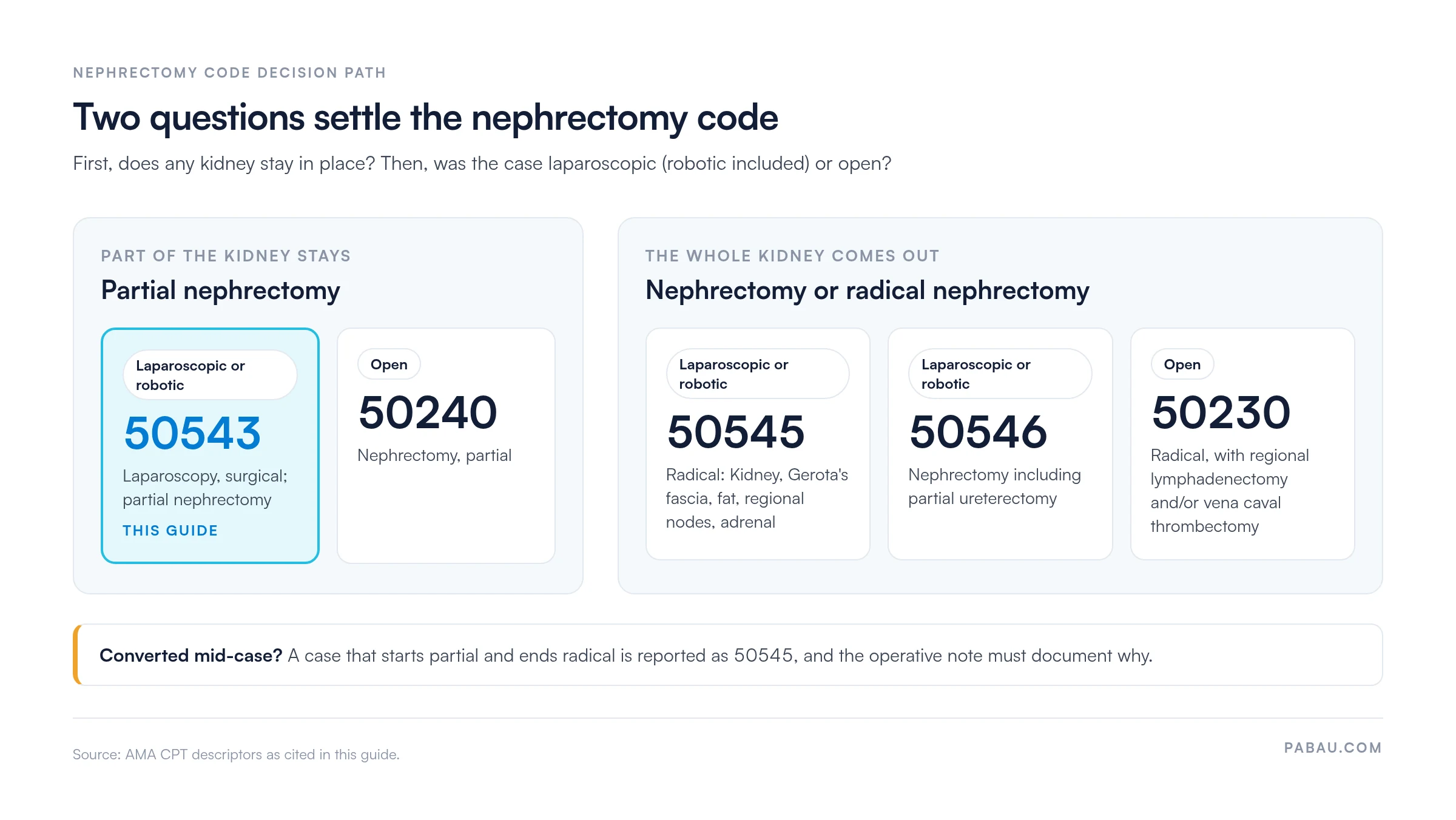
The clinical decision point between 50543 and 50545 is nephron-sparing intent. Sometimes the surgeon starts a partial resection but converts to radical nephrectomy because of intraoperative findings. The code then changes to 50545, and the operative note must document the reason for conversion.
The operative note is the main evidence a payer checks on a CPT code 50543 claim. Payers scrutinize these claims because the code sits next to higher-value radical nephrectomy codes, and robotic-assisted cases draw extra review. Meeting clean claim requirements for this code means the operative note must contain all of the following elements.
Modifier selection for CPT 50543 follows standard surgical modifier rules. The table below covers the most commonly applicable modifiers.
Medical necessity for CPT code 50543 depends on the paired ICD-10-CM diagnosis code. Payer Local Coverage Determinations (LCDs) issued by Medicare Administrative Contractors specify which diagnosis codes support nephron-sparing surgery. Renal malignancy is the most common indication, though benign tumors and other structural pathology also qualify under most LCDs.
Always specify laterality using C64.1 or C64.2 rather than C64.9 when the operative site is documented. Unspecified codes invite payer queries that delay payment.
Medicare payment for CPT code 50543 is calculated from the CMS Medicare Physician Fee Schedule using the Resource-Based Relative Value Scale (RBRVS). The total RVU is multiplied by the annual conversion factor and adjusted by the Geographic Practice Cost Index (GPCI) for the practice’s locality. Use the FastRVU 2026 RVU lookup to retrieve current year-specific figures for your locality, as values change with each annual MPFS final rule.
CPT 50543 is a facility-setting surgical code, so the MPFS facility rate is the figure that applies. That rate is the total RVUs multiplied by the conversion factor and adjusted by the GPCI, and it changes every year. Look it up in the CMS fee schedule tool before quoting allowables to physicians.
Commercial payer contracted rates vary and are generally set as a multiplier of Medicare allowables. Pabau, the practice management platform we build, connects to the Claim.MD clearinghouse. That connection supports real-time eligibility verification and ERA posting for 50543 claims across thousands of US payers.
Prior authorization requirements for CPT code 50543 vary by payer type and plan. Managing this step within a structured revenue cycle management workflow reduces last-minute submission delays. Traditional Medicare fee-for-service generally does not require prior authorization for 50543, though CMS prior authorization programs are expanding and should be monitored. Medicare Advantage plans and commercial insurers most commonly require pre-authorization for this code.
When submitting prior auth requests for 50543, include the imaging report with tumor size, laterality, and radiologist interpretation. Plan medical policies may set tumor size or clinical criteria for the nephron-sparing approach, so check each payer’s policy.
CPT 50543 generates a predictable set of denials. Most are preventable with front-end workflow controls. For practices already dealing with a backlog, a structured denial management workflow helps prioritize high-value surgical code appeals. Below are the top denial patterns for this code and the corrective action for each.
Review denial codes in medical billing to identify the specific CARC reason code on each remittance before determining the appeal path. The denial reason code drives the appeal strategy more than any general guidance.
Build a 50543-specific denial tracking log. Note the denial reason code (CARC), payer, and whether the claim was for a robotic or standard laparoscopic case. After 20-30 claims you will see which payer-code combinations drive most denials and can fix the workflow upstream.
CPT 50543 carries a 90-day global surgery period under CMS policy. Routine post-operative care within 90 days of the procedure date is bundled into the surgical fee. Billing separately for routine follow-up visits during this period will result in denial. Verify the current global period indicator in the CMS MPFS lookup tool, because CMS may adjust global indicators in annual rule updates.
What is bundled in the 90-day global: Routine post-operative office visits, incision checks, suture removal, and follow-up imaging ordered in direct response to the procedure.
What may be billed separately: Treatment of a new or unrelated condition, or a complication needing a return to the OR (modifier 78). Services from a different physician not involved in the original surgical care use the modifier 54/55 split. An electronic claim submission workflow that applies the global period flag keeps a bundled follow-up visit from going out as a separate E/M service.
Without a pre-submission check, a 50543 error surfaces only when the remittance comes back. By then the claim carries a CARC code, and someone has to pull the operative note, correct the claim, and resubmit it.
Pabau’s denial-reducing claims management checks the claim before it leaves the practice. It validates CPT and ICD-10 pairings and flags modifier mismatches, such as an RT modifier on a C64.2 diagnosis.
Your coder fixes the mismatch while the operative note is still open, not weeks later in an appeal. Remittance data then posts back through Claim.MD, so recurring 50543 denials show up by payer.

Pabau’s claims management tools flag code selection errors and modifier mismatches before submission, so your CPT 50543 claims reach payers clean. See how Pabau supports urology revenue cycle workflows.

For CPT 50543, the operative note settles the code before the coder does. When the note says partial nephrectomy, names the side, and records the approach, a 50543 claim holds up on review.
Conversions carry the most risk. A case that starts nephron-sparing and ends radical is billed as 50545, and only the surgeon’s documented reason protects that claim. Agree a note template with your surgeons that captures resection extent, laterality, and any conversion.
Book a demo to see how Pabau checks 50543 pairings and modifiers before your claims reach the payer.

Need to understand how denials are categorized? Pabau’s Claim.MD clearinghouse guide explains how remittance data flows from payer to practice and how denial codes are surfaced in real time.
Want to reduce billing errors across your urology practice? What is revenue cycle management outlines the end-to-end billing workflow from eligibility check to payment posting.
Submitting 50543 claims electronically? Electronic remittance advice (ERA) explains how 835 files work and how practices use remittance data to identify patterns in surgical claim denials.
New to the claim lifecycle? What is medical billing walks through how a claim moves from coded encounter to payment.
CPT code 50543 describes laparoscopic surgical partial nephrectomy. In this minimally invasive procedure, only a portion of the kidney is removed and the remaining renal tissue is preserved. It applies to both standard laparoscopic and robotic-assisted laparoscopic approaches.
CPT 50543 is laparoscopic partial nephrectomy (kidney partially removed); CPT 50545 is laparoscopic radical nephrectomy (entire kidney removed). The distinction is the extent of resection, not the surgical approach. Use the operative note language to determine which code applies.
Yes. Under the CPT codebook’s surgical guidelines, robotic assistance is not reported separately, so the robot creates no separate code. CPT 50543 covers both standard and robotic-assisted laparoscopic partial nephrectomy. Document the robotic platform and warm ischemia time in the operative note for payer documentation compliance.
The most commonly used modifiers are: Modifier 22 for complex cases, such as a hilar tumor or solitary kidney, and LT or RT for laterality. Modifier 51 applies when 50543 is performed with another procedure in the same session, and modifier 50 covers the rare bilateral case. Avoid appending modifier 22 without a cover letter describing the specific complexity.
Medicare reimbursement for CPT 50543 varies by locality and by year. CMS sets it through the MPFS: Total RVUs multiplied by the conversion factor, adjusted by the GPCI for your locality. Use the CMS Medicare Physician Fee Schedule lookup tool at cms.gov or FastRVU to retrieve the current year’s figure for your practice location.
No. CPT 50546 is laparoscopic nephrectomy including partial ureterectomy. The kidney is removed, so it is mutually exclusive with 50543 on the same kidney. CPT 50543 is a partial nephrectomy where the kidney is preserved. A lymphadenectomy performed with a partial nephrectomy is reported separately where payer and CCI edits allow. Check unlisted 38589 or the applicable lymph node code.
The most common denial reasons are: Wrong code selected (50545 billed instead of 50543), missing prior authorization, and laterality mismatches. A mismatch means the ICD-10 code and the LT/RT modifier disagree. Insufficient operative documentation for the robotic approach and unbundling errors follow. Most denials are preventable with front-end claim edits and complete operative note language.