ICD-10 Code G89.4: Chronic pain syndrome
ICD-10 Code G89.4: Definition and clinical classification ICD-10 Code G89.4 is t...

Last Updated: Nov 10, 2026
Billable Code Specific Code
K42.9 is the billable ICD-10-CM code for umbilical hernia without obstruction or gangrene. It applies when the hernia is reducible and the note documents no trapped bowel and no gangrenous tissue.
K42.9 sits in category K42 with two siblings: K42.0 adds obstruction, and K42.1 adds gangrene. Code assignment turns on the physician's reducibility statement, so a note that never mentions it leaves the claim open to denial.
Let Pabau's smart automation suggest the right codes, reduce claim denials, and keep your practice compliant—effortlessly.
Automate repetitive tasks and focus on what matters most—your patients.
Reduce coding errors and ensure compliance with the latest regulations.
Clean claims, fewer denials, and faster reimbursements.
Powerful insights and reporting to help your practice thrive.
HIPAA compliant SOC 2 certified GDPR-compliant Trusted by 4,000+ clinics worldwide

K42.9 applies only when the umbilical hernia is reducible, with neither obstruction nor gangrene documented in the clinical note.
K42.0 adds obstruction without gangrene, and K42.1 adds gangrene. Choosing the wrong sibling code is a frequent K42.9 denial trigger.
The physician note must state the hernia’s location, its reducibility, and the absence of obstruction signs for K42.9 to hold up in a payer audit.
Since January 1, 2023, the repair is billed with CPT 49591 to 49596, chosen by total defect size and by whether the hernia is reducible.
With K42.9 as the inpatient principal diagnosis, a hernia repair groups to MS-DRG 353, 354 or 355, depending on CC and MCC status.
ICD-10 code K42.9 is the billable ICD-10-CM code for an umbilical hernia without obstruction or gangrene.
That means a reducible hernia at the umbilical ring, with no trapped bowel and no dead tissue. The code has no further subdivision, so it is reported as written. The table below collects the reference fields coders check most often.
K42.9 covers a protrusion of abdominal contents through the umbilical ring where the hernia is reducible. The contents can be pushed back through the defect by hand or return on their own. The note documents no bowel obstruction and no tissue death (gangrene) at the encounter.
The “without obstruction or gangrene” qualifier works as a hard coding rule. If the note documents any obstruction signs or gangrenous tissue, K42.9 is incorrect, and K42.0 or K42.1 applies instead.
Age is not a limiting factor. According to the CDC/NCHS ICD-10-CM web tool, K42.9 carries no age-specific exclusion or guideline restriction. It is valid for patients from neonates to adults.
K42.9 is the default code in the K42 category, because an umbilical hernia seen for elective repair usually has no acute complications. The table below shows the three sibling codes and the clinical factor that separates each.
A frequent coding error is submitting K42.0 for a hernia that was reducible at presentation. Incarceration means the contents are trapped and cannot be reduced, a distinct clinical finding that needs explicit documentation.
If the note says “reducible umbilical hernia” or “hernia easily reduced on exam,” K42.9 is correct whatever repair approach is chosen. Gangrenous contents found at surgery move the claim to K42.1 instead.
Before selecting K42.0, ask one question: does the operative note or clinic note explicitly state the hernia was non-reducible or incarcerated? If the physician reduced it manually during the visit and then scheduled elective repair, the encounter supports K42.9, not K42.0. Payer auditors look for the reducibility statement, so make sure it is in the note.
Several hernia codes sit close to K42.9, both anatomically and in the tabular hierarchy. The deciding factor is location. An umbilical hernia protrudes through the umbilical ring, and a hernia at any other abdominal wall site takes a different code.
Ventral and incisional hernias cause the most confusion in surgical billing. An incisional hernia from a prior laparotomy sits on the anterior abdominal wall but not at the umbilicus, so code K43.2.
If a patient has an incisional hernia and a separate umbilical defect, both codes may be reported. Confirm in the operative note that the surgeon addressed two distinct defects.
Payers auditing hernia claims look for five elements in the physician note. If any one is missing, the claim is open to a medical necessity denial.
Pairing tight documentation with clean claim submission practices shortens the time between service and payment. Each element above maps to a payer audit criterion. When all five are present, the claim is less likely to be pulled for manual review.
K42.9 is a diagnosis code, so it is submitted alongside the CPT code for the repair performed. Since January 1, 2023, anterior abdominal hernia repairs, umbilical included, use one code family. The code is chosen by total defect size and by whether the hernia is reducible or incarcerated, and the surgical approach no longer changes it.
A diagnosis-procedure mismatch is a primary denial trigger, so the CPT choice matters beyond payment. CPT 49593 (reducible, defect 3 to 10 cm) against K42.9 is a valid pairing. CPT 49594 against K42.9 creates a flag, because its descriptor says incarcerated while K42.9 says without obstruction.
Each code covers open, laparoscopic and robotic repair, with mesh included when it is placed. Codes 49580 to 49587 were deleted on January 1, 2023, so remove them from any crosswalk that still lists them. Confirm descriptors against the current AMA CPT code set before billing.
Laid out as a grid, the size and status split shows which repair codes can ever sit on a K42.9 claim.
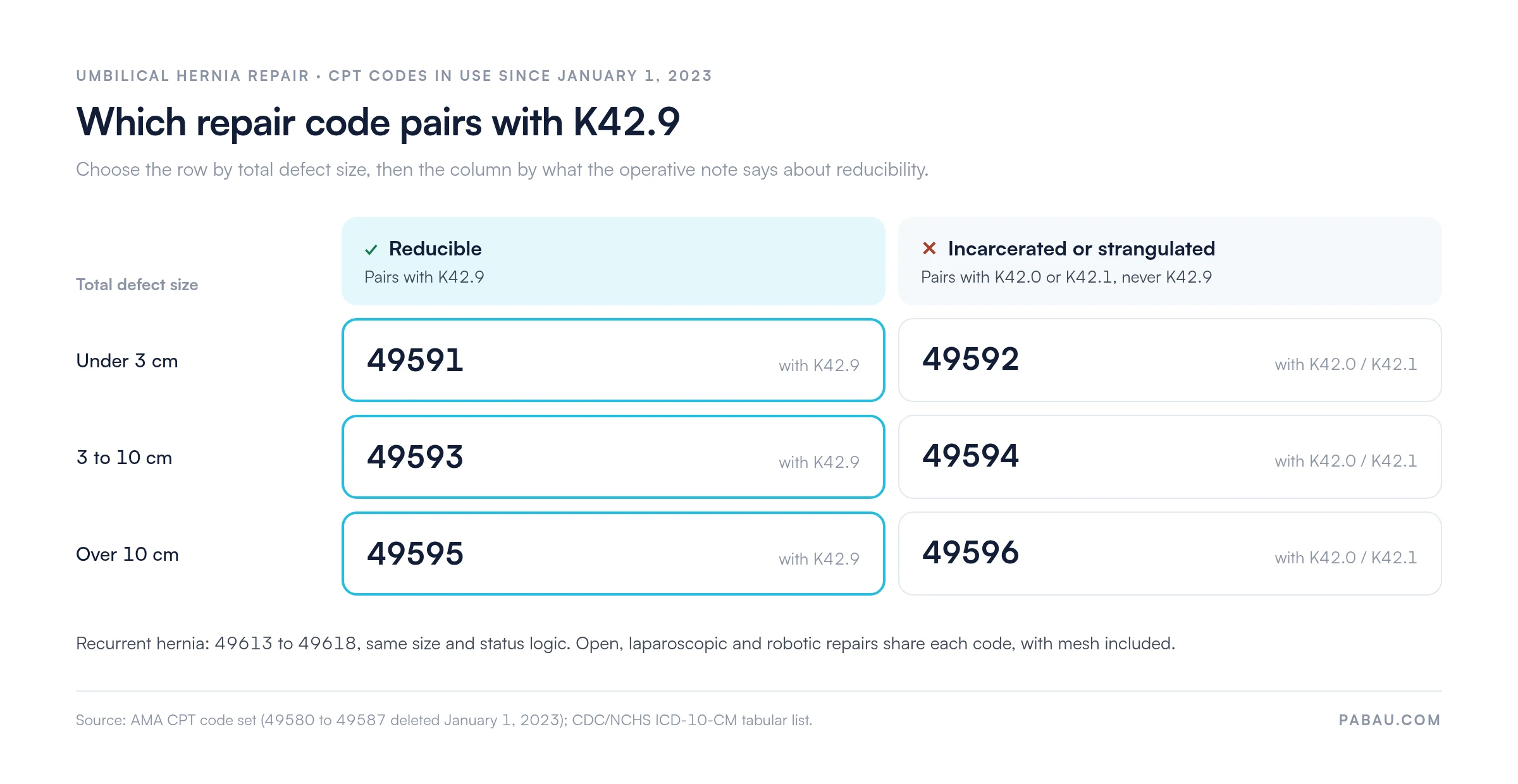
When K42.9 is the principal diagnosis on an inpatient admission for repair, the case groups into the hernia procedure DRG family. The split depends on complicating or major complicating conditions (CCs/MCCs). Per the CMS MS-DRG Definitions Manual, that family is MS-DRG 353 (with MCC), 354 (with CC) and 355 (without CC/MCC).
All three carry the title “hernia procedures except inguinal and femoral.” Exact assignment depends on the procedure performed and the patient’s secondary diagnoses. Confirm with the current CMS ICD-10 codes and MS-DRG manual for your fiscal year version.
The Centers for Medicare and Medicaid Services (CMS) updates DRG weights, which set inpatient payment, every year. Never quote a specific DRG weight without citing the fiscal year version of the Definitions Manual.
Prior authorization requirements for umbilical hernia repair vary by payer and plan year. Medicare does not impose a blanket preauthorization requirement for umbilical hernia repair, but Medicare Advantage plans frequently do.
Commercial insurers commonly require authorization for elective repair billed with K42.9, because the reducible presentation signals a planned procedure. Urgent repairs of incarcerated hernias (K42.0) are more often handled under emergency rules.
Typical reasons a payer turns down the authorization request include:
Running insurance eligibility verification at the front end of the encounter also shows whether a plan needs preauthorization before the scheduling call ends.
K42.9 denials cluster around four causes. Each has a specific corrective action that prevents the same denial from recurring on future claims.
Systematic denial management workflows track these four patterns across all hernia claims, not just individual cases. When denials cluster around one provider or one documentation step, the pattern shows up in aggregate reporting.
Reading the medical billing denial codes on the remittance shows whether the problem is coding (CO-11) or authorization (CO-15, CO-197). The appeal can then go to the right person.
Run a quarterly audit of all claims submitted with K42.9 and filter by denial reason code. If CO-11 (diagnosis inconsistent with procedure) appears more than twice in a quarter, hold a 15-minute review. Bring your surgical coder and the operating physician together to agree on what the operative note must include. That single habit closes the K42.9 vs K42.0 mix-up faster than any coding refresher course.
CMS and the National Center for Health Statistics (NCHS) jointly publish the ICD-10-CM Official Guidelines for Coding and Reporting. They govern how K42.9 is sequenced and when it can be the principal diagnosis. The guidelines relevant to hernia coding are found within Chapter 11 (Diseases of the Digestive System) and the outpatient versus inpatient conventions in Section II.
The AAPC’s ICD-10-CM code lookup tool and the ICD List reference database both mirror the official CMS/NCHS tabular list. They are useful for confirming K42.9’s excludes notes and crosswalk mappings when you build claim edits.
Many practices still check K42.9 against the paired CPT code by hand, with the operative note in one system and the claim in another. A mismatch then surfaces weeks later as a CO-11 denial.
Pabau, the practice management platform we build, keeps the clinical note, the prior authorization and the claim on one patient record. US claims go out through Claim.MD as CMS-1500/837P claims, with eligibility checks and ERA remittances returned to the same system.
The authorization code, dates and sessions sit on the patient’s case, and Pabau warns the team when one is missing.
When the claim is built in claims software for practices that also holds the note, the coder reads the reducibility statement before submission. Our guide to the Claim.MD clearinghouse explains how claims, eligibility checks and remittances move between practice and payer.
Connecting claim data to revenue cycle management reporting gives practice managers a view of K42.9 claim volume, denial rates, and days to payment.

Pabau keeps the clinical note, prior authorization and claim on one patient record, and sends US claims through Claim.MD. Your coders confirm reducibility and the repair code before the claim leaves the practice.

Treat the reducibility statement as the deciding fact on every umbilical hernia claim. If the note confirms it, K42.9 stands and the repair code follows from the defect size. If the note is silent, query the physician before the claim is built.
That query costs a few minutes at coding. A CO-11 denial costs a resubmission, an appeal, and weeks of delayed payment. Check any crosswalk or charge sheet that still lists 49580 to 49587 too, since claims carrying those deleted codes are rejected.
Book a demo to see how Pabau keeps the operative note, the prior authorization and the Claim.MD claim together for your hernia repair billing.

Need a broader overview of the medical billing process? Medical billing fundamentals explains how ICD-10-CM diagnosis codes move through the claim lifecycle from encounter to payment.
Seeing repeated denials across your hernia claims? How Claim.MD clearinghouse works explains how claims, eligibility checks and remittances move through a clearinghouse.
Want to understand how the 837 file carries your ICD-10 data to payers? The 837 transaction file explained breaks down how K42.9 and its paired CPT code are packaged and transmitted electronically.
ICD-10 code K42.9 is the billable ICD-10-CM diagnosis code for umbilical hernia without obstruction or gangrene. The hernia is reducible, with no documented bowel obstruction and no gangrenous tissue. It is active and billable in the current ICD-10-CM tabular list (verify against the fiscal-year release in use), under Chapter 11, block K40-K46.
K42.0 applies when the umbilical hernia has obstruction (the contents are incarcerated and cannot be reduced) but no gangrene. K42.9 applies when the hernia is reducible, with no obstruction and no gangrene. The clinical note’s reducibility statement decides it. If the physician documented that the hernia reduced manually or spontaneously, K42.9 is correct.
Since January 1, 2023, K42.9 pairs with the reducible codes in the CPT 49591 to 49596 series. Choose 49591, 49593 or 49595 by total defect size: under 3 cm, 3 to 10 cm, or over 10 cm. The same codes cover open, laparoscopic and robotic repair, so the approach is documented in the operative note. Recurrent repairs use 49613, 49615 or 49617.
A K42.9 claim is usually denied for one of four reasons. The usual culprits are the wrong sibling code (K42.0 for a reducible hernia) and missing medical necessity documentation. Absent prior authorization and a mismatch with the CPT code complete the list. Each needs a targeted correction rather than a blanket recode.
Yes. K42.9 carries no age-specific exclusion in the ICD-10-CM tabular list and applies to patients from neonates to adults. The current repair codes, CPT 49591 to 49596, are chosen by total defect size and reducible versus incarcerated status, not by age or approach.
An inpatient hernia repair with K42.9 as principal diagnosis groups to MS-DRG 353 (with MCC), 354 (with CC) or 355 (without CC/MCC). That is the hernia procedure family, except inguinal and femoral, in the CMS MS-DRG Definitions Manual. DRG weights change annually, so verify against the current fiscal year version before quoting a payment amount.