HCPCS code L0638: Custom fabricated LSO billing guide
HCPCS code L0638 is a brace built for one patient HCPCS code L0638 is the Level ...

Last Updated: Nov 2, 2026
45381 is the CPT code for colonoscopy, flexible; with directed submucosal injection(s), any substance. It covers three uses: a submucosal lift before a lesion is removed, India ink tattooing to mark a site, and an injection to stop bleeding.
The substance does not change the code, so saline, epinephrine, India ink and hyaluronic acid solutions all bill as 45381. Most denials trace back to missing documentation of the substance injected and unbundled billing of 45380 or 45385 without the right modifier.
Let Pabau's smart automation suggest the right codes, reduce claim denials, and keep your practice compliant—effortlessly.
Automate repetitive tasks and focus on what matters most—your patients.
Reduce coding errors and ensure compliance with the latest regulations.
Clean claims, fewer denials, and faster reimbursements.
Powerful insights and reporting to help your practice thrive.
HIPAA compliant SOC 2 certified GDPR-compliant Trusted by 4,000+ clinics worldwide

CPT 45381 covers colonoscopy with directed submucosal injection of any substance, including saline lifts, India ink tattoos, and hemostatic agents.
It is a standalone (not add-on) code. Report 45381 instead of 45378. Use Modifier 59 only when billing it with another therapeutic code such as 45380 or 45385.
Documentation must name the substance injected, the site, and the clinical indication, or claims will be denied on medical necessity grounds.
Pabau’s claims management software supports CPT and ICD-10 coding workflows to reduce denial rates for GI practices billing 45381.
CPT code 45381, as maintained by the American Medical Association (AMA), carries the official descriptor: “Colonoscopy, flexible; with directed submucosal injection(s), any substance.” It belongs to Category I of the CPT code set and is a standalone, non-add-on code. It replaces the diagnostic base code 45378 whenever a directed injection is the therapeutic act.
The word “directed” in the descriptor is clinically significant. It means the injection targets a specific site, not a diffuse or prophylactic application. A blanket mucosal rinse does not meet the threshold. The endoscopy report must identify the exact anatomical site where the injection was delivered.
Three clinical scenarios support billing CPT 45381. Outside these, the code does not apply even if a substance was introduced during the colonoscopy.
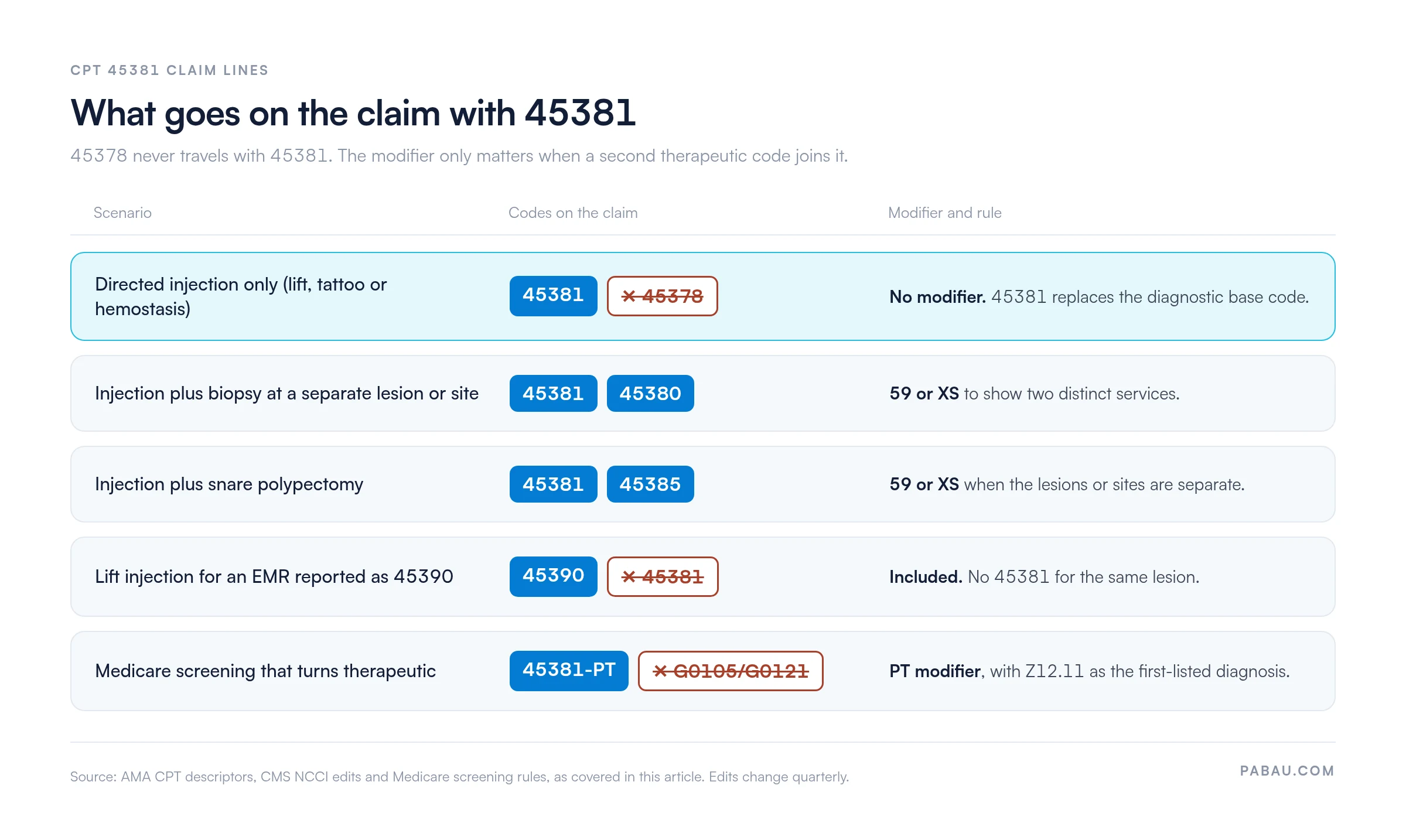
What 45381 does not cover is equally important. A snare polypectomy is CPT 45385, not 45381. A biopsy is CPT 45380, and a colonoscopy with no therapeutic intervention is 45378. An EMR reported as 45390 already includes the lift injection, so 45381 is not added for that lesion.
The most frequent coding confusion in GI practices involves choosing between 45378, 45380, 45381, and 45385. Each has a distinct clinical trigger. Picking the wrong one results in either undercoding (lost revenue) or overcoding (audit risk).
A submucosal lift right before a snare polypectomy is the most common case where 45381 and 45385 meet. Bill both codes, check the current NCCI table for the pair, and leave 45378 off the claim. When the lift and the snare treat separate lesions or sites, append Modifier 59 to 45381.
The endoscopy report is the billing record for CPT 45381. Every element below must appear in writing before the claim is submitted, or the payer has grounds for a medical necessity denial. Building a clean claim for 45381 starts with what the gastroenterologist documents in the procedure note.
A superbill that captures the procedure details at the point of care should link to the full procedure note. That creates the documentation chain payers expect during a post-payment audit.
CPT 45381 needs a modifier when it is billed alongside another therapeutic colonoscopy code in the same session. The modifier tells the payer that two distinct services were performed, not one bundled procedure.
Medicare recognizes the X-modifiers as more specific alternatives to 59, and some contractors prefer them. Commercial payers generally accept Modifier 59. Check each payer’s current policy before billing, as guidance differs by contractor and plan.
The National Correct Coding Initiative (NCCI) sets column 1/column 2 edit pairs that control how 45381 can be billed alongside adjacent codes. CMS updates these edits quarterly, so check the current NCCI edit tables before billing any code combination.
The matrix below puts each of these pairings on a single claim line. It also covers the EMR and Medicare screening cases explained elsewhere in this guide.
For facility billing, OPPS APC grouping applies to HOPDs, and the ASC payment system applies to ASCs. Neither uses the professional fee schedule. The facility payment may package the injection into the session’s primary procedure, so facility coders should verify current packaging rules separately from physician coding.
Medicare pays for CPT 45381 under the Medicare Physician Fee Schedule (MPFS), with the rate varying by place of service. Pabau, the practice management platform we build, sends claims through Claim.MD, its US clearinghouse partner.
Whichever route you use, the place-of-service code sits at claim level and decides which fee schedule rate applies. Always verify rates with the current-year CMS Physician Fee Schedule lookup tool, as rates update every January 1.
The facility rate paid to the physician is lower than the non-facility rate because the practice expense component reflects that the facility bears overhead costs. After submitting, review the electronic remittance advice (ERA) to confirm the correct rate was applied and to spot reductions under Medicare’s multiple endoscopy rule.
Always attach the correct place-of-service code before submitting a 45381 claim. POS 11 (physician office) pays the non-facility MPFS rate, while POS 22 (hospital outpatient) and POS 24 (ASC) pay the facility rate. A POS mismatch is one of the most common preventable denials for colonoscopy codes.
Prior authorization requirements for CPT 45381 vary by payer and by clinical indication. Medicare does not generally require prior authorization for diagnostic or therapeutic colonoscopy. Coverage is governed by Noridian Article A57342 (Billing and Coding: Diagnostic and Therapeutic Colonoscopy), which applies to Noridian jurisdictions. Check your own MAC’s article.
Medical billing compliance requirements for GI practices include checking that the clinical indication for the injection matches the payer’s coverage policy before the procedure.
The safest workflow is to verify coverage and authorization through the payer’s provider portal before scheduling any elective case with a planned submucosal injection.
Denials for CPT 45381 cluster around a predictable set of errors. The top preventable ones are billing 45378 with 45381, or omitting the modifier when 45381 pairs with 45380 or 45385.
When a payer returns one of these, the claim adjustment reason code on the remittance names the problem. Our guide to denial codes for billers decodes each one. A structured denial management process that tracks them by CPT code catches patterns quickly.
The claims management software within Pabau logs denial reasons against individual procedure codes. GI billing teams can then spot systematic issues instead of investigating each denial on its own.
Whether the colonoscopy began as a screening or a diagnostic encounter changes how Medicare processes a 45381 claim. When a screening turns therapeutic in the same session, the claim keeps Z12.11 as the first-listed diagnosis and adds a PT modifier.
The diagnosis code submitted with CPT 45381 must logically support the need for a directed submucosal injection. The AAPC code lookup and Noridian Article A57342 both address which diagnosis categories establish medical necessity for therapeutic colonoscopy. A57342 applies to Noridian jurisdictions, so check your own MAC’s article.
Payer LCD policies and billing articles define which diagnosis codes are covered for each procedure code. Verify the applicable policy for your Medicare Administrative Contractor before billing, since covered diagnoses for 45381 may vary between jurisdictions.
Today, a GI biller usually finds a 45381 problem after the fact. The remittance arrives with a denial code, and someone traces it back by hand. The cause is often a note that never named the substance, or a claim that still carried 45378.
Pabau keeps the procedure note, the codes and the claim on the same patient record. Modifiers are attached before submission, and claims route through Claim.MD with the place-of-service code already set.
Denial reasons are logged against each procedure code, so a run of 45378 pairing errors or missing modifiers shows up as a pattern. Your billing team fixes the report template once instead of appealing claim by claim.

Pabau’s claims management workflows help GI practices track CPT codes, apply correct modifiers, and submit clean 45381 claims across professional and facility settings.

CPT 45381 rewards practices that settle the claim line before the scope is withdrawn. The most preventable denials are billing 45378 with 45381, or omitting the modifier when 45381 pairs with 45380 or 45385. Missing substance documentation is the third.
Put a substance field and an injection-site field in the endoscopy report template, and check screening status before the claim is built. The trade-off is a slightly longer procedure note, which costs far less than one appeal.
Book a demo to see how Pabau links GI procedure notes to clean 45381 claims.

Weighing up the biopsy code that pairs with 45381? CPT code 45380 covers colonoscopy with biopsy, including when it bills alongside an injection.
Need the diagnostic base code 45381 replaces? CPT code 45378 explains the diagnostic colonoscopy and why it drops off a therapeutic claim.
Billing an average-risk Medicare screening? HCPCS code G0121 covers the screening code and what changes when the scope turns therapeutic.
Looking to understand denial reason codes on your EOBs? Denial codes in medical billing explains CARC and RARC codes so GI billing teams can act on remittance advice faster.
Need a structured overview of clearinghouse submission for colonoscopy claims? Medical claims clearinghouse guide covers how 837P files route from practice to payer and how rejections differ from denials.
CPT code 45381 is a colonoscopy procedure code covering a flexible colonoscopy with directed submucosal injection(s) of any substance. It includes submucosal lifts before lesion removal, India ink tattooing for surgical localization, and hemostatic injections for bleeding control.
Yes with 45380, but not with 45378. Bill 45381 with 45380 (biopsy) in the same session, appending Modifier 59 to 45381 when the biopsy is at a separate lesion or site. 45378 billed alongside 45381 is an error, so remove 45378 and bill 45381 as the single colonoscopy code. Medicare also recognizes XS or XU in place of 59.
Modifier 59 (distinct procedural service) applies when 45381 is billed with another therapeutic colonoscopy code, such as 45380 or 45385, in the same session. It is never used to pair 45381 with 45378. Medicare recognizes the X-modifiers, XS (separate structure) and XU (unusual non-overlapping service), as more specific alternatives to 59, and some contractors prefer them. Modifier 53 applies if the procedure was discontinued, and Modifier 22 supports unusually complex injection services with supporting documentation.
No, the substance does not change the code. The descriptor specifically says “any substance,” so saline, epinephrine, India ink, hyaluronic acid, and other lifting agents all bill under 45381. The substance must still be named in the procedure note to satisfy documentation requirements and support medical necessity review.
CPT 45381 applies to both, but the encounter type affects reimbursement. When a Medicare screening colonoscopy includes a submucosal injection, bill 45381 with Modifier PT and Z12.11 as the first-listed diagnosis. Do not bill G0105 or G0121 as well. The patient then owes coinsurance, which is 15% through 2026, 10% in 2027-2029 and 0% from 2030.
The most common preventable denials are billing 45378 with 45381, or omitting the modifier when 45381 pairs with 45380 or 45385. Missing documentation of the substance injected comes next, followed by an ICD-10 code that does not match the clinical indication. All of them are fixable at the point of documentation, before the claim is submitted.