

HCPCS Code Q4175: Billing, coverage, and documentation guide
HCPCS code Q4175: Code description and product identity HCPCS Code Q4175 is the ...

Last Updated: Nov 20, 2026
44388 is the CPT code for colonoscopy through stoma; diagnostic, including collection of specimen(s) by brushing or washing, when performed (separate procedure). It applies when the scope enters the colon through a colostomy or ileostomy rather than the anus.
A common billing error with this family is submitting 45378, the transanal colonoscopy code, when the procedure note documents stomal access. That substitution commonly triggers a denial, because the two codes describe different access routes.
Let Pabau's smart automation suggest the right codes, reduce claim denials, and keep your practice compliant—effortlessly.
Automate repetitive tasks and focus on what matters most—your patients.
Reduce coding errors and ensure compliance with the latest regulations.
Clean claims, fewer denials, and faster reimbursements.
Powerful insights and reporting to help your practice thrive.
HIPAA compliant SOC 2 certified GDPR-compliant Trusted by 4,000+ clinics worldwide

CPT code 44388 describes a diagnostic colonoscopy through a surgical stoma (colostomy or ileostomy), and the access route is what separates it from transanal 45378.
A diagnostic exam that cannot reach the cecum or colon-small intestine anastomosis for unforeseen reasons is reported as 44388 with modifier 53.
Companion codes 44389-44408 are stand-alone therapeutic codes that include the diagnostic exam, so 44388 is not billed with them for the same session.
Pabau’s practice management software submits electronic claims through Claim.MD, with eligibility checks and ERA remittances in the same workflow.
CPT code 44388 describes a diagnostic colonoscopy performed through a colostomy or ileostomy, including collection of specimens by brushing or washing, when performed. CMS Transmittal 4153 names 44388 as the colonoscopy through stoma code and sets out how an incomplete exam is billed.
In the CPT code set maintained by the American Medical Association, the colonoscopy-through-stoma family runs from 44388 to 44408. 44388 is the diagnostic code in that family, not a screening code, and that shapes modifier selection and payer coverage.
The key distinction from other colonoscopy codes is anatomical access. Colonoscopy codes 45378-45398 describe transanal insertion. CPT code 44388 requires documented access through a surgically created stoma. If the scope passes transanally and reaches the colon in a patient who has a stoma, 45378 is the correct code. A transanal exam limited to the rectal stump is reported as 45330 instead, as the documentation trap below explains.
CPT code 44388 applies when a patient with a surgical stoma requires direct endoscopic evaluation of the colon proximal to that opening. Most of these patients have had a Hartmann’s procedure or a total or subtotal colectomy with end colostomy. Others carry a diverting stoma placed for bowel obstruction or trauma.
Clinical indications where the code is appropriate include:
Watch for one documentation trap. A patient with a stoma may still have a rectal stump. The physician can examine it transanally on the same date as the stomal colonoscopy. That stump exam is normally reported as flexible sigmoidoscopy 45330, not 45378. The record must document both entry points, and the pair is subject to NCCI edits and modifier 59.
CPT 44388 and CPT 45378 describe a colonoscopy through two different routes. 44388 is for stomal access, and 45378 is for transanal access. Submitting 45378 when the operative note documents stomal entry is a coding error, however complete the examination was. The decision flow below takes a stomal colonoscopy from the access route to the final code and modifier.
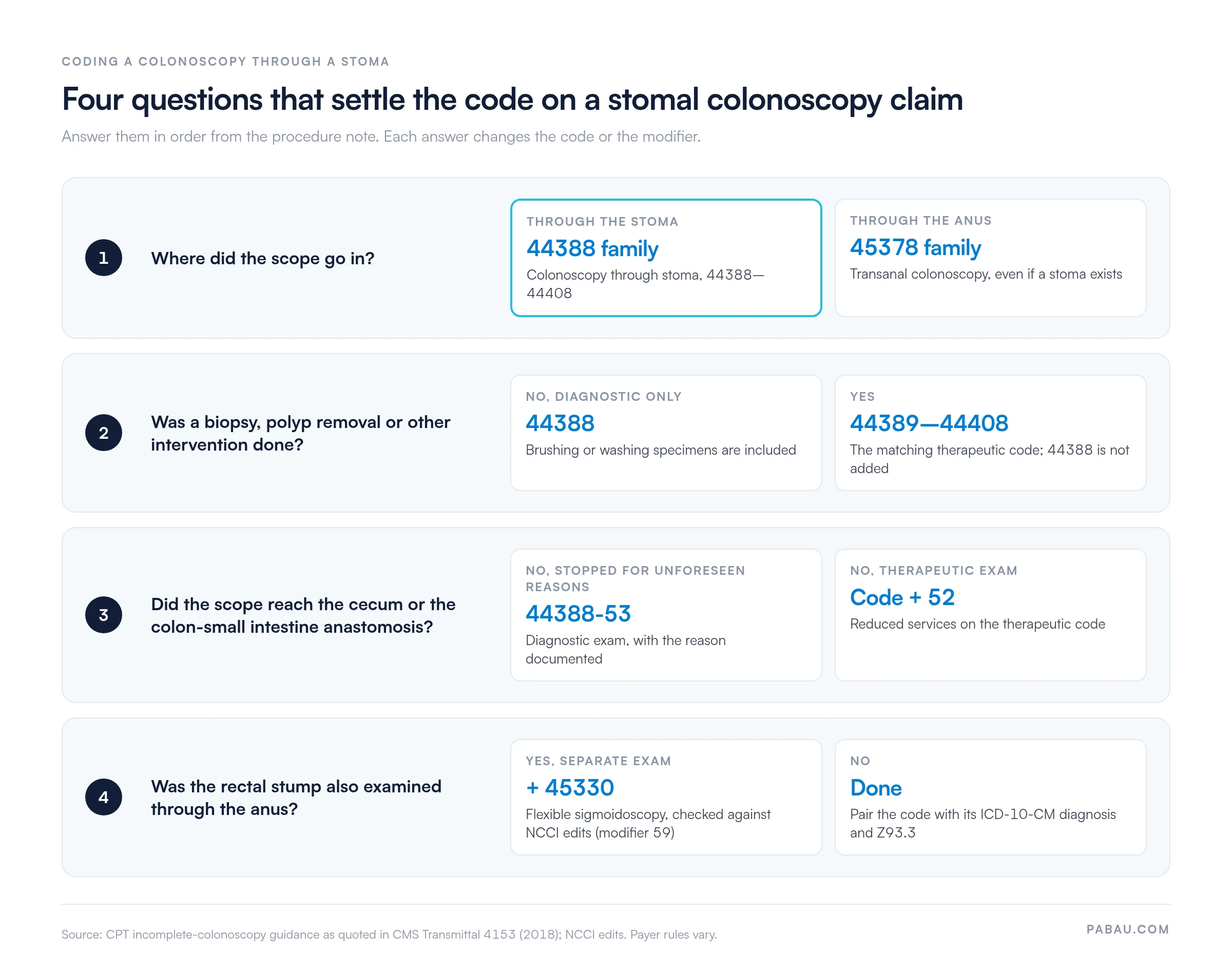
Side by side, the two codes differ on the points a payer reviewer checks first.
Mixing up these two codes is a common cause of 44388 denials. When auditing a denied stomal colonoscopy claim, check the submitted code first, because a 45378 on a stoma patient is a frequent culprit.
The 44388 family includes therapeutic companion codes for interventions performed during a stomal colonoscopy. Each one is a stand-alone code, not an add-on, and each includes the diagnostic exam that 44388 describes. NCCI edits bundle 44388 into them, so 44388 is not billed on top of a therapeutic code for the same session.
The five most common are listed below. The family continues through 44401-44408. Those codes include ablation (44401), stent placement (44402), EMR (44403), submucosal injection (44404), balloon dilation (44405), endoscopic ultrasound (44406, 44407), and decompression (44408).
When a biopsy and control of bleeding happen in the same session, report 44389 and 44391 together, without 44388. NCCI edits for this family update quarterly. Check the current CMS NCCI edit tables before submitting combination claims, because bundling relationships can change.
Every CPT 44388 claim requires an ICD-10-CM diagnosis code that establishes medical necessity for the stomal colonoscopy. The diagnosis names the clinical indication the procedure note documents. A general “colonoscopy surveillance” label does not establish medical necessity on its own.
Each MAC’s colonoscopy billing and coding article lists the diagnoses that support medical necessity. Noridian’s A57342 and Novitas’s billing article A58428 are two examples.
Z93.3 (colostomy status) or Z93.2 (ileostomy status) should almost always appear as a secondary diagnosis on a 44388 claim. That status code documents why the stomal route was used. Without it, the access route is harder to defend during an audit. For current ICD-10-CM code descriptions and coverage criteria, the CMS ICD-10 codes page is the authoritative reference.
Medicare covers CPT code 44388 as a diagnostic colonoscopy when the claim documents medical necessity. The criteria sit in your MAC’s colonoscopy LCD and its billing and coding article, such as A58428. Because 44388 is a diagnostic code, Medicare’s screening colonoscopy rules for G0105 and G0121 do not govern this claim.
Key coverage requirements for 44388 under Medicare and most commercial payers:
Keeping colonoscopy claims within medical billing compliance means tracking each MAC’s articles as they are revised. Check the effective date of A57342, A58428, or your MAC’s equivalent on the CMS Medicare Coverage Database before applying its criteria.
CMS sets reimbursement for CPT code 44388 through the Medicare Physician Fee Schedule (PFS). Facility settings (hospital outpatient, ASC) and non-facility settings (office) have separate rates.
The 2026 figures below come from the CMS national RVU file (April 2026 release) and are national, unadjusted values. Payment varies by locality. Use the CMS Physician Fee Schedule look-up tool to retrieve locality-specific amounts and confirm the current-year values. Annual PFS final rules can adjust RVUs and conversion factors.
RVU values are only part of the reimbursement picture. Medicare multiplies the total RVU by the annual conversion factor. It then adjusts the result by the geographic practice cost index (GPCI) for your locality. For a live 2026 lookup including GPCI adjustments, FastRVU’s 2026 RVU lookup tool pulls directly from the CMS data file.
A 44388 facility claim from an ASC is paid under the ASC payment schedule, which is separate from the hospital outpatient rate and typically lower. Confirm both rates when counseling patients or negotiating contracts.
Before billing 44388 from an ASC, compare the ASC payment rate against the hospital outpatient rate for your locality. The difference can be significant in some markets. If the practice has a choice of facility, it affects net revenue per procedure.
Documentation failures are a frequent cause of 44388 denials. The operative or procedure note must contain specific elements that connect the clinical scenario to the CPT code submitted. Submitting a clean claim for stomal colonoscopy depends on a procedure note that answers six distinct questions a payer reviewer will ask.
An efficient approach to revenue cycle management for endoscopy practices includes a pre-submission checklist tied to the procedure note template. Coders can then verify all six elements before the claim leaves the practice.
CPT code 44388 denials follow predictable patterns, and most trace back to one of the root causes below. A denial management workflow that sorts denials by root cause shows which fix to apply first.
For CARC and RARC codes, the denial codes reference covers the ones coders meet most often.
Several modifiers are relevant to CPT code 44388 depending on how the procedure was performed and what happened during the session. Modifier selection is a common source of audit exposure, particularly modifier 33, which is frequently misapplied to this code.
The most common modifier error on 44388 claims is appending modifier 33 to claim preventive-service cost-sharing waivers. CPT 44388 is classified as a diagnostic procedure by CMS and most commercial plans. Modifier 33 does not change that classification and will not remove patient cost-sharing. It signals a preventive intent the code does not carry, which can trigger a coverage review.
Without a connected billing workflow, a coder rebuilds each stomal colonoscopy claim from the procedure note. A missing modifier 53 or a 45378 keyed in place of 44388 then surfaces only when the remittance comes back.
Pabau lets practices submit CMS-1500 claims electronically through Claim.MD from the patient record. Its claims software for gastroenterology runs eligibility checks before the visit, posts ERA remittances when payers respond, and handles secondary claims.
Prior authorization codes, dates and sessions are tracked on the patient’s case, with a warning when one is missing. For a commercial plan that requires authorization for stomal colonoscopy, the warning shows while there is still time to request it.

Submit 44388 claims electronically through Claim.MD, with eligibility checks and ERA remittances in one workflow, and track prior authorizations on each patient’s case.

CPT code 44388 rewards coders who read the procedure note before the patient’s history. The entry point decides the code family, and the intervention decides whether 44388 or a companion code goes on the claim. The extent of the exam then decides the modifier.
Build those three checks into your pre-submission review, and pair every claim with its clinical diagnosis plus Z93.3 or Z93.2. Confirm your MAC’s colonoscopy article before you bill, because coverage criteria differ between contractors.
Pabau lets your team submit those claims through Claim.MD and see ERA remittances in the same workflow. Book a demo to see how it handles stomal colonoscopy claims for your GI or colorectal practice.

Coding a transanal exam instead? CPT code 45378 covers diagnostic colonoscopy through the anus, the code most often confused with 44388.
Need a broader overview of the medical billing process? What is medical billing explains the end-to-end claims lifecycle from patient encounter through payment posting.
Looking for a clearinghouse integration guide? Pabau’s Claim.MD clearinghouse guide covers how the integration handles electronic claim submission and remittance for US practices.
Want to reduce first-pass denials across your code set? Denial management in healthcare outlines a systematic approach to identifying, working, and preventing recurring claim denials.
CPT code 44388 describes a diagnostic colonoscopy performed through a surgical stoma, including collection of specimens by brushing or washing, when performed. It applies to patients with a colostomy or ileostomy when the scope enters through the stoma rather than the anus.
Use 44388 when the endoscope is inserted through a surgical stoma, and 45378 when it is inserted transanally. The operative note determines the correct code, not the patient’s surgical history. A patient with a stoma still gets 45378 when the scope passes transanally and reaches the colon. A transanal exam limited to the rectal stump is reported as 45330, and a patient without a stoma cannot receive 44388.
The most common are 44389 (biopsy), 44390 (foreign body removal), 44391 (bleeding control), 44392 (hot biopsy forceps removal), and 44394 (snare removal). The family runs through 44408. Each is a stand-alone therapeutic code that includes the diagnostic exam, so 44388 is not billed with it for the same session.
Yes. Medicare covers CPT code 44388 as a diagnostic colonoscopy when the claim documents medical necessity. Check your MAC’s colonoscopy LCD and billing and coding article, such as A58428, for the covered diagnoses. Medicare fee-for-service does not generally require prior authorization for this code, but Medicare Advantage plans may.
For 2026, CPT 44388 carries 4.22 total RVUs in a facility and 10.59 in an office, per the CMS national RVU file. At the $33.4009 conversion factor, that is about $140.95 and $353.72 before locality adjustment. Use the CMS Physician Fee Schedule look-up tool for your MAC’s adjusted figure.
Not for the same exam, because the two codes describe different access routes to the colon. A separate transanal exam of a remaining rectal stump is normally reported with flexible sigmoidoscopy code 45330. That pairing is subject to NCCI edits and modifier 59.
Modifier 53 applies when a diagnostic exam stops short of the cecum or colon-small intestine anastomosis for unforeseen reasons. Modifier 52 applies to a reduced therapeutic exam, and 59 marks a distinct procedure under NCCI edits. Facilities use 73 or 74 for canceled or discontinued procedures. Modifier 33 does not fit 44388, because the code describes a diagnostic procedure.





