

HCPCS code E0198: Water pressure pad billing guide
HCPCS code E0198 is a water pad for a standard mattress HCPCS code E0198 is the ...

Last Updated: Oct 13, 2026
45331 is the CPT code for sigmoidoscopy, flexible; with biopsy, single or multiple. It covers a flexible scope exam of the rectum and sigmoid colon in which the physician samples tissue at one or more sites. The code is reported once, however many biopsies are taken.
The scope must not advance proximal to (beyond) the splenic flexure, or it becomes a colonoscopy code. In 2026, Medicare pays about $323 in the office and about $67 in a hospital outpatient department or ASC.
Let Pabau's smart automation suggest the right codes, reduce claim denials, and keep your practice compliant—effortlessly.
Automate repetitive tasks and focus on what matters most—your patients.
Reduce coding errors and ensure compliance with the latest regulations.
Clean claims, fewer denials, and faster reimbursements.
Powerful insights and reporting to help your practice thrive.
HIPAA compliant SOC 2 certified GDPR-compliant Trusted by 4,000+ clinics worldwide

CPT code 45331 covers a flexible sigmoidoscopy with biopsy, reported once per session however many specimens are taken.
If the scope advances beyond the splenic flexure, 45331 no longer applies, so bill a colonoscopy code such as 45378 or 45380.
Append modifier 59 when 45331 shares a date with a distinct GI procedure that an NCCI edit would bundle. Use modifier 52 for an intentionally reduced exam.
In 2026, Medicare pays about $323 for 45331 in the office and about $67 in a hospital outpatient department or ASC.
Pabau’s claims management software pre-fills the claim from the patient record and offers CPT and ICD-10-CM code lookup. It also checks that required claim fields are complete before sending.
CPT code 45331 is the code for a flexible sigmoidoscopy with biopsy, single or multiple, as defined by the American Medical Association. The physician passes a flexible scope through the rectum into the sigmoid colon and samples tissue at one or more sites. The exam can reach part of the descending colon, but it stays at or below the splenic flexure.
The phrase “single or multiple” matters. Whether the physician takes one specimen or six, you report 45331 once. A separate biopsy or tissue-handling charge from the same physician is unbundling, and NCCI edits will deny it.
Think of the splenic flexure as a billing border. Stay at or below it and take tissue, and the claim is 45331. With no tissue taken, the right code is 45330. Advance beyond the flexure, even briefly, and the exam becomes a colonoscopy, billed as 45378 for a diagnostic exam or 45380 with biopsy.
That’s why the procedure note must record the maximum insertion depth. It’s the clinical fact that justifies the code, and the chart below maps both questions to the four codes.
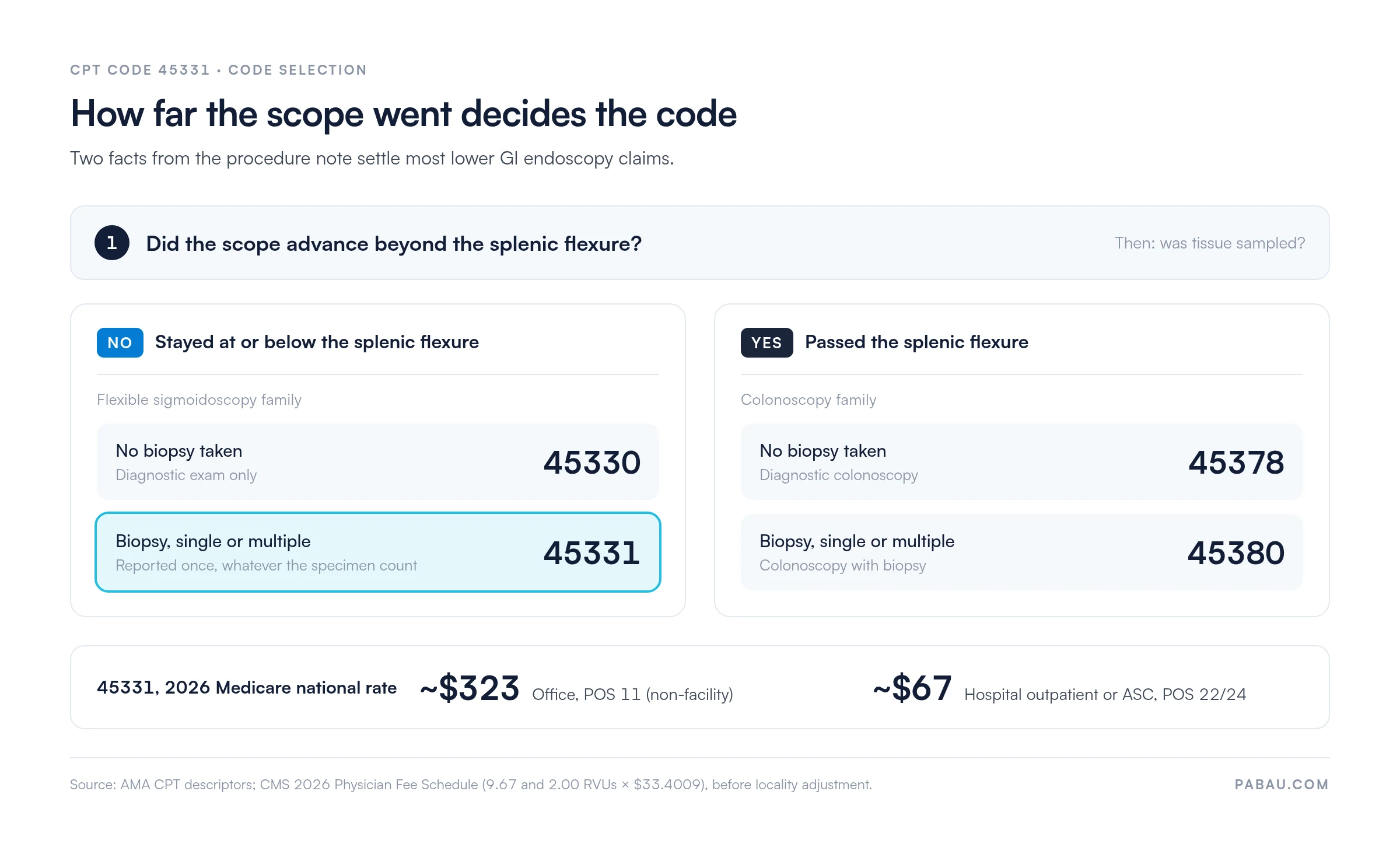
Payer audits on flexible sigmoidoscopy claims almost always turn on what the procedure note says. Strong medical billing compliance starts with the note, long before anyone builds the claim.
The note supporting 45331 should establish five facts:
The diagnosis code is your medical necessity argument. A weak or mismatched ICD-10 code is one of the most common reasons 45331 claims bounce on first submission.
Modifier choice is where experienced coders slow down. The right modifier protects payment. The wrong one, or a missing one, triggers an NCCI edit or a medical review request.
Modifiers 52 and 53 get mixed up most often. Use 52 when the physician planned a limited exam from the outset. Use 53 when the exam started but stopped early for patient safety. Swapping them sends the claim back for medical review.
The 2026 Medicare Physician Fee Schedule pays 45331 at two rates, depending on where the procedure happens. The facility rate is lower because the hospital or ASC collects its own payment for overhead.
You can confirm both in the CMS Physician Fee Schedule lookup tool. Practices using Pabau, the practice management platform we build, can submit these claims electronically through the Claim.MD integration.
These are national figures before locality adjustment, so your payment will differ by region. Check the FastRVU 2026 RVU lookup tool before you set your fee schedule. Commercial rates vary by contract, so confirm your negotiated rate for 45331 with each payer.
After each 45331 claim pays, review the electronic remittance advice. It’s the fastest way to catch a short payment before it repeats across a billing cycle.
Medicare covers diagnostic flexible sigmoidoscopy under CMS coverage policies when the documented indication establishes medical necessity. Diagnostic 45331 sits apart from the screening benefits, G0121 (screening colonoscopy) and G0104 (screening flexible sigmoidoscopy). Keep these points in mind:
Run eligibility verification and check prior-authorization requirements for flexible sigmoidoscopy at least 48 hours before the appointment date. Payer policies for elective GI procedures vary widely and change often. Checking the day before is usually too late to reschedule without disrupting the patient.
Here’s the path a typical office-based 45331 claim takes, and where each step can stall.
Steps 2 and 4 are where a short review prevents the denials listed below. When a denial does arrive, our guide to medical billing denial codes explains what each CARC code means.
Most 45331 denials trace back to a handful of predictable errors. Practices with solid denial management workflows track them by CARC code, so they fix the cause upstream instead of appealing claims one at a time.
Same-date GI billing triggers more NCCI edit conflicts than almost any other procedure family. The AAPC’s CPT code reference and the NCCI Policy Manual list the current edit pairs. The table below covers the combinations practices ask about most.
When a patient needs both a flex sig with biopsy and a diagnostic colonoscopy on one date, document the distinct medical necessity for each. Without that note, modifier 59 won’t protect the claim.
Run through these checks before the claim leaves the practice. Each one maps to a denial reason above.
Audit your last 90 days of 45331 claims by denial reason code. If one CARC code shows up more than three times, fix the note template or the authorization step behind it, not just the individual claim.
Coding references tell your team what 45331 means. They can’t carry the code from the patient record onto the claim, and that hand-off is where errors creep in.
In Pabau’s claims management software, the claim form pre-fills the CPT code and ICD-10 diagnoses from the patient record. Built-in CPT and ICD-10-CM lookup libraries let coders confirm a code without leaving the claim. Before sending, Pabau checks that required claim fields are complete, so submitting a clean claim takes less rework.
Authorization codes are required fields on the claim before it can be sent. A missing authorization number is caught in the practice, before the claim reaches the payer.

Pabau pre-fills claims from the patient record, offers CPT and ICD-10-CM code lookup, and checks required fields before you submit through Claim.MD.

For 45331, the procedure note does most of the billing work. When the note proves the depth, the biopsy sites, and the indication, the code holds up in an audit.
So put your effort upstream. Fix the note template and the authorization step once, and the same denials stop repeating every month. The trade-off is a few extra fields for the physician, which costs far less than reworking claims.
Pabau supports that routine with claims pre-filled from the patient record, code lookup, required-field checks, and submission through Claim.MD. Book a demo to see how it handles your GI procedure claims.

Did the scope pass the splenic flexure? CPT code 45378 covers the diagnostic colonoscopy and how it differs from a flex sig.
Took a biopsy during a colonoscopy? CPT code 45380 explains how colonoscopy with biopsy is coded and paid.
Need a framework for reducing claim rejections? What is medical billing walks through the end-to-end revenue cycle process, from charge capture through payment posting.
Tracking remittance data across multiple payers? What is revenue cycle management covers how to measure and improve collection rates across a GI practice.
Want to understand clearinghouse options for GI claims? Medical claims clearinghouse explains how clearinghouses validate and route claims before they reach payers.
In 2026, Medicare pays approximately $323 non-facility (office) and $67 facility (outpatient hospital or ASC), before locality adjustment. Those figures come from 9.67 and 2.00 RVUs multiplied by the $33.4009 conversion factor.
For Medicare, report 45331 with modifier PT when a screening flex sig becomes diagnostic because a biopsy was taken. The deductible is waived, though coinsurance can still apply. Many commercial payers ask for modifier 33 instead, so check each payer’s policy.
45331 carries a 000 global period, so there is no postoperative care period. A visit on a later day, such as a pathology results review, is billed separately.
One. The descriptor reads “single or multiple,” so a session with one biopsy and a session with six are billed the same way.
Yes, when the biopsy and the snare polypectomy treat different lesions. Append modifier 59 or XS and document each lesion’s location. A biopsy of the same lesion later removed by snare isn’t billed separately.



