CCSD code F4600: Incisional drainage of salivary gland abscess
CCSD code F4600: what the descriptor covers CCSD code F4600 covers incisional dr...

Last Updated: Oct 20, 2026
44960 is the CPT code for appendectomy; for ruptured appendix with abscess or generalized peritonitis. It covers removal of a ruptured appendix through an open incision when the surgeon finds a periappendiceal abscess or generalized peritonitis.
Its siblings are 44950 for open appendectomy without rupture, 44955 for an add-on appendectomy at another major procedure, and 44970 for the laparoscopic approach. The completed approach and the operative findings decide which one applies.
Let Pabau's smart automation suggest the right codes, reduce claim denials, and keep your practice compliant—effortlessly.
Automate repetitive tasks and focus on what matters most—your patients.
Reduce coding errors and ensure compliance with the latest regulations.
Clean claims, fewer denials, and faster reimbursements.
Powerful insights and reporting to help your practice thrive.
HIPAA compliant SOC 2 certified GDPR-compliant Trusted by 4,000+ clinics worldwide

CPT Code 44960 covers open appendectomy for a ruptured appendix with abscess or generalized peritonitis only. Appendicitis without rupture is 44950, and the laparoscopic approach is 44970.
The operative report must document intraoperative confirmation of rupture, abscess or purulent material, and peritoneal lavage to support medical necessity.
Pair 44960 with a diagnosis that reflects the complicated presentation, such as K35.20, K35.21 or K35.33.
44960 carries a 90-day global surgical period, so routine post-op visits in that window are bundled and cannot be billed separately.
Pabau, the practice management platform we build, connects to the Claim.MD clearinghouse. Its claim validation includes NCCI edit logic, so bundling conflicts surface before a 44960 claim goes out.
CPT Code 44960 is defined by the American Medical Association as: Appendectomy; for ruptured appendix with abscess or generalized peritonitis. Two elements must both be present. The appendix has ruptured or perforated, and the surgeon found either a walled-off periappendiceal abscess or free purulent material indicating generalized peritonitis. Neither element alone is sufficient. Code a perforation with caution when the surgeon documents no abscess or peritoneal contamination.
The stand-alone appendectomy codes divide by two variables: surgical approach and clinical presentation. A wrong pick either under-codes a complicated case or bills a higher-complexity code without the documentation to back it up. The decision path below runs the questions in the order a coder should ask them.
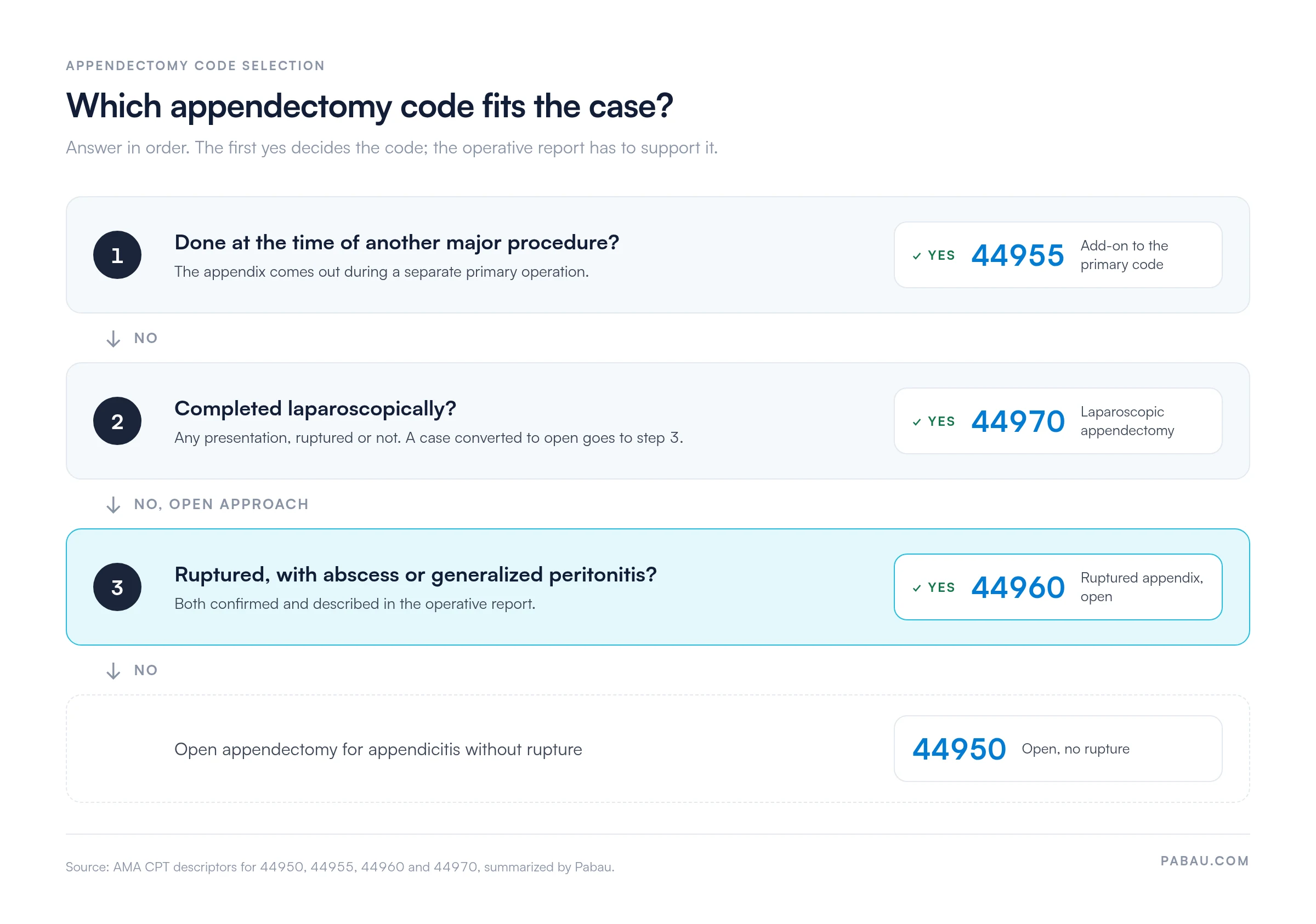
The table sets out each code against its approach and presentation.
Laparoscopic-to-open conversion: when a surgeon begins laparoscopically but converts to open after finding a ruptured appendix with peritonitis, the correct code is 44960, not 44970. The code follows the completed surgical approach. The operative report must document both the conversion reason and the findings that triggered it.
The two clinical presentations that support 44960 are distinct enough that coders should treat them as separate documentation checklists.
Preoperative CT or ultrasound findings showing perforation or abscess strengthen the record but do not substitute for intraoperative confirmation. Payers performing medical necessity review look for the operative report first.
Review the operative report before assigning any appendectomy code. If the surgeon describes a perforated or ruptured appendix but does not explicitly note abscess or generalized peritonitis, query the surgeon before billing 44960. An operative note that says only ‘perforated appendix’ without abscess or peritoneal contamination language may not support the higher-complexity code on payer review.
The diagnosis code must reflect the complicated, acute presentation. A simple appendicitis code does not satisfy medical necessity for 44960 and is a reliable path to denial. The relevant codes come from the K35 subcategory, which was restructured in ICD-10-CM FY2020 – an update that still catches practices using pre-revision codes.
Verify subcodes against the current CMS ICD-10-CM tabular list for the applicable fiscal year. The K35 subcategory expanded in FY2020 and practices still using pre-revision codes risk ICD-CPT mismatch denials.
Modifier selection for 44960 is driven by three scenarios: increased procedural complexity, multiple procedures at the same session, and surgical assistant services. Each modifier requires supporting documentation.
Modifier -59 can bypass modifier-indicator-1 NCCI edits (those where CMS permits an override with an appropriate modifier). It cannot bypass modifier-indicator-0 edits, which represent mutually exclusive code pairs. Confirm the specific edit pair’s indicator in the current CMS NCCI edit table before appending -59.
Medicare pays for 44960 under the Resource-Based Relative Value Scale (RBRVS). The payment amount is calculated as: Total RVU x Geographic Practice Cost Index (GPCI) x Conversion Factor. All three variables shift annually and vary by locality, so any dollar figure here is a reference point. Verify current rates against the CMS Physician Fee Schedule lookup tool for your MAC locality.
The values above come from the CMS 2026 RVU file. Use a tool like FastRVU to check them by locality before presenting fee schedule data to physicians or administration. Commercial payers typically pay a percentage of Medicare or a negotiated fee, and rates vary widely by plan and market.
CPT Code 44960 carries a 90-day global surgical period. CMS bundles routine post-operative care by the operating surgeon into the single 44960 payment, from the day before surgery through 90 days after.
Accurate superbill documentation during the global period should clearly record whether each visit relates to the index appendectomy. If it does not, a signed attestation from the surgeon supports the modifier and protects the claim from audits.
Surgical billing staff need to treat the operative report as the primary claim defense. For 44960, the operative note must contain each of the following elements to withstand payer medical necessity review and billing compliance audits.
Good medical billing workflows flag missing operative report elements before claims drop, not during a post-denial review. With a 44960 checklist in the surgical team’s post-case routine, billing receives a complete operative note on the first pass.
Build a short operative report checklist for 44960 that surgeons complete before dictation. It confirms rupture or perforation in writing, describes the abscess or free purulent material, documents peritoneal lavage, and notes any drain. A checklist attached to the surgical case workflow catches a missing element before the claim is submitted, not after the denial arrives.
Denials on 44960 cluster around five patterns. Each has a corrective action that can be built into the pre-submission workflow.
Structured denial management workflows sort 44960 denials by root cause: documentation, code selection, or NCCI conflict. Billing teams can then fix the upstream process instead of working each denial in isolation. Review common denial codes in medical billing to cross-reference the CARC/RARC codes your clearinghouse returns on 44960 rejections.
CMS’s National Correct Coding Initiative edits identify code pairs that should not be billed together because one procedure is considered a component of the other. For 44960, the most common conflicts involve services that are part of the ruptured-appendix operative encounter.
For definitive bundling guidance, check the current CMS NCCI Policy Manual and the quarterly edit tables published by CMS. Edit pairs and their modifier indicators change with each quarterly update. Never rely on a cached or year-old edit table for surgical code combinations.
Without a connected clearinghouse, a 44960 claim is checked by hand. The coder reads the operative report, keys the codes into a separate portal, and hears about bundling or eligibility problems only when the denial arrives.
Pabau’s Claim.MD clearinghouse integration moves those checks ahead of submission. Eligibility is verified in real time before the surgical date, and the claim goes out electronically as a CMS-1500. Claim validation through the Claim.MD clearinghouse includes NCCI edit logic, so a bundled drain or adhesion code is flagged before the payer sees it.
Your coder still assigns 44960 and its diagnosis from the operative report, and the claims management software catches errors in what was keyed. The Claim.MD clearinghouse reaches thousands of US payers and returns CARC codes on rejected claims. Your team resolves conflicts at the clearinghouse stage rather than after a full denial cycle.
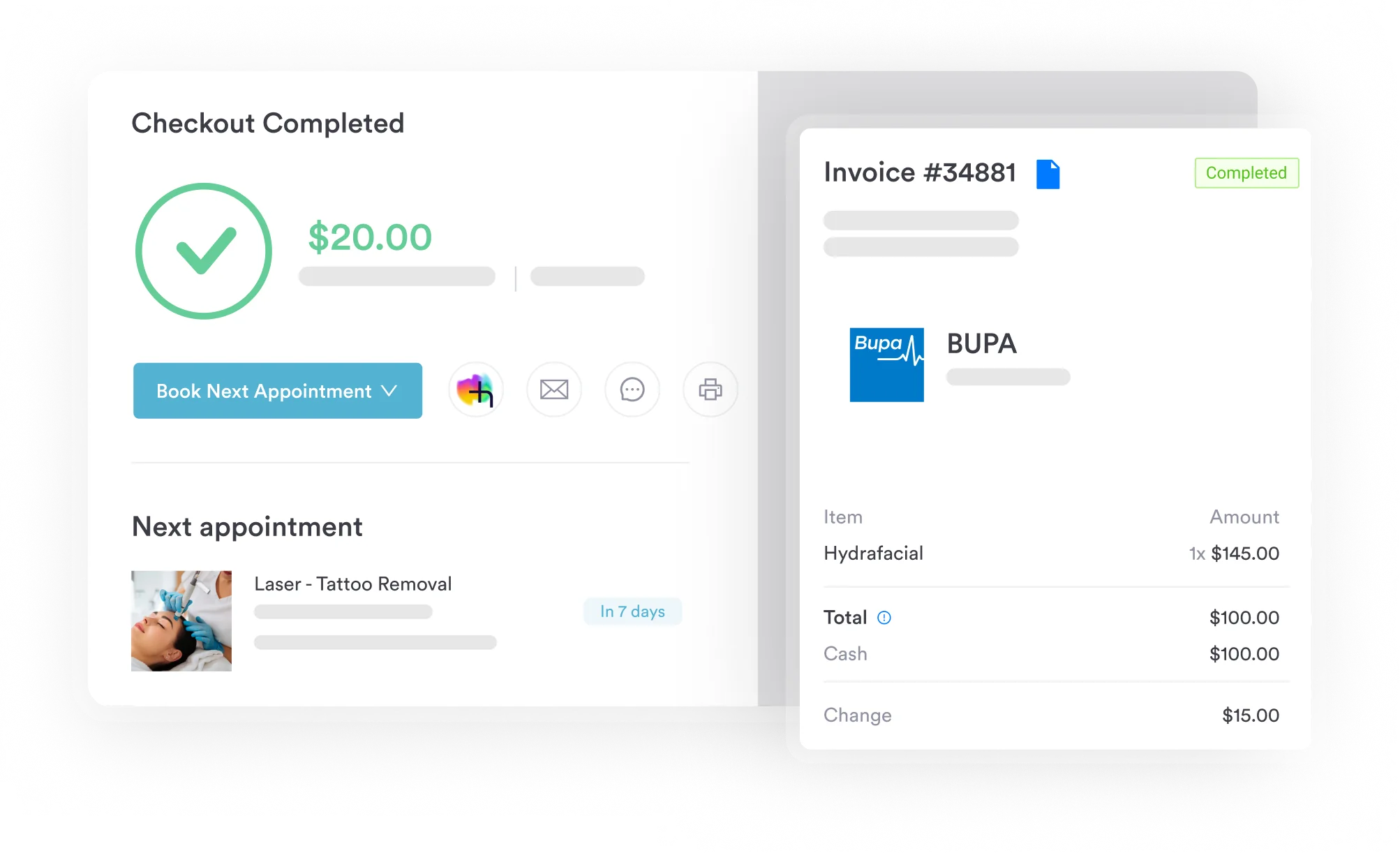

Claim validation through the Claim.MD clearinghouse includes NCCI edit logic. Pabau adds real-time eligibility checks and electronic claim submission for surgical codes like CPT 44960.

Code 44960 only when the operative report says the appendix ruptured and names the abscess or generalized peritonitis the surgeon found. If the note stops at a perforated appendix, query the surgeon before the claim goes out. No modifier or diagnosis code can rescue a thin operative record.
The trade-off is speed against defensibility. Holding a claim for a day to get an addendum costs far less than appealing a 90-day global procedure after review.
Pabau connects your billing team to the Claim.MD clearinghouse for real-time eligibility, claim validation that includes NCCI edit logic, and ERA matching. Book a demo to see how it handles your surgical claims from eligibility check to remittance.

Need to understand how clearinghouse submissions work? How medical claims clearinghouses work explains the end-to-end electronic claim submission process from practice to payer.
Dealing with remittance posting after surgical claims? Electronic remittance advice (ERA) covers how to read and reconcile ERA files returned after 44960 claims settle.
Want to verify patient eligibility before the surgical date? Insurance eligibility verification outlines the pre-authorization and coverage check process for major surgical procedures.
CPT Code 44960 covers an open appendectomy performed for a ruptured appendix with either a periappendiceal abscess or generalized peritonitis. It does not apply to appendicitis without rupture, which is 44950, or to the laparoscopic approach, which is 44970. An incidental appendectomy at the time of another major procedure is the add-on code 44955.
44950 is open appendectomy for appendicitis without rupture. 44960 is open appendectomy for a ruptured appendix with abscess or generalized peritonitis. 44970 is laparoscopic appendectomy for any presentation where the laparoscopic approach is completed. Incidental appendectomy at another major procedure is the add-on code 44955, and approach plus intraoperative findings decide the rest.
The primary pairings are K35.20 (acute appendicitis with generalized (diffuse) peritonitis without abscess) and K35.21 (with abscess). K35.33 fits a perforated appendix with localized peritonitis and abscess. Verify subcodes against the current fiscal year CMS ICD-10-CM tabular list, because outdated K35 subcodes still cause ICD-CPT mismatch denials.
No. 44960 and 44970 are mutually exclusive, because one is an open approach and the other is laparoscopic. When a laparoscopic case converts to open after finding a ruptured appendix, bill 44960 for the completed open procedure only.