HCPCS Code G0163: Skilled nursing observation and assessment
What is HCPCS Code G0163? HCPCS Code G0163 is a deleted Level II code for skille...

Last Updated: Oct 15, 2026
44970 is the CPT code for laparoscopy, surgical, appendectomy.
It covers removal of the appendix completed entirely through a minimally invasive laparoscopic approach, whether or not the appendix has ruptured. The CPT code carries the approach and the ICD-10-CM code carries the severity. 44970 holds only while the operation stays laparoscopic. A conversion to an open approach moves the claim to 44950 or 44960.
Let Pabau's smart automation suggest the right codes, reduce claim denials, and keep your practice compliant—effortlessly.
Automate repetitive tasks and focus on what matters most—your patients.
Reduce coding errors and ensure compliance with the latest regulations.
Clean claims, fewer denials, and faster reimbursements.
Powerful insights and reporting to help your practice thrive.
HIPAA compliant SOC 2 certified GDPR-compliant Trusted by 4,000+ clinics worldwide

CPT code 44970 is the procedure code for laparoscopic appendectomy, used whether the appendix is ruptured or non-ruptured.
ICD-10-CM diagnosis code selection carries the rupture distinction: K35.x codes for perforated or complicated cases, K37 for unspecified appendicitis.
44970 carries a 90-day global surgery period under Medicare, bundling most follow-up E/M visits unless modifier -24 applies.
Pabau’s claims management tools support modifier tracking and denial workflow automation for surgical codes including 44970.
CPT code 44970 is defined by the American Medical Association (AMA) as: Laparoscopy, surgical, appendectomy.
That single descriptor covers all laparoscopic appendix removals regardless of whether the appendix is ruptured. What decides the code is the approach the surgeon finished on. A conversion to an open procedure moves the claim to 44950 or 44960.
The division of labor between the two code sets is what makes or breaks the claim. The CPT code describes the technique. The ICD-10-CM code carries the clinical severity. Getting either one wrong on a 44970 claim creates an immediate mismatch that triggers denial.
A laparoscopic appendectomy removes the appendix through three small port incisions rather than a single large abdominal opening. Coders need a working understanding of the technique because the operative report must confirm each step for the code to be defensible on audit.
If the surgeon converts to an open procedure after beginning laparoscopically, the operative note must document the reason. The code changes to 44950 or 44960 at that point. CPT code 44970 only stands when the entire removal is completed laparoscopically.
The appendectomy code family sits at 44950-44979. Selecting the wrong code in this range is the most common misuse error the AAPC coding community flags for this procedure.
Note that 44950 and 44960 differentiate by rupture status, while 44970 does not. The rupture information for laparoscopic cases lives entirely in the ICD-10 diagnosis code. Reporting 44979 takes a separate operative report and a written description of the procedure. No descriptor exists for the payer to price the claim against.
Understanding the boundaries of 44970 prevents both undercoding and overbilling on general surgery claims.
A right colectomy is the resection that most often carries the appendix out with it. Done laparoscopically with terminal ileum removal and an ileocolostomy, that case codes to 44205. Done open instead, the same resection codes to 44160. The appendix leaves with the cecum, so no separate appendectomy line belongs on the claim.
Payers require a diagnosis code that establishes medical necessity for laparoscopic appendectomy. The codes below are the most common pairings, and selecting the wrong specificity is one of the top denial triggers for 44970 claims. Note that K35.2, K35.20, K35.21 and K35.89 are category headers rather than billable codes. Each one needs a sixth character before it goes on a claim.
Documenting the pathology result in the record helps defend the diagnosis code selection when payers request medical records. Selecting K35.80 or K35.890 requires the operative report to confirm that no rupture or generalized peritonitis was present at the time of surgery. The wider ICD-10-CM code index shows how the sixth character behaves across the rest of the K35 subcategory.
Modifier usage on 44970 is a frequent audit trigger. Applying modifiers without the supporting operative documentation is one of the clearest routes to a post-payment recovery demand. Always verify modifier acceptance with the individual payer before billing.
Modifier -22 requires a written explanation of the additional work attached to the claim. Without it, most payers deny the upward adjustment automatically. Dense adhesions alone do not support a separate CPT code 44180 line when the lysis only opened access to the appendix.
Run every 44970 claim through your current NCCI edits before submission. CMS updates NCCI edits quarterly, so a bundling rule that applied in Q1 may change by Q3. Keep your claim editing software updated to avoid preventable denials on modifier -51 and -59 situations.
CPT code 44970 carries a 90-day global surgery period under the Medicare Physician Fee Schedule. All routine post-operative care is bundled into the surgical payment for those 90 days. Verify the current global period indicator against the CMS Physician Fee Schedule lookup tool, since indicators can change with annual updates.
The global period begins the day after surgery for every 90-day major surgical code, 44970 included. Billing a routine follow-up E/M without one of these modifiers inside that window leads to an automatic denial.
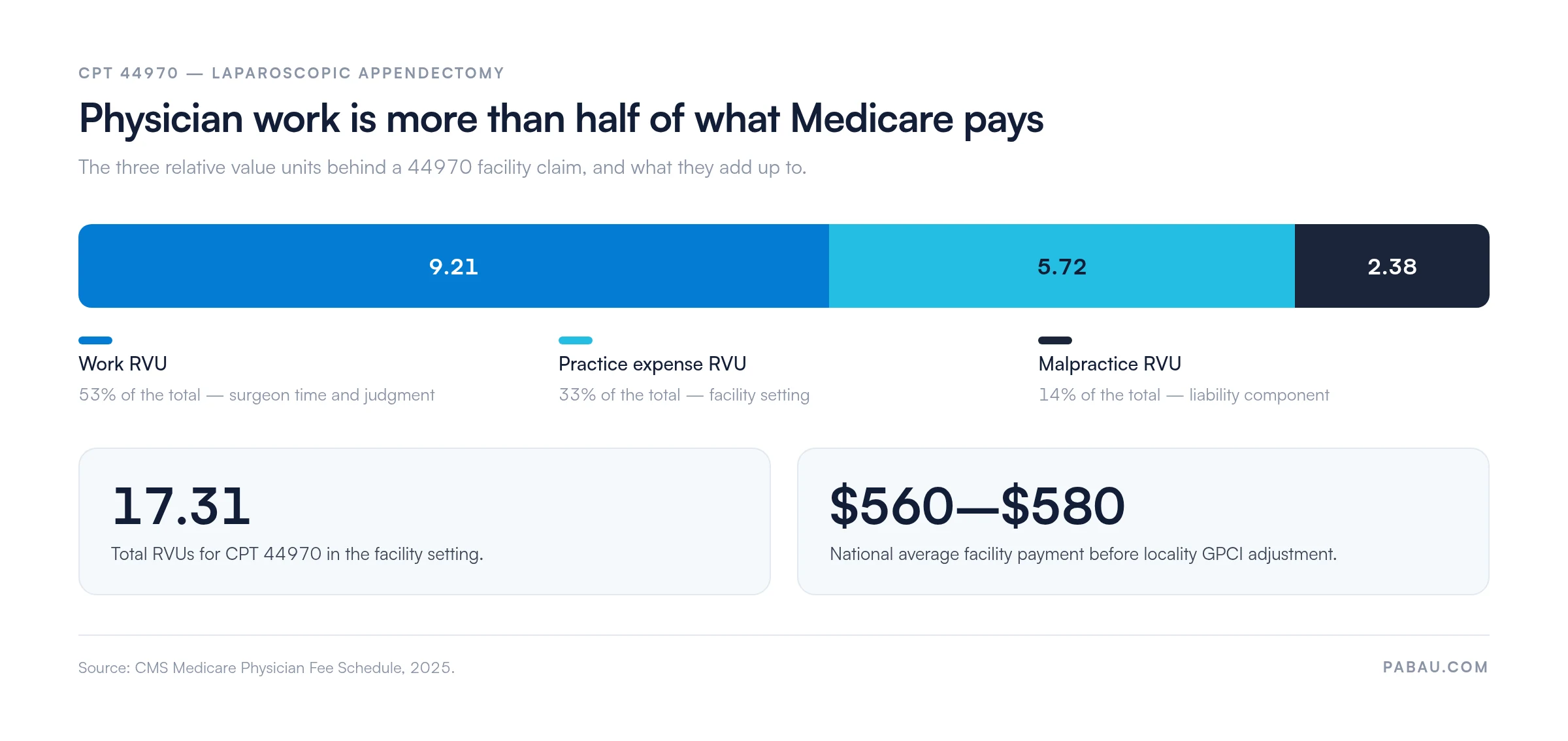
Medicare reimbursement for CPT code 44970 is calculated using the Medicare Physician Fee Schedule (MPFS) and varies by geographic practice cost index (GPCI). The figures below reflect the 2025 national average facility values. Use the CMS MPFS lookup tool for your locality-specific amounts, and confirm current-year rates against each annual update.
The three components are not weighted evenly, and that shapes how you treat a complex case. Physician work accounts for just over half the total. A difficult dissection argued under modifier -22 is therefore asking the payer to increase the largest component.
Commercial payer rates are not published, so check your individual contracts rather than assuming a multiple of the Medicare amount. Where a contract pays a percentage of MPFS, a mid-year conversion factor change moves that figure too.
Medicare does not require prior authorization for CPT code 44970 in most circumstances, since appendicitis is typically an emergency or urgent condition. Commercial plans vary considerably, and the medical billing compliance rules that govern documentation and retention differ by payer and plan type.
When PA cannot be obtained before an emergency surgery, submit the claim with the emergency documentation. File a retro-authorization request if the payer requires one. Keep a record of the clinical notes, emergency department records, and imaging that support the medical necessity determination.
An operative report that lacks specific language about the approach is the single fastest route to a 44970 denial or audit finding. Coders should confirm all five elements below are present before assigning the code.
The claim itself should then match the operative note exactly. That means the laparoscopic approach, the correct ICD-10-CM code, and only the modifiers the documentation supports.
Denial patterns on 44970 follow predictable themes. Addressing them in the workflow before submission is more efficient than working appeals after the fact.
Five of those six denials are caught by reading the operative note before the claim is built. The sixth, prior authorization, is caught at scheduling, which is why the two checks belong to different people in the workflow.
Create a 44970-specific pre-submission checklist: approach confirmed laparoscopic, ICD-10 code matches pathology, PA documented if required, modifiers attached with supporting notes. Running this checklist before claim submission takes two minutes and prevents the most common denial patterns described above.
In most general surgery billing teams, 44970 denials get logged in a spreadsheet that sits outside the system the claim was built in. The reason code is recorded, the appeal is written, and the pattern behind six similar denials is never assembled.
Practice management software like Pabau keeps the operative documentation, the codes, and the claim in one patient record. Our claims management software holds a claim for review when a required modifier or diagnosis code is missing. Denial reason codes are grouped by procedure, so a recurring 44970 problem reads as one pattern rather than six unrelated appeals.
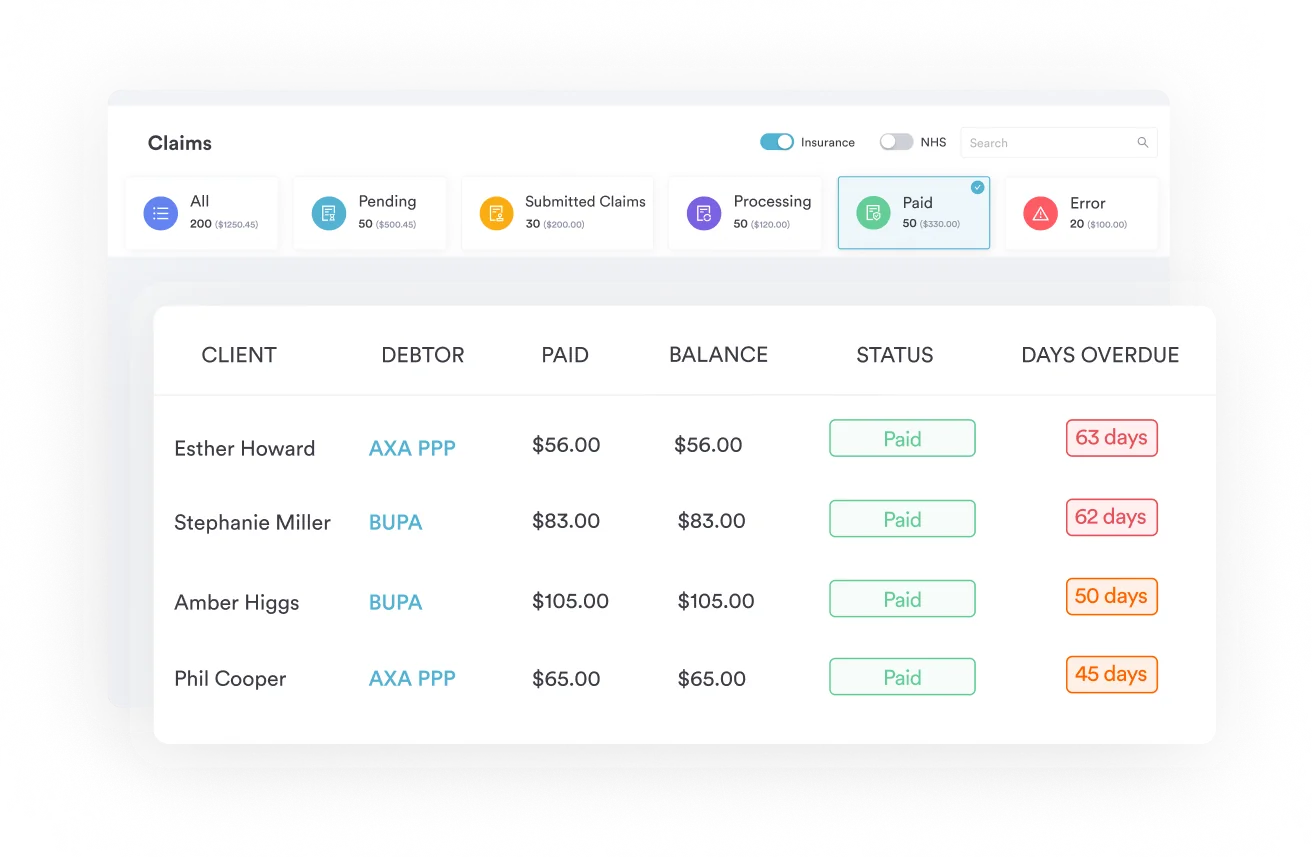
For a surgical practice, that means fewer rework hours per claim. Billing staff spend their time on the cases that genuinely need an appeal. The claims that should have gone out clean go out clean.

Pabau’s surgical claims management tools help general surgery practices track modifiers, manage denial workflows, and submit cleaner claims. See how it works in a live demo.

CPT code 44970 is a simple code to understand and an easy one to lose money on. The procedure itself is well defined, so failed claims fail on the paperwork around it. Three details do the damage: the approach language in the operative note, the sixth character on the K35 code, and an undocumented modifier.
Treat those three as a single pre-submission check rather than three separate habits. A practice that does will clear most 44970 claims on first submission, and the appeals that remain will be the ones genuinely worth arguing.
Book a demo to see how Pabau tracks modifiers, documentation, and denial patterns across your surgical claims.

Need to understand how surgical claims flow through a clearinghouse? Medical claims clearinghouse guide explains the submission and adjudication process from claim creation through payment.
Working through a high denial rate on surgery claims? Denial codes in medical billing covers the CARC and RARC codes that appear on surgical remittances and how to respond to each.
Want to understand the 837P electronic claim format for 44970? 837 EDI file guide covers the transaction structure used to submit claims electronically to payers and clearinghouses.
CPT code 44970 is the procedure code for laparoscopic appendectomy, defined by the AMA as “Laparoscopy, surgical, appendectomy.” It covers surgical removal of the appendix completed entirely through a minimally invasive laparoscopic approach, for both ruptured and non-ruptured presentations.
Yes. CPT code 44970 is used for laparoscopic appendectomy regardless of whether the appendix is ruptured. The ICD-10-CM diagnosis code carries the rupture distinction: K35.201 or K35.211 for perforated cases, K35.80 or K35.890 for non-perforated cases, and K37 for unspecified appendicitis.
The 2025 national average Medicare facility payment for CPT 44970 is approximately $560-$580. That figure comes from 9.21 work RVUs, 5.72 practice expense RVUs, and 2.38 malpractice RVUs, converted at the current CMS conversion factor. Rates vary by locality, so check the CMS Physician Fee Schedule lookup tool for your MAC jurisdiction.
CPT code 44970 carries a 90-day global surgery period under Medicare. Routine post-operative care is bundled into the surgical payment for the 90 days following the procedure. Separate E/M visits during this window require modifier -24 for an unrelated condition, or modifier -25 for a significant service on the day of surgery.
CPT 44970 is for laparoscopic appendectomy. 44950 covers open appendectomy without rupture or peritonitis, and 44960 covers open appendectomy with rupture, abscess, or generalized peritonitis. The distinction is approach. Once a surgeon converts to open, 44970 becomes incorrect and the claim moves to 44950 or 44960 depending on the clinical findings.
Medicare generally does not require prior authorization for CPT 44970, since appendicitis typically presents as an urgent or emergency condition. Commercial plans vary, and some require PA for semi-elective laparoscopic appendectomy such as an interval appendectomy. Always verify with the individual payer, and document emergency circumstances thoroughly when PA cannot be obtained in advance.
Six reasons account for most 44970 denials. Three sit in the coding itself: billing 44950 instead of 44970, using a non-billable ICD-10-CM code, and NCCI bundling conflicts. The rest are missing prior authorization, E/M billing inside the 90-day global period without a modifier, and an undocumented modifier -22.