CCSD Code V1730: Extraoral fixation of mandible
What is CCSD code V1730? CCSD code V1730 is the UK private medical insurance cod...

Last Updated: Nov 24, 2026
43254 is the CPT code for esophagogastroduodenoscopy, flexible, transoral; with endoscopic mucosal resection. It covers EMR anywhere in the esophagus, stomach, or duodenum, billed once per session however many lesions are removed.
The code needs three documented steps: a submucosal injection lift, a snare or cap resection, and specimen retrieval. A snare removal with no documented lift is 43251, and a forceps biopsy is 43239.
Let Pabau's smart automation suggest the right codes, reduce claim denials, and keep your practice compliant—effortlessly.
Automate repetitive tasks and focus on what matters most—your patients.
Reduce coding errors and ensure compliance with the latest regulations.
Clean claims, fewer denials, and faster reimbursements.
Powerful insights and reporting to help your practice thrive.
HIPAA compliant SOC 2 certified GDPR-compliant Trusted by 4,000+ clinics worldwide

CPT code 43254 describes EGD with endoscopic mucosal resection, billed once per session however many lesions are removed.
The operative note must confirm the injection lift, the resection technique (en bloc or piecemeal), and specimen retrieval. Auditors flag notes that omit the lift.
A snare removal without a documented lift is 43251, a forceps biopsy is 43239, and NCCI edits bundle diagnostic EGD (43235) into 43254.
Under the 2026 Medicare Physician Fee Schedule, 43254 carries 7.09 total RVUs, about $237 nationally before geographic adjustment.
In Pabau’s practice management software, claim validation catches missing or invalid details before submission, and prior-authorization status is tracked on the case.
CPT code 43254 covers a flexible, transoral esophagogastroduodenoscopy (EGD) with endoscopic mucosal resection (EMR). The CPT code set is maintained by the AMA’s CPT Editorial Panel. Its official descriptor for 43254 reads: Esophagogastroduodenoscopy, flexible, transoral; with endoscopic mucosal resection.
The physician passes a flexible scope through the mouth into the esophagus, stomach, and duodenum. A mucosal lesion is then removed with the full EMR technique, rather than a forceps biopsy (43239) or a standard snare polypectomy (43251).
43254 applies to EMR anywhere in the esophagus, stomach, or duodenum during a single transoral scope session. The site (Barrett’s esophagus, gastric polyp, duodenal adenoma) shapes the medical necessity documentation, but it does not change the code.
Endoscopic mucosal resection removes tissue in a way a standard biopsy does not. Each clinical step below maps to something the operative note must contain to support 43254.
The submucosal lift is the step that separates 43254 from simpler codes. A note that describes snare resection without mentioning injection gives auditors grounds to downcode to 43251 or deny outright.
The boundaries below separate 43254 from the upper GI codes it is most often confused with, in both directions.
Covered scenarios:
Not covered by 43254 (use a different code):
The per-session rule is worth flagging separately. Some practices try to bill 43254 more than once when two or more lesions are removed at the same encounter, and payers reject this. Bill 43254 once, and document every lesion in a single operative note.
These five codes are the ones coders most often substitute for 43254 in error. The table shows the key distinction for each.
The 43254 versus 43239 distinction is the one that surfaces most often in denials and audits. 43239 covers biopsy forceps sampling: A small tissue sample is taken for histology, but the lesion is not excised.
43254 requires the full mucosal resection technique, with a submucosal lift, snare or cap capture, and removal of the mucosal layer. Billing 43239 when EMR was performed is undercoding, and billing 43254 for a biopsy is upcoding.
Snare removal is the closer call. 43251 covers a polyp or lesion removed by snare technique with no injection lift. An injection with no resection afterward is 43236. Read the operative note first, then pick the code. The chart below maps each documented finding to the code it supports.
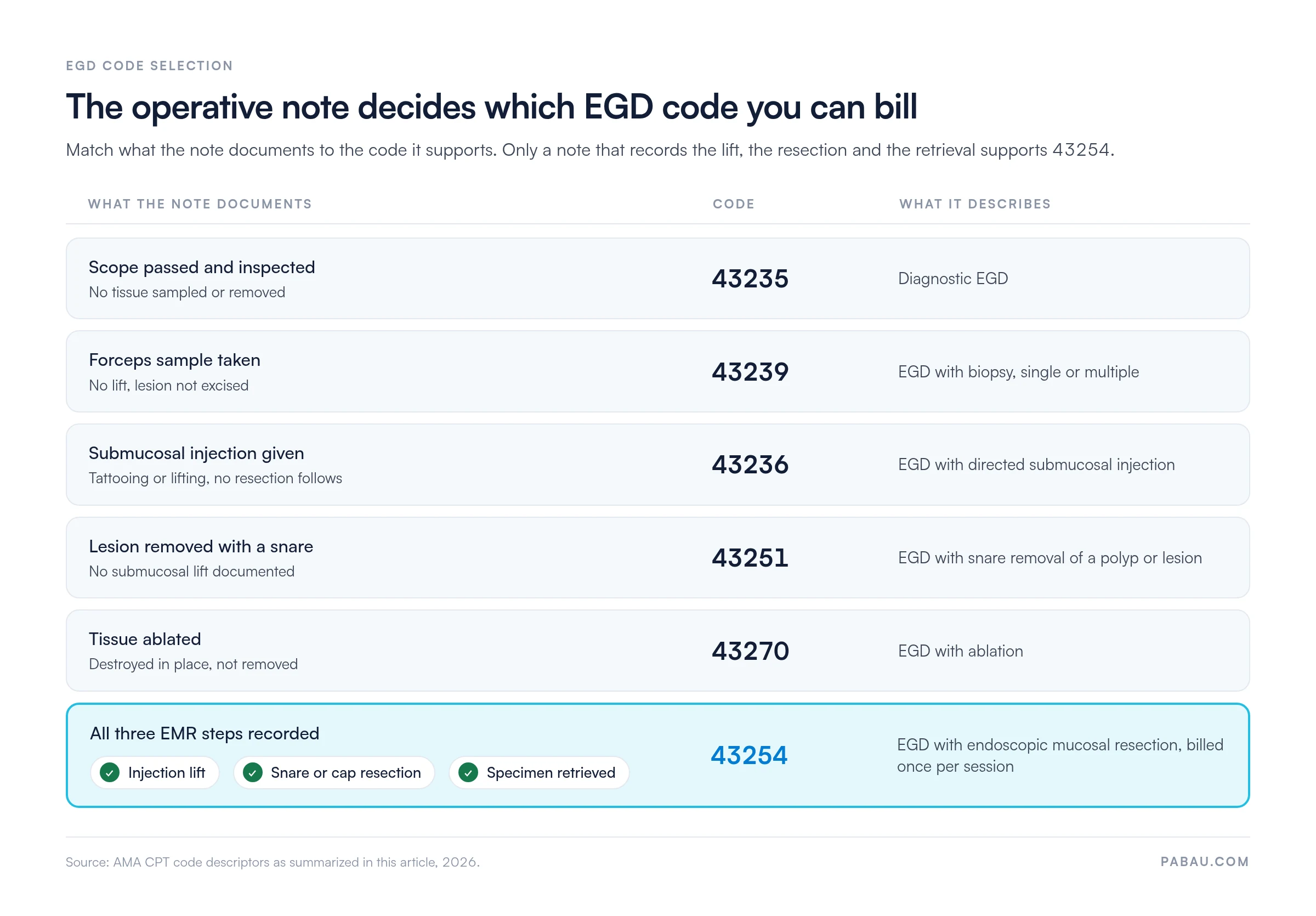
An operative note that supports 43254 must contain each of the following elements. Missing any one of them gives commercial and Medicare auditors a basis to deny or downcode the claim.
Auditors focus hardest on the submucosal lift and specimen retrieval. Notes that describe resection without mentioning the injection technique are often denied. The payer reads the case as a standard snare polypectomy (43251) rather than EMR.
Medicare payment rates for CPT code 43254 are set annually through the Medicare Physician Fee Schedule (MPFS). The figures below are 2026 values from FastRVU’s 43254 entry, which uses the CMS conversion factor of $33.4009. Always verify current-year values in the CMS MPFS lookup tool before billing.
Use the FastRVU 2026 RVU lookup to calculate location-adjusted reimbursement from your practice’s geographic practice cost index (GPCI). Payment varies by Medicare Administrative Contractor (MAC) region. Pabau connects to the Claim.MD clearinghouse for US billing. Through it, you can submit electronic claims to thousands of US payers, run real-time eligibility checks, and receive ERA remittances into your billing workflow.
Commercial payers handle 43254 differently from Medicare. Some require prior authorization for every EMR procedure, while others apply it only above a lesion-size threshold or for indications such as Barrett’s-related dysplasia. Check the payer’s current medical policy before scheduling the procedure.
National Correct Coding Initiative (NCCI) edits bundle 43235 into 43254 when both are billed on the same date of service. The diagnostic component of EGD is included in the more complex code, so submitting both without a modifier results in denial of 43235.
If a separate diagnostic examination was performed at a distinct encounter, modifier 59 (or an X-modifier) may be appropriate. This is uncommon and needs specific documentation support, so confirm the current NCCI edit tables before unbundling.
ASC facility fees are negotiated separately from physician reimbursement. In an ASC, the physician reports 43254 on the professional claim and the facility bills its own claim. Payers may apply different prior-auth rules to each. Submitting a clean claim in this two-track setup means checking the place-of-service code on both claims (22 for HOPD, 24 for ASC).
Modifier selection for 43254 depends on what else was billed at the same encounter and on the payer’s rules.
CMS guidance allows X-modifiers (XE, XS, XP, XU) as more specific alternatives to -59 when payers accept them. Some MACs and commercial payers prefer the X-modifier subset, so confirm your payer’s modifier policy before substituting.
CPT code 43254 carries a 0-day global period under the 2026 Medicare Physician Fee Schedule. A 0-day global means no post-operative services are bundled into the procedure fee beyond the day of the procedure itself. Verify the global period in the MPFS database each year, because CMS can reassign global periods in annual rule updates.
Because the global period is 0 days, follow-up office visits after discharge are billed separately with the appropriate E/M code. The visit must be documented as medically necessary and distinct from routine procedure follow-up.
Complications requiring a return encounter (bleeding, perforation) are also billed separately, using the applicable complication diagnosis code paired with the appropriate procedure or E/M code.
Denials on 43254 cluster around a handful of root causes. Knowing them in advance lets billing staff build pre-submission checks rather than reactive appeals. Effective denial management workflows catch these before the claim reaches the payer.
Knowing the medical billing denial codes on each remittance helps your billing team triage rejections quickly and prioritize which appeals to build first.
Run a quarterly audit of all 43254 claims submitted in the past 90 days, and pull the denial rate by denial reason code. If documentation-related denials (CO-16, CO-252) make up more than 15% of 43254 rejections, fix the operative note template before retraining billing staff. Work with the physicians to add an EMR-specific documentation checklist to the procedure report.
In many GI practices, a coder reads the EMR note after the case, picks a code, and learns weeks later whether the payer agreed. A missing lift statement or an absent authorization only surfaces once the denial arrives.
Pabau’s claims management software moves those checks ahead of submission. Claim validation catches missing or invalid details before the claim goes out. Prior-authorization status is tracked on the case, with the auth code, dates, and sessions, and a warning appears when an authorization is missing.
A procedure note template in Pabau can also prompt for the submucosal injection, the resection technique, and specimen retrieval. Those are the three elements auditors check first, so the note supports the code before the claim is built.
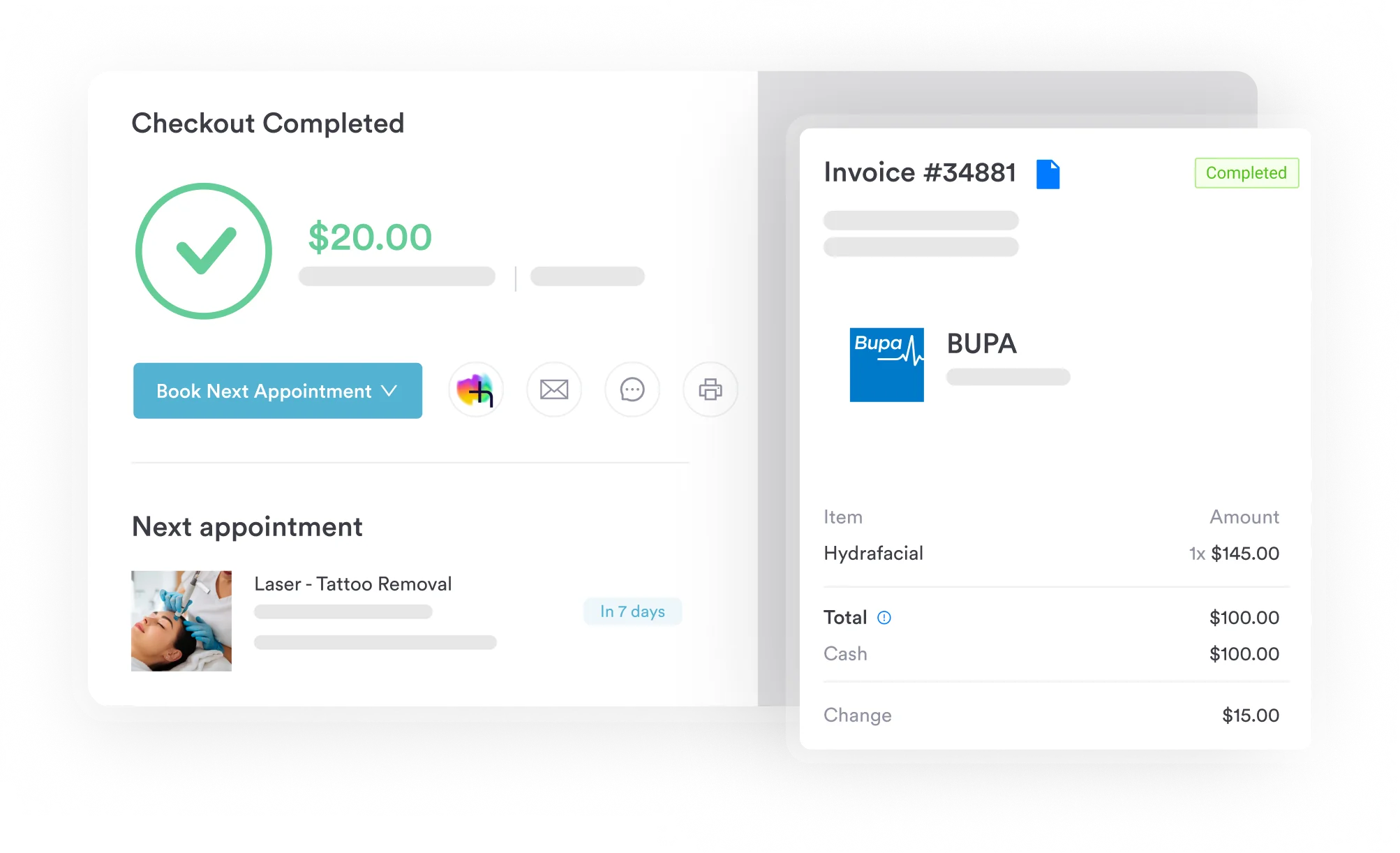

Pabau’s claim validation catches missing or invalid details before a 43254 claim goes out, and prior-authorization status is tracked on the case. Your GI billing team spends less time on rework and appeals.

CPT code 43254 pays when the operative note proves EMR took place. That means the lift, the resection, and the retrieval, all in writing. Bill it once per session, and keep 43235 off the same claim unless a separate encounter is documented.
Fix the note template first, because no appeal can rescue a note that never mentions the injection. Then let Pabau’s claim validation catch missing or invalid details before submission, with prior-authorization status tracked on the case. Book a demo to see how Pabau keeps 43254 claims clean in a GI practice.

Removed a lesion by snare without a lift? CPT code 43251 covers EGD with snare removal of a polyp or lesion, the code a note without the lift supports.
Controlling bleeding during an upper endoscopy? CPT code 43255 covers EGD with control of bleeding by any method.
Want to understand how claim denials are classified and appealed? Denial management in healthcare covers the full workflow from denial reason code to corrective action.
Looking for a plain-English breakdown of how claims flow from procedure to payment? Revenue cycle management explained walks through every stage from eligibility check to remittance posting.
CPT code 43254 covers esophagogastroduodenoscopy (EGD) with endoscopic mucosal resection. The physician injects the submucosa to lift the lesion, then removes it with a snare or cap. It applies to EMR in the esophagus, stomach, or duodenum and is billed once per session, however many lesions are removed.
43254 requires full endoscopic mucosal resection, with a submucosal injection lift and excision of the lesion. 43239 covers biopsy only, where forceps sample tissue without a lift or full mucosal removal. Billing 43254 for a biopsy is upcoding, and billing 43239 for EMR is undercoding.
Modifier -59, or an X-modifier, unbundles a separately identifiable service from an NCCI-bundled pair when documentation supports it. Medicare prices same-family EGD codes under its special endoscopy rule, so check payer guidance before adding -51. Standard single-session EMR with no co-billed services usually submits without a modifier.
CPT 43254 carries a 0-day global period under the 2026 Medicare Physician Fee Schedule. No post-operative services are bundled into the fee beyond the day of the procedure, so later office visits are billed separately. Confirm the global period in the CMS MPFS lookup each year, because CMS can reassign it.
Not without modifier support. NCCI edits bundle 43235 (diagnostic EGD) into 43254 on the same date of service, because the diagnostic component is part of the more complex procedure. Billing both without modifier 59 or an X-modifier leads to denial of 43235. Use the modifier only when a separate diagnostic encounter is documented.
Most 43254 denials trace back to the operative note or the claim setup. The note may omit the submucosal injection or lift, or a commercial payer’s prior authorization was never obtained. Other denials come from billing 43235 or 43239 alongside 43254 without a modifier, or from a place-of-service code that mixes up HOPD and ASC.
Under the 2026 Medicare Physician Fee Schedule, 43254 carries 7.09 total RVUs. At the 2026 conversion factor of $33.4009, that comes to about $237 nationally before geographic adjustment. Your locality’s GPCI changes the amount your MAC actually pays.