

HCPCS code E0198: Water pressure pad billing guide
HCPCS code E0198 is a water pad for a standard mattress HCPCS code E0198 is the ...

Last Updated: Oct 13, 2026
43242 is the CPT code for esophagogastroduodenoscopy, flexible, transoral, with transendoscopic ultrasound-guided intramural or transmural fine needle aspiration/biopsy(s). The code includes endoscopic ultrasound examination of the esophagus, stomach, and either the duodenum or a surgically altered stomach. In a surgically altered stomach, the jejunum is examined distal to the anastomosis.
In plain terms, the endoscopist samples a lesion in or just beyond the GI wall under ultrasound guidance during one upper endoscopy. No needle pass means the claim belongs on 43259 or 43237, and a limited exam with FNA is 43238. Below, you'll find the documentation, 2026 RVUs, modifiers, and denial fixes that keep a 43242 claim clean.
Let Pabau's smart automation suggest the right codes, reduce claim denials, and keep your practice compliant—effortlessly.
Automate repetitive tasks and focus on what matters most—your patients.
Reduce coding errors and ensure compliance with the latest regulations.
Clean claims, fewer denials, and faster reimbursements.
Powerful insights and reporting to help your practice thrive.
HIPAA compliant SOC 2 certified GDPR-compliant Trusted by 4,000+ clinics worldwide

CPT code 43242 covers an upper endoscopy with EUS-guided fine needle aspiration, and the complete EUS exam is included rather than billed separately.
No needle pass means no 43242. Use 43259 for a complete EUS exam or 43237 for a limited one.
EUS-guided FNA with only a limited exam is 43238, so the procedure note must state how far the exam went.
For 2026, 43242 carries 6.88 total RVUs and pays about $229.80 nationally, the same in facility and non-facility settings before GPCI.
Moderate sedation by the endoscopist is reported separately with 99152 and 99153, while a separate anesthesia provider usually bills 00731.
CPT code 43242 is the code for an esophagogastroduodenoscopy (EGD) with ultrasound-guided fine needle aspiration (FNA) or biopsy through the scope. Per the official descriptor, it includes the endoscopic ultrasound (EUS) exam of the esophagus, stomach, and duodenum. After gastric surgery, the jejunum examined distal to the anastomosis stands in for the duodenum.
The sample can come from inside the GI wall (intramural) or from a structure just beyond it (transmural). The AMA’s CPT code set treats the EUS exam as part of 43242. Billing a separate EUS code for the same session trips National Correct Coding Initiative (NCCI) edits. CPT also bars reporting 76942 or 76975 with it.
Two scenarios fall outside 43242. Diagnostic EUS without FNA goes to 43237 (limited EUS) or 43259 (complete upper GI EUS). EUS-guided FNA of the lower GI tract belongs to a separate code family, such as 45342 for sigmoidoscopy or 45392 for colonoscopy. And an esophagus-only FNA done through an esophagoscope is 43232.
Each step below leaves something in the procedure note that a payer can check during a medical necessity review.
If the operative note skips any of these steps, the claim is exposed on medical necessity review.
A clean claim for CPT 43242 starts with a procedure note that answers every question an auditor asks. When an element is missing, the claim usually comes back denied. The report should state each of the following:
The superbill for the encounter must carry an ICD-10 code that supports the indication in the procedure note. A mismatch between the two documents is a leading audit trigger.
Payers judge medical necessity from the ICD-10-CM code submitted with CPT 43242. An unsupported or mismatched diagnosis is one of the most frequent denial reasons for this procedure.
The table lists the diagnoses most often linked to it. Check each pairing against the applicable local coverage determination (LCD) or payer policy before you submit.
Always assign the most specific code available. K31.9 works while a more precise diagnosis is still pending. Payers may challenge it, though, if it keeps appearing across one patient’s claims. The AAPC Codify CPT lookup includes a crosswalk that helps coders check supported pairings before submission.
Medicare sets payment for CPT 43242 each year through the Medicare Physician Fee Schedule (MPFS). For 2026, the national RVUs and payment are identical in facility and non-facility settings. Your locality amount still shifts with the Geographic Practice Cost Index (GPCI) and the site-of-service rules.
These are national figures, so check your locality’s amount in the CMS Physician Fee Schedule Look-Up Tool before you quote a fee. Commercial rates vary widely and follow each payer contract. The FastRVU 2026 lookup is a quick cross-check for the work RVU and total RVU.
Run a quarterly check on your Medicare Advantage contracts. MA plans are not required to follow traditional Medicare rates for 43242, and some pay well below the MPFS national amount. Spotting low-paying contracts early lets your billing team flag underpayments before they age past the timely-filing window.
Modifier errors are another frequent denial trigger for 43242. Each modifier below fits one specific situation. Appending the wrong one, or leaving off a required one, changes how the payer adjudicates the claim.
Five upper GI codes get mixed up in EUS billing. Two questions settle almost every case. Was a needle pass made under EUS guidance? And how far did the ultrasound exam go?
Laid out as a grid, the needle pass and the exam’s extent point to one code each.
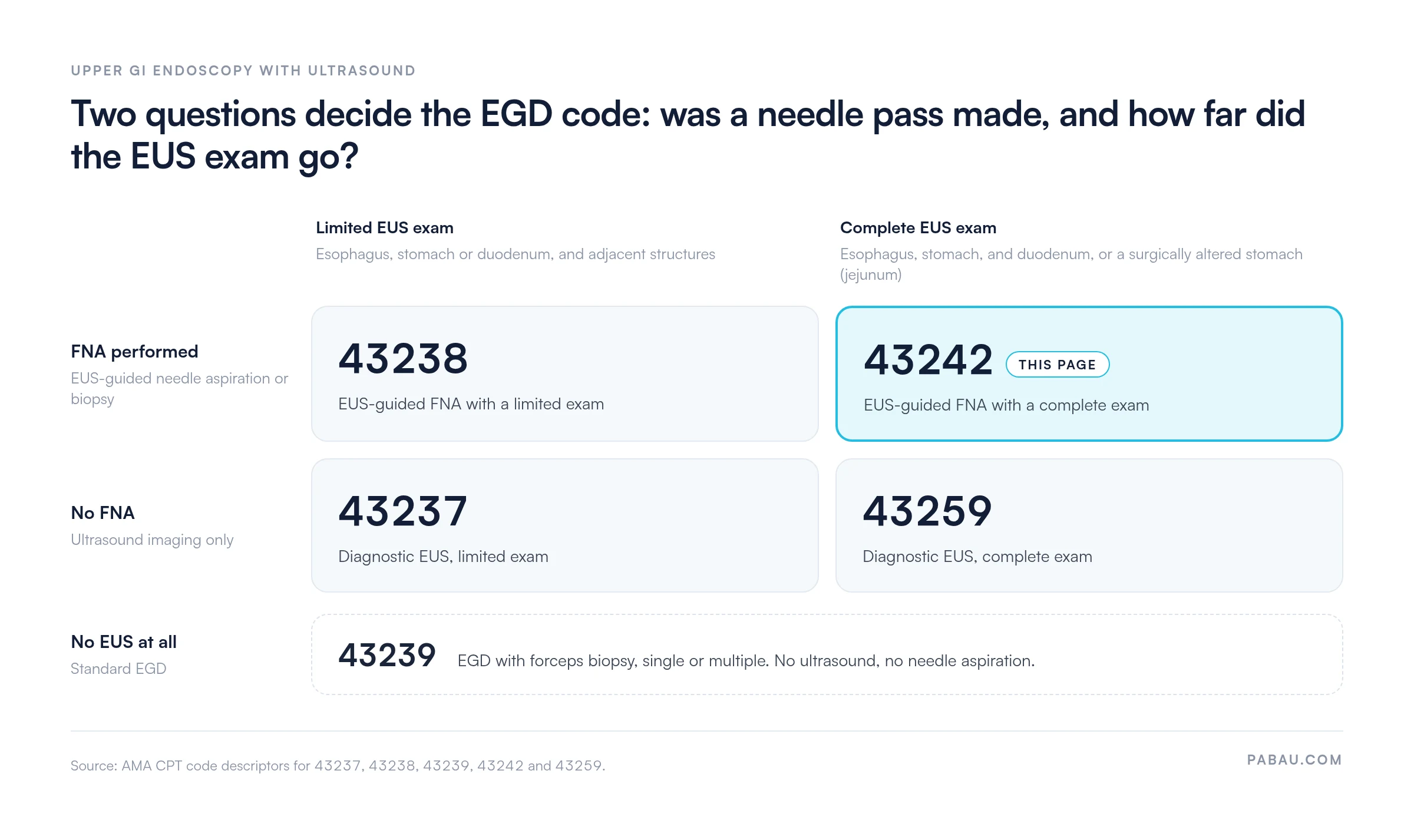
A common error looks like this. The endoscopist performs EUS imaging only, with no needle pass, and the claim still goes out as 43242. Without FNA, the code is 43237 if the EUS exam was limited. It is 43259 if the full esophagus, stomach, and duodenum exam was done.
Forceps biopsy is the other trap. Code 43239 bundles into 43242 under NCCI edits. A forceps biopsy of a separate lesion in the same session may still be reported with modifier 59 when the note supports it.
Duct brushing and washing are a third route to tissue. Both are built into 43260, the diagnostic ERCP code, so neither is reported separately when the duct is sampled that way.
Prior authorization (PA) rules for 43242 vary by payer, plan, and region. Traditional Medicare does not require PA for 43242. Medicare Advantage (MA) plans increasingly do, and each plan sets its own criteria.
Skip PA on a plan that requires it and you can expect a non-covered service denial. A participating provider usually cannot bill the patient for that service without a signed Advance Beneficiary Notice (ABN) or the plan’s equivalent notice.
For commercial payers, the PA request for 43242 typically needs:
Medicaid programs vary by state. Some require PA for every EUS procedure, while others cover 43242 without it when medical necessity criteria are met. Verify with the specific plan before scheduling.
Most 43242 denials are preventable. Good denial management workflows start with logging every CARC denial code you receive against this code. Patterns then become visible. The table maps the most common denial reasons to their fixes.
CPT 43242 carries a zero-day (000) global surgical period under the Medicare Physician Fee Schedule, like other upper endoscopy codes. Check the current-year MPFS, because Medicare Advantage and commercial contracts can assign different periods.
A 000 global bundles no postoperative visits into the procedure payment. Here is how evaluation and management (E/M) visits work around it:
When a separate anesthesiologist or certified registered nurse anesthetist (CRNA) provides anesthesia for EUS-FNA, they bill it on their own claim. The endoscopist bills 43242.
Anesthesia providers usually report 00731 for EUS-FNA. Code 00813 applies only when a lower GI endoscopy is also done in the same session. Confirm the base code with the anesthesia group before submitting.
Moderate sedation works differently. The 2017 CPT changes removed it from endoscopy codes, so it is no longer bundled into 43242. When the endoscopist provides it, report 99152 for the first 15 minutes in patients age 5 or older. Add 99153 for each additional 15 minutes.
Flag 43242 cases that need MAC or general anesthesia at scheduling, not at claim submission. When the anesthesia billing team knows early, the 00731 claim can go out the same day as the endoscopy claim. That avoids the coordination-of-benefits delays that follow when anesthesia claims arrive weeks later.
Run through these points on every EUS-FNA claim before it leaves the practice:
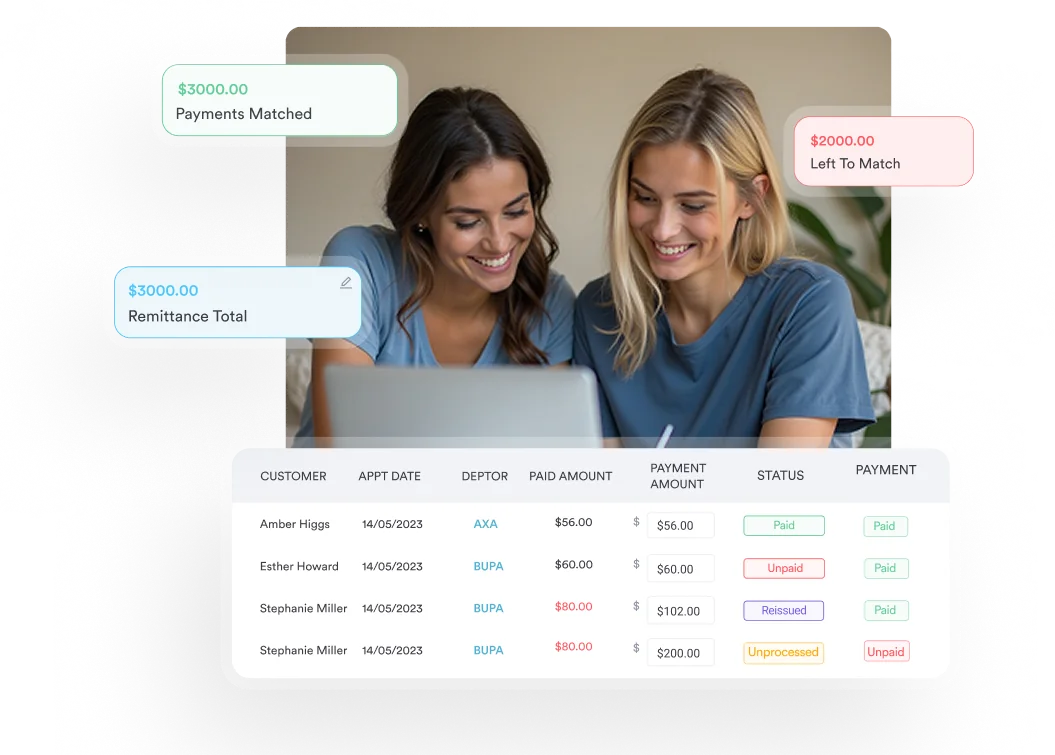
Many GI practices still key each 43242 claim into a clearinghouse portal by hand. The remittance then lands somewhere else, and someone matches payments to claims in a spreadsheet.
Pabau, the practice management platform we build, keeps that loop in one system. For cleaner claims management, it pre-fills the CMS-1500 from the patient record. It also checks required fields, such as member ID and authorization number, before the claim can be sent.
In the US, claims go out electronically through the Claim.MD integration. Eligibility checks, claim status, and electronic remittance advice (ERA) come back into Pabau. Code choice and modifiers stay with your coders, so the checklist above still applies.

Pabau pre-fills each claim from the patient record, checks required fields, and submits it through Claim.MD. Remittances and claim status come back to the same system, so denied EUS-FNA claims surface quickly.

Get the code choice right before the claim exists. For 43242, the procedure note has to state the needle pass and the full extent of the EUS exam, in words a payer can find.
Build both into a note template the endoscopist completes before leaving the room. Your coder can then choose between 43242, 43238, 43259, and 43237 from the note, not from memory. Fewer claims come back for correction, and the 2026 payment has a better chance of landing on the first pass.
The trade-off is a slightly longer note, and that minute costs far less than a resubmission. Book a demo to see how Pabau sends procedure claims and brings the remittances back into one system.

Need to understand how claim errors get tracked and resolved? Electronic remittance advice explains how ERA files carry CARC and RARC denial reason codes back to your billing team after each claim adjudication.
Submitting claims through a clearinghouse for the first time? Medical claims clearinghouse covers how clearinghouses validate, translate, and route 837P files to payers, and what to look for when choosing one.
Want to reduce the time between procedure and payment? Revenue cycle management outlines the end-to-end workflow from eligibility verification through final payment posting for procedure-based specialties.
Chasing approvals before an EUS-FNA? Prior authorization process walks through each step from request to approval, and what payers expect at each stage.
Yes. The descriptor covers fine needle aspiration or biopsy, so 43242 applies to FNA needles and core biopsy (FNB) needles alike. The needle type changes the note, not the code. Record the needle type and gauge so the specimen matches the claim.
CPT 43242 requires an EUS exam of the upper GI tract plus FNA tissue sampling. CPT 43239 is EGD with biopsy, single or multiple, with no EUS. CPT 43259 is a complete upper GI EUS exam without FNA. If FNA was not done, use 43259 for a full exam or 43237 for a limited exam.
Report one unit per session. The descriptor already covers multiple needle passes and more than one sampled site, so extra passes or lesions do not add units. Document each lesion sampled so the single unit is fully supported.
The pathologist bills the specimen work on a separate claim. An on-site adequacy check (ROSE) is usually reported with 88172, plus 88177 for each additional evaluation episode. The final cytopathology interpretation and report is 88173. None of these are part of the endoscopist’s 43242 claim.



