



HCPCS code E0198: Water pressure pad billing guide
HCPCS code E0198 is a water pad for a standard mattress HCPCS code E0198 is the ...

Last Updated: Oct 13, 2026

CPT code 99152 covers moderate sedation administered by the same physician performing the procedure, for patients aged 5 or older. It pays for the initial 15 minutes of intraservice time.
Age determines code selection: use 99151 for patients under age 5, 99152 for patients aged 5 and older. Getting this wrong is one of the most common audit triggers.
Documentation must capture the pre-sedation assessment, drug name and dose, intraservice start and stop times, and the patient’s response. Missing any element risks a denial.
Cardiac catheterization is not a bundled procedure for sedation. Since the 2017 CPT update, 99151, 99152 and 99153 are separately reportable alongside it.
Practice management software like Pabau submits 99152 claims through the Claim.MD clearinghouse and tracks their status, so denials surface early.
CPT code 99152 describes moderate (conscious) sedation provided by the same physician who performs the diagnostic or therapeutic procedure. It applies to patients aged 5 years or older, and it covers the initial 15 minutes of intraservice time.
The American Medical Association (AMA) publishes and maintains the CPT code set. It defines moderate sedation as a drug-induced depression of consciousness in which the patient still responds purposefully to verbal commands. That response may come alone or with light tactile stimulation, and both the protective reflexes and the airway stay intact.
This reference covers the AMA descriptor, the age and provider rules that decide which code applies, and how to calculate intraservice time. It also covers what belongs in the record, 2026 Medicare rates, bundled procedures, and the errors that draw audits.
Age is the single deciding variable between 99151 and 99152. Both codes apply when the same physician who performs the procedure also administers the sedation. The cut-off is the patient’s age on the day of the procedure.
A 4-year-old patient requires 99151. A 5-year-old requires 99152. Billing 99152 for a patient who is not yet 5 is a coding error that surfaces on audit. Confirm the date of birth before you pick the code, rather than inferring it from the appointment record.
CPT code 99152 sits in a family of moderate sedation codes covering different age groups, provider arrangements, and time increments. Mixing up the same-physician codes (99151-99153) with the separate-provider codes (99155-99157) is a frequent audit finding. Two questions settle it, and the grid below shows what each answer produces.
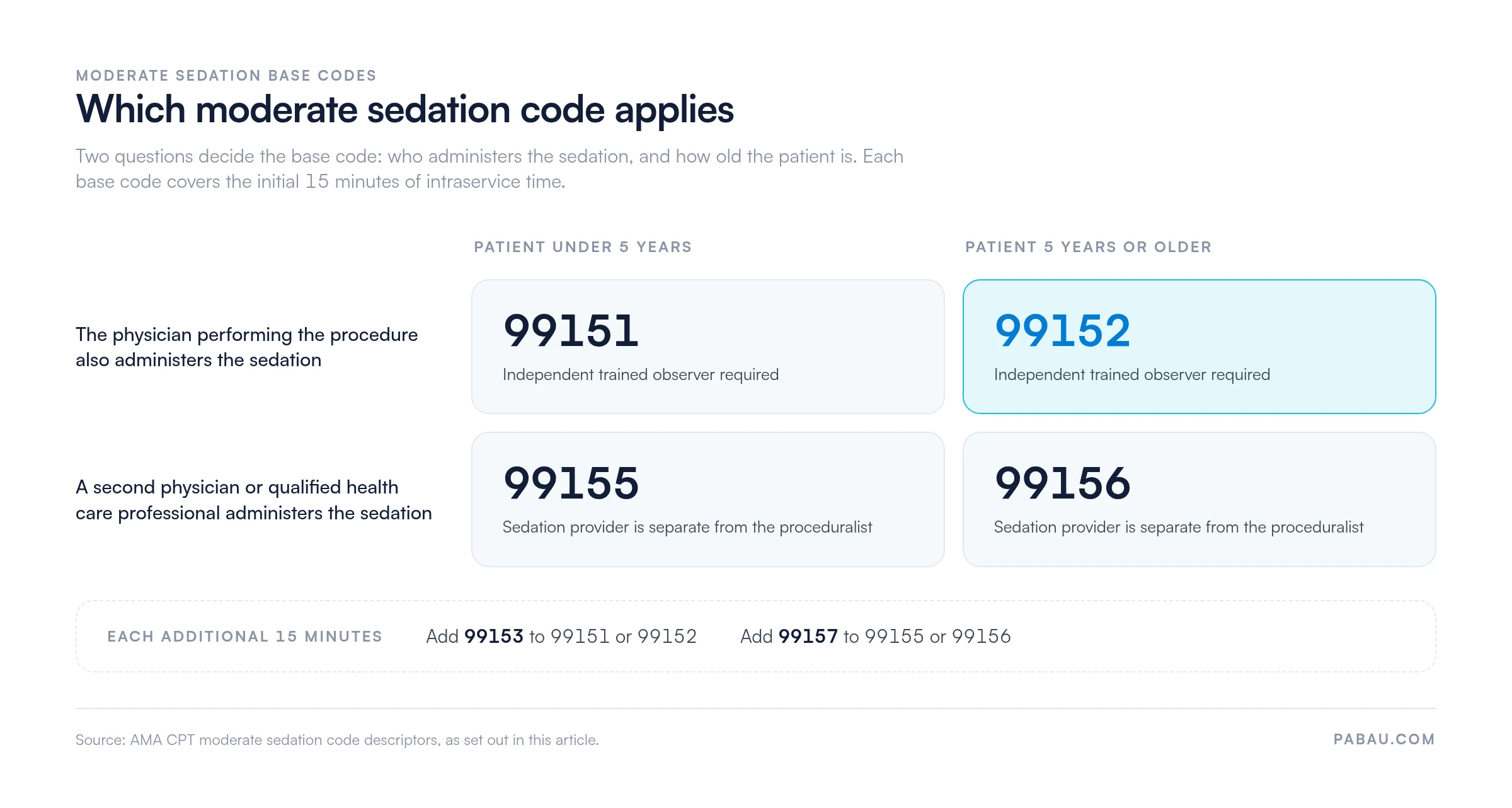
The distinction in that column is easy to blur. Codes 99151 and 99152 need an independent trained observer, who monitors the patient but does not administer the drug. Codes 99155 to 99157 need a second physician or qualified health care professional who administers the sedation, separate from the physician doing the procedure.
When moderate sedation runs beyond the initial 15 minutes, report 99153 for each additional 15-minute increment. Report it once for 16-30 minutes beyond the base, twice for 31-45 minutes, and so on. A few rules apply:
Intraservice time starts when the sedating drug is administered. It ends when the physician stops providing continuous, in-person monitoring. The AMA definition is that precise, and most time-related audit findings come from drifting away from it.
The medical record must carry a start time and an end time precise enough to support each unit billed. Rounding intraservice time up to the nearest 15-minute block without documented evidence is an audit red flag.
A claim for 99152 with 99153 appended needs evidence of at least 23 minutes. That is the initial 15 minutes plus the 8-minute threshold for the extra unit.
Documentation is what separates a defensible 99152 claim from an overpayment recovery. Payers scrutinize sedation codes closely, and Medicare more than most. Every element below belongs in the medical record before the claim goes out.
A superbill that captures these elements in a structured format cuts charting time and stops a required element going missing at claim time. Any single omission can turn a legitimate claim into an unsubstantiated one on audit.
Review your documentation template for 99152 before your next moderate sedation case. Confirm it captures start time, stop time, observer identity, serial vital signs, and consciousness level at intervals. A five-minute template check prevents a denial that takes hours to appeal.
Medicare reimbursement for 99152 comes from the Medicare Physician Fee Schedule (MPFS), which the Centers for Medicare and Medicaid Services (CMS) updates every year.
The figures below are 2026 national averages. Actual payment varies by locality through the CMS geographic practice cost index (GPCI) adjustments. Check the fee schedule lookup for your own locality before you bill.
The RVU breakdown for 99152 covers work RVUs, practice expense RVUs, and malpractice RVUs. Practice expense is the component that moves between the facility and non-facility rates, which is why the two figures differ so much. The CMS lookup returns the current value of each component by code.
Commercial payer rates vary considerably. Many large insurers pay above Medicare rates for moderate sedation. Some managed care plans apply bundling edits that go beyond the CMS Correct Coding Initiative (CCI). Check each payer’s contract and local coverage determination (LCD) before you assume Medicare rates apply.
Not every procedure that uses moderate sedation earns a separate 99152 charge. CCI edits fold sedation into the payment for certain procedures, so the global payment already includes it.
Billing 99152 alongside one of those procedures produces a CCI edit denial, which comes back with its own reason code. Our guide to denial codes explains how to read one and what to do next.
Bundling edits change with each quarterly CCI update, so verify the current edits before you bill sedation separately. The categories where sedation is most often bundled are:
Cardiac catheterization is the exception worth knowing, because it is widely assumed to work the other way. The 2017 CPT update removed the sedation value from the interventional cardiology codes. That change is what makes 99151, 99152, and 99153 separately reportable alongside cardiac catheterization.
Bundling rules also vary by payer. A procedure that CMS allows you to bill with 99152 may be bundled under a commercial plan’s own policy. Before the first claim for any new procedure type, review the sedation bundling rules payer by payer.
Moderate sedation claims draw audit attention for a structural reason. The same-physician rule and the time-based units create several points where the record can fail to support the charge. The errors below turn up repeatedly in OIG work plan reviews and payer audits.
Check the AAPC CPT code reference against the CCI edit tables before you add a new procedure type to the billing workflow. That habit heads off the systematic errors that build into a pattern an auditor can spot.
Confirm payer-specific modifiers too, since some commercial plans want modifier 25 or 59 when sedation is billed with an evaluation code.
Time-based sedation billing has two manual failure points. One is capturing intraservice time as the procedure happens. The other is getting the claim submitted and followed up once it leaves the practice. Both are workflow problems rather than coding problems, and both are easier to solve in the system the practice already charts in.
Practice management software like Pabau handles the second half of that job. Pabau’s claims management software connects to the Claim.MD clearinghouse for US practices. A 99152 claim goes out electronically, and its status comes back into the same record. Electronic remittance advice lands there too, so a CCI edit rejection reaches your biller in days rather than weeks.
Structured documentation is the other lever, and it sits with your note template. When intraservice start and stop times are fields in that template, they get recorded during the procedure rather than reconstructed from memory afterward. The chart and the charge then agree, which is where most 99152 audit failures start.

Pabau’s claims management software submits your 99152 claims through Claim.MD, tracks the status of each one, and brings remittance advice back into the patient record. See how it fits your practice.

CPT code 99152 is simple in concept and unforgiving in execution. Age, provider identity, intraservice time, and bundling each carry their own audit exposure, and the record is what settles all four.
The practices that stay out of trouble here are rarely the ones with the sharpest coders. They are the ones whose sedation note already asks for the start time, the stop time, and the observer’s name. Fix the template once, and the coding question mostly answers itself on every case after that.
The trade-off worth remembering is that bundling rules move quarterly while your habits do not. Re-check the edits for any procedure you sedate for regularly. Book a demo to see how Pabau carries a 99152 claim from the sedation note through to the clearinghouse.

Need to understand how claims reach your payer? Medical claims clearinghouse explained covers how 837 files move from practice to payer and what happens when they do not.
Want fewer resubmissions? What is a clean claim in medical billing covers the fields payers check first, before a claim ever reaches an edit.
Troubleshooting a rejected file? What is an 837 file breaks down each segment, so you can find what the clearinghouse flagged.
Want to reduce insurance denials systematically? Getting credentialed with insurance companies walks through the enrollment steps that affect which payers accept your claims.
CPT code 99152 reports moderate (conscious) sedation provided by the same physician performing the diagnostic or therapeutic procedure. It applies to patients aged 5 years or older and covers the initial 15 minutes of intraservice time. An independent trained observer must be present throughout the sedation period.
The difference is patient age. CPT 99151 applies when the patient is under 5 years old, and 99152 applies at age 5 or older. Both require the same physician to perform the procedure and administer the sedation. Both use 99153 as the add-on code for additional time.
Intraservice time begins when the sedating agent is administered. It ends when the physician stops providing continuous face-to-face monitoring. Pre-sedation assessment, consent discussions, and post-procedure documentation do not count. The medical record must carry precise start and stop times to support each unit billed.
Yes. When moderate sedation runs beyond the initial 15-minute period, 99153 is appended to 99152 for each additional 15-minute increment. One unit of 99153 needs at least 8 additional minutes beyond the base period. Each additional unit needs its own documented time entry.
Moderate sedation and conscious sedation describe the same clinical service. The CPT code set previously used the term “conscious sedation” and moved to “moderate sedation” to match the American Society of Anesthesiologists (ASA) continuum. The two terms are interchangeable for coding purposes, and 99152 covers both.
CCI edits bundle sedation into many gastrointestinal endoscopy procedures in facility settings and into certain interventional radiology codes. Cardiac catheterization is not one of them, because the 2017 CPT update removed the sedation value from the interventional cardiology codes. The list changes with quarterly CCI updates, so check the current edits before billing 99152 separately.



