HCPCS code C1731: Catheter billing, OPPS reimbursement, and denial guide
HCPCS code C1731: Official descriptor and code series context HCPCS code C1731 i...

Last Updated: Oct 8, 2026
A4619 is the HCPCS Level II code for a face tent. This open-sided interface delivers oxygen or humidified aerosol without sealing over the nose and mouth.
How Medicare pays depends on the equipment it is used with. With rented oxygen equipment, the face tent is included in the rental allowance and is not paid separately. With oxygen equipment the patient owns, it is denied as non-covered. With an E0565 or E0572 aerosol compressor, it has its own coverage path under the nebulizer policy.
Let Pabau's smart automation suggest the right codes, reduce claim denials, and keep your practice compliant—effortlessly.
Automate repetitive tasks and focus on what matters most—your patients.
Reduce coding errors and ensure compliance with the latest regulations.
Clean claims, fewer denials, and faster reimbursements.
Powerful insights and reporting to help your practice thrive.
HIPAA compliant SOC 2 certified GDPR-compliant Trusted by 4,000+ clinics worldwide

HCPCS code A4619 is the face tent, an open-sided interface used to deliver oxygen or humidified aerosol.
Used with rented oxygen equipment, the face tent is included in the oxygen rental allowance and is not paid as a separate line.
Face tents used with oxygen equipment the beneficiary owns are denied as non-covered under CMS policy article A52514.
The nebulizer policy (A52466) gives A4619 its own coverage path alongside the E0565 and E0572 aerosol compressors.
Check which equipment the face tent runs on before you bill, because that one fact decides whether A4619 is payable.
HCPCS code A4619 is the CMS-maintained Level II supply code for the face tent, a respiratory accessory used with oxygen or aerosol equipment. The code sits within the HCPCS A-code range, which covers medical and surgical supplies.
Whether Medicare pays for it depends on the equipment it runs with. Rented oxygen absorbs it into the rental, owned oxygen gets it denied, and an E0565 or E0572 compressor gives it its own line.
The table below is the quick-reference summary billers typically need before building a claim.
The face tent is an open, cup-shaped mask that fits loosely under the chin. Unlike a standard mask, it does not seal around the nose and mouth. That makes it suitable for patients who find a sealed mask claustrophobic. It also suits patients whose facial wounds, burns, or oral surgery sites rule out a tight-fitting interface.
The descriptor is simply “face tent.” That brevity causes misuse in two directions. Some billers use A4619 for a different interface. Others bill it as a separate line when Medicare has already paid for it inside an oxygen rental.
The device, not the therapy, decides between A4619 and A7015. A7015 is the aerosol mask used with a DME nebulizer, while A4619 is the open face tent. A face tent stays A4619 whether it carries oxygen or aerosol, so match the code to the interface on the delivery ticket.
Understanding the clinical application helps billers pair the correct diagnosis codes and write documentation that survives a medical necessity review.
Face tents are most commonly used in four clinical scenarios:
For oxygen delivery, flow rates typically sit between 8 and 15 liters per minute. Oxygen concentration varies and is lower than a non-rebreather mask at equivalent flow. Clinicians adjust flow based on pulse oximetry targets, and that detail belongs in the order and progress notes.
Face tents also deliver humidified aerosol from a large-volume nebulizer driven by an aerosol compressor. This is the setup the nebulizer policy covers for conditions such as cystic fibrosis, bronchiectasis, and tracheostomy status.
Medicare treats A4619 under one of two policies, and the equipment the face tent connects to decides which. The diagram below maps the three outcomes that follow.
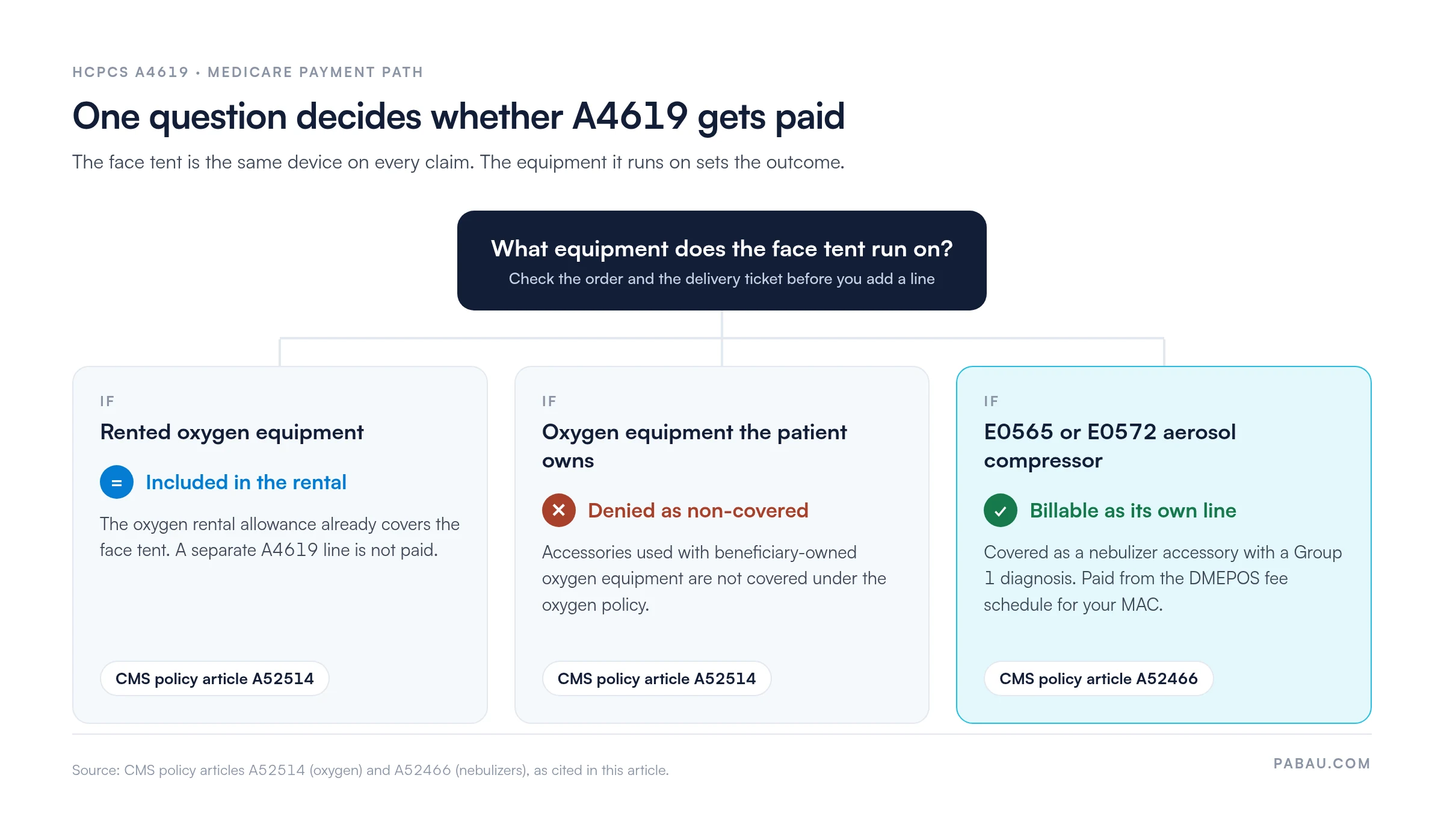
Oxygen use: Bundled into the rental. Under CMS policy article A52514, oxygen accessories are included in the allowance for rented oxygen equipment. The face tent appears in that list by name, alongside cannulas, tubing, and masks. The monthly oxygen rental payment already covers it, so a separate A4619 line for that patient is not paid.
The same article says the supplier must provide any accessory the treating practitioner orders. Accessories used with beneficiary-owned oxygen equipment are denied as non-covered. A face tent for a patient who owns their oxygen system is therefore not billable to Medicare under the oxygen policy.
Aerosol use: A coverage path of its own. CMS policy article A52466, the nebulizer policy, lists A4619 with the aerosol compressors E0565 and E0572. That group carries its own covered ICD-10 codes, including cystic fibrosis, bronchiectasis, and tracheostomy status.
When the face tent is used with a covered compressor and a listed diagnosis applies, it is billed as a nebulizer accessory.
For that aerosol path, allowed amounts come from the CMS DMEPOS fee schedule and vary by MAC jurisdiction. Pull the current-year figures for your region before quoting an amount. There is no separate amount to quote on the oxygen path, because the rental allowance absorbs it.
Supporting a clean A4619 claim also requires a solid claims management workflow. It should capture the order, the equipment in use, the diagnosis code, and the delivery record before submission.
A4619 documentation has to show which coverage path the face tent sits on, then meet that path’s rules. Standard billing documentation for a face tent should include the following:
The superbill documentation for a DME supply claim differs from a physician office visit superbill. On the aerosol path, the face tent appears as a line item with A4619, the correct quantity, and a service date matching the delivery date. A mismatch between those two dates is a common trigger for pre-payment review.
Before an A4619 line goes out, ask one question first: What equipment does this face tent run on? Rented oxygen means the tent is already paid for inside the rental. Owned oxygen means Medicare will deny it. Only an aerosol compressor with a Group 1 diagnosis gives you a separately billable line, so check that pairing before the order and delivery dates.
Diagnosis codes decide A4619 payment on the aerosol path. On the oxygen path, the diagnosis supports the oxygen rental claim instead, because the face tent has no separately paid line. The table below shows a selection of the Group 1 codes A52466 lists for A4619, E0565, and E0572.
A listed code is not enough on its own, because the LCD’s other coverage criteria still apply. Diagnosis codes also update every October 1. Verify pairing codes against the current version of A52466 before submitting.
Medicare’s prior authorization (PA) requirement for DMEPOS items is determined by the PA expansion program, which CMS updates periodically. As of current CMS guidance, A4619 face tents are generally low-cost supply items not subject to mandatory PA under Medicare. However, commercial payers and state Medicaid plans vary significantly.
Maintaining thorough billing compliance requirements documentation before delivery protects you when a payer requests retrospective justification. If a PA is required and was not obtained, the claim will be denied and the supplier cannot bill the patient for a Medicare-covered item.
Four HCPCS codes sit close enough to A4619 that miscoding is routine. The table below shows the key distinguishing factor for each, which is the detail a payer’s edit system checks.
Use the AAPC HCPCS code lookup to compare descriptor language side by side when selecting between these codes. A few words in the descriptor are often the only distinction payers apply. On the oxygen side, A4620 follows the same rental bundling rule as the face tent.
A4619 denials cluster around seven issues, and the first two come straight from the oxygen policy. Payers report each one on the remittance with standard denial codes, and the table below maps each cause to its fix. Structured denial management strategies catch them at billing rather than after denial.
Submitting a clean claim for A4619 means clearing each of these triggers before the claim leaves your billing system. Start with equipment and ownership, because no documentation fixes a bundled or non-covered line.
Build an A4619 checklist in your billing system with five fields: Equipment type, equipment ownership, order date, diagnosis code, and signed delivery receipt. Add a biller sign-off next to each one. A claim that cannot clear the first two fields should not reach submission as a separate A4619 line.
The face tent is one of the few respiratory accessories that appears in both the oxygen and the nebulizer policies. Each policy treats it differently, so the pairing on the claim decides payment. Here is how the rules apply in practice:
When a patient uses both oxygen and aerosol therapy, record which device each face tent serves. That note is what tells a reviewer whether the line is bundled or separately covered.
Most A4619 errors start before the claim is built. The biller often cannot see whether the face tent runs on rented oxygen, owned oxygen, or an aerosol compressor. Without that detail, bundled supplies go out as separate lines and claims for patient-owned equipment come back denied.
Pabau keeps the order, the equipment record, the diagnosis, and the signed delivery receipt in one patient file. Its claims tools track HCPCS codes and flag incomplete records before submission. Billers can see the coverage path at a glance instead of chasing the clinical team for it.
The result is fewer separate lines for bundled supplies and fewer denials that trace back to missing equipment details.

Pabau helps DMEPOS suppliers and clinical practices track HCPCS codes, manage documentation, and submit clean claims without manual chasing. See how it handles your DME workflow.

A4619 looks like a simple supply code, yet its payment depends entirely on the equipment behind it. With rented oxygen, the face tent is already paid for. With owned oxygen, Medicare will not pay for it at all. With an aerosol compressor and a qualifying diagnosis, it is a billable nebulizer accessory.
Make equipment and ownership the first fields your team checks, and most A4619 denials disappear before they start. To see how Pabau can build that check into your billing workflow, book a demo.

Need to understand how denials are classified and appealed? Denial management in healthcare breaks down CARC codes, appeal timelines, and how to build a denial prevention workflow.
Want a structured framework for submitting error-free claims? Clean claim submission guide covers every field payers check before adjudicating a DMEPOS or physician claim.
Looking for compliance guidance on billing documentation? Medical billing compliance outlines the documentation standards that protect suppliers during MAC audits.
HCPCS code A4619 covers the face tent, an open-sided interface used when a sealed mask is clinically inappropriate. It can deliver oxygen or humidified aerosol. It does not cover nasal cannulas, aerosol nebulizer masks (A7015), or the oxygen and compressor equipment itself, which carry separate HCPCS codes.
No. A face tent (A4619) and a standard oxygen mask are distinct devices with distinct billing codes. A variable concentration mask bills under A4620, and an aerosol mask used with a DME nebulizer bills under A7015. Using the wrong code results in a denial, even when the clinical documentation is otherwise complete.
It depends on the equipment. With rented oxygen equipment, the face tent is included in the oxygen rental allowance under CMS policy article A52514, so it is not paid separately. With beneficiary-owned oxygen equipment, it is denied as non-covered. With an E0565 or E0572 aerosol compressor and a Group 1 diagnosis from A52466, it is covered as a nebulizer accessory.
Start with a signed order that names the face tent and the equipment it is used with. On the oxygen path, the documentation supports the oxygen rental claim, which already includes the face tent. On the aerosol path, add a Group 1 diagnosis from A52466 and a note on why a face tent was chosen. Every claim also needs a signed proof of delivery.
The most common causes are billing A4619 separately when it is bundled into an oxygen rental, and billing it for beneficiary-owned oxygen equipment. Other causes include a diagnosis outside the A52466 Group 1 list, a missing or late order, and lapsed supplier enrollment. Quantity limits and wrong interface codes cause the rest.
Under traditional Medicare Part B, A4619 face tents are generally not subject to mandatory prior authorization. However, Medicare Advantage plans, commercial insurers, and state Medicaid programs each set their own PA requirements. Always verify with the specific payer before supplying the device, because delivering without a required PA results in a denial.
Yes, in the right pairing. CMS policy article A52466 lists A4619 with the E0565 and E0572 aerosol compressors and gives them a shared list of covered diagnoses. If A4619 and the A7015 aerosol mask appear on the same date, document why the patient needed both interfaces.