CCSD Code S5322: Injection of therapeutic substance into keloid scar
CCSD Code S5322: definition and clinical description CCSD Code S5322 is the proc...

Last Updated: Nov 13, 2026
Billable Code Specific Code
36522 is the CPT code for photopheresis, extracorporeal. It reports one complete extracorporeal photopheresis (ECP) session. The patient's white blood cells are collected, treated with methoxsalen, exposed to UVA light and reinfused.
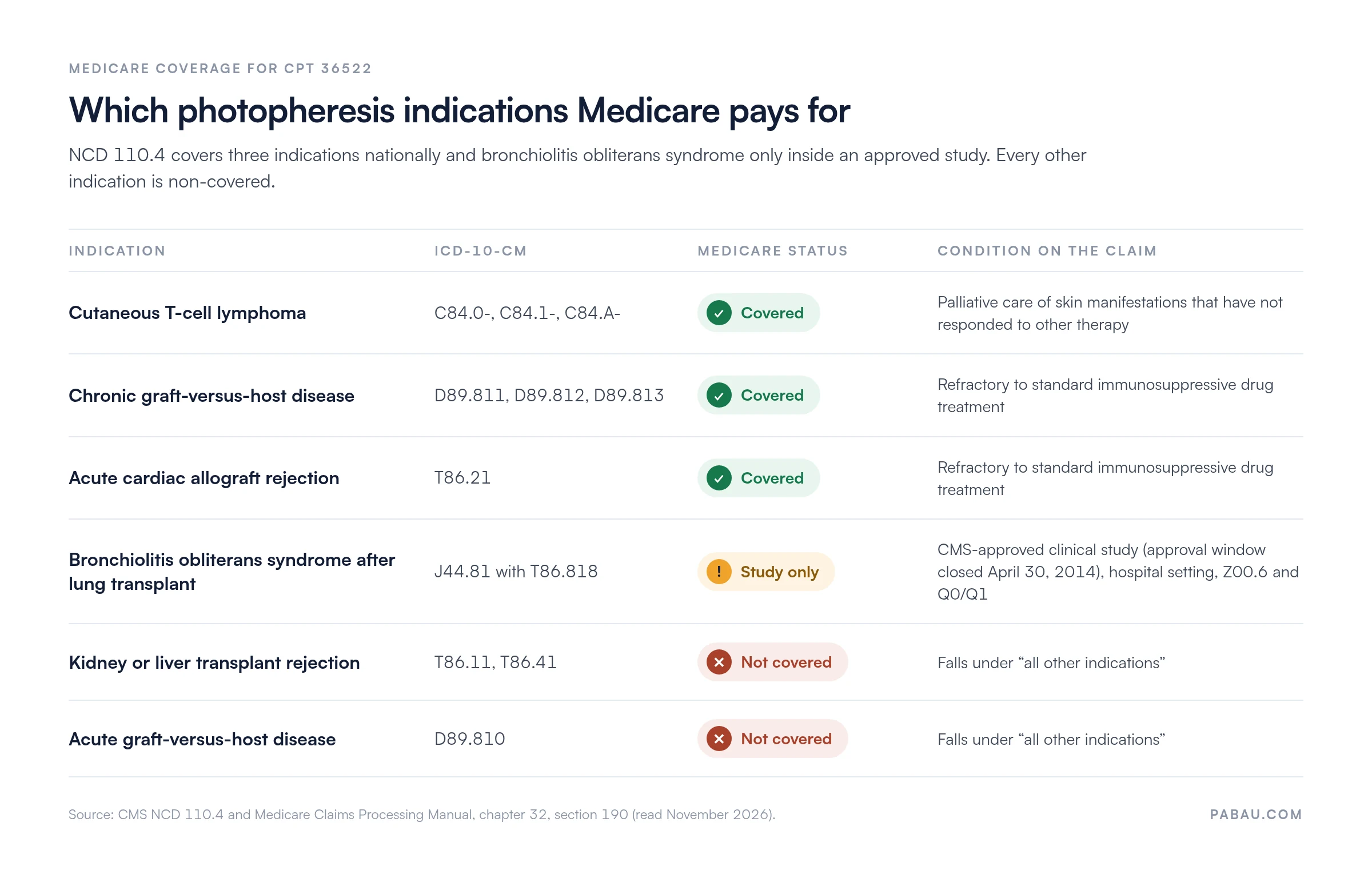
Medicare covers ECP under NCD 110.4 for cutaneous T-cell lymphoma, refractory chronic graft-versus-host disease and refractory acute cardiac allograft rejection. Bronchiolitis obliterans syndrome after lung transplant is covered only within a CMS-approved clinical study.
Let Pabau's smart automation suggest the right codes, reduce claim denials, and keep your practice compliant—effortlessly.
Automate repetitive tasks and focus on what matters most—your patients.
Reduce coding errors and ensure compliance with the latest regulations.
Clean claims, fewer denials, and faster reimbursements.
Powerful insights and reporting to help your practice thrive.
HIPAA compliant SOC 2 certified GDPR-compliant Trusted by 4,000+ clinics worldwide

CPT code 36522 reports one complete extracorporeal photopheresis (ECP) session, covering leukapheresis, photoactivation and reinfusion.
Methoxsalen (UVADEX) is reported separately under a HCPCS drug code and is not bundled into 36522.
Medicare NCD 110.4 covers ECP for cutaneous T-cell lymphoma, refractory chronic GvHD and refractory acute cardiac allograft rejection.
Bronchiolitis obliterans syndrome after lung transplant is covered only inside a CMS-approved clinical study, and every other indication is non-covered.
Most commercial payers require prior authorization for 36522, so a missing or expired authorization is an avoidable denial.
CPT code 36522 describes a single session of extracorporeal photopheresis performed as a complete service. CMS names “36522 – Photopheresis, extracorporeal” as the code for billing ECP in the Medicare Claims Processing Manual. One session covers leukapheresis, photoactivation of the collected cells with psoralen, and reinfusion of the treated leukocytes.
ECP runs on specialized apheresis equipment, with a qualified operator and a treating physician. Each of those elements must be documented for the claim to hold up under payer review.
The bundle decides what sits on the 36522 claim line and what needs a line of its own.
Folding the drug into 36522 without a separate J-code is a common ECP billing error. It understates the claim and leaves the drug unpaid.
Documentation drives medical necessity. When payers audit a CPT code 36522 claim, they look for five core elements.
A complete superbill documentation record for ECP should contain all five elements. Missing any single element gives a payer a defensible reason to deny the claim as “insufficient documentation of medical necessity.”
Attach the ECP machine’s automated session printout to every encounter note. It captures UVA dose, irradiation duration, and cell volume in a standardized format that satisfies most payer audit requests without additional narrative. Practices using Pabau, the practice management platform we build, can upload the printout to the patient record before the claim goes out.
Every CPT code 36522 claim must include at least one ICD-10-CM diagnosis code that establishes medical necessity. Payers cross-reference the diagnosis against their coverage policy before adjudicating the claim. Full descriptors for each code below are in our ICD-10-CM code library.
NCD 110.4 names what is covered, and every other indication is non-covered. For the cardiac indication, our T86.21 page explains how heart transplant rejection is coded. Commercial payers keep their own lists, so check the policy before treating a Medicare non-covered indication as unpayable.
Medicare coverage for CPT code 36522 is governed by National Coverage Determination 110.4, last revised through CMS decision memo CAG-00324R2. The NCD sorts indications into three tiers.
A BOS claim also has to carry its clinical study details. CMS returns it as unprocessable without diagnosis code Z00.6, the Q0 or Q1 modifier and the trial number. Institutional claims also need condition code 30. Set side by side, the three tiers leave little room for interpretation.
The CMS Physician Fee Schedule search tool allows you to look up the current payment rate for 36522 by Medicare Administrative Contractor locality. Facility and non-facility rates differ significantly, so verify the correct setting before submitting.
When Medicare coverage for a session is uncertain, give the patient an Advance Beneficiary Notice (ABN) before treatment and keep the signed copy. Insurance eligibility verification before the first ECP session confirms what the patient’s plan will pay before care starts.
Most commercial payers require prior authorization for CPT code 36522. The authorization process varies by payer, but several elements appear consistently across major carrier policies.
Payer medical policies are not uniform. Aetna, Cigna, UnitedHealthcare, and regional BCBS plans each maintain separate photopheresis coverage policies with different criteria. Always pull the current policy directly from the payer’s provider portal before submitting a PA request. Meeting medical billing compliance standards means documenting every PA request, approval number, and expiry date in the patient record.
Extracorporeal photopheresis sits within the therapeutic apheresis code range (36511-36522). Selecting the wrong code is an audit risk and a denial trigger.
36522 and 36511 are frequently confused because both involve separating leukocytes. The difference is what happens to the cells. 36511 collects and discards white blood cells (leukapheresis for therapeutic reduction), while 36522 collects, photoactivates, and returns them. They describe entirely different procedures with different equipment and clinical goals. Billing 36511 instead of 36522 for an ECP session will result in underpayment and may trigger a documentation request.
ECP claims fail for predictable reasons, and each denial pattern maps to a specific fix before resubmission. Structured denial management workflows route every denial to its fix, so a resubmission goes out corrected the first time.
Modifier selection and companion code accuracy are OIG audit triggers for apheresis claims. Apply them consistently and document the basis for each.
UVADEX (methoxsalen for extracorporeal use) does not have its own permanent HCPCS J-code as of the current code year. Bill it under J9999 (not otherwise classified, antineoplastic drugs) and attach the invoice price, drug name, NDC, and dose administered. Some MACs require a drug invoice on file. Confirm the current J-code assignment with your MAC’s Local Coverage Article before billing, as CMS periodically assigns specific J-codes for previously unclassified drugs.
CPT code 36522 reimbursement varies by payer, place of service, and geographic locality. Here are the key reference points for benchmarking.
UVADEX (billed separately via J9999) adds significant cost to the per-session charge. Drug invoice pricing and MAC-allowed amounts for J9999 vary. Always verify the allowed amount with the payer before assuming full reimbursement of the drug cost.
Commercial payer rates for 36522 are contract-specific. Many commercial payers reimburse at a multiplier of the Medicare PFS rate (commonly 110-150% for hospital outpatient, lower for physician office settings). Reference your payer contract fee schedule for the contracted rate. If 36522 is not separately listed in the contract, escalate to the payer’s provider relations team to establish an agreed rate before delivering the service.
Verifying the contracted rate before each course of ECP treatment prevents surprise write-offs. Clean claim submission for high-cost apheresis services requires confirming both the authorization and the expected allowed amount before the first session. Use the AAPC CPT code lookup to cross-check the descriptor and work RVU against your fee schedule build.
Run a quarterly reconciliation of 36522 claims against the fee schedule to catch payment shortfalls early. Payers occasionally downcode ECP to a lower-value apheresis code (36511 or 36516) on the remittance. If the allowed amount appears lower than expected, pull the ERA and compare the paid code to the submitted code. Pabau’s electronic remittance advice integration surfaces these discrepancies automatically at the claim level.
A course of ECP commonly runs two sessions a week for 8 to 12 weeks, and every session is billed as its own claim. Tracked by hand, the authorization number, its expiry date and the sessions used sit in a spreadsheet beside the billing system. A missed expiry date then surfaces weeks later as a CO-15 denial.
In Pabau’s claims management software, the authorization code, dates and session count sit on the patient’s case, with a warning when one is missing. Claims go out through the Claim.MD clearinghouse, which connects to thousands of US payers.
Eligibility checks and ERA remittances come back to the same record. A session paid as 36511 instead of 36522 shows up when the remittance posts, not at the quarterly reconciliation.

Pabau keeps each prior authorization’s code, dates and session count on the patient’s case and sends claims through Claim.MD. Your ECP billing team sees a missing authorization before the payer does.

Most 36522 denials can be prevented before the first session. Check the indication against NCD 110.4, get the authorization, and put the methoxsalen on its own claim line. A BOS patient adds one more question, which is whether an approved study exists to bill under at all.
Medicare’s list is short and fixed, so the coverage answer is clear for every patient. Commercial policies change more often, which makes the authorization record the document to keep current across a course of sessions. Book a demo to see how Pabau tracks authorizations and claims for every ECP session in a course.

Need a clearinghouse that handles high-complexity claims? How the Claim.MD clearinghouse works explains claim routing to thousands of US payers, eligibility checks and ERA reconciliation.
Setting up authorization tracking for a course of ECP? The prior authorization process walks through each step from the request to the approval.
Reconciling a short-paid apheresis claim? Electronic remittance advice explained shows how to read an 835 line by line.
Trying to benchmark your denial rate against industry norms? Revenue cycle management fundamentals covers denial rate benchmarks and RCM metrics for specialty practices.
CPT code 36522 is the billing code for extracorporeal photopheresis, a therapeutic apheresis procedure. The patient’s leukocytes are separated, treated with psoralen, exposed to UVA light, and reinfused. One unit of 36522 is billed per complete ECP session. The psoralen drug must be billed separately via a HCPCS J-code.
Bill 1 unit of 36522 per complete ECP session. If two distinct ECP sessions occur on the same date of service, bill 2 units with modifier 76. Document the clinical necessity for same-day sessions. Do not bill fractional units or use 36522 for incomplete procedures.
Yes. Under NCD 110.4, Medicare covers CPT code 36522 for cutaneous T-cell lymphoma that has not responded to other therapy. It also covers chronic GvHD and acute cardiac allograft rejection that are refractory to standard immunosuppressive drugs. Bronchiolitis obliterans syndrome after lung transplant is covered only within a CMS-approved clinical study. Every other indication, including acute GvHD and kidney or liver transplant rejection, is non-covered.
Modifier 59 applies when a distinct procedural service is performed on the same date as 36522. Modifier 25 applies when a separately identifiable E/M visit is documented on the same DOS. Modifier 76 applies if a second ECP session occurs on the same date. Modifier Q0 or Q1 applies when ECP is delivered in an approved clinical study, which Medicare requires for BOS.
Methoxsalen (UVADEX) for extracorporeal use does not have a dedicated permanent HCPCS J-code and is currently billed under J9999 (not otherwise classified, antineoplastic drugs). Attach the drug invoice, NDC, dose, and drug name to the claim. Verify the current J-code assignment with your MAC’s Local Coverage Article annually, as CMS may assign a specific code.
Yes, prior authorization is required by most commercial payers for CPT code 36522. Medicare does not require prior authorization for the indications NCD 110.4 covers. A Medicare BOS claim must instead carry the approved study’s details. Always check the specific payer’s current PA requirements before scheduling the first ECP session.