ICD-10 Code Y76.0: Diagnostic obstetric and gynecological devices
ICD-10 Code Y76.0: Definition and billable status ICD-10 Code Y76.0 is a valid, ...

Last Updated: Oct 23, 2026
Billable Code Specific Code
T86.21 is the billable ICD-10-CM code for heart transplant rejection. It applies when the attending physician documents rejection of the transplanted heart, whatever the rejection type or biopsy grade.
Z94.1 (heart transplant status) is not added to a T86.21 claim, because the complication code already identifies a heart transplant patient. Denials often start with a note that says "transplant complication" without naming rejection. Others confuse rejection with T86.22 failure, T86.23 infection or T86.290 vasculopathy.
Let Pabau's smart automation suggest the right codes, reduce claim denials, and keep your practice compliant—effortlessly.
Automate repetitive tasks and focus on what matters most—your patients.
Reduce coding errors and ensure compliance with the latest regulations.
Clean claims, fewer denials, and faster reimbursements.
Powerful insights and reporting to help your practice thrive.
HIPAA compliant SOC 2 certified GDPR-compliant Trusted by 4,000+ clinics worldwide

T86.21 is a billable ICD-10-CM code for heart transplant rejection, valid FY2016 through FY2027, under Chapter 19 block T80-T88.
Z94.1 (heart transplant status) is not reported with T86.21, because Guideline I.C.21.c.3 says the complication code already identifies a heart transplant patient.
T86.21 (rejection) and T86.22 (failure) each need the physician’s own statement. Coders cannot make that clinical call from test results.
Pabau, the practice management platform we build, submits claims through Claim.MD with eligibility checks, authorization cases and electronic remittance advice (ERA) tracking.
ICD-10 Code T86.21 is the designated billable diagnosis code for heart transplant rejection within the ICD-10-CM classification system. It is confirmed billable for FY2016 through FY2027 per the CMS ICD-10 coding and billing guidance.
The code sits within Chapter 19 (Injury, poisoning and certain other consequences of external causes). Its block is T80-T88 (Complications of surgical and medical care, not elsewhere classified). Its parent code is T86.2 (Complications of heart transplant), which is itself not billable. T86.21 is the correct code when the physician has documented rejection as the specific complication.
Heart transplant rejection occurs when the recipient’s immune system identifies donor heart tissue as foreign and mounts an attack against it. Three rejection types are recognized clinically, each with different timelines, mechanisms, and documentation implications for coders.
ICD-10-CM does not subdivide T86.21 by rejection type or ISHLT grade. The code captures all acute rejection episodes, regardless of grade or mechanism, as long as the physician has documented rejection as the clinical determination.
Endomyocardial biopsy (EMB) is the gold standard for confirming heart transplant rejection. Coders don’t interpret the diagnostic pathway themselves. They need to know it so they can tell what documentation the record must contain before T86.21 is assigned.
The ResDAC ICD coding guidance notes that diagnosis codes must be grounded in physician documentation, not test results alone. A biopsy showing ISHLT Grade 2R (moderate rejection) supports the code only with the physician’s note. That note must state that rejection is occurring and treatment is starting.
The diagnostic sequence coders typically see in the record:
Step 5 is where claims fail. A biopsy result in the record with no attending attestation is not sufficient. Clinical documentation integrity (CDI) specialists should query when the biopsy grade is elevated but the physician note reads only “transplant follow-up” or “graft dysfunction.”
Knowing where T86.21 sits helps coders pick the right sibling code when the note describes something other than rejection. Category T86 covers complications of all transplanted organs and tissue. Subcategory T86.2 narrows that to the transplanted heart, and T86.298 takes any named complication the other codes don’t cover.
T86.2 itself is never reported on a claim. Payers will reject any bill carrying the parent code without the child-level specificity that T86.20 through T86.298 provide. T86.20 is a last resort for a note that names no specific complication, so a query usually beats assigning it.
The T86.2 codes also carry a “use additional code” note for other transplant complications. Examples include graft-versus-host disease (D89.81-), post-transplant lymphoproliferative disorder (D47.Z1) and malignancy associated with a transplanted organ (C80.2).
T86.21 (rejection), T86.22 (failure), T86.23 (infection) and the T86.29- codes are told apart by the physician’s own statement. Coders must not make that clinical call themselves. The decision path below starts from the wording of the attending note.
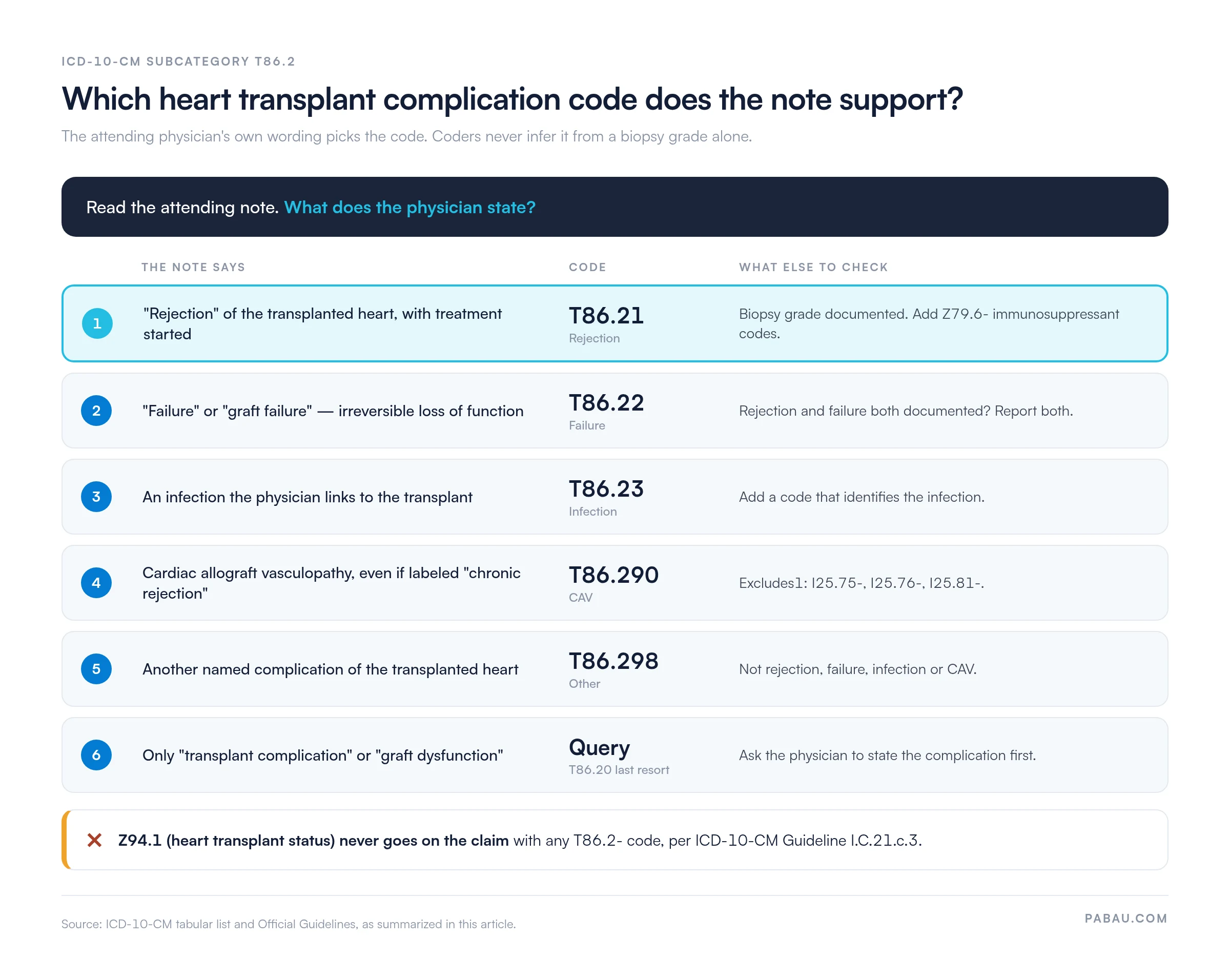
Work down the rows in order and stop at the first match. The table below adds the documentation each code needs and the note that should trigger a CDI query.
With T86.22, the deciding factor is irreversibility. Rejection implies the immune event is being treated and the graft may recover. Failure means the graft can no longer perform its function. If the physician documents both rejection and failure, both codes may be reported. Confirm sequencing against AHA Coding Clinic.
ICD-10-CM Official Guidelines Section I.C.21.c.3 says Z94.1 (heart transplant status) should not be used with a code from subcategory T86.2. The status code adds no information, because the complication code already shows the patient has a transplanted heart. The additional codes that do belong on a T86.21 claim describe other complications, drug therapy and drug effects.
When auditing a T86.21 claim, check that Z94.1 is not on it. Guideline I.C.21.c.3 treats the status code as redundant next to a T86.2- code, so remove it before the claim goes out. Then confirm the attending note states rejection in those words.
Sufficient documentation for T86.21 must come from the treating physician, not from pathology or nursing notes alone. CDI specialists and coders reviewing records for this code should look for the following elements.
CDI query language that works: “The biopsy performed on [date] showed [Grade]. Please clarify in the medical record whether heart transplant rejection is present and whether treatment is being initiated.” This avoids leading the physician toward a particular code while still generating the documentation coders need.
Medicare covers medically necessary treatment for heart transplant rejection under the same inpatient and outpatient rules that apply to post-transplant care generally. Commercial payers typically follow Medicare’s national coverage framework but add local coverage requirements. Verifying current payer-specific Local Coverage Determinations (LCDs) before claim submission reduces avoidable denials.
Prior authorization is commonly required for inpatient admissions triggered by a rejection episode. For readmissions within 30 days of a prior transplant-related discharge, some payers apply bundled payment policies that affect how T86.21 is reported. Submit T86.21 as the principal diagnosis for rejection-related inpatient stays, with any additional complication, drug-effect and immunosuppressant codes following. Z94.1 stays off the claim.
T86.21 denials follow a predictable pattern, and each cause below has a fix you can apply before submission. The denial codes on the remittance tell you which one hit. Structured denial management workflows show transplant programs which reason recurs most, so CDI work goes there first.
Cardiac allograft vasculopathy (CAV) is a chronic immune-mediated process that causes diffuse coronary artery narrowing in the transplanted heart. It is sometimes called “chronic rejection,” but it is not coded as T86.21.
CAV is a separate disease process from acute rejection episodes, and it has its own code, T86.290. T86.290 carries an Excludes1 note for atherosclerosis of the coronary arteries of a transplanted heart (I25.75-, I25.76-, I25.81-). Those codes are not reported alongside it.
Assigning T86.21 to a CAV encounter misrepresents the clinical picture and can trigger payer audit queries. T86.21 implies an acute immune event that needs active anti-rejection treatment, while CAV involves chronic vascular management.
When an acute rejection episode and CAV are both present in the same encounter, code each one. Use T86.21 for the acute rejection and T86.290 for CAV. Physician documentation must support both as concurrent conditions to assign both codes. Verify specific code assignment against current AHA Coding Clinic guidance, as coding practice for CAV continues to evolve.
Practices reviewing pre-2015 records or reconciling legacy claims encounter ICD-9-CM codes for transplant complications. The T86 category maps primarily from the ICD-9-CM 996 series (complications of transplanted organ). Per the AAPC ICD-10-CM coding reference, the general equivalence mapping (GEM) from CMS identifies the following approximate crosswalk.
The GEM is not a 1:1 crosswalk. ICD-9 code 996.83 mapped to the entire heart transplant complication category. ICD-10-CM requires specificity (rejection, failure, infection, CAV or other) that ICD-9 did not require. Always verify crosswalk assignments against official CMS GEM files rather than relying on system auto-conversion.
Run a periodic audit of your T86.21 claims for Z94.1. Any claim that carries it alongside a T86.2- code should have the status code removed, per Guideline I.C.21.c.3. Check the same claims for an attending note that states rejection in those words, and query any that do not.
Transplant billing teams usually find a T86.21 coding error after the denial arrives, by rereading the attending note against the code list line by line.
Pabau sends claims through Claim.MD, our US clearinghouse partner. That Claim.MD clearinghouse connection submits CMS-1500 claims to thousands of US payers, with eligibility checks before submission.
With Pabau’s claims management software, billing teams store each insurer authorization as a case, so the approval for a rejection admission sits with its claim. Each T86.21 claim is then tracked through to ERA receipt, while the attending note is still easy to query.

Pabau’s claims management platform connects to thousands of US payers through Claim.MD and tracks every T86.21 claim through to electronic remittance. Coding teams spend less time chasing claims and more time on documentation quality.

Heart transplant rejection coding turns on the attending physician’s own words. When the note states rejection, T86.21 is supported. When it says only “transplant complication,” query before you pick between T86.21, T86.22, T86.23 and the T86.29- codes.
Leave Z94.1 off the claim, because the complication code already tells the payer this is a heart transplant patient. Spend that effort on the codes that add information instead, such as the Z79.6- drug therapy and any other transplant complication.
Pabau’s clean claim submission through Claim.MD checks patient eligibility before a claim goes out. Each T86.21 claim is then tracked through to payer ERA receipt. Book a demo to see how Pabau keeps transplant complication claims clean from note to remittance.

Need a structured framework for tracking claim denials? Denial management in healthcare covers how to categorize, track, and appeal claim denials systematically.
Submitting transplant claims electronically for the first time? Claim.MD clearinghouse overview explains how electronic claim submission works across thousands of US payers.
Want to understand how ERA remittances work after claim submission? Electronic remittance advice breaks down how to read and reconcile ERA files for transplant complication codes.
Does the note link an infection to the new heart? ICD-10 code T86.23 covers heart transplant infection and the additional code that identifies the infection.
Coronary narrowing labeled as chronic rejection? ICD-10 code T86.290 explains how cardiac allograft vasculopathy is coded and which I25 codes it excludes.
ICD-10 Code T86.21 is the billable diagnosis code for heart transplant rejection under ICD-10-CM Chapter 19, block T80-T88. It applies when a physician has documented that the recipient’s immune system is rejecting the transplanted heart, confirmed through clinical evaluation, biopsy, or both.
Yes, T86.21 is a billable ICD-10-CM code valid from FY2016 through FY2027. Its parent code, T86.2 (complications of heart transplant), is not billable and should never appear on a claim.
T86.21 is heart transplant rejection, an immune-mediated attack on donor tissue that may respond to treatment. T86.22 is heart transplant failure, an irreversible deterioration of graft function. The distinction requires the physician’s own statement. Coders cannot make this clinical determination from test results alone.
No. ICD-10-CM Official Guidelines Section I.C.21.c.3 says Z94.1 (heart transplant status) should not be used with a code from subcategory T86.2. The complication code already shows that the patient has a heart transplant, so the status code adds no information.
Cardiac allograft vasculopathy (CAV) is a chronic process causing diffuse coronary narrowing in the transplanted heart. It is not coded as T86.21. CAV has its own code, T86.290 (cardiac allograft vasculopathy), and its Excludes1 note bars I25.75-, I25.76- and I25.81- on the same claim. Assigning T86.21 to a CAV encounter misrepresents an acute rejection episode and may trigger payer audit queries. Verify against current AHA Coding Clinic guidance.