CPT code 33234: Pacemaker lead removal billing guide
CPT code 33234: Official descriptor and code placement CPT code 33234 is the cod...

Last Updated: Nov 26, 2026
35371 is the CPT code for open thromboendarterectomy of the common femoral artery, including patch graft closure when performed. The surgeon removes plaque or clot through a groin incision, and any patch closing the artery is bundled into the code.
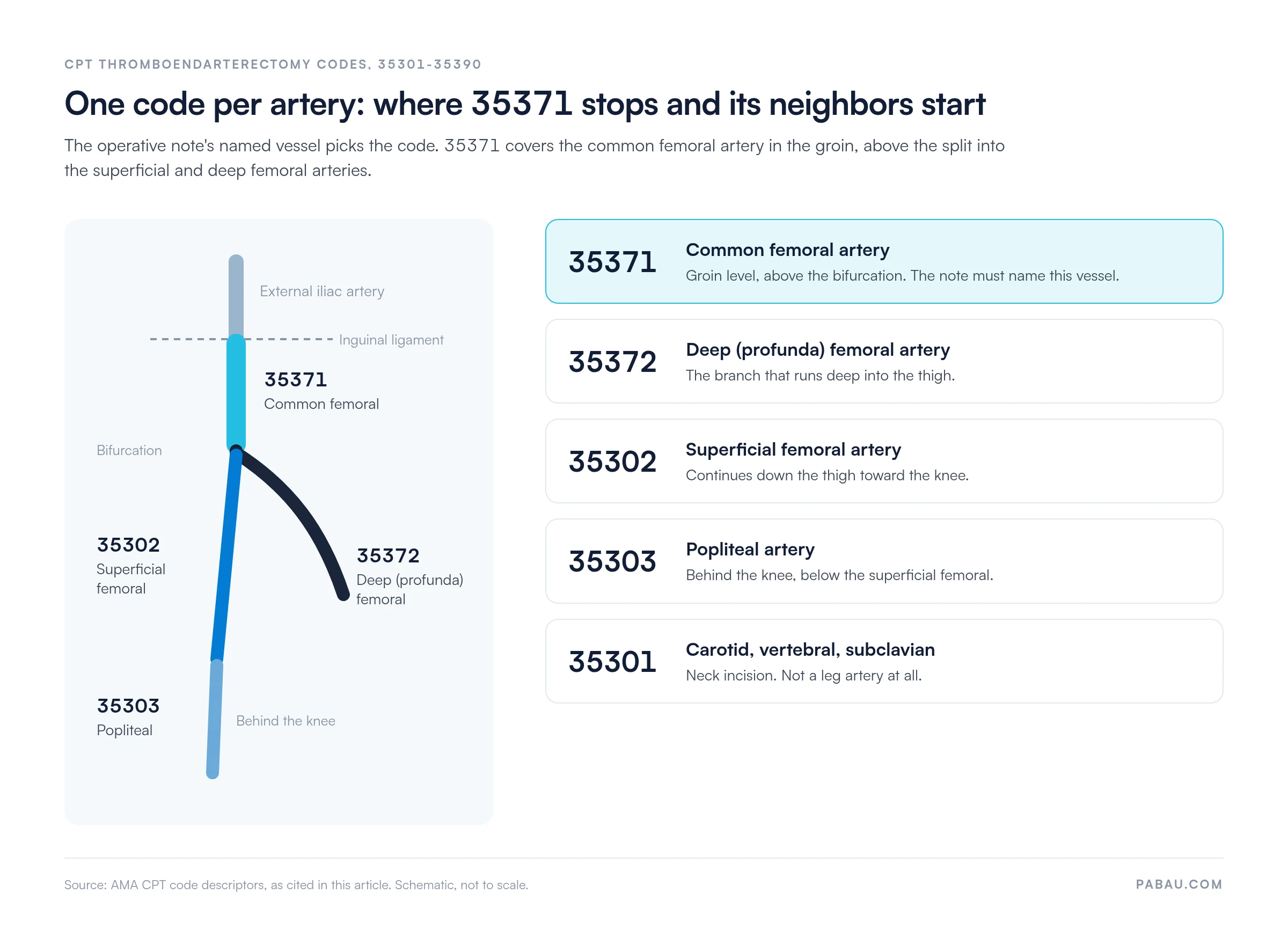
The code covers the common femoral segment only, above its split in the upper thigh. The deep (profunda) femoral artery is 35372, and the superficial femoral artery is 35302.
Let Pabau's smart automation suggest the right codes, reduce claim denials, and keep your practice compliant—effortlessly.
Automate repetitive tasks and focus on what matters most—your patients.
Reduce coding errors and ensure compliance with the latest regulations.
Clean claims, fewer denials, and faster reimbursements.
Powerful insights and reporting to help your practice thrive.
HIPAA compliant SOC 2 certified GDPR-compliant Trusted by 4,000+ clinics worldwide

CPT code 35371 reports open thromboendarterectomy of the common femoral artery, with any patch closure bundled into the code.
The deep (profunda) femoral artery is 35372, the superficial femoral is 35302 and the popliteal is 35303, so the named vessel decides the code.
The 2026 work RVU is 14.93, but locality GPCIs change the payment, so check the CMS fee schedule lookup for your area.
Most denials trace to an unnamed vessel, thin medical necessity evidence, a missing prior authorization or a bundling edit with a neighboring code.
Modifier 59 or XS applies only when the operative note documents a second, separate lesion in another artery.
CPT code 35371 reports an open thromboendarterectomy of the common femoral artery, the short groin segment above its split into two branches.
The descriptor comes from the AMA’s CPT code set, which the AMA’s CPT Editorial Panel maintains. It reads: Thromboendarterectomy, including patch graft, if performed; common femoral artery.
The code sits in the thromboendarterectomy range, 35301-35390, under Arteries and Veins in the cardiovascular surgery section.
The phrase “including patch graft, if performed” is a bundling instruction. If the surgeon closes the arteriotomy with a patch, that work is already valued inside 35371. Adding a separate patch graft code invites a National Correct Coding Initiative (NCCI) edit denial.
The thromboendarterectomy family assigns one code per artery. Picking the wrong neighbor is the most common coding error on these claims, and the map below shows where each code sits.
Carotid endarterectomy codes follow different documentation rules, and our page on CPT code 35301 walks through them.
Both codes involve femoral arteries, which is why they get confused. 35371 covers the common femoral artery, at or above the bifurcation. 35372 covers the deep (profunda) femoral artery, the branch that dives into the deep thigh.
Surgeons often clear plaque from the profunda origin during a common femoral endarterectomy. Ask whether the note describes that, or a distinct endarterectomy of the profunda itself. Only the second points to 35372, and you should check the current NCCI edit table before reporting both.
Can CPT 35371 and 35302 be billed together? Yes, but only when the operative note documents two separate lesions. One sits in the common femoral artery and a distinct one in the superficial femoral artery, with separate endarterectomy planes. Append modifier 59 or XS to the secondary code to show a distinct procedural service.
A contiguous lesion is different. If one plaque runs unbroken from the common femoral into the superficial femoral, report one code, based on where most of the work happened. Reporting both for one lesion is unbundling under NCCI policy, so ask a certified vascular coder when the note is unclear.
Knowing the surgical steps tells you what the operative report needs to contain. A missing step is a common reason a 35371 claim comes back with a records request.
Confirm steps 1 through 4 appear in plain terms. A note that says only “femoral endarterectomy” doesn’t support 35371, and neither does one describing a profunda-only procedure.
Payers, Medicare contractors included, expect the operative report to prove medical necessity and name the exact procedure. Meeting billing compliance requirements for 35371 means the note covers each element below.
A clean claim for 35371 pairs that documentation with the right diagnosis and authorization number. If any check fails, request an addendum before you bill.
Each claim passes through six hands-on stages, and each one can stall it.
Delays cluster at steps 2 and 5. A vague note stalls coding, and a wrong code pairing trips an edit during adjudication.
Every 35371 claim needs an ICD-10-CM code that establishes medical necessity. The pairings below are the most common. Coverage policy varies by payer and Medicare contractor, so confirm it before billing.
Left-leg equivalents of I70.211, I70.221 and I70.261 end in “2” rather than “1”. For a left thigh ulcer, the code is I70.241.
CMS sets RVUs and the Medicare conversion factor each year. For 2026, 35371 carries 14.93 work RVUs. Payment then shifts with your locality, so check the CMS Physician Fee Schedule lookup before you quote a figure.
The FastRVU 2026 lookup tool breaks out work, practice expense and malpractice RVUs with location multipliers.
A wrong modifier is a frequent reason 35371 claims are denied. The table maps each modifier to the scenario that warrants it.
Traditional Medicare generally doesn’t require prior authorization for 35371, but many Medicare Advantage and commercial plans do. Check each plan’s policy before you schedule an elective case. A steady prior authorization process keeps surgery dates from slipping while paperwork catches up.
When authorization is required, the package usually includes the items below. Thresholds differ by plan, so check current policy.
35371 claims draw denials because the documentation rules are specific and three neighboring codes sit close by. The table maps each denial to its fix, within broader denial management workflows. For the reason codes behind them, see our guide to denial codes in medical billing.
Set up a claim scrubbing rule that flags any 35371 claim carrying modifier 50 when the operative report documents only one side. Catching this before submission costs seconds; fixing it after a denial costs days.
Without connected software, a coder rekeys the CPT and ICD-10 codes into a claim form. Eligibility gets checked by phone, and remittances are matched to accounts by hand.
Pabau, a practice management platform with surgical practice claims software built in, pre-fills the CMS-1500 from the patient record. The CPT code on the service lands on the charge line, and the claim won’t send until required fields are complete.
In the US, claims go out electronically through Claim.MD. Your team runs real-time eligibility checks and posts ERA remittances back to the account. Practices that bill from surgical superbills can export CMS-1500-ready data too.
That leaves your coders free to focus on the operative note, which is where 35371 claims are won or lost.

Pabau pre-fills CMS-1500 claims from the patient record, checks eligibility and posts ERA remittances through Claim.MD. Your 35371 claims go out complete.

35371 rewards precision more than most surgical codes. Get the vessel name into the operative note, and the code, the modifier and the diagnosis fall into line.
The trade-off is a little time up front. A one-minute check of the note costs far less than an addendum request after a denial. If your surgeons work across the common femoral, profunda and superficial femoral arteries, agree a note template that names each one.
Book a demo to see how Pabau pre-fills and submits surgical claims, so your billing team can focus on choosing the right code.

Need a clearinghouse reference for 35371 electronic claims? Understanding the Claim.MD clearinghouse explains how payer-connected claim routing works for surgical procedure codes.
Getting repeat denials on vascular claims? Reading electronic remittance advice walks through decoding 835 ERA files and finding the reason code behind each rejection.
Building a pre-auth workflow for open vascular cases? Insurance eligibility verification covers how to confirm coverage and authorization status before the day of surgery.
Need a form for the authorization request itself? Medical prior authorization form gives your team a ready template for the clinical details payers ask for.
Hospitals code inpatient femoral endarterectomy as extirpation of matter. Open removal from the right femoral artery is 04CK0ZZ, and from the left is 04CL0ZZ. The surgeon still reports 35371.
Yes. Codes such as I70.231 carry a “use additional code” note for the ulcer itself. Add an L97.1- code for the thigh ulcer, which records its severity.
No. 35371 is an open procedure. Catheter-based femoral treatment uses the lower extremity revascularization codes, such as 37224 for femoral or popliteal angioplasty.
Yes. The code describes the procedure, not whether it is a first attempt. Scar tissue and extra operating time may support modifier 22 when the note quantifies the added work.
It carries 14.93 work RVUs for 2026. Use the CMS fee schedule lookup for your locality’s payment rather than a national average.
Traditional Medicare generally doesn’t, but many Medicare Advantage and commercial plans do. Check the plan’s policy before scheduling an elective case.