CPT code 36468: Injection sclerotherapy of telangiectasia billing guide
CPT code 36468 covers spider veins on a limb or the trunk CPT code 36468 reports...

Last Updated: Nov 13, 2026
77332 is the CPT code for treatment devices, design and construction; simple (simple block, simple bolus). It covers designing and building a basic beam-modifying device for an external beam radiation therapy course.
The device type decides the tier. Multiple blocks, stents, bite blocks and a special bolus fall under 77333. Irregular blocks, special shields, compensators, wedges, molds and casts fall under 77334. Choosing the wrong tier is a common source of denials and audit questions.
Let Pabau's smart automation suggest the right codes, reduce claim denials, and keep your practice compliant—effortlessly.
Automate repetitive tasks and focus on what matters most—your patients.
Reduce coding errors and ensure compliance with the latest regulations.
Clean claims, fewer denials, and faster reimbursements.
Powerful insights and reporting to help your practice thrive.
HIPAA compliant SOC 2 certified GDPR-compliant Trusted by 4,000+ clinics worldwide

CPT Code 77332 covers the design and construction of a simple treatment device, which the descriptor defines as a simple block or a simple bolus.
Multiple blocks, stents, bite blocks and a special bolus are 77333, while irregular blocks, special shields, compensators, wedges, molds and casts are 77334.
Choosing the wrong device tier is a common source of denials and audit questions, so the record should name the device that was built.
The CPT descriptor sets no physicist signature rule, though payer or institutional policy may require physicist sign-off.
Medicare rates change every year, so check the CMS Physician Fee Schedule lookup for your locality before billing.
CPT Code 77332 is the procedure code for “treatment devices, design and construction; simple (simple block, simple bolus).”
The descriptor comes from the AMA’s CPT code set, which the AMA’s CPT Editorial Panel maintains and updates. The service covers designing and building a basic beam-modifying device for a patient’s external beam radiation therapy course.
The service is billed per device constructed, not per treatment fraction. 77332 sits in the 77295-77370 physics subsection, alongside basic dosimetry, special physics consultations (77370) and the intermediate and complex device tiers (77333-77334).
The CPT descriptor names two simple devices, and only two. Each one qualifies under CPT Code 77332:
Wedges and compensators are not simple devices. The CPT descriptor for 77334 lists them with irregular blocks, special shields, molds and casts. Multiple blocks, stents, bite blocks and a special bolus fall under 77333.
Immobilization devices are not named in the 77332 descriptor. Check payer and ASTRO coding guidance before assigning one to a tier. Billing the wrong tier for a device is a common source of denials and audit questions.
The three treatment device codes form a tiered series, and the AMA defines each tier by device type. The device named in the record decides the code, and the wrong tier produces either a denial or an underpayment.
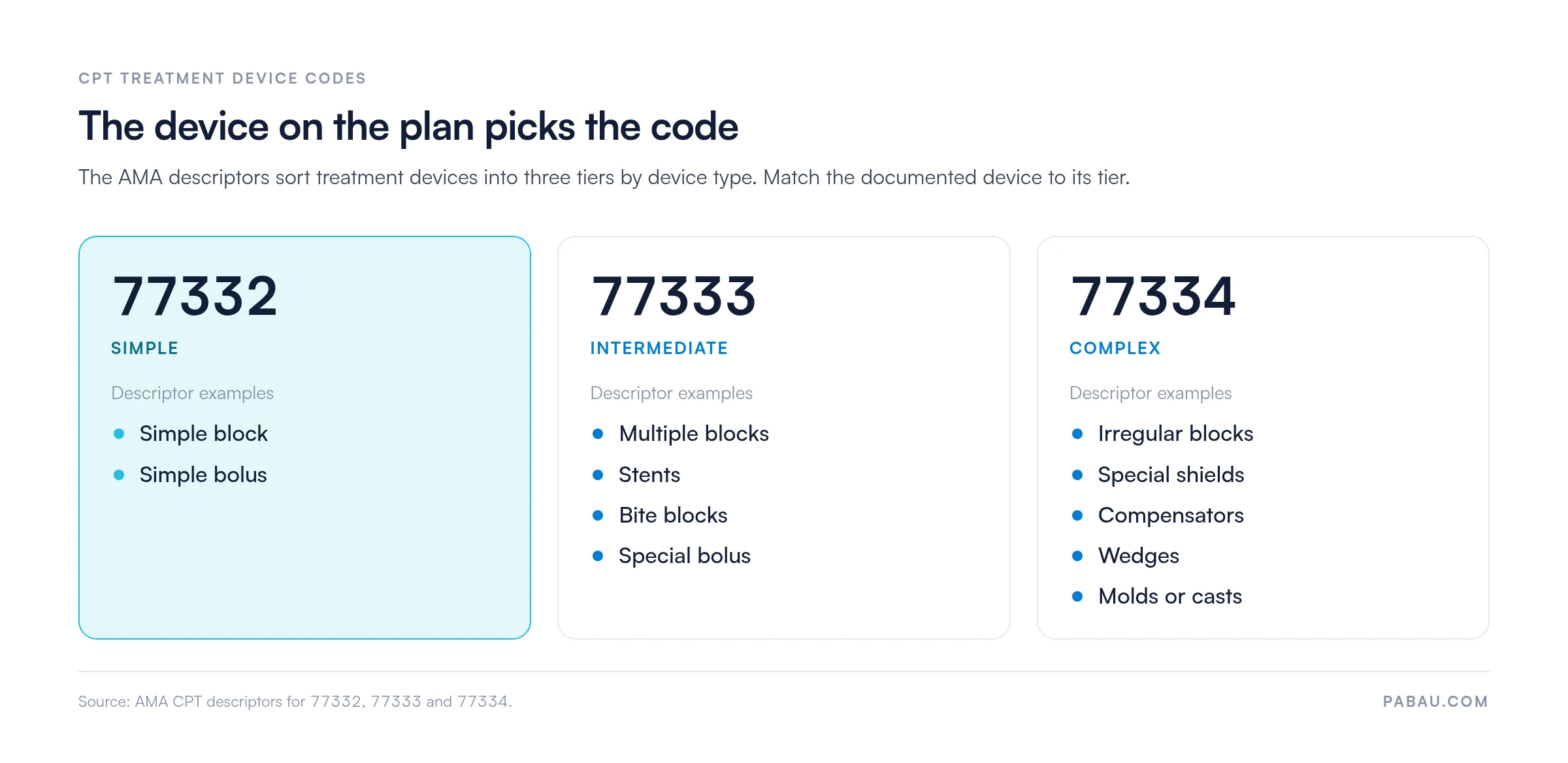
77332 covers a simple block or a simple bolus. 77333 covers multiple blocks, stents, bite blocks or a special bolus. 77334 covers irregular blocks, special shields, compensators, wedges, molds or casts.
When a device sits near the line between two tiers, check payer and ASTRO coding guidance before choosing the code. The device note should name the device and its tier, and that tier must match the code billed.
CPT Code 77332 sits in the radiation oncology section (77261-77799), whose physics subsection is 77295-77370. Knowing its neighbors helps billing staff avoid accidental bundling errors. In a radiation oncology course, the sequence runs:
The CPT descriptor does not say who must perform the service. Supervision rules come from CMS and payer policy instead. Under Medicare Part B, CMS generally requires direct supervision for physics services billed in a physician office setting.
Hospital outpatient departments bill the technical service on the facility claim under the Outpatient Prospective Payment System (OPPS). The physician group bills its professional work separately where applicable.
CPT Code 77332 has a professional and a technical component under the Physician Fee Schedule (PFS). Modifier 26 reports the professional component, and modifier TC reports the technical component, when different entities furnish them.
Payer-specific rules govern modifier splitting. Check the payer’s policy or your MAC’s guidance before submitting a split-component claim for CPT Code 77332.
Run a modifier audit on your 77332 claims every quarter. Pull every claim with modifier 26 or TC and confirm the other party billed the matching component. An orphaned modifier-26 claim with no matching TC claim can leave the technical component unpaid for months before anyone notices.
Every CPT Code 77332 claim needs documentation that supports the tier billed. A missing element gives a payer grounds to deny or audit the claim. Following medical billing compliance standards, the record should include:
Where a simple device is used in a multi-field plan, state the tier and the reason for it in the device note. Check payer and ASTRO coding guidance for the level of detail they expect.
Medicare payment for CPT Code 77332 is set each year by CMS through the Medicare Physician Fee Schedule (MPFS). Rates vary by location through the Geographic Practice Cost Index (GPCI).
For 2026, the PFS conversion factor is $33.4009 for most clinicians. Look up the current global, professional and technical amounts for your locality in the CMS Physician Fee Schedule lookup tool before billing.
Use the FastRVU lookup tool to retrieve the current work, practice expense and malpractice RVUs for 77332 by locality.
Traditional Medicare generally does not require prior authorization for CPT Code 77332, but Medicare Advantage plans often do. Requirements vary by plan and state. Before billing, verify insurance eligibility and authorization status for every radiation oncology course.
Some plans require authorization for the entire treatment course rather than for individual physics service codes.
National Correct Coding Initiative (NCCI) edits govern which codes may be billed together on the same date of service. Key bundling rules affecting CPT Code 77332:
CMS updates the NCCI edit tables quarterly. Check current edit pairs in the CMS NCCI edit files before billing 77332 on a date when other planning or dosimetry codes are also billed.
Denials on 77332 claims tend to trace back to six causes, and each one has a specific fix. Tracking them by medical billing denial codes helps billing staff spot repeat problems quickly.
Use this checklist at the point of billing to cut first-pass denials. The claims management software in a practice management system can automate several of these checks, particularly the eligibility verification step.
Billing staff managing CPT Code 77332 alongside a full course of treatment codes face a documentation-heavy workflow. Device notes, payer authorization rules, modifiers and NCCI edits all create audit exposure when they are tracked by hand.
Pabau, the practice management platform we build, sends US claims through its Claim.MD clearinghouse integration. Your team runs eligibility checks before the visit, submits CMS-1500 claims and receives electronic remittance advice (ERA) back in Pabau.
Coverage problems surface before the claim goes out, so fewer claims come back denied. When a payer asks for documentation, the claim history and remittances are already in one place.
Build a CPT 77332 documentation template that includes a device tier checkbox (Simple / Intermediate / Complex), a one-line clinical rationale field and a signature date. Attach it to every treatment device order. When a payer requests records, this template is the fastest proof that the tier was chosen before billing, not after a denial.

Pabau’s claims tools and Claim.MD integration help practices verify eligibility, submit claims and receive remittances in one system. Your team catches coverage problems before a 77332 claim goes out.

Bill 77332 only when the record names a simple block or a simple bolus. Wedges, compensators and every other device named in the 77333 or 77334 descriptors take those codes instead.
Put the device and its tier in the note before the claim goes out. Then check NCCI pairs on any date that also carries planning or dosimetry codes. Those two checks catch tier and bundling errors before a payer does.
Pabau keeps eligibility checks, Claim.MD claims and remittances in one system for your billing team. Book a demo to see how Pabau handles 77332 claims for your practice.

Need a clearinghouse for radiation oncology claims? Claim.MD clearinghouse overview explains how the integration handles electronic claim submission and ERA processing for US practices.
Confused by denial codes on a rejected 77332 claim? Denial codes in medical billing provides a reference guide to CARC reason codes and how to respond to each.
Want to benchmark your clearinghouse costs? Claim.MD pricing breaks down what practices pay for clearinghouse submission and what to compare when evaluating options.
Billing ongoing physics oversight during treatment? CPT code 77336 covers continuing medical physics consultation and how it is reported.
Planning a 3D conformal course? CPT code 77295 explains the 3D conformal treatment planning code that often precedes device work.
CPT Code 77332 covers the design and construction of a simple radiation treatment device. The descriptor defines that device as a simple block or a simple bolus. Wedges and compensators are not simple devices. The CPT descriptor places them under 77334.
CPT 77332 covers a simple block or a simple bolus. CPT 77333 covers multiple blocks, stents, bite blocks or a special bolus. CPT 77334 covers irregular blocks, special shields, compensators, wedges, molds or casts. The device named in the record decides the code.
Medicare pays CPT 77332 through the Physician Fee Schedule, and the amount varies by locality. For 2026, the conversion factor is $33.4009 for most clinicians. Check the CMS Physician Fee Schedule lookup tool for your current global, professional and technical amounts.
The entity that furnishes the service bills it. A freestanding practice that owns the equipment bills the global code. Where components are split under the PFS, one entity bills modifier 26 and another bills TC. A hospital outpatient department bills the technical service on its facility claim.
Yes. Modifier 26 reports the professional component, and modifier TC reports the technical component under the Physician Fee Schedule. Global billing, with no modifier, applies when one entity furnishes both components. Never bill both modifier 26 and modifier TC on the same claim.
Common denial reasons include choosing the wrong device tier, missing device documentation and no prior authorization. Bundling conflicts with same-day planning or dosimetry codes and modifier errors cause denials too. A pre-submission documentation checklist catches each of them.