HCPCS Code V5095: Semi-implantable middle ear hearing prosthesis
HCPCS Code V5095: Definition and clinical descriptor HCPCS Code V5095 is the Lev...

Last Updated: Nov 25, 2026
43332 is the CPT code for repair of a paraesophageal hiatal hernia (including fundoplasty) via laparotomy, except neonatal, without implantation of mesh or other prosthesis.
Coders most often confuse it with the laparoscopic codes 43281 and 43282, or with 43333, the open repair with mesh. Approach, mesh status and patient age are the three variables that separate 43332 from its neighbors.
Let Pabau's smart automation suggest the right codes, reduce claim denials, and keep your practice compliant—effortlessly.
Automate repetitive tasks and focus on what matters most—your patients.
Reduce coding errors and ensure compliance with the latest regulations.
Clean claims, fewer denials, and faster reimbursements.
Powerful insights and reporting to help your practice thrive.
HIPAA compliant SOC 2 certified GDPR-compliant Trusted by 4,000+ clinics worldwide

CPT Code 43332 reports an open paraesophageal hiatal hernia repair through a laparotomy, with fundoplasty included and no mesh, in a non-neonatal patient.
Mesh is the one variable that separates 43332 from 43333, so an operative note that documents mesh belongs on 43333.
Fundoplasty is part of the 43332 descriptor, so a separate fundoplication code on the same claim triggers an NCCI edit.
A repair completed laparoscopically is reported with 43281 or 43282, and an open chest or thoracoabdominal repair with 43334 to 43337.
Pabau, a practice management platform, tracks the prior authorization on the case and submits the claim through Claim.MD.
CPT Code 43332 reports an open repair of a paraesophageal hiatal hernia through a laparotomy, with no mesh or other prosthesis. Fundoplasty is included in the code. In addition, the code does not apply to neonates. It also sits under Esophagus repair in the Digestive System surgery section of the CPT code set, which the AMA’s CPT Editorial Panel maintains.
The table below lists each field a coder should confirm before submitting a claim.
CPT Code 43332 covers the open surgical repair of a paraesophageal hiatal hernia, with fundoplasty included in the code and no prosthetic mesh. Each element of that descriptor is a code-selection variable.
Paraesophageal (not sliding): A sliding hiatal hernia (Type I) sees the gastroesophageal junction migrate above the diaphragm. In contrast, a paraesophageal hernia (Types II, III, and IV) involves herniation of the gastric fundus or other abdominal organs through the hiatus. The junction may or may not keep its normal position. So, 43332 applies only to paraesophageal repair. Sliding hiatal hernia repairs usually map to different esophageal procedure codes.
Open (laparotomy): The surgeon enters the abdomen through a midline or subcostal incision. A repair completed laparoscopically is reported with 43281 when no mesh is placed, or 43282 when it is. In contrast, an open repair through the chest uses 43334 or 43335, and a thoracoabdominal incision uses 43336 or 43337. If a laparoscopic approach was converted to open, the final completed approach governs code selection.
Fundoplication included: The gastric fundus is wrapped around the lower esophagus to reinforce the lower esophageal sphincter. Common wraps are Nissen (360-degree), Toupet (partial posterior) and Dor (partial anterior). So this component is part of the 43332 descriptor and is never reported separately.
Without prosthesis: No synthetic or biologic mesh was used to reinforce the crural closure. If the operative note documents mesh placement, 43333 is the correct code, regardless of which code was submitted.
Documentation decides whether a code holds up. These are the operative steps a coder should check in the report before assigning CPT 43332.
The 43332 code family runs from 43332 to 43337, and every code in it is an open repair. Two variables decide the code: the incision (laparotomy, thoracotomy or thoracoabdominal) and whether mesh was placed. Laparoscopic repair is a separate family, 43281 and 43282.
The grid below shows the decision at a glance. The table after it adds fundoplasty and neonatal status for each code.
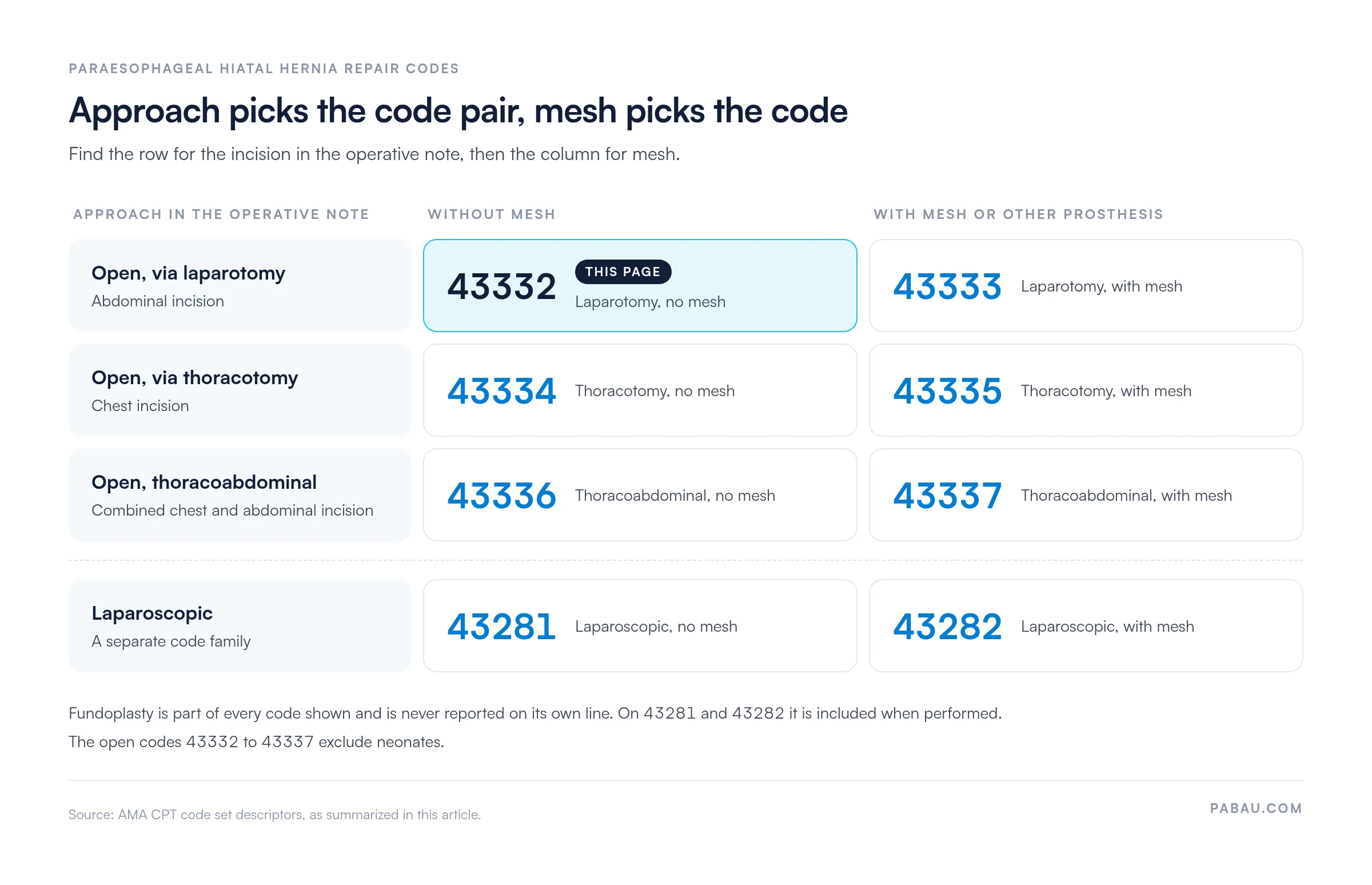
These two codes are the same in every respect except mesh. The clinical decision to use mesh belongs to the surgeon, based on hernia size, crural defect quality, and recurrence risk. However, the code follows what the operative note says happened in the OR, whatever the preoperative plan was.
When a laparoscopic procedure converts to open through a laparotomy, only 43332 or 43333 applies. The laparoscopic codes (43281, 43282) cannot be billed for a procedure completed via laparotomy. Also, codes 43334 to 43337 are open thoracic approaches, not laparoscopic ones. The operative note must clearly state the final approach. Phrases like “converted to open due to adhesions” or “open laparotomy performed” are the documentation anchors a coder needs.
A clean 43332 claim requires a diagnosis code that establishes medical necessity for paraesophageal hernia repair. Then, use a CPT-to-ICD-10 crosswalk tool to check payer-accepted pairings. The table below lists the primary and secondary diagnosis codes most commonly submitted with CPT 43332.
K44.9 is the default for elective paraesophageal hernia repair. Upgrade to K44.0 or K44.1 when the operative or preoperative notes document obstruction or vascular compromise. These higher-acuity codes also strengthen medical necessity arguments with payers.
Medicare reimburses 43332 under the Physician Fee Schedule based on relative value units (RVUs). Rates change annually with each MPFS update, so check them against the CMS Physician Fee Schedule lookup tool for the current year and your locality.
Use FastRVU’s 2026 RVU lookup for a quick Work/PE/MP breakdown. The table below explains what each RVU component covers, so pull the dollar figures from live CMS data before billing.
Practices using Pabau can submit claims through Claim.MD, Pabau’s US clearinghouse integration. It sends 837P electronic claims, Medicare claims included, and returns ERAs so your team can match payments against expected RVU-based amounts. The medical claims clearinghouse guide shows how 837P submission and ERA remittance work end to end.
Several modifiers commonly apply to 43332. Each changes reimbursement or signals a clinical situation to the payer. In fact, attaching the wrong modifier, or omitting a required one, is a frequent denial trigger.
Modifier 22 requires more than a brief note in the margin. Write a separate operative summary that quantifies the extra work. Give the time above typical, the complicating factors (prior repairs, hernia size, adhesion grade), and how they changed the procedure. Payers often deny modifier 22 on first submission and ask for this detail on appeal. Documenting it upfront shortens the cycle.
Most commercial payers and many Medicare Advantage plans require prior authorization for 43332 because the procedure is usually elective. Check each plan’s current policy before scheduling, because authorization requirements change with plan year updates. See the surgical billing compliance framework for a step-by-step pre-auth process.
Clinical documentation usually required for prior authorization includes:
However, traditional Medicare (Parts A/B) does not require prior authorization for 43332. Medicare Advantage plans set their own prior-auth rules, so practices serving Medicare Advantage patients must check plan-specific policies each time.
The most frequent CPT 43332 denial categories follow a clear pattern. Each one has a root cause in documentation or code selection. In fact, none stems from the procedure itself. Solid denial management workflows start with the operative note, not the remittance advice.
When a claim comes back with a claim denial code, match the CARC reason code to the denial categories above to find the fastest fix. Most 43332 denials are correctable on appeal when the operative documentation is complete. The goal is submitting a clean claim the first time, which means checking the documentation before the claim goes out.
CPT Code 43332 carries a 90-day global surgical package. This bundles all routine preoperative and postoperative services related to the procedure into the single 43332 payment. Otherwise, billing separately for bundled services generates an NCCI edit denial.
Bundled (included in the 90-day global):
Not bundled (separately billable):
When an E/M service during the 90-day window is for a problem unrelated to the hernia repair, append modifier 24. Also, the note must clearly document the unrelated condition. Payers audit global period billing closely for this code family.
The six denial categories above all start before the claim reaches the payer. Code selection errors, missing authorization, and unbundling happen in the billing workflow, not in the OR. So catching them means checking the approach, the mesh status and the authorization while the claim is still being built.
Pabau’s claims management for surgeons covers three of the most common 43332 failure points:
In short, the outcome is fewer 43332 claims coming back for a missing authorization, and less time spent matching remittances by hand.
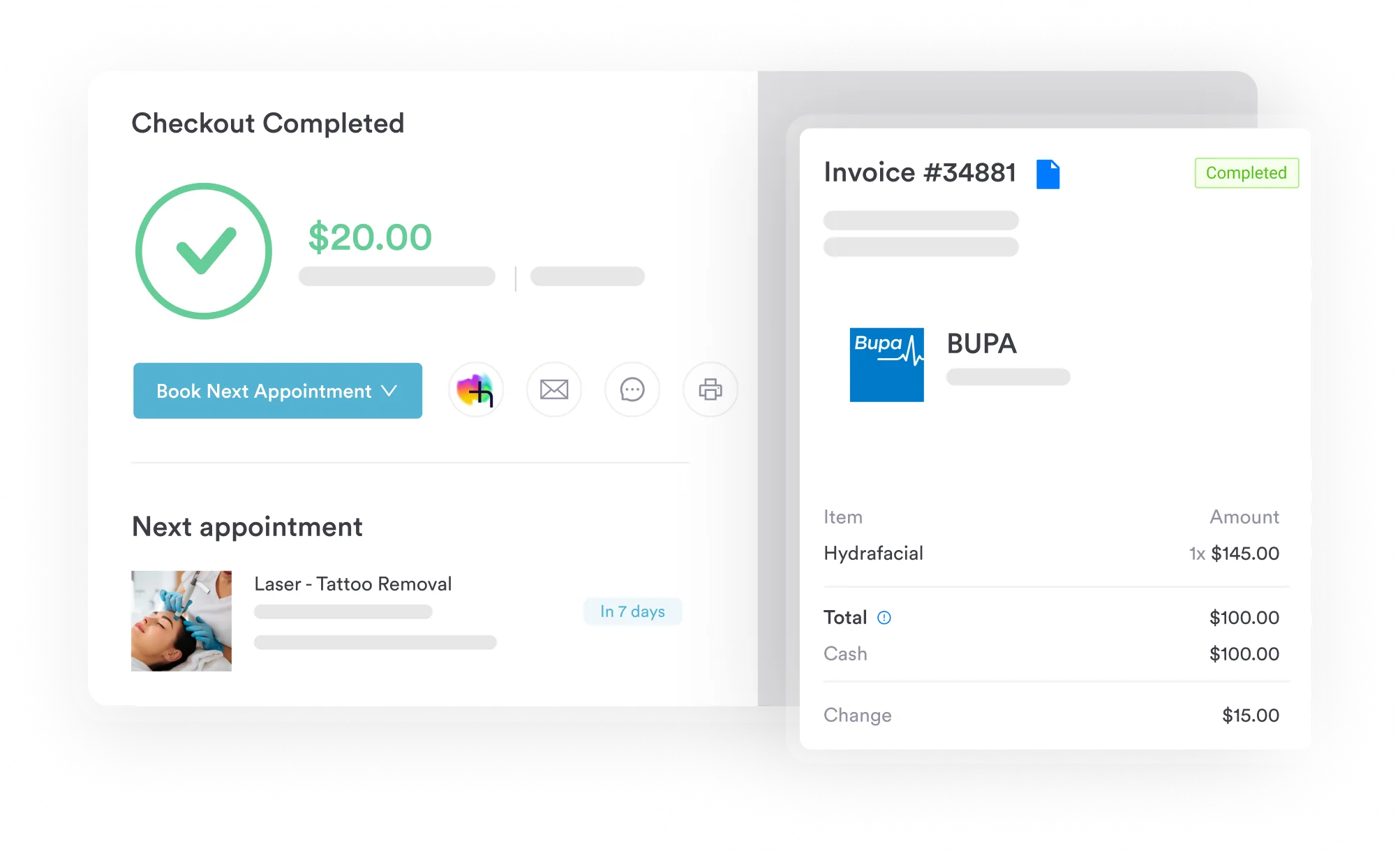

Pabau tracks the authorization code, dates and sessions on each case, with a warning when one is missing. Claims go out through Claim.MD, and ERAs come back ready to reconcile.

Code 43332 from the operative note, not from the surgical booking. First, the incision decides the code pair. Second, mesh decides the code within it. A note that states both settles the claim before it is built.
If your surgeons dictate to a template, add an explicit mesh line and a final-approach line to it. In short, those two lines prevent the approach and mesh denials, which each take a full rebill to correct.
Book a demo to see how Pabau keeps the authorization, the claim and the remittance for each 43332 case together.

Need a full framework for surgical claim denials? Denial management in healthcare covers root-cause analysis, appeal workflows, and tracking metrics for surgical specialty practices.
Submitting claims electronically for the first time? Understanding the 837 file format explains how professional claims are structured for payer submission and what field-level errors cause rejections.
Want to understand what makes a claim pay first time? Clean claim best practices outlines the data elements that must be present and accurate before a surgical claim goes out the door.
CPT Code 43332 covers the open (laparotomy) repair of a paraesophageal hiatal hernia with fundoplication, performed without prosthetic mesh, in non-neonatal patients. The code bundles the hernia reduction, crural closure, and fundoplication wrap into a single billable unit. None of those components can be reported separately.
The only difference is prosthetic mesh. 43332 is used when no mesh was placed, and 43333 when mesh reinforced the crural closure. Both codes describe the same open paraesophageal repair with fundoplication. Mesh status is the single variable separating them.
CPT 43332 is for open (laparotomy) surgery only. If the procedure was completed laparoscopically, use 43281 (without mesh) or 43282 (with mesh), which include fundoplasty when performed. Open thoracotomy or thoracoabdominal approaches use 43334-43337. If a laparoscopic case converted to open, the final completed approach determines the code.
CPT 43332 carries a 90-day global surgical package. Related office visits within 90 days of the procedure date are bundled into the 43332 payment and cannot be billed separately. Unrelated E/M services during the global period require modifier 24.
No. Fundoplication is included in the CPT 43332 descriptor and is subject to NCCI bundling edits. Billing a fundoplication code alongside 43332 will trigger a denial. The wrap is part of the procedure, not an add-on service.