

HCPCS Code Q4185: Cellesta flowable amnion billing guide
HCPCS Code Q4185: definition and official descriptor HCPCS Code Q4185 is the Lev...

Last Updated: Nov 20, 2026
31257 is the CPT code for nasal/sinus endoscopy, surgical, with total (anterior and posterior) ethmoidectomy, including sphenoidotomy. The surgeon removes the anterior and posterior ethmoid cells and opens the sphenoid sinus in one procedure.
CPT 31259 describes the same procedure plus removal of tissue from the sphenoid sinus, so the operative note decides between the two. 31255 (total ethmoidectomy without sphenoidotomy) and 31254 (partial ethmoidectomy) are separate codes, and both remain active.
Let Pabau's smart automation suggest the right codes, reduce claim denials, and keep your practice compliant—effortlessly.
Automate repetitive tasks and focus on what matters most—your patients.
Reduce coding errors and ensure compliance with the latest regulations.
Clean claims, fewer denials, and faster reimbursements.
Powerful insights and reporting to help your practice thrive.
HIPAA compliant SOC 2 certified GDPR-compliant Trusted by 4,000+ clinics worldwide

CPT code 31257 reports a surgical nasal/sinus endoscopy with total (anterior and posterior) ethmoidectomy, and the sphenoidotomy is included in the code.
Report 31259 instead when the surgeon also removes tissue from the sphenoid sinus, so the operative note must say whether sphenoid tissue came out.
31254 (partial ethmoidectomy) and 31255 (total ethmoidectomy without sphenoidotomy) are active codes, and 31257 joined them in the 2018 revision of the ethmoid family.
31257 carries a 000 global period, so only the day of surgery is bundled and post-operative visits on later dates are billed separately.
For 2026, CMS values 31257 at 7.80 work RVUs and 11.23 total RVUs, about $375 nationally before geographic adjustment.
CPT code 31257 is the code for a surgical nasal/sinus endoscopy with a total ethmoidectomy, anterior and posterior, that includes a sphenoidotomy. It is a Category I code, and its descriptor is maintained by the AMA’s CPT Editorial Panel. Opening the sphenoid sinus is part of the code, so it never needs a second code on the same side.
FastRVU’s 2026 entry for CPT 31257 abbreviates the code as “Nsl/sins ndsc tot w/sphendt” and lists a 000 global period. The official long descriptor and the main billing attributes are below.
The surgeon passes a rigid endoscope through the nostril and works back through the ethmoid air cells, anterior first, then posterior. The dissection continues to the front wall of the sphenoid sinus, and the surgeon opens the sphenoid into the nasal cavity. That opening is the sphenoidotomy, and 31257 already pays for it.
Each part of the descriptor carries coding weight. “Surgical” separates this procedure from diagnostic nasal endoscopy (31231), which a surgical sinus endoscopy includes. “Total” means both the anterior and posterior ethmoid cells. “Including sphenoidotomy” means the sphenoid is opened as part of the same code.
Removal of tissue from inside the sphenoid sinus is the one sphenoid step 31257 leaves out. Polyps or diseased mucosa cleared from the sphenoid move the claim to 31259.
CPT 31257 and 31259 describe the same dissection, a total ethmoidectomy with a sphenoidotomy. The only difference is whether the surgeon removes tissue from inside the sphenoid sinus. If the sphenoid is opened and inspected, the code is 31257. If tissue is removed from it, the code is 31259.
The errors run in both directions. A sphenoid that was opened and only inspected, billed as 31259, overstates the work. Disease cleared from the sphenoid but billed as 31257 leaves earned payment unclaimed. Adding a sphenoidotomy code fixes neither, because both codes already include it.
Each side is coded on its own. Suppose the surgeon opens the left sphenoid and finds it clear, then removes polyps from the right sphenoid. That case is reported as 31257-LT and 31259-RT, not as 31259-50.
CPT 31255 covers a total (anterior and posterior) ethmoidectomy without a sphenoidotomy. CPT 31254 covers a partial, anterior-only ethmoidectomy. Both are active codes, and neither was retired when 31253, 31257 and 31259 were added in 2018.
Use 31255 when the surgeon stops at the front wall of the sphenoid without opening it. Once the sphenoid is opened, report 31257 rather than 31255 plus 31287 for that side. Never report 31254 or 31255 with 31257 on the same side. Three questions about the operative note settle the code for each side.
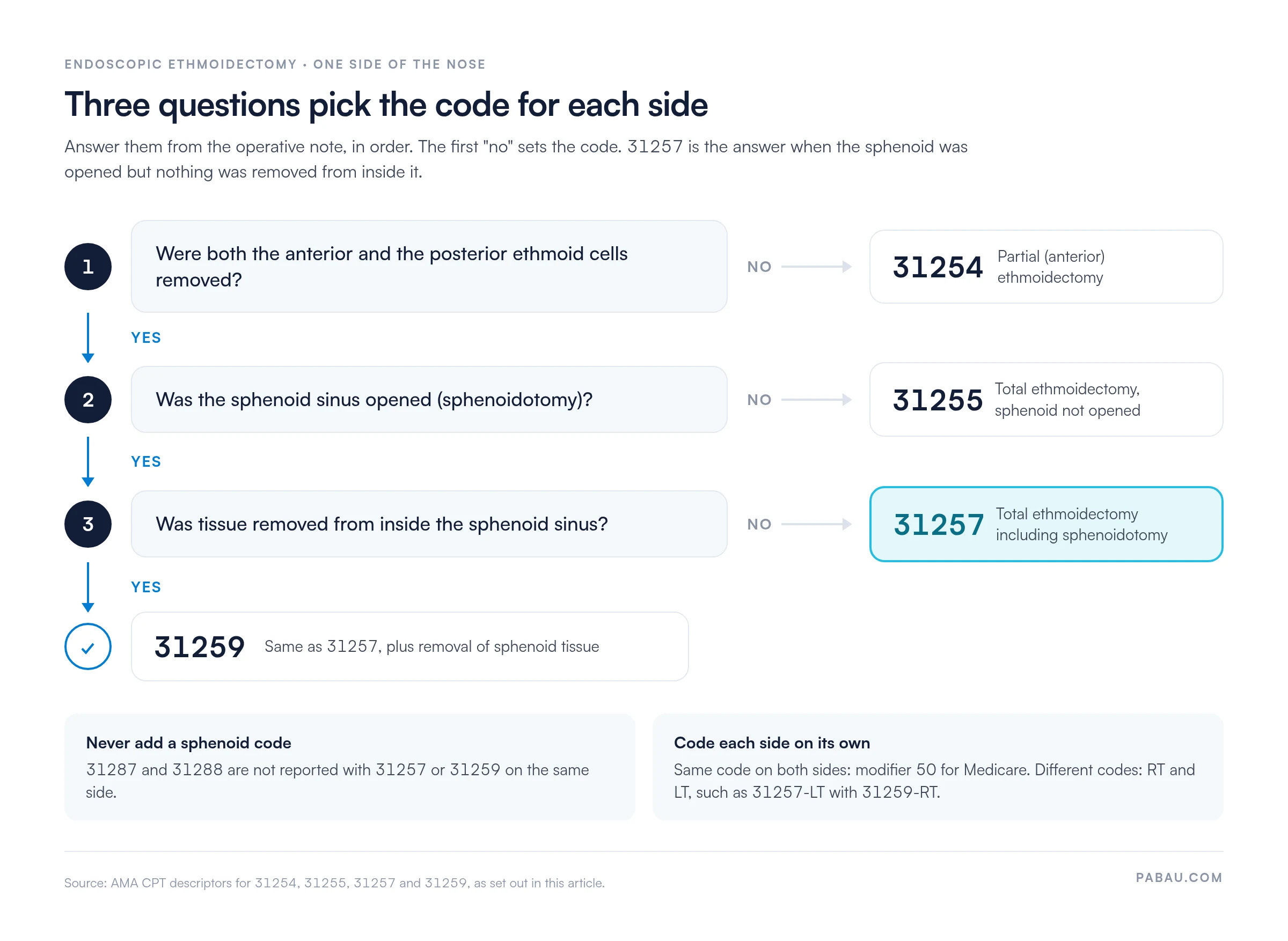
Check the current NCCI procedure-to-procedure edits before pairing any two of these codes on one claim, because the edits are updated quarterly. The AAPC CPT code lookup is a quick way to confirm each descriptor before submission.
Medical necessity for CPT 31257 rests on the ICD-10-CM codes linked to the claim. Chronic sinusitis (J32) and nasal polyp (J33) codes are the usual pairings, and you can confirm each descriptor in the CDC/NCHS ICD-10-CM web tool. Each payer’s policy sets the diagnoses it accepts, so check it before surgery.
When the CT scan and operative note name the ethmoid and sphenoid sinuses, code each documented sinus instead of J32.9. A specific diagnosis is easier to defend if the payer asks for records.
Medicare pays CPT 31257 through the Medicare Physician Fee Schedule (MPFS). For 2026, CMS assigns 7.80 work RVUs and 11.23 total RVUs in both settings. At the 2026 conversion factor of $33.4009, that comes to about $375.09 nationally.
Your Medicare Administrative Contractor (MAC) then adjusts that figure by the Geographic Practice Cost Index (GPCI) for your locality. Confirm the current values in the CMS Physician Fee Schedule Look-Up Tool before you rely on them.
Because the facility and non-facility totals match, place of service does not change the national physician rate for 31257. The procedure is typically performed in a hospital outpatient department (POS 22) or an ambulatory surgical center (POS 24). Report the POS where the surgery took place, and the facility bills its own fee separately.
Coverage for CPT 31257 depends on evidence that chronic sinus disease persisted despite medical treatment. Criteria vary by payer and by policy. Medicare criteria come from your MAC, while commercial payers publish their own medical policies. The record usually needs to show the following:
Many commercial plans require prior authorization for endoscopic sinus surgery. Check the plan’s policy and authorization rules before scheduling, because criteria differ by payer and change over time.
Audit exposure on CPT 31257 sits in the operative note. Each item below supports a clean claim submission, and a missing one invites a records request or a post-payment review.
Pull ten recent 31257 and 31259 operative notes. For each one, check that the note says the sphenoid was opened and states whether tissue was removed from it. Any note that leaves this unclear needs a surgeon query before the claim goes out.
CPT 31257 carries a bilateral surgery indicator of 1, so it can be reported with modifier 50 when both sides receive the same procedure. The claim format depends on the payer.
CPT 31257 has a 000 global period, so only the day of the procedure is bundled into the surgical payment. Post-operative office visits on later dates are billed separately, without a global-period modifier.
An E/M visit on the day of surgery is included unless it is significant and separately identifiable, which takes modifier 25. A later endoscopic debridement is its own procedure, coded on its own date of service when it is documented.
The errors below come from the sphenoid split and from adding codes that the 31257 descriptor already covers. Effective denial management workflows catch them before submission or soon after.
In many ENT practices, the operative note lives in one system and the claim gets built in another. A coder reads the note days later and decides whether the sphenoid was only opened or also cleared. Each handoff is a chance to land on the wrong side of the 31257 and 31259 split.
Pabau, a practice management platform with clinical records and insurance billing, keeps the visit record and the claim on one patient file. Its claims management software sends US claims as CMS-1500/837P files through Claim.MD, with eligibility checks before the visit. ERA remittances come back into the same record after payment.
Practices that bill patients directly can issue a superbill from that record instead. The coder still makes the code decision, but the operative note sits next to the claim. Any query to the surgeon about sphenoid tissue goes out before submission, while the case is still fresh.
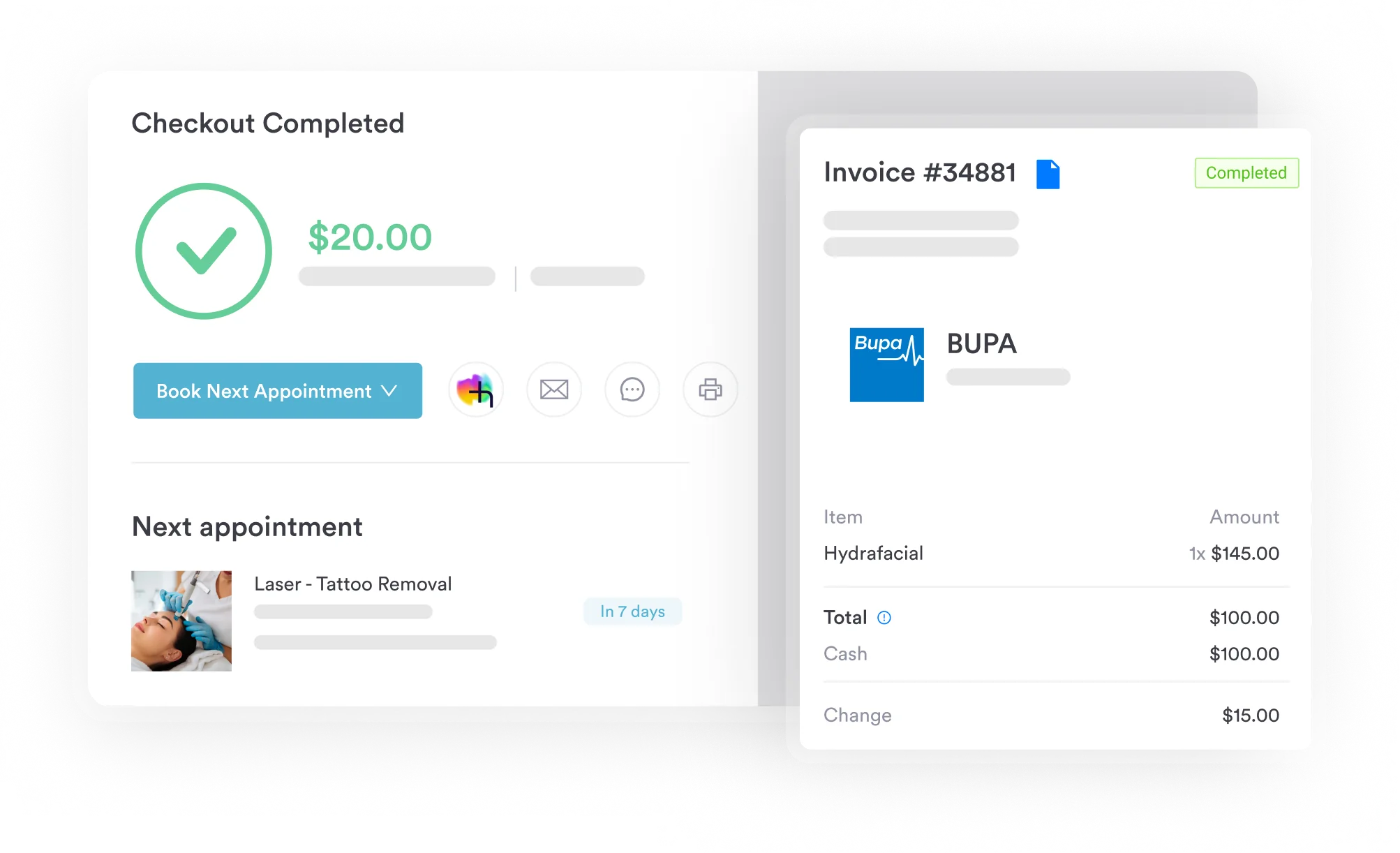

Pabau keeps clinical records, eligibility checks and Claim.MD claim submission on one patient file. Coders can check the operative note before a 31257 or 31259 claim goes out.

CPT 31257 turns on what happens inside the sphenoid. The sphenoidotomy is already in the code, so the question on every claim is whether tissue came out of that sinus. If it did, the claim belongs on 31259. If it did not, 31257 stands alone, with no sphenoidotomy code beside it.
Start with the operative note template. A required line on sphenoid status, for each side, settles the code choice before the chart reaches billing. Then check old cheat sheets for a 90-day global or a 31257 that stops short of the sphenoid, and correct them.
Book a demo to see how Pabau keeps the operative note and the Claim.MD claim on the same patient record.

Need a denial resolution framework? Denial codes in medical billing explains how to read CARC/RARC codes on ERA responses and map them to corrective actions.
Submitting claims electronically for the first time? 837 electronic claim file covers the EDI transaction set that clearinghouses such as Claim.MD use to send claims to Medicare and commercial payers.
Tracking post-payment adjustments? Electronic remittance advice (ERA) explains how 835 ERA files communicate payer payment decisions, including bilateral rate adjustments on modifier 50 claims.
Removing sphenoid tissue without an ethmoidectomy? CPT code 31288 covers the standalone endoscopic sphenoidotomy with tissue removal, and when it gives way to 31259.
Exploring the frontal sinus in the same case? CPT code 31276 explains the frontal sinus exploration code that pairs with 31257 on the same side.
CPT code 31257 describes a surgical nasal/sinus endoscopy with a total (anterior and posterior) ethmoidectomy that includes a sphenoidotomy. The surgeon opens the sphenoid sinus as part of the procedure. Removing tissue from inside the sphenoid moves the claim to 31259.
Both codes cover a total ethmoidectomy with a sphenoidotomy. CPT 31259 adds removal of tissue from the sphenoid sinus. Use 31259 only when the operative note documents tissue removed from the sphenoid, and report 31257 otherwise.
Yes. CPT 31254 (partial, anterior ethmoidectomy) and 31255 (total ethmoidectomy without sphenoidotomy) are active codes. The 2018 revision added 31253, 31257 and 31259 alongside them. Use 31255 when the sphenoid is not opened.
CPT 31257 has a 000 global period. Only the day of the procedure is bundled into the surgical payment. Post-operative visits on later dates are billed separately.
Many commercial payers require prior authorization for endoscopic sinus surgery, including CPT 31257. For Medicare, coverage criteria come from your Medicare Administrative Contractor (MAC). Verify requirements with each payer before scheduling surgery.
Yes. CPT 31257 has a bilateral indicator of 1. For Medicare, append modifier 50 to a single claim line, and payment is based on 150% of the unilateral amount. Some commercial payers prefer two lines with RT and LT modifiers.
No, not on the same side. The sphenoidotomy is already part of 31257, so 31287 adds nothing. When tissue is removed from the sphenoid, report 31259 in place of 31257 rather than adding 31288.
Chronic sinusitis codes such as J32.2 (ethmoidal), J32.3 (sphenoidal) and J32.4 (pansinusitis) are common pairings. Nasal polyp codes J33.0 and J33.1 apply when polyps are documented. Avoid J32.9 when the CT scan and operative note name the sinuses involved.
Yes, when the surgeon also performs a maxillary antrostomy with tissue removal. CPT 31267 covers maxillary work that 31257 does not include. Check the current NCCI edits for the pair before submitting.
For 2026, CMS assigns CPT 31257 7.80 work RVUs, 2.29 practice expense RVUs and 1.14 malpractice RVUs. That totals 11.23 RVUs in both settings, or about $375.09 at the $33.4009 conversion factor before GPCI adjustment.





