J32.9 is the billable ICD-10-CM code for chronic sinusitis, unspecified. It applies when the provider documents chronic sinusitis but the record names no affected sinus.
The code sits in category J32, Chronic sinusitis, within Chapter 10, Diseases of the respiratory system (J00-J99). Sinusitis documented without acute or chronic also defaults to J32.9 in the ICD-10-CM index. When the note names one sinus, several or all of them, a site-specific code from J32.0 to J32.8 applies instead.
Automate repetitive tasks and focus on what matters most—your patients.
Improve accuracy
Reduce coding errors and ensure compliance with the latest regulations.
Get paid faster
Clean claims, fewer denials, and faster reimbursements.
Grow with confidence
Powerful insights and reporting to help your practice thrive.
HIPAA compliant•SOC 2 certified•GDPR-compliant•Trusted by 4,000+ clinics worldwide
Key takeaways
J32.9 is the billable ICD-10-CM code for chronic sinusitis when the record names no affected sinus.
Sinusitis documented without acute or chronic defaults to J32.9 in the ICD-10-CM index, so acute disease must be stated to reach J01.
Site-specific codes J32.0 to J32.8 replace J32.9 whenever the note or the imaging report names the sinuses involved.
J01 lists sinusitis NOS (J32.9) as Excludes1, so J32.9 and an acute sinusitis code don’t belong on the same claim.
Pabau, the practice management platform we build, submits CMS-1500/837P claims through Claim.MD and tracks each one, with eligibility checks and ERA remittances alongside.
ICD-10 code J32.9 covers chronic sinusitis with no site named
ICD-10 code J32.9 is the billable ICD-10-CM code for chronic sinusitis, unspecified. The NCHS ICD-10-CM tabular list files it under category J32, with one inclusion term: “Sinusitis (chronic) NOS.” You use it when the provider confirms chronic sinusitis but the record names no sinus.
The table below holds the core facts to check before the claim goes out.
Field
Detail
Code
J32.9
Official descriptor
Chronic sinusitis, unspecified
Billable / specific
Yes, valid for HIPAA-covered transactions
ICD-10-CM chapter
Chapter 10, Diseases of the respiratory system (J00-J99)
Code block
J30-J39, Other diseases of upper respiratory tract
Code category
J32, Chronic sinusitis
Inclusion term
Sinusitis (chronic) NOS
Plain “sinusitis” in a note lands on J32.9 by default
J32.9 describes inflammation of the paranasal sinuses that the provider documents as chronic, without naming the sinus involved. ICD-10-CM itself sets no duration. Clinically, the AAO-HNS adult sinusitis guideline defines chronic rhinosinusitis as symptoms lasting 12 weeks or longer.
The index matters more than many coders expect. Under the main term “Sinusitis,” the word “(chronic)” is a nonessential modifier, and the default code is J32.9. The FY2026 official coding guidelines tell you to assign the default code when a condition is documented without acute or chronic.
So a note that says only “sinusitis” codes to J32.9. Reaching J01.90 takes the word “acute” in the record. The same guidelines also accept unspecified codes when they reflect what was known at that encounter.
Presentations that commonly land on J32.9 include:
Persistent nasal congestion, facial pressure or postnasal drip for more than three months, with no sinus named in the note
Chronic rhinosinusitis (CRS) recorded without imaging or endoscopy findings that identify a site
Follow-up visits where the original encounter never recorded which sinus was affected
Sinusitis documented with no acuity at all, which the index sends to the default code
J32’s tabular notes decide what you report alongside it
Category J32 carries an includes note, a “use additional code” note and one Excludes2 note. The chapter adds a tobacco note, and J01 adds an Excludes1 that names J32.9 directly. Misreading these is a common source of claim edits.
Note type
Code / condition
Coding action required
Inclusion term (J32.9)
Sinusitis (chronic) NOS
This term maps directly to J32.9, with no additional code needed for the sinusitis itself
Includes (J32)
Sinus abscess, empyema, infection, suppuration
Chronic forms of these conditions code within J32, by site where documented
Use additional code (J32)
Infectious agent, B95-B97
Add the organism code when the record identifies the infectious agent
Add the code that matches the documented tobacco history or exposure
Excludes2 (J32)
Acute sinusitis – J01.-
Not included in J32. A site-specific J32.0-J32.8 code and a J01 code may both be reported when both conditions are documented
Excludes1 (at J01)
Sinusitis NOS (J32.9)
J32.9 is not reported with a J01 code. Query for the site when acute and chronic disease are both documented
A named sinus moves you off J32.9
J32.9 is the unspecified code within the J32 family. Before settling on it, check whether the note or the imaging report supports one of the site-specific codes in the table below. The official guidelines call for the most specific code the documentation supports.
Code
Descriptor
Use when…
J32.0
Chronic maxillary sinusitis
Note documents maxillary sinus involvement
J32.1
Chronic frontal sinusitis
Note documents frontal sinus involvement
J32.2
Chronic ethmoidal sinusitis
Note documents ethmoidal sinus involvement
J32.3
Chronic sphenoidal sinusitis
Note documents sphenoidal sinus involvement
J32.4
Chronic pansinusitis
Documentation confirms all sinus groups are affected, not just “bilateral” or “multiple”
J32.8
Other chronic sinusitis
Two or more sinuses named but not all, such as maxillary and ethmoidal without frontal or sphenoidal
J32.9
Chronic sinusitis, unspecified
No sinus site is documented, and a provider query doesn’t add one
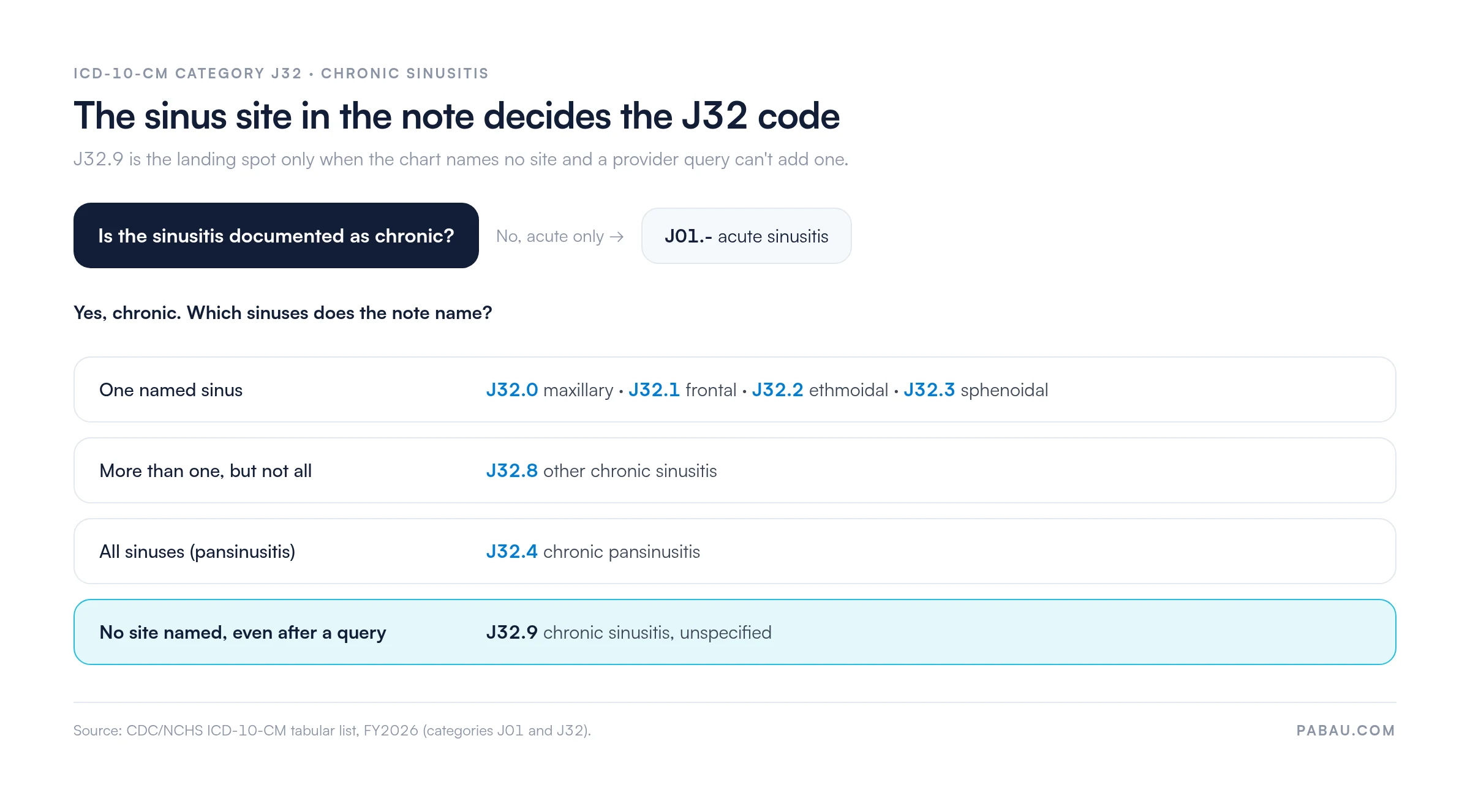
Read as a decision, the table comes down to one question about the note, as the path below shows.
J32.9 sits at the end of the path, reached only when no site survives a provider query. Codes follow the CDC/NCHS FY2026 ICD-10-CM tabular list.
J32.9 vs J01.90 comes down to documented acuity
A frequent sinusitis coding error is assigning J01.90 (acute sinusitis, unspecified) to a patient whose record describes a chronic condition.
The choice decides which payer policies apply and which procedures can pass medical necessity review. Use this comparison when you review encounter notes.
Feature
J32.9 (Chronic, unspecified)
J01.90 (Acute, unspecified)
Clinical duration (AAO-HNS)
12 weeks or more
Up to 4 weeks
Symptom pattern
Persistent and low grade, sometimes with flares
Sudden onset, often with fever and more severe facial pain
Documentation signal
“Chronic,” “long-standing,” “ongoing,” or no acuity stated at all
“Acute,” “sudden onset,” “new episode”
Surgery eligibility
Accepted as a primary diagnosis for FESS with medical necessity documentation
Rarely supports FESS, so surgical claims under it are likely to be denied
Common error
Using J32.9 when a J32.0-J32.8 site is documented
Using J01.90 when the note says “chronic” or lists prior sinusitis treatment
“Recurrent” is the word to watch. Recurrent acute sinusitis has its own codes in J01, ending in 1, such as J01.91. It is not a synonym for chronic sinusitis.
Documentation that holds up for chronic sinusitis
Payers look harder at J32.9 than at site-specific J32 codes, because it often signals thin documentation. A defensible claim needs a few specific elements in the provider’s note. A clean claim review before billing catches most of the missing ones.
Acuity statement: The word “chronic,” a stated duration of 12 weeks or more, or a treatment history that shows long-standing disease.
Sinus site: A named site, which moves the claim to a more specific J32 code. Otherwise, a statement that the site can’t be identified on current evidence.
Symptoms: At least two of the cardinal CRS symptoms. These are nasal obstruction, mucopurulent drainage, facial pain or pressure, and reduced sense of smell.
Prior treatment: Earlier antibiotic courses, nasal steroid use or previous acute episodes, which support the chronic designation.
Imaging or endoscopy: For surgical or specialist claims, a CT or nasal endoscopy report showing mucosal thickening or obstruction. Most payers expect imaging before they approve FESS.
If a note has no acuity statement and no site, send a provider query before you assign J32.9. Coding from the problem list alone carries forward whatever the last encounter recorded.
Medical necessity hinges on failed treatment and imaging
CPT descriptors come from the AMA’s CPT code set, while Medicare coverage rules come from Local Coverage Determinations (LCDs). Each Medicare Administrative Contractor (MAC) publishes its own. Policies vary, but most payers apply criteria like these.
Office visits (E/M codes): Usually met when the note documents chronic symptoms, prior treatment and a plan of care. Imaging isn’t needed for an E/M visit when the picture is clearly chronic.
CT sinuses: Many payers want documented failure of conservative treatment, such as nasal steroids or antibiotics, before approving CT. Some check this at prior authorization, and others on retrospective review.
Nasal endoscopy (CPT 31231): Generally covered under J32.9 when the note documents CRS symptoms and a reason for endoscopic evaluation.
FESS: Needs the strongest file. That means failed medical management over the payer’s required period, CT evidence of disease and a statement that conservative treatment is exhausted.
Review your MAC’s sinus-related LCDs each year, because coverage criteria change between cycles. In revenue cycle management terms, that means a prior authorization step before any surgery or advanced imaging gets scheduled.
These CPT codes travel with J32.9 most often
The table below lists CPT codes often paired with J32.9 in ENT and primary care billing. Check pairings against the AAPC Codify ICD-10-CM resources and the current year’s NCCI edits, because bundling rules change annually.
CPT code
Service description
Audit-risk note
99213 / 99214
Office or other outpatient visit, established patient (low to moderate medical decision making)
Low risk. Make sure MDM or time documentation supports the level selected
31231
Nasal endoscopy, diagnostic
Moderate risk. Some payers require prior authorization under J32.9
31254
Nasal/sinus endoscopy with ethmoidectomy, partial
Higher risk. Prior authorization is typically required, and J32.9 alone may fall short without imaging evidence
31255
Nasal/sinus endoscopy with ethmoidectomy, total
Higher risk, same as 31254
31256
Nasal/sinus endoscopy with maxillary antrostomy
Consider J32.0 if maxillary documentation exists, since J32.9 may trigger a specificity query
31267
Nasal/sinus endoscopy with maxillary antrostomy and removal of tissue from the maxillary sinus
High audit risk with J32.9. J32.0 fits better if the maxillary site is documented
70486
CT scan, maxillofacial area, without contrast
Many payers want documented failure of medical management before approving imaging under J32.9
Procedure codes that name a sinus, such as 31256 and 31267, sit awkwardly beside an unspecified diagnosis. The diagnostic endoscopy rules are covered under 31231, and partial ethmoidectomy under 31254.
For sinus imaging, the page on 70486 covers the CT itself. Other sinus procedures are listed in our CPT code library.
Prior authorization tightens around sinus surgery
Not every service billed under J32.9 needs prior authorization. Several high-cost services do with most commercial payers and many Medicaid managed care plans. Knowing which ones before scheduling saves a surgical cancellation or a retrospective denial.
Services that commonly require prior authorization with J32.9:
CT sinuses (70486): Many commercial payers require authorization when J32.9 is the requesting diagnosis. Include documentation of failed medical management. Some plans route imaging through a radiology benefit manager (RBM), so confirm the route first.
FESS (31254, 31255, 31256, 31267, 31276, 31288): Typically requires prior authorization with most payers. The request needs the CT report, documented failed medical therapy over the required period and the operative plan. Most payers expect supporting imaging even when the site is unspecified.
Allergy testing and immunotherapy: When ordered in the context of CRS, some payers require authorization. They may challenge J32.9 as the primary diagnosis if an allergy-specific code fits better.
When the sinus site is genuinely unknown, say so in the request narrative. A single line such as “bilateral diffuse CRS, specific site not isolable on current imaging” answers the specificity question before a reviewer asks it.
How a J32.9 claim moves from note to payment
Most J32.9 problems start upstream of the claim form. Here is the path a typical sinusitis claim takes, and where it tends to stall.
The encounter note. The provider records acuity, symptoms, treatment history and any site. A missing site here is what produces J32.9 later.
Code assignment. The coder checks the index and the tabular notes, then queries the provider if the site is unclear.
Authorization. Imaging and surgery need the auth number on file before the service date.
Claim build and scrub. The claim goes out as a CMS-1500 or 837P, and the clearinghouse rejects format and eligibility errors.
Adjudication and remittance. The payer applies its edits and medical necessity rules, then returns an ERA with payment or denial reasons.
Before you submit, run this J32.9 checklist
The note says “chronic,” gives a duration of 12 weeks or more, or documents long-standing disease.
No sinus is named in the note, the CT report or the endoscopy findings.
No J01 code sits on the same claim, since J01 lists J32.9 as Excludes1.
An organism code from B95-B97 is added if the record names the infectious agent.
The prior authorization number is attached for any CT or sinus surgery.
The procedure code doesn’t name a sinus that the diagnosis leaves unspecified.
Pro Tip
Before billing J32.9 on a FESS claim, confirm three things. CT evidence is attached or referenced in the operative note. Failed medical management is documented over the payer’s required period. The chart shows prior conservative treatment. A claim missing any one of them is easy for a reviewer to deny.
J32.9 denials usually trace back to the note
Unspecified sinusitis codes draw payer edits when the claim’s own attachments point to a named site. Good denial management workflows deal with these causes before the remittance arrives.
Unspecified code when a site is documented: A CT report in the same encounter references maxillary disease, so J32.0 is expected. Resolution: cross-check J32.9 claims against any attached imaging report before release.
No acuity or duration documented: The note mentions sinusitis but nothing that supports a chronic course for surgery or imaging. Resolution: remind providers to state “chronic” or a duration, plus the treatment history.
Missing imaging for FESS: J32.9 is the primary diagnosis, but no CT is referenced in the authorization paperwork. Resolution: attach the CT report to the request and reference it in the operative note.
Acute and chronic codes mixed: J01.90 on one encounter and J32.9 on the next confuses the payer’s view of the episode. Resolution: review earlier claims before submitting follow-up visits.
No prior authorization for surgery: FESS is billed under J32.9 without a valid auth number. Resolution: make auth confirmation part of the surgical scheduling checklist.
Each of these is cheaper to fix before submission than after. That makes claim status tracking worth as much as the coding itself.
How Pabau keeps J32.9 claims moving from auth to payment
In many ENT and primary care practices, a sinusitis claim touches four tools. Eligibility gets checked on a payer portal and authorizations sit in a spreadsheet. Claims go out through a separate clearinghouse, and remittances arrive by mail or another login.
Pabau, our practice management platform, brings those steps into one system. Its specialty practice claims software checks eligibility and submits CMS-1500/837P claims through Claim.MD. ERA remittances and secondary claims come back to the same record.
For FESS and sinus CT, the authorization code, dates and sessions are tracked on the patient’s case. Pabau warns you when one is missing, so the problem shows up before the service date.
Pabau’s claim tracking shows where each sinusitis claim sits, so your team spots a denied J32.9 claim and reworks it quickly.
Track every sinusitis claim from auth to payment
Pabau checks eligibility, tracks prior authorizations on the case and submits claims through Claim.MD. Remittances come back to the same record, so your team sees each claim’s status in one place.
Treat J32.9 as the answer to one narrow situation. The provider confirmed chronic sinusitis, or documented sinusitis with no acuity, and no sinus is named anywhere in the record. Every other case has a better code, and finding it usually takes one query or one look at the CT report.
The payoff shows on surgical and imaging claims, where payers read the diagnosis most closely. A named site, a stated duration and an attached CT give a reviewer far fewer reasons to say no.
Book a demo to see how Pabau tracks sinus surgery authorizations and gets each claim through Claim.MD to remittance.
Continue your research
Need a denial prevention framework for ENT billing?Denial management in healthcare covers the workflow for identifying, correcting and preventing claim denials.
Submitting claims electronically for the first time?Claim.MD clearinghouse guide explains how the clearinghouse route works and which payer connections are available.
Want the full revenue cycle behind sinusitis billing?Revenue cycle management guide explains how diagnosis coding connects to submission, adjudication and payment posting.
Billing frontal sinus surgery?CPT code 31276 covers endoscopic frontal sinus exploration and its documentation.
How do you code chronic sinusitis with nasal polyps?
Code both conditions. The J32 code covers the sinusitis, and a J33 code covers the polyps. J33.0 is a polyp of the nasal cavity, J33.8 covers other sinus polyps and J33.9 is an unspecified nasal polyp.
What ICD-9 code did J32.9 replace?
J32.9 maps from ICD-9-CM 473.9, chronic sinusitis, unspecified. You may still see 473.9 in older records or problem lists carried over from before October 2015.
Is recurrent sinusitis coded as J32.9?
No. Recurrent acute sinusitis has its own J01 codes ending in 1. J01.01 covers the maxillary sinus, and J01.91 applies when the site is unspecified.
Does J32.9 need an organism code?
Only when the record identifies the infectious agent. Category J32 tells you to add a code from B95-B97 in that case.
What is the difference between J32.4 and J32.9?
J32.4 is chronic pansinusitis, used when documentation confirms that all sinus groups are inflamed. J32.9 applies when the sinus site is unspecified. Multiple but not all sinuses is J32.8.