

CPT Code 52352: Ureteroscopic stone removal billing guide
CPT Code 52352: Official descriptor and procedure overview CPT Code 52352 descri...

Last Updated: Oct 30, 2026
29914 is the CPT code for arthroscopy, hip, surgical; with femoroplasty (i.e., treatment of cam lesion). It covers arthroscopic removal of a cam-type bony bump at the femoral head-neck junction, the overgrowth behind cam femoroacetabular impingement (FAI).
It belongs to a three-code family with 29915 (acetabuloplasty for a pincer lesion) and 29916 (labral repair). 29914 can be reported with either sibling when the operative note documents each procedure. Diagnostic arthroscopy, chondroplasty and synovectomy in the same hip are not reported on top of it.
Let Pabau's smart automation suggest the right codes, reduce claim denials, and keep your practice compliant—effortlessly.
Automate repetitive tasks and focus on what matters most—your patients.
Reduce coding errors and ensure compliance with the latest regulations.
Clean claims, fewer denials, and faster reimbursements.
Powerful insights and reporting to help your practice thrive.
HIPAA compliant SOC 2 certified GDPR-compliant Trusted by 4,000+ clinics worldwide

CPT 29914 covers arthroscopic femoroplasty, the resection of a cam lesion that causes femoroacetabular impingement (FAI).
It pairs with acetabuloplasty (29915) or labral repair (29916), but diagnostic arthroscopy (29860), chondroplasty (29862) and synovectomy (29863) are not reported with it.
The operative note must name the femoroplasty explicitly and confirm adequate cam resection on fluoroscopy or arthroscopic imaging.
Most commercial and Medicare Advantage plans require prior authorization, while traditional Medicare does not, though LCD medical necessity criteria still apply.
Pabau, the practice management platform we build, submits 29914 claims through its Claim.MD integration and flags denied claims for rework.
CPT code 29914 is defined by the American Medical Association as Arthroscopy, hip, surgical; with femoroplasty (i.e., treatment of cam lesion). It describes a surgical procedure. Diagnostic-only hip arthroscopy takes CPT 29860, so reporting 29914 for a look-only scope is a coding error.
The code captures arthroscopic removal of the cam-type bony prominence at the femoral head-neck junction, which causes femoroacetabular impingement (FAI). FAI must be documented and confirmed by imaging before surgery. Without that documentation chain, the claim lacks medical necessity support, whatever the surgeon performed in the operating room.
Key scope boundaries:
All three codes belong to the hip arthroscopy family, and each describes a separate surgical act within a hip preservation procedure. The billing question is which combinations can be reported in the same session.
National Correct Coding Initiative (NCCI) edits decide which code pairs can be reported together, and CMS updates them quarterly. 29914 is reported with 29915 when a pincer lesion is also resected, or with 29916 when the labrum is repaired. Coding sources report no NCCI edit between 29914 and 29916, so that pairing is standard for femoroplasty plus labral repair.
Whether either pairing needs a modifier follows the current NCCI table and each payer’s policy, so check both before you submit. The 29915 and 29916 pairing is different. Coding sources report the two as mutually exclusive under NCCI, so confirm the current edit and payer policy before billing both.
Medical necessity for CPT code 29914 depends on pairing it with ICD-10-CM codes that establish both the FAI diagnosis and the specific laterality. Payers using Local Coverage Determinations (LCDs) often require a primary FAI-specific code rather than a generic hip pain code.
Laterality matters. Submitting M24.859 (unspecified hip) when the operative report documents a right-hip procedure is a preventable denial. Many MAC LCDs require the laterality-specific code as the primary diagnosis. Always match the ICD-10 laterality suffix to the operative side documented in the surgeon’s note.
Thin operative notes are a common cause of CPT code 29914 denials. The record must demonstrate a continuous chain from pre-operative diagnosis through intraoperative findings to the specific surgical act performed.
A compliant 29914 record contains all of the following:
Build a 29914 prior authorization packet with three parts: the FAI imaging report, a physical therapy summary with dates, and a short surgeon narrative. The narrative links the imaging findings to the planned femoroplasty. Reuse the packet for every request to cut preparation time and auth denials.
Practices using claim-scrubbing billing software can build pre-submission checklists that flag missing elements before the claim reaches the clearinghouse. Catching a missing therapy-trial note at the billing stage costs seconds. Catching it at appeal costs hours.

Prior authorization requirements for CPT code 29914 vary by payer type, plan, and even MAC jurisdiction, so check each patient’s plan individually.
Confirming insurance eligibility verification before scheduling the procedure is the simplest way to identify auth requirements. A patient’s plan-year coverage may differ from the prior year even with the same insurer. Verify at the point of scheduling, not the day before surgery.
Medicare reimbursement for CPT code 29914 is calculated from the relative value units (RVUs) published each year in the Medicare Physician Fee Schedule (MPFS). Rates vary by locality. The figures below reflect the national average, so verify them against your MAC’s locality-adjusted rate in the CMS Physician Fee Schedule Look-Up Tool.
The 90-day global period is a frequent source of confusion. Routine recovery visits, such as wound checks, range-of-motion assessments and standard post-op evaluations, are bundled into the global payment. Only an E&M for an unrelated condition, or a complication that needs a return to the operating room, falls outside the global window.
CPT code 29914 denials cluster around five avoidable errors, and a denial management routine catches each one before submission.
Tracking denial reason codes on 29914 claims shows which of these five patterns your practice hits most often. Reviewing medical billing denial codes against the operative notes usually surfaces the same one or two root causes. Those can be fixed at the workflow level rather than case by case.
Hip arthroscopy often involves more than one surgical component in a single session. The chart below shows which codes can sit alongside 29914 on the same claim, and which ones it already includes.
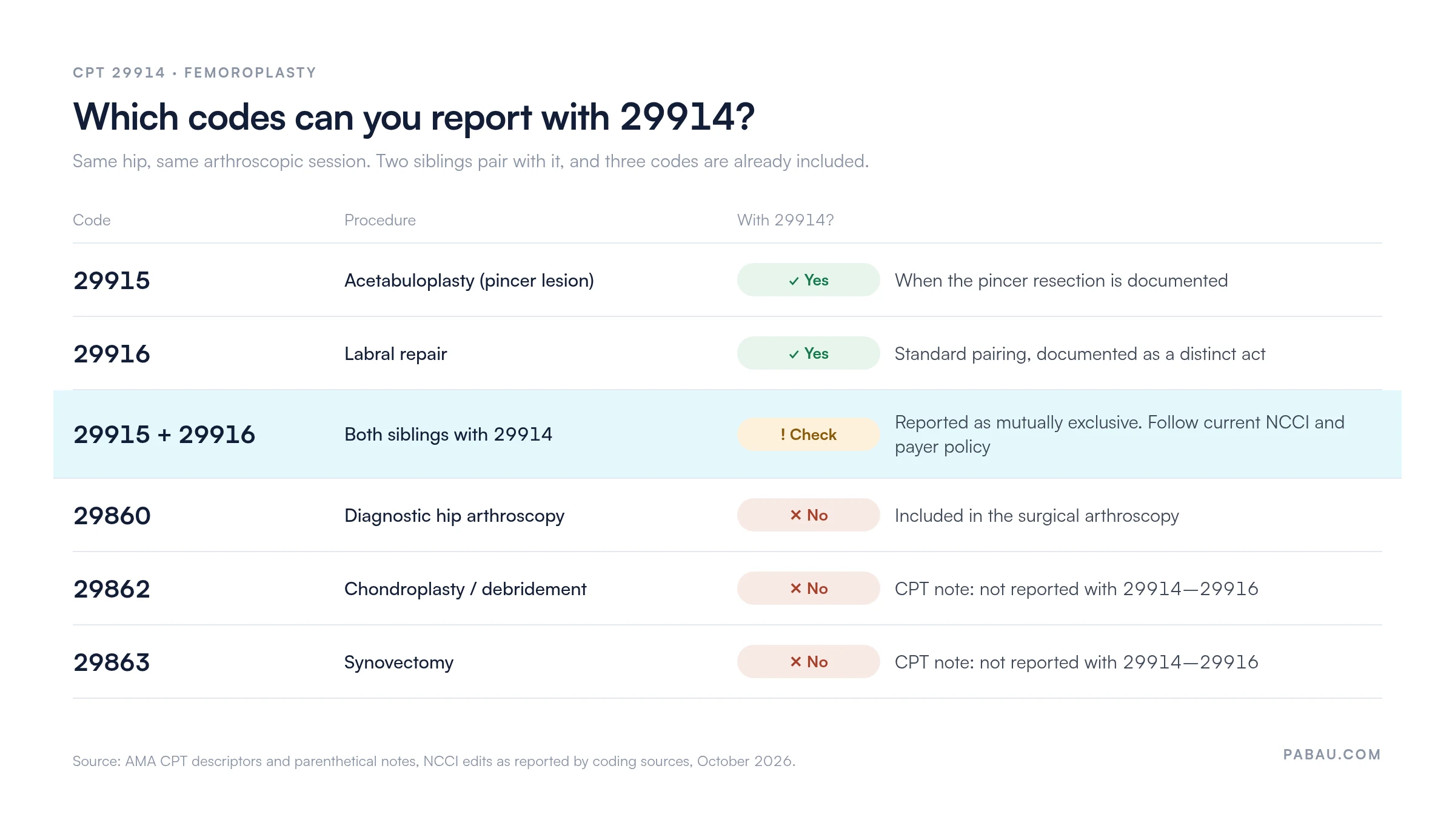
The table adds the modifier and documentation notes for each pairing.
Chondroplasty and synovectomy are not separately reportable with 29914. NCCI and CPT guidance bundle 29862 and 29863 into these codes, so a modifier does not unbundle them.
Practices with high hip arthroscopy volume benefit from clean claim submission workflows that review the code pairs on every 29914 claim. If a payer’s own edits bundle 29916 into 29914, the practice loses roughly the full 29916 payment on that case. Across a busy orthopedic practice, that adds up quickly.
Run a quarterly audit of 29914 claims paid below the expected rate, filtered by code pair (29914 + 29916, 29914 + 29915). If one payer keeps underpaying the secondary code, review that payer’s modifier and bundling policy. Correct it on future claims rather than re-billing old ones.
Orthopedic and sports medicine practices billing CPT code 29914 lose time to prior authorization delays, thin operative notes and repeat denials. Pabau’s Claim.MD integration sends electronic claims to thousands of US payers and runs real-time eligibility checks before the visit.
Many practices still key claims into a separate clearinghouse portal and match remittances by hand. In Pabau, the CMS-1500 claim is generated from the invoice already in the patient record. Claim.MD then sends it to the payer in the 837P electronic claim format, so nobody builds an X12 file.
Remittances come back as ERAs matched to the claims they settle, and denied claims are flagged for rework. Your billing team sees which 29914 claims need a pairing fix or a missing therapy note while the appeal window is still open.

Pabau integrates with Claim.MD to check eligibility, submit CPT 29914 claims electronically, and flag denied claims for rework. See how orthopedic and sports medicine practices use Pabau to cut claim rework.

Most 29914 claims are won or lost before the first incision. Build the imaging, therapy-trial and prior authorization record first, then code from the operative note rather than the surgical plan.
The pairing rules deserve the most caution, because coding sources and payers still read them differently. Check the current NCCI table and each payer’s policy every quarter. An underpaid 29914 + 29916 claim is your prompt to review that payer’s rules.
Pabau handles the eligibility check, claim submission and denial follow-up for orthopedic practices billing 29914 at volume. Book a demo to see how it fits your payer mix.

Want to understand how clean claims reduce surgical billing rework? Clean claim submission best practices covers the pre-submission steps that prevent front-end rejections on high-value procedure codes.
Dealing with repeated denials on arthroscopy claims? Electronic remittance advice (ERA) explained shows how to read CARC and RARC denial codes to fix root causes instead of re-billing blindly.
Looking for a clearinghouse that handles orthopedic claim volume? Medical claims clearinghouse guide explains how to evaluate clearinghouse options for surgical practices.
CPT code 29914 is the surgical procedure code for hip arthroscopy with femoroplasty. It covers arthroscopic resection of a cam lesion to treat femoroacetabular impingement (FAI). Diagnostic-only hip arthroscopy is billed with CPT 29860 instead.
CPT 29914 covers femoroplasty (cam lesion resection), 29915 covers acetabuloplasty (pincer lesion resection), and 29916 covers labral repair. 29914 can be reported with 29915 or with 29916 when the operative note documents each procedure. Coding sources report 29915 and 29916 as mutually exclusive under NCCI, so billing them together depends on current NCCI edits and payer policy.
Yes, traditional Medicare covers CPT 29914 when medical necessity criteria are met. That means a confirmed FAI diagnosis on imaging and documented failed conservative treatment. Traditional Medicare does not require prior authorization, but coverage follows the Local Coverage Determination (LCD) for your MAC jurisdiction. Medicare Advantage plans typically do require prior authorization.
Most commercial plans (BCBS, Aetna, Cigna, UHC) and Medicare Advantage plans require prior authorization for 29914, but traditional Medicare does not. State Medicaid programs typically require it as well. Verify the plan’s requirements at scheduling, since they can change year to year even within the same insurer.
CPT 29914 carries a 90-day global surgery period. Routine post-operative visits during this period are bundled into the surgical payment and cannot be billed separately. An E&M for a completely unrelated condition during the 90-day period may be billed separately with modifier -24. Verify the current global period assignment via the CMS Physician Fee Schedule Look-Up Tool for the active fee schedule year.
The primary supporting ICD-10-CM code is M24.851 (right hip) or M24.852 (left hip) for femoroacetabular impingement. Hip pain codes such as M25.551/M25.552 support symptom burden but are not enough on their own for most payers. When 29916 is added, M24.151/M24.152 or a traumatic S73.19- code supports the labral repair. Always match laterality to the operative side in the surgeon’s note.



