CPT code 21011: Excision of soft tissue tumor of the face
CPT code 21011: Official descriptor and procedure overview CPT code 21011, as pu...

Last Updated: Oct 8, 2026
CPT Code 29916 is the billing code for arthroscopy, hip, surgical; with labral repair. The surgeon uses an arthroscope to reach the hip joint and reattach a torn or detached labrum.
According to the American Medical Association, which maintains the CPT code set, 29916 includes any diagnostic arthroscopy performed in the same operative session. That means you cannot bill a separate diagnostic arthroscopy code alongside it. Medicare pays about $930.55 for the code nationally in 2026.
This reference covers the 2026 Medicare fee schedule, modifier rules, the ICD-10 crosswalk, NCCI bundling edits, ASC considerations, and documentation requirements. It also explains when 29999 replaces 29916, so billing teams and orthopedic practice managers can submit clean claims for hip labral repair.

CPT Code 29916 describes arthroscopy, hip, surgical with labral repair. Diagnostic arthroscopy is included in it and cannot be billed separately.
The 2026 Medicare national rate is about $930.55, built on 14.63 work RVUs and 27.86 total RVUs. Rates still vary by GPCI locality.
Modifiers -LT and -RT for laterality and -22 for increased complexity are the ones you apply most often. A missing laterality modifier is the leading denial cause.
Pabau’s claims management software links the operative note to claim submission, so the documentation that justifies 29916 travels with the claim.
CPT Code 29916 is defined by the AMA as: Arthroscopy, hip, surgical; with labral repair. It sits in the Musculoskeletal System chapter of the CPT code set, under the Endoscopy and Arthroscopy subsection.
The code applies when the surgeon arthroscopically visualizes the hip joint and identifies a labral tear or detachment. The repair itself typically uses suture anchors to reattach the labrum to the acetabular rim.
Hip labral tears most commonly result from femoroacetabular impingement (FAI), hip dysplasia, or acute trauma. Payers approve the surgery only after conservative management has failed, so the record needs that history. Physical therapy, activity modification, and NSAIDs all count toward it.
The operative note should describe the tear morphology, the repair technique, and the number of suture anchors placed. It should also say why the surgeon repaired the labrum rather than debriding it.
Medicare reimburses CPT Code 29916 under the Medicare Physician Fee Schedule (MPFS). The published rate is a national average, and your payment moves with the Geographic Practice Cost Index (GPCI) for your locality.
The figures below come from the CMS Physician Fee Schedule lookup tool. Verify them against current CMS data before billing.
Important note on rate accuracy: Medicare rates for CPT Code 29916 change every year. The figures above are the 2026 national averages published by FastRVU’s 2026 RVU lookup.
CMS lists the same amount for the facility and non-facility settings, because the procedure is effectively never performed in an office. Your own payment will differ once GPCI adjustments apply, so pull the official CMS MPFS file for final billing reference.
Hip arthroscopy is almost never performed in a non-facility (office) setting. The procedure needs general or regional anesthesia and sterile arthroscopic equipment. Nearly all 29916 claims are therefore submitted from a hospital outpatient department or an ASC.
CMS confirms that CPT 29916 is payable in the ASC setting. The practice bills the professional component while the ASC bills its facility fee separately. Commercial payer contracts may override Medicare rates, so check your ASC participation agreements before billing.
Modifier selection is one of the most denial-prone steps in billing hip arthroscopy. A missing laterality modifier is the single most common reason CPT 29916 claims are rejected on first submission. Use the table below to pick the right modifier for each clinical scenario.
Commercial payers often follow Medicare modifier policy, but verify payer-specific rules before submitting. Modifier -22 needs a separate written narrative explaining why the work was substantially greater than typical. Without it, the modifier will be ignored or denied.
Every claim for CPT Code 29916 must carry an ICD-10-CM diagnosis code that establishes medical necessity. The codes below are the ones most commonly paired with hip labral repair, and the full ICD-10-CM code index covers the rest. Acceptance of any single code is payer-specific and subject to local coverage determinations.
Coders should select the most specific ICD-10-CM code that the operative findings and pre-operative imaging support. Document the imaging study, since MRI with arthrogram is typical for labral tears.
Record the failure of conservative treatment too, because payers that require prior authorization read it before approving surgery. The AAPC Codify CPT lookup carries current crosswalk data if you want to verify a pairing.
The same matching discipline runs through other specialties. Our page on CPT 67904, the eyelid ptosis repair code, crosswalks the H02 diagnosis codes to the side recorded in the operative note.
CPT Code 29916 is one of four surgical hip arthroscopy codes. Choosing the wrong sibling code is a common upcoding or undercoding error. The table below maps each code to its clinical meaning, so coders can pick the right descriptor from the operative report.
When the surgeon performs both a labral repair and a femoroplasty in the same session, 29914 and 29916 may both be billed with modifier -51. Check the NCCI edit pair for those codes before submitting, since payer policy varies. Billing 29916 when only debridement was performed is upcoding, and it triggers audit risk.
The distinction usually comes down to a few words in the operative report. The map below shows which phrase supports which code.
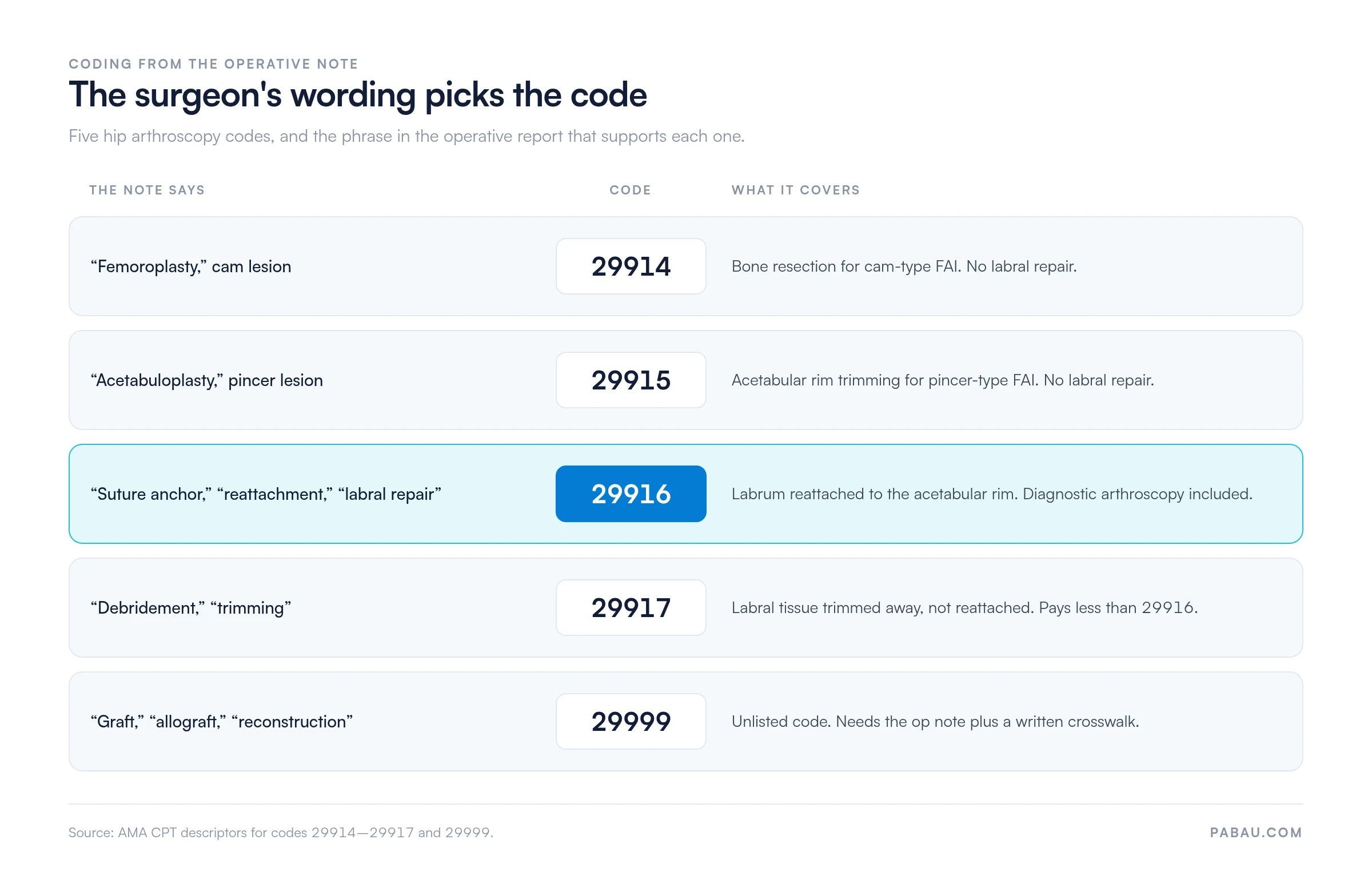
Pull the operative report before coding. If the surgeon describes “anchor placement” or “suture repair of the labrum,” that confirms 29916. If the note only says “debridement” or “trimming,” the correct code is 29917. The difference matters for reimbursement and for audit compliance.
The National Correct Coding Initiative (NCCI) defines which code pairs cannot be billed together without a modifier. For CPT Code 29916, the most important bundling rules are:
Before submitting any 29916 claim with additional codes, verify the current NCCI PTP edit tables via the CMS code list. The tables are updated quarterly, so an edit that was bypassable last year may have changed. When one of those conflicts does reach the payer, managing claim denials becomes the billing team’s next job.
Insurers deny CPT Code 29916 claims more often over thin documentation than over coding errors. The operative note is the foundation of every hip labral repair claim.
A note reading only “hip arthroscopy with labral repair” is not enough for most commercial payers. Without the technique, the anchor count, and the tear extent, expect a medical records request or an outright denial.
Structured operative note templates that prompt the surgeon for each required element bring denial rates down. The prompt catches a missing laterality line or an unrecorded anchor count while the surgeon is still writing. That is weeks earlier than a payer audit would find it.
Proving that a lesser option failed also drives coverage on the equipment side. The face-to-face examination behind HCPCS code K0820 must record difficulty with mobility-related activities of daily living at home. It also has to explain why a manual wheelchair or group 1 device is inadequate.
CPT 29999 is the unlisted arthroscopy procedure code. Use it when the procedure performed matches no specific descriptor in the 29914-29917 range. It is not a workaround for a poorly documented procedure that actually fits 29916.
Submitting 29999 requires a cover letter or an attached operative report. It has to explain the procedure in detail and say why no existing code applies. It also needs a crosswalk to the closest analogous code, usually 29916, so the payer can price the service.
Without that package, 29999 claims are typically denied on first submission. Practices that handle unlisted codes often keep a standard 29999 submission template, so the documentation is consistent every time.
If the surgeon performed a labral reconstruction with graft tissue rather than a direct suture repair, 29916 is the wrong code. Check the operative note for words like ‘graft,’ ‘allograft,’ or ‘reconstruction’ versus ‘repair,’ ‘suture anchor,’ or ‘reattachment.’ The word choice determines whether you need 29999.
A denied CPT Code 29916 claim costs more in aged revenue than in rework time. Repeated appeal cycles push the payment further out every round. Orthopedic practices that keep clinical documentation and billing in separate systems lose the most here.
The handoff between the two systems is where denial-causing errors enter. The coder never sees the full operative note, the laterality modifier is dropped at submission, or the medical necessity narrative never attaches to the claim.
Practice management software like Pabau keeps the clinical record and the billing queue in one system. Our orthopedic claims management tools carry the operative note, the diagnosis codes, and the procedure codes together. When a hip labral repair claim is built, the clinical note is already attached to it.
Billing staff can verify laterality, confirm the repair technique matches 29916 rather than 29917, and attach the imaging report before the claim leaves the practice. Pabau’s Claim.MD integration then handles the electronic route out. It covers claim submission, payer eligibility checks, claim status tracking, remittance advice, and payer enrollment.
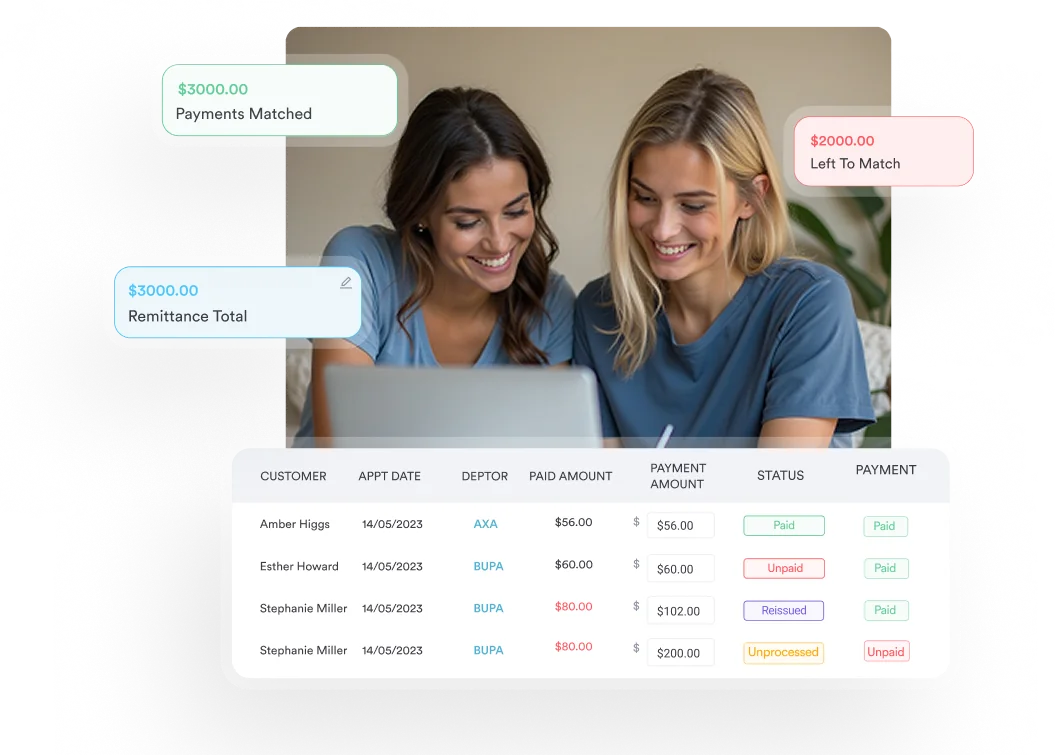
For orthopedic and sports medicine practices running high volumes of arthroscopic procedures, that single workflow keeps scheduling, clinical documentation, and billing in step. Electronic claim submission from the same record removes the manual re-entry that causes avoidable rejections.

Pabau connects clinical documentation to claim submission in one workflow. Operative notes captured at the point of care link directly to your billing queue. The documentation that justifies CPT Code 29916 is attached when the claim goes out.

The operative report decides whether a hip labral repair claim gets paid. If it names the anchors, the tear extent, and the side, the code and the modifiers follow from it without argument. If it does not, no amount of billing skill will rescue the claim on appeal.
So the work that pays off is upstream. Give surgeons a note template that prompts for each required element, and the denials you are currently appealing mostly stop arriving. Book a demo to see how Pabau keeps hip arthroscopy documentation attached to the claim it justifies.

Need to understand clearinghouse claim validation? Medical claims clearinghouse overview explains how clearinghouses check claims before they reach payers.
Managing billing compliance across your practice? Revenue cycle management guide outlines the end-to-end process from documentation through payment posting.
CPT Code 29916 covers arthroscopy, hip, surgical; with labral repair. The surgeon uses an arthroscope to repair a torn or detached hip labrum, typically with suture anchors. The code includes any diagnostic arthroscopy performed in the same session, so you cannot bill a diagnostic arthroscopy code alongside it.
Medicare’s 2026 national rate for CPT 29916 is about $930.55, based on 14.63 work RVUs and 27.86 total RVUs. CMS lists the same amount for facility and non-facility settings. Your payment will vary by GPCI locality, so check the CMS Physician Fee Schedule lookup tool before billing.
The laterality modifiers -LT and -RT are required by most payers. Modifier -22 covers substantially increased procedural complexity and needs a supporting narrative. Modifier -51 applies to multiple procedures billed in the same session. Modifier -59, or XS, XU, XE and XP, unbundles a separately payable service from an NCCI edit pair. Missing -LT or -RT is the leading cause of initial rejections.
Commonly used ICD-10-CM codes include M24.051 and M24.052 for a loose body in the right or left hip. M25.551 and M25.552 cover hip pain, and S73.001A and S73.002A cover acute traumatic cases. Select the most specific code supported by imaging findings and clinical documentation. Medical necessity determination is payer-specific.
Use CPT 29999 when the procedure involved a labral reconstruction with graft tissue, autograft or allograft, rather than a primary suture repair. It also applies when a novel technique was performed that no code in the 29914-29917 range describes. Submitting 29999 requires an attached operative note and a written explanation of why no specific code applies.
Diagnostic arthroscopy codes (29860, 29861) and labral debridement (29917) are bundled into CPT Code 29916 and cannot be billed separately on the same day. Femoroplasty (29914) and acetabuloplasty (29915) may be separately billable with modifier -51 when performed in the same session. Verify the current NCCI PTP edit tables with CMS before submitting, since edit status is updated quarterly.