HCPCS Code Q4185: Cellesta flowable amnion billing guide
HCPCS Code Q4185: definition and official descriptor HCPCS Code Q4185 is the Lev...

Last Updated: Nov 20, 2026
73503 is the CPT code for radiologic examination, hip, unilateral, with pelvis when performed; minimum of 4 views. It reports a plain-film study of one hip in which four or more images are taken.
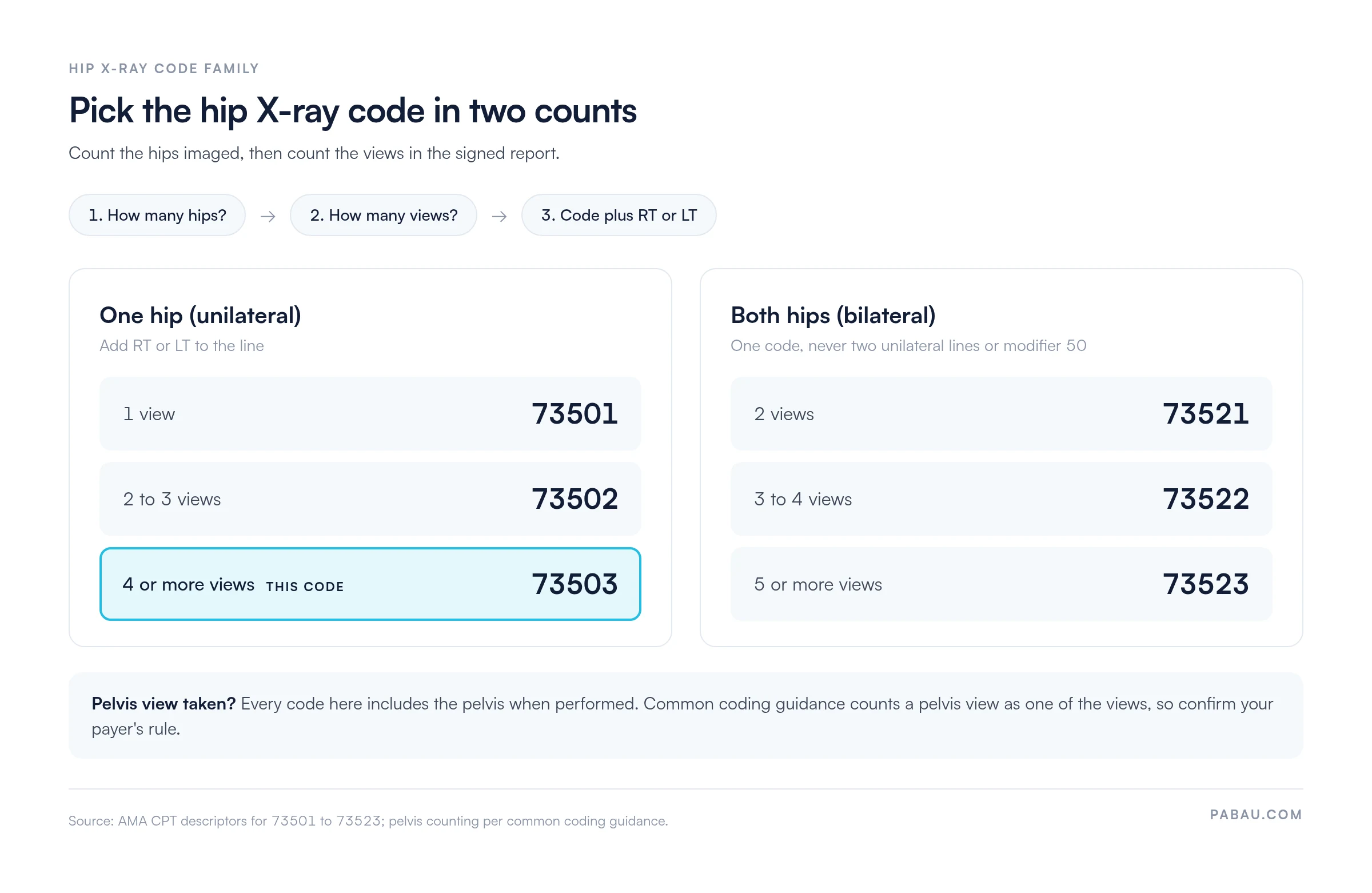
The view count in the signed report decides the code. One view is 73501, two or three views are 73502, and a study of both hips moves to 73521, 73522 or 73523.
Let Pabau's smart automation suggest the right codes, reduce claim denials, and keep your practice compliant—effortlessly.
Automate repetitive tasks and focus on what matters most—your patients.
Reduce coding errors and ensure compliance with the latest regulations.
Clean claims, fewer denials, and faster reimbursements.
Powerful insights and reporting to help your practice thrive.
HIPAA compliant SOC 2 certified GDPR-compliant Trusted by 4,000+ clinics worldwide

CPT code 73503 reports an X-ray of one hip with a minimum of four views, with the pelvis included when performed.
One view is 73501 and two or three views are 73502, so the view count in the signed report picks the code.
Both hips in one session move to 73521, 73522 or 73523, never to two 73503 lines or modifier 50.
Medicare’s 2026 national rate for the global service is about $63, based on 1.88 total RVUs.
Whether an AP pelvis view counts toward the four is coding guidance, not descriptor text, so confirm your payer’s rule.
CPT code 73503 reports a plain-film X-ray of one hip with at least four views. The American Medical Association’s CPT code set gives the full descriptor as “Radiologic examination, hip, unilateral, with pelvis when performed; minimum of 4 views.”
The code closes the 73501 to 73503 unilateral hip family, where only the view count changes. 73501 is one view, 73502 is two or three, and 73503 is four or more. The AMA restructured the family this way in 2016, replacing the older view-count codes.
“With pelvis when performed” means a pelvis view may be part of the study. It doesn’t make a pelvis view mandatory for 73503. A four-view series typically adds oblique or cross-table lateral projections to the standard AP and lateral views, ordered for complex arthritis, trauma or surgical planning.
Two types of study sit outside this family. A hip arthrogram is reported with 73525 for the radiological supervision and interpretation, with the contrast injection coded separately. MRI of the hip maps to 73721 to 73723, and CT to 73700 to 73702.
A coder can’t assign 73503 from the order alone. The claim only holds up when the signed report carries each of these elements.
Before assigning 73503, count the projections listed in the signed report. If fewer than four are documented, query the radiologist for an addendum or code the lower view count.
A four-view hip study needs a diagnosis that explains why the extra projections were ordered. The table lists the codes most often paired with 73503.
Match the diagnosis side to the RT or LT modifier, because a mismatch invites a denial. Pain codes carry more risk on a four-view study than a confirmed diagnosis does. The CDC/NCHS ICD-10-CM web tool is the authoritative source for current descriptors.
Four modifiers apply routinely to 73503. Which ones you use depends on who owns the equipment and who reads the images.
Global billing applies when one practice owns the equipment, employs the technologist and reads the study. Bill 73503-RT or 73503-LT with no component modifier. In hospital outpatient departments and imaging centers, billing is often split. The facility bills 73503-TC and the radiologist’s group bills 73503-26.
Modifier 50 doesn’t belong on 73503. When both hips are imaged in one session, the bilateral codes 73521 to 73523 describe the service.
The CMS Physician Fee Schedule sets the 73503 rate each January. For 2026, the global service carries 1.88 total RVUs, including a work RVU of 0.26. At the 2026 conversion factor of $33.4009, that’s about $62.79 nationally, before your locality adjustment.
Component amounts shift with each locality, so pull them from the CMS tool before you quote them. The FastRVU 73503 page shows the same RVU values. Commercial payers, Medicare Advantage plans and state Medicaid programs set their own rates.
Code selection in the hip X-ray series turns on two counts: how many hips, and how many views. The chart walks through the choice, sides first and views second.
The classic error here is a bilateral study billed as two 73503 lines, one RT and one LT. Payers read that as duplicate billing. Bill 73521, 73522 or 73523 instead, matched to the total view count.
The descriptor says the pelvis is included “when performed,” but it doesn’t say whether an AP pelvis view counts toward the minimum of four. That question is settled by coding guidance and payer policy, not by the descriptor text.
Common coding guidance counts a pelvis view taken with the hip series as one of its views. Under that reading, 72170 isn’t reported on top for the same series. Confirm the rule your payer applies, and document each projection so either reading can be checked.
Traditional Medicare doesn’t require prior authorization for standard diagnostic X-rays, 73503 included. Medical necessity documentation is still required, and other payers set their own rules.
When authorization is obtained, enter the number in Box 23 of the CMS-1500 form. A missing or invalid number usually returns CARC 15, and absent authorization returns CARC 197. Routine insurance eligibility verification catches most of these before the visit.
Most 73503 denials come from preventable code-selection and documentation errors. The table maps each pattern to its claim adjustment reason code (CARC) and the fix. Our guide to denial codes in medical billing explains each code in more depth.
Route each returned claim back to the biller with its reason code, and log the pattern. Fixing it at charge entry costs far less than an appeal.
The National Correct Coding Initiative (NCCI) controls which codes can be billed together on one date of service. Two rules matter most for 73503.
NCCI edit tables update every quarter. Check the CMS NCCI edits page for current pairs before you appeal a bundling denial.
Each handoff is a chance for the side or the view count to slip. Here’s the usual path for a practice that bills the global service.
Steps three and four trip up most claims. A report that says “hip series” with no view list leaves the coder guessing, so run the checks below before release.
Run this check at charge entry, while the encounter is fresh and the radiologist can still add an addendum.
Most 73503 errors start at charge entry, when someone keys a side or a view count from memory. Pabau, the practice management platform we build, pre-fills each claim from the patient record. The CPT code attached to the service lands on the charge line, with the diagnosis drawn from the recorded problem list.

Before a claim leaves, Pabau’s claims management software checks that required fields such as membership numbers and authorization codes are complete. US claims then go out through Claim.MD, the clearinghouse Pabau connects to.
From the same Claims dashboard, US practices run real-time eligibility checks, track each claim’s status and post ERA remittances. When a 73503 line comes back, the reason sits beside the claim, so your biller can fix the side or the view count and resubmit.

Pabau pre-fills each claim from the patient record and holds it until required fields are complete. US claims then go out through Claim.MD, with eligibility checks, status tracking and ERA posting.

Coding 73503 comes down to counting. Count the hips imaged and the views in the signed report, then apply your payer’s rule on the pelvis view. Four or more views of one hip is 73503, and three or fewer is not.
The trade-off is a minute of checking at charge entry against weeks of rework on a denied claim. Make laterality and the view list required fields on the order, and most 73503 denials stop at the source.
Want to see how Pabau pre-fills hip X-ray claims and tracks them to payment? Book a demo with our team.

Need a full reference for CARC and RARC denial codes? Denial codes in medical billing covers the most common claim adjustment reason codes and how to respond to each.
Imaging both hips in one session? CPT code 73521 covers the two-view bilateral hip study, the first code in the family that replaces two 73503 lines.
Want fewer claims bounced back at submission? What makes a clean claim walks through the fields and checks that get a claim paid on the first pass.
Looking to understand how clearinghouses fit into the billing cycle? Medical claims clearinghouse guide explains how clearinghouses validate, route, and report on electronic claims.
Posting payments and denials by hand? Electronic remittance advice (ERA) explains how 835 ERA files automate payment posting and denial identification.
>
Both are unilateral hip X-ray codes that include the pelvis when performed. 73502 covers two or three views, while 73503 covers a minimum of four.
Under common coding guidance, no. A retake of the same projection for poor positioning or motion is one view, so only distinct projections count toward the four.
Yes. A frog-leg lateral is a distinct projection from a cross-table lateral, so each one counts as a separate view when both are taken and documented.
Yes, for Medicare. Diagnostic X-rays sit outside the global surgical package, so a post-op hip series is billed separately, with a diagnosis that supports it.
73503 can be used at any age when four or more views of one hip are taken. The former infant and child pelvis-and-hips code, 73540, was deleted in 2016, so bilateral studies now use 73521 to 73523.