CCSD code H4430: Examination of rectum under anaesthetic
CCSD code H4430 pays for the examination alone CCSD code H4430 is the UK private...

Last Updated: Oct 20, 2026
29915 is the CPT code for arthroscopy, hip, surgical; with acetabuloplasty (ie, treatment of pincer lesion). Surgeons report it when they trim excess bone from the acetabular rim that pinches the femoral neck in pincer-type impingement. Medicare pays about $932 nationally in 2026, with a 90-day global period.
It sits beside two codes that are easy to mix up. Femoroplasty for a cam lesion is 29914, and labral repair is 29916. Bill 29916 on top of a rim trim and the claim fails an NCCI edit. So the right code comes down to which lesion the operative note says was treated.
Let Pabau's smart automation suggest the right codes, reduce claim denials, and keep your practice compliant—effortlessly.
Automate repetitive tasks and focus on what matters most—your patients.
Reduce coding errors and ensure compliance with the latest regulations.
Clean claims, fewer denials, and faster reimbursements.
Powerful insights and reporting to help your practice thrive.
HIPAA compliant SOC 2 certified GDPR-compliant Trusted by 4,000+ clinics worldwide

CPT code 29915 reports arthroscopic acetabuloplasty, which trims a pincer lesion off the acetabular rim.
Femoroplasty for a cam lesion is 29914, and labral repair is 29916, so the operative note decides the code.
NCCI treats 29915 and 29916 as mutually exclusive, so a rim trim with labral refixation is billed as one code.
Mixed cam-pincer surgery can carry 29914 and 29915 together, with the second code reduced under the endoscopy payment rule.
In 2026, the national Medicare rate for 29915 is about $932, with a 90-day global period.
CPT code 29915 is the surgical hip arthroscopy code for acetabuloplasty, the treatment of a pincer lesion. The surgeon burrs away excess bone from the acetabular rim. That gives the femoral neck room to move when the hip flexes.
It is a primary procedure code, not an add-on. CMS lists it as an active, separately priced code with a 90-day global period. Medicare prices it in a facility only.
Every RVU figure in this article comes from the CMS 2026 Physician Fee Schedule relative value file, October release. Practices in a qualifying alternative payment model use the $33.5675 conversion factor instead, which gives about $936.87. Your local rate also moves with the geographic practice cost index (GPCI).
Pincer impingement starts on the socket side of the joint. The acetabulum covers too much of the femoral head, so its rim strikes the femoral neck in flexion. Over time, the labrum caught between them gets crushed and torn.
Surgeons confirm the shape on imaging before they schedule the case. These are the markers payers and auditors look for:
Cam impingement is the mirror image. There, the bump sits on the femoral head-neck junction, and surgeons measure it with the alpha angle. Reshaping that bump is femoroplasty, which belongs to 29914.
Several steps happen in almost every rim trim, and none of them earns its own claim line:
JPOSNA’s Coding Corner confirms that capsular closure and acetabular chondroplasty are part of these procedures. Billing them separately only invites a denial.
The femoroacetabular impingement (FAI) family has three codes, one for each structure the surgeon treats. So pick the code from the operative note, not from the diagnosis.
All three are primary codes with 90-day globals. None of them is an add-on, whatever older guides say. For the labral side of the family, see our guide to CPT code 29916.
Many patients have both deformities. When the surgeon trims the rim and also reshapes the femoral neck, report 29915 and 29914 together. The current National Correct Coding Initiative (NCCI) practitioner file holds no edit between this pair.
Each lesion needs its own description in the note, though. If the note only mentions the rim, an auditor will find no support for the 29914 line.
The labrum is where 29915 claims get tangled. During a rim trim, the surgeon often detaches the labrum, trims the bone, and then sutures the labrum back. That refixation is part of the acetabuloplasty.
CPT tells coders not to report 29916 with 29915, and NCCI lists the pair as mutually exclusive. Report the code that matches the main work. Their RVUs differ by only 0.05, so the choice barely changes payment.
NCCI bundles several hip arthroscopy codes into 29915. These are the edits that matter most in the 2026 Q4 practitioner file:
Indicator 1 means a modifier can unlock a pair, but only for a distinct service. Surgery on the other hip qualifies. A second step inside the same joint does not.
Two neighbors often show up in the wrong place. CPT 29905 is subtalar joint arthroscopy with synovectomy, an ankle code, so it never belongs on a hip claim. CPT 29861, loose body removal, has no NCCI edit with 29915, but the note must show it as separate work.
Edits change every quarter, so check the current file on the CMS NCCI procedure-to-procedure page before you submit.
Nationally, 29915 carries 27.91 total RVUs in a facility. Multiply that by the $33.4009 conversion factor and you get $932.22 before GPCI.
CMS gives 29915 multiple procedure indicator 3, the special rule for endoscopies. Its base code is 29860, diagnostic hip arthroscopy. When two codes from that family are billed together, the second one pays only its value above the base.
Here is how that works on a mixed cam-pincer case, with the chart below showing the cut:
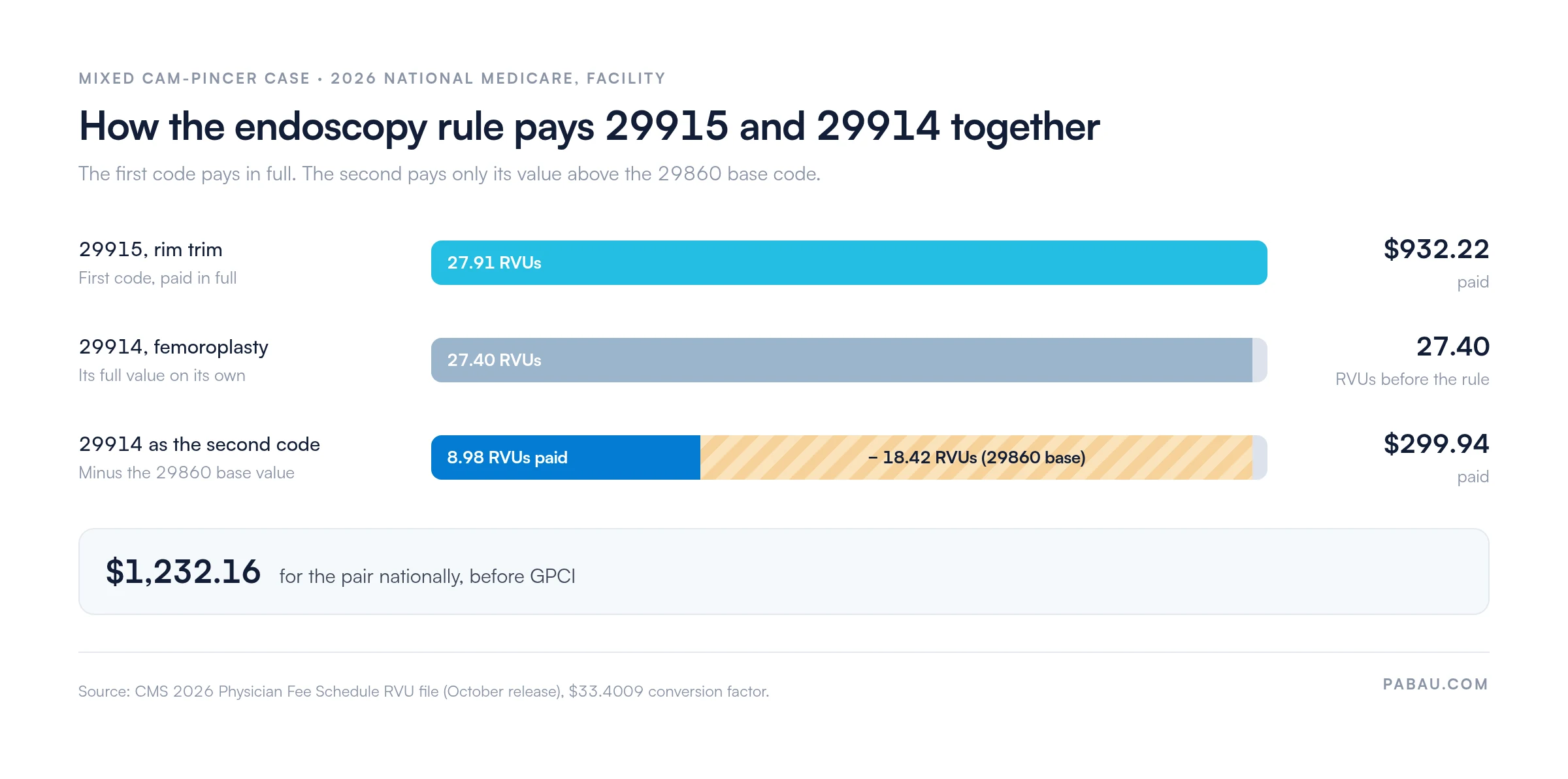
A second line paid at about a third is the rule working as designed. Check the math before you file an appeal. Commercial contracts may price multiple scopes differently, so read each one.
CMS assigns 29915 a 90-day global period. The package covers the day before surgery, the day of surgery, and 90 days afterward.
Routine post-op visits sit inside that fee. Some payers ask you to log them with 99024 anyway. These services can still be billed with the right modifier:
When surgeons split the care, CMS weights the global at 10% pre-op, 69% intraoperative and 21% post-op. Modifiers 56, 54 and 55 bill each share.
Hip claims without a side are among the easiest to reject. Use this table to match the modifier to the case:
ICD-10-CM has no code named femoroacetabular impingement. Instead, payers accept a set of hip derangement, sprain and pain codes. Aetna’s policy groups them under hip impingement syndrome.
Hip osteoarthritis (M16.-) sits on Aetna’s not-covered list for this surgery. If arthritis is the only diagnosis on the claim, expect a medical necessity denial. A pain code such as M25.551 is weak on its own too, because it records the symptom rather than the impingement.
Most commercial plans review hip arthroscopy before surgery, and their policies ask for similar evidence:
Before you book the case, run an insurance eligibility check so a plan exclusion doesn’t surface after surgery. Keep in mind that an approval doesn’t guarantee payment. The claim still has to clear the same edits as any other.
Auditors read the note for proof that bone came off the acetabulum. A note that only says “hip arthroscopy with debridement” points them straight to 29862.
A note that supports 29915 covers these points:
A clean hip arthroscopy claim follows the same path every time. Each step hands something to the next one:
A clean claim at step five saves weeks of rework at step six.
These errors cause most of the rework on hip FAI claims. Each one has a simple fix:
For the remark codes behind each rejection, see our list of denial codes in medical billing.
Coding the case is only half the job. The claim still has to reach the payer, and the remittance has to land against the right visit.
Pabau, the billing and practice software our team builds, raises a CMS-1500 claim from the invoice and sends it through Claim.MD. The remittance (ERA) comes back and is matched to the claim and invoice.
Your coder still chooses the codes and the modifiers. Pabau’s claims management software removes the re-keying between the invoice, the claim and the payment.

Pabau raises US CMS-1500 claims from the invoice, sends them through Claim.MD, and matches the returned remittance (ERA) to the invoice. Your billing team spends less time chasing payments.

CPT code 29915 rewards a careful read of the operative note. Rim work is 29915, femoral neck work is 29914, and a standalone labral repair is 29916.
The costly errors are predictable. Adding 29916 to a rim trim fails an edit. Appealing a correctly reduced second scope wastes an appeal. A missing side sends the claim straight back.
Build the checklist above into your pre-bill review, and those denials get caught before the claim leaves. Book a demo to see how Pabau sends hip arthroscopy claims through Claim.MD and matches each remittance to its invoice.

Billing a labral repair without a rim trim? CPT code 29916 billing guide covers the labral side of the hip FAI family.
Need to know how clearinghouse submissions work? Claim.MD clearinghouse guide explains how 837P claims are checked and routed to payers.
Want to understand the claim file itself? 837 electronic claim file guide walks through what each claim segment carries.
Facing payer audits on surgical claims? Medical billing compliance practices covers audit triggers and defensible documentation.
Seeing repeat denials from one payer? Denial management in healthcare shows how to track root causes and fix them.
Yes, when it is done arthroscopically. Rim trimming, rim resection and pincer resection all describe acetabuloplasty. CPT 29915 covers only the arthroscopic version, so an open rim trim needs a different code.
Yes. Medicare gives 29915 assistant-at-surgery indicator 2, so an assistant can be paid. A non-physician assistant, such as a PA, bills with modifier AS. Medicare pays that at 13.6% of the surgeon’s fee.
Yes, if the revision trims the acetabular rim. CPT has no separate revision code for hip arthroscopy. When the case takes far more work than usual, modifier 22 may apply, backed by a note explaining the extra time and effort.
No. Medicare prices 29915 only in a facility, and its non-facility rate is listed as NA. Bill it with a facility place of service, such as a hospital outpatient department.
No, because ICD-10-CM has no pincer-specific code. Pair 29915 with the derangement, sprain or pain code that matches the note, and name the pincer findings in the operative report.