CPT code 21011: Excision of soft tissue tumor of the face
CPT code 21011: Official descriptor and procedure overview CPT code 21011, as pu...

Last Updated: Oct 8, 2026
CPT code 29876 is the procedure code for arthroscopy, knee, surgical; synovectomy, major, two or more compartments.
It covers arthroscopic removal of inflamed synovial tissue from at least two of the knee’s three compartments. Medicare’s 2026 national payment is $614.91, built from 18.41 total RVUs and carrying a 90-day global period.
Two problems cost practices money on this code. Payers push back on medical necessity when the operative report never names the compartments. NCCI edits then fire when 29876 goes out alongside a meniscectomy code.
This guide covers the 2026 RVUs, the fee schedule, modifiers, and the ICD-10 crosswalk. It also covers the endoscopic payment rule that makes 29876 behave unlike most surgical codes.

CPT code 29876 describes arthroscopic knee synovectomy in two or more compartments, which separates it from single-compartment code 29875.
Medicare’s 2026 national payment is $614.91, built from 8.65 work, 7.99 practice expense and 1.77 malpractice RVUs.
A 90-day global period applies, and CMS does not pay an assistant at surgery on this code.
Billing 29876 with 29881 triggers the endoscopic family rule rather than the standard 50% multiple-procedure reduction.
Practice management software like Pabau builds each claim from the invoice and tracks it to payment on one dashboard.
The American Medical Association’s CPT code set defines 29876 as: Arthroscopy, knee, surgical; synovectomy, major, two or more compartments.
Two phrases in that descriptor decide whether a claim survives review. “Major” and “two or more compartments” are what separate this code from the minor procedures, and the operative report has to state both.
The surgeon inserts an arthroscope through small incisions and excises inflamed or hypertrophied synovial membrane from at least two distinct compartments. Common indications are rheumatoid arthritis, pigmented villonodular synovitis (PVNS), and other inflammatory synovial diseases where conservative management has already failed.
The knee has three compartments: medial, lateral, and patellofemoral. CPT 29876 requires documentation confirming synovectomy in at least two of them. When the operative report describes work in only one compartment, the code does not apply. Bill 29875 for the limited procedure instead, or an unlisted code if neither descriptor matches the operative report.
Descriptor thresholds work the same way on supply lines. HCPCS code K0746 covers pad sizes above 48 square inches, and wounds close together take one larger dressing rather than several smaller sets.
Medical necessity has to be supported by a covered diagnosis. Payers typically require synovial pathology confirmed on imaging or prior diagnostic arthroscopy, plus a record of failed conservative care. The table below lists the ICD-10-CM codes used most often with this procedure.
Watch the M65.1 subcategory here. M65.161 and M65.162 read as a close match in an encoder, but they mean other infective tenosynovitis. Picking them for an inflammatory synovitis misstates the pathology the surgery treated. The payer reads the diagnosis before it reads the operative note.
One coverage limitation catches practices out. Medicare and many private payers, including Aetna under CPB 673, generally do not cover knee arthroscopy for primary osteoarthritis.
The diagnosis has to reflect synovial disease rather than degenerative joint disease. Where the operative diagnosis falls outside the six rows above, work from the wider ICD-10-CM code reference before choosing a laterality digit.
Relative Value Units determine what Medicare pays. The figures below come from the CMS relative value file for 2026, released in December 2025. Each component is multiplied by its Geographic Practice Cost Index before the conversion factor is applied.
Both settings carry the same practice expense, which surprises coders used to a higher office figure on other codes. CMS flags the non-facility column “NA” for 29876. In the file layout, that flag means the procedure is rarely or never performed outside a facility, so no separate office rate is established. The ASC or hospital bills its own facility fee on top.
CY 2026 has two conversion factors, set by the MACRA payment tracks. The CMS Physician Fee Schedule lookup tool is the authoritative source for your own locality. The national amounts before geographic adjustment are below.
These are the physician amounts only. Rates then move by MAC locality: a practice billing in San Francisco collects more than one in rural Alabama, purely on GPCI. Check your locality-specific rate in the CMS lookup before you project surgical revenue for the year.
CPT 29876 is a unilateral procedure by default. Leaving off the laterality or circumstance modifier is one of the most common reasons a knee arthroscopy claim is denied. The modifiers below are the ones that come up.
One modifier family will not be paid on this code at all. CMS assigns 29876 an assistant-at-surgery indicator of 1, which the file layout defines as a statutory payment restriction. Modifier 80, 82 or AS on a 29876 line gets denied by Medicare however the operative report reads.
Good claim denial management starts at the modifier line. A missing LT or RT on a knee arthroscopy claim is a leading cause of payer-initiated denials, and a pre-submission checklist catches it every time.
CPT 29876 carries a 90-day global surgical package. The procedure fee covers pre-operative visits on the day of or day before surgery, the intra-operative work, and routine post-operative care for 90 days afterwards. A standard E&M visit billed during that window for a related complaint will trigger a denial or an overpayment request.
Practices with high surgical volume should track global periods per patient inside the billing system. Catching a post-op E&M code before it goes out costs a few seconds. Answering an overpayment letter six months later costs a great deal more.
Track global periods in your scheduling system by flagging patients as post-op with a 90-day end date. Build a workflow that prompts billers to check global status before attaching an E&M code to any follow-up visit for that patient.
NCCI edits govern which codes may be reported together, and concurrent billing with meniscectomy codes is where most 29876 errors start. The AAPC has noted that payer preferences differ on whether 29876 and 29881 can go out together. Billers have to follow each payer’s own guidance.
Yes, sometimes. Both procedures must be clinically distinct, separately documented, and reported with modifier 59, and the payer’s own policy has to permit it. Some payers bundle the pair and reimburse only the higher-valued code. Check the current NCCI edit table and the payer policy before submitting both lines.
When a payer does allow both codes, the payment math is not the one most billers project. CMS assigns 29876 a multiple-procedure indicator of 3 and names 29870, diagnostic knee arthroscopy, as its endoscopic base code.
Under that rule, Medicare pays the higher-valued endoscopy in full, then adds only the difference between the second endoscopy and the base code.
Run it at the 2026 national amounts. 29876 pays in full at $614.91. 29881 is worth $515.71 on its own, but 29870 carries a facility total of $399.81, so the claim picks up only the $115.90 difference. The pair pays $730.81, which is $141.96 below what a straight 50% reduction would suggest.
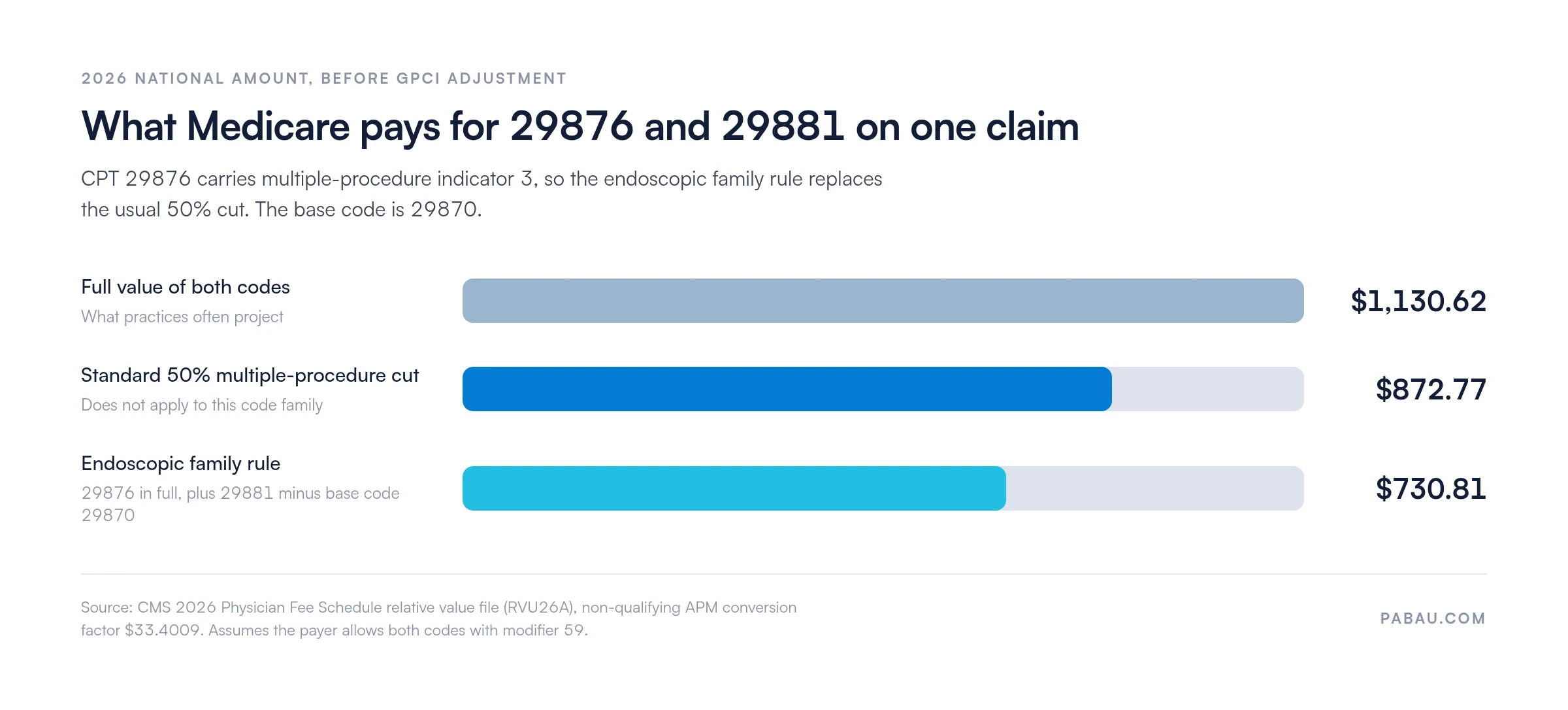
The same rule runs across the whole 29870-29889 family, so any two arthroscopic knee codes on one claim get the same treatment. CO-97, bundled or included in another service, is the reason code that shows up most on these claims. It signals that a bundling edit fired, not that the documentation was thin.
The 29870-29889 range covers the full spectrum of arthroscopic knee procedures. Seeing where 29876 sits against the codes around it helps coders pick the accurate descriptor instead of undercoding or overcoding the session.
Amounts are the 2026 national facility totals at the nonqualifying APM conversion factor. See AAPC Codify for the full 29870-29889 range with crosswalks and payer coverage notes.
Surgeons working a major synovectomy sometimes find a loose fragment in the same knee. Removal of that fragment is reported under CPT 29874, not under either synovectomy code. Check the current NCCI table before both lines go out on one claim.
The operative report decides these claims. Auditors look for three things. They want the compartments treated named explicitly, the synovectomy confirmed as major in extent, and medical necessity tied to the ICD-10-CM diagnosis. A note reading “knee arthroscopy with synovectomy” without naming compartments does not support 29876.
Capture this detail at the point of service rather than reconstructing it weeks later. Billing staff left to interpret an ambiguous operative note will either undercode the claim or send it out unsupported, and both cost the practice money.
A code lookup ends where the work starts. Once the surgeon signs the operative note, someone rekeys the codes into a clearinghouse portal. A week later, someone else opens a second portal to find out whether the payer accepted the claim. Every hand-off between those steps is somewhere a surgical claim can stall.
Practice management software like Pabau keeps the sequence in one system. Its medical claims management builds the claim from the invoice you already raised. Patient, treatment and insurer details are pulled straight from the patient record into a pre-filled submission.
Validation checks run in the background before it sends, so missing membership numbers and authorization codes surface before the payer sees them.
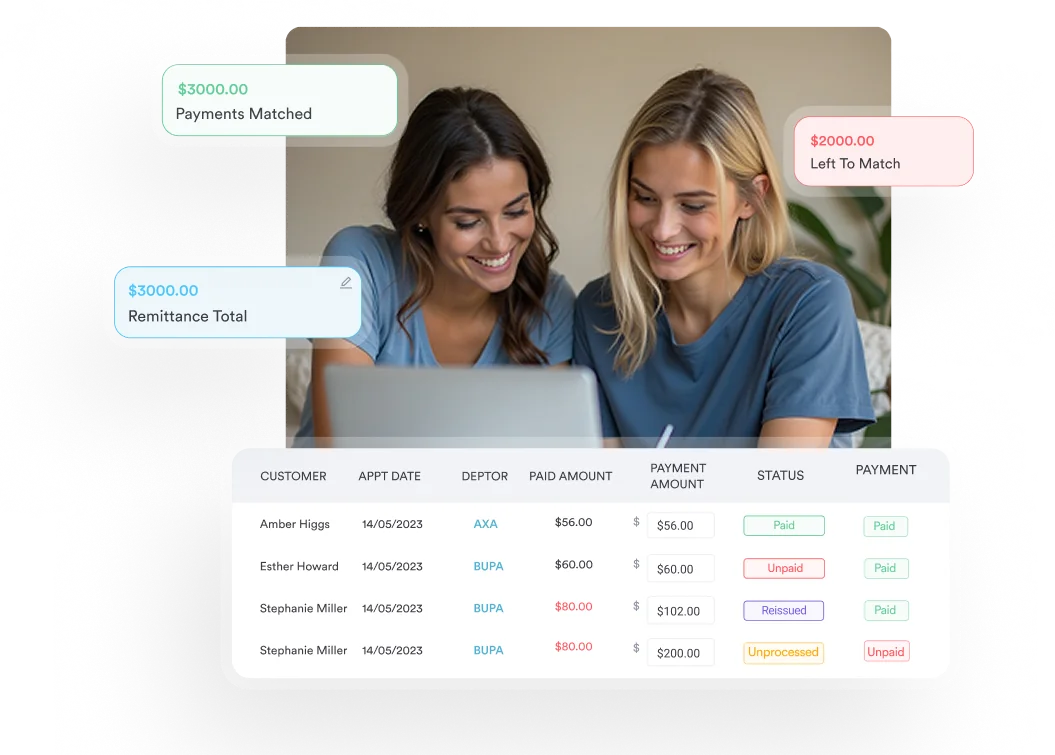
Every claim then sits on one dashboard, moving through pending, submitted, processing, paid and error. You can filter by date, insurer or invoice ID. That matters on a code like 29876, where a 90-day global period means you are watching one surgical episode for a full quarter.
US practices connect through Claim.MD, which carries electronic claims to thousands of US payers. The same connection returns real-time eligibility checks and claim status updates from the payer. Electronic remittance advice comes back into Pabau tied to the claims it settles, so an underpaid arthroscopy line is visible without opening a separate portal.
Run a five-point check before any 29876 claim leaves. Confirm the laterality modifier, the compartments named in the operative report, and a diagnosis that supports medical necessity. Then check the global period for any concurrent E&M code. Apply the endoscopic base-code math if a second arthroscopic code is on the claim.

Pabau builds each claim from the invoice you already raised and tracks it from submission to remittance on a single dashboard. Orthopedic practices see where a claim stalled without opening a payer portal.

The money on 29876 turns on one document and one indicator table. The operative report has to name the compartments and describe the extent of the resection. The CMS indicators then decide what the claim is worth once a second arthroscopic code lands beside it.
Build the pre-bill review around those two. A coder who confirms compartments, laterality, and the endoscopic base-code math before submission will not be arguing about CO-97 three weeks later. The trade-off is a few minutes on each surgical claim against an appeal that takes hours.
Book a demo to see how Pabau follows a 90-day surgical claim from the invoice through to the remittance that settles it.

Submitting claims electronically? Understanding the 837 file format explains how electronic claim files are structured and what clearinghouses do with them before they reach the payer.
How does revenue cycle management connect to surgical billing? What is revenue cycle management outlines the full billing lifecycle from encounter documentation to final payment posting.
Want the operative detail to reach the coder intact? What a superbill is shows how to capture diagnosis and procedure detail at the point of service.
Chasing a lower first-pass rejection rate? What makes a clean claim lists the fields payers check before a claim is ever adjudicated.
CPT code 29876 covers arthroscopic knee synovectomy, major, in two or more compartments of the knee joint. The surgeon resects inflamed or hypertrophied synovial membrane from at least two of the medial, lateral and patellofemoral compartments. Single-compartment synovectomy is reported with 29875 instead.
The 2026 national amount is $614.91, from 18.41 total RVUs and the $33.4009 conversion factor. Clinicians paid on the qualifying APM track receive $617.98. GPCI adjustment moves the figure by locality, so check the CMS fee schedule lookup for your own MAC.
Append LT or RT for laterality on every claim. Modifier 50 covers both knees in one session and pays 150% of the single-code amount. Modifier 59 applies when another arthroscopic code carries an NCCI edit, and modifier 22 when the work was substantially greater than usual. Medicare will not pay an assistant at surgery on 29876.
Sometimes, and it depends on the payer. Some allow both with modifier 59 where the procedures are clinically distinct and separately documented, while others bundle them and pay only the higher-valued code. When both are allowed, Medicare applies the endoscopic family rule rather than a 50% reduction, paying $730.81 for the pair in 2026.
The global period is 90 days. Routine post-operative visits, wound checks and standard knee-related E&M encounters in that window are included in the procedure fee and cannot be billed separately. Unrelated services, and complications requiring a return to the OR, are billable with the appropriate modifier.
Generally no. Medicare and major private payers including Aetna, under CPB 673, do not cover knee arthroscopy for primary osteoarthritis. Coverage applies when the diagnosis reflects synovial disease such as rheumatoid arthritis or PVNS. The ICD-10-CM code and the operative report both have to establish that.