

CCSD code G5100: Bypass of duodenum billing guide
CCSD code G5100 bills a bypass that leaves the duodenum in place CCSD code G5100...

Last Updated: Oct 16, 2026
29873 is the CPT code for arthroscopy, knee, surgical; with lateral retinacular release. Through the scope, the surgeon cuts the tight lateral retinaculum so the kneecap can track centrally again.
The code covers a lateral release only. A medial release in the same session may push the claim to 29999, and an open release goes to 27425. Payment also includes a 90-day global period. The sections below cover code selection, NCCI pairings, operative note requirements, and a checklist to run before you submit.
Let Pabau's smart automation suggest the right codes, reduce claim denials, and keep your practice compliant—effortlessly.
Automate repetitive tasks and focus on what matters most—your patients.
Reduce coding errors and ensure compliance with the latest regulations.
Clean claims, fewer denials, and faster reimbursements.
Powerful insights and reporting to help your practice thrive.
HIPAA compliant SOC 2 certified GDPR-compliant Trusted by 4,000+ clinics worldwide

CPT 29873 covers an arthroscopic lateral retinacular release of the knee, and a medial release is not part of it.
When both medial and lateral releases are performed, 29999 (unlisted arthroscopy) may be required instead of 29873.
The operative report must document the anatomical site, release technique, and pre-operative diagnosis justifying medical necessity.
Same-session knee scopes such as 29877 often bundle with 29873 under NCCI, so modifier 59 needs a distinct site in the note.
Pabau’s claims management software pre-fills the claim from the record and checks required claim fields before submission.
CPT code 29873 is the code for an arthroscopic knee procedure in which the surgeon releases the lateral retinaculum. According to the American Medical Association’s CPT code set, the official descriptor is: Arthroscopy, knee, surgical; with lateral retinacular release.
Through the scope, the surgeon cuts the lateral retinaculum with a blade or an electrocautery device. That’s the fibrous tissue connecting the patella to the lateral femoral condyle and the iliotibial band. Releasing it eases lateral patellar compression, so the kneecap tracks normally in the trochlear groove again.
The code sits in the 29800-29999 endoscopy and arthroscopy range of the musculoskeletal surgery section, alongside the knee arthroscopy family (29870-29889). It applies whether the release is a standalone procedure or the primary component of the session.
Use CPT 29873 when the operative note documents an arthroscopic lateral retinacular release for a specific condition. That condition has to cause lateral patellar compression or maltracking. Medical necessity is the threshold payers audit most often on this code.
Accepted clinical indications include:
Payers routinely deny 29873 when the chart shows the release as incidental to a primary procedure, with no standalone indication. The operative note has to justify the release as a necessary, distinct part of the surgical plan.
This is where coders stumble most. CPT 29873 specifies a lateral retinacular release. When the surgeon releases both the medial and lateral retinaculum arthroscopically in one session, the lateral-only descriptor may not capture the full procedure. Billing 29873 alone could then misrepresent the service.
Coding authorities, including community discussion on AAPC forums, suggest a combined release may require CPT 29999 (arthroscopy, unlisted procedure) when no existing code describes it. Verify this against AAPC’s CPT code reference and your MAC’s local coverage determinations before submitting.
When you submit CPT 29999, payers want a detailed operative report and a letter of medical necessity explaining why no existing code fits. Most also expect a crosswalk to the closest analogous code, which is 29873 here. Payment is negotiated or set by the payer rather than taken from the standard fee schedule.
Knowing the knee arthroscopy family prevents both underbilling and NCCI bundling denials. The codes most often confused with, or billed alongside, CPT 29873 are 29877, 29880, 29881, 29882, and 29883.
National Correct Coding Initiative (NCCI) edits control same-session bundling for knee arthroscopy codes. CMS updates them quarterly, so re-check the pairings above against the current tables before each billing cycle.
Modifier 59 (distinct procedural service) can override certain NCCI column-2 edits. The operative report has to show a separate anatomical site, a separate incision, or a distinct pathology the primary code doesn’t treat. Appending modifier 59 without that documentation is a compliance risk.
Say the surgeon releases the lateral retinaculum and shaves cartilage in the medial compartment during the same scope. For a commercial payer, 29873 plus 29877 with modifier 59 may work, provided the note names the separate compartment. For Medicare, report chondroplasty in a different compartment with G0289 rather than 29877.
Without a separate compartment in the note, report 29873 on its own. The shaving then counts as part of the release.
Thin operative documentation is the most common reason CPT 29873 claims are denied or downgraded on audit. The note must establish four things clearly.
Payers also audit for consistency between the operative note, the claim, and the anesthesia record. A clean claim submission for 29873 needs all three to agree on procedure, site, and date. When the surgeon’s note and the facility’s charge capture disagree, post-payment audits often follow.
Build a 29873 documentation checklist into your operative note template. Flag any note missing the release technique or the patellar tracking observation before it leaves the surgical suite. Catching it there takes a minute, while catching it on appeal takes hours.
Medicare payment for CPT 29873 is based on the Resource-Based Relative Value Scale (RBRVS). The CMS Physician Fee Schedule publishes the work, practice expense, and malpractice RVUs for each code.
Rates vary by locality, so use the FastRVU 2026 lookup tool to calculate the payment for your Medicare Administrative Contractor (MAC) locality.
CMS has no national coverage determination specific to arthroscopic lateral retinacular release. Local Coverage Determinations (LCDs) from individual MACs govern coverage instead.
Requirements vary by jurisdiction. Some MACs want documented failure of conservative therapy for a set period before approving 29873, while others rely on payer medical policy.
Medicare Advantage plans add another layer. Many require prior authorization for knee arthroscopy, including CPT 29873, and the rule varies by plan rather than by geography.
Run a real-time eligibility check against the patient’s specific plan before the procedure date, so prior authorization requirements surface at scheduling.
A 29873 claim passes five checkpoints before it’s paid, and each one has a typical denial attached. The flow below shows what to check at each stage.
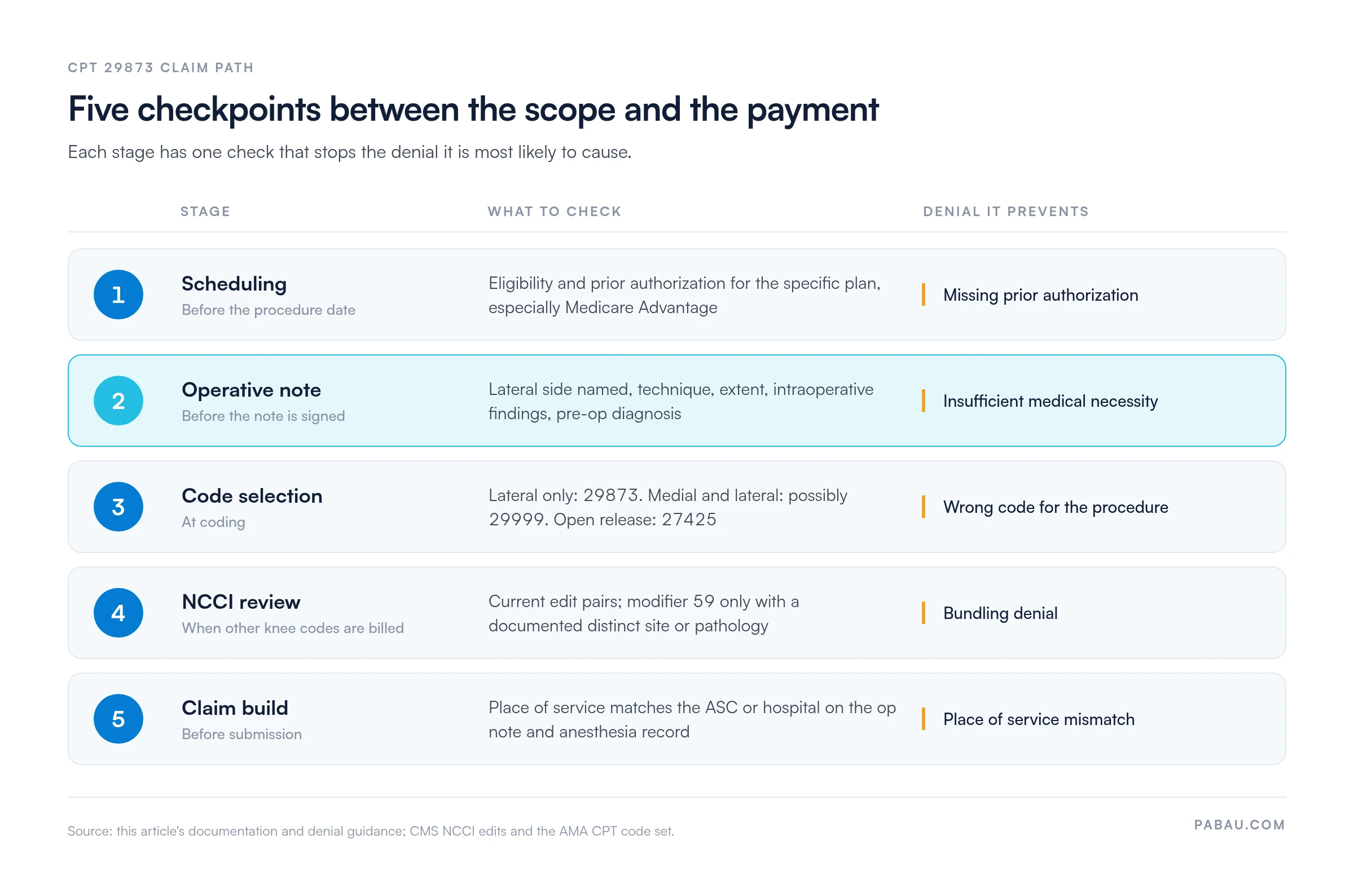
Two stages carry the most weight. Late amendments to an operative note draw payer scrutiny, so the note needs to be complete before it’s signed. NCCI review matters whenever another knee code shares the session.
Most CPT 29873 denials fall into a predictable set of categories. Seeing the pattern helps practices fix the root cause rather than chase individual appeals.
Structured denial management workflows help practices track 29873 denials by payer, denial code, and root cause. Reviewing the common denial codes on your 29873 remittances shows which documentation problems to fix first.
Run a monthly denial audit on CPT 29873 claims. Sort by denial reason code and payer. If CO-197 (authorization absent) keeps appearing with one Medicare Advantage plan, the fix is a change to the scheduling workflow, not more appeals.
In many orthopedic and sports medicine practices, a biller still types the CPT code, diagnosis, and place of service from the op note. Each re-typed field is another chance for the claim to disagree with the note.
Pabau, the practice management platform we build, connects the clinical record to the claim. Its claims management software pre-fills claims from the record, includes code lookup libraries, and checks required claim fields before you send.
It connects to Claim.MD’s clearinghouse with real-time eligibility verification, so prior authorization requirements surface at scheduling rather than on the remittance advice.
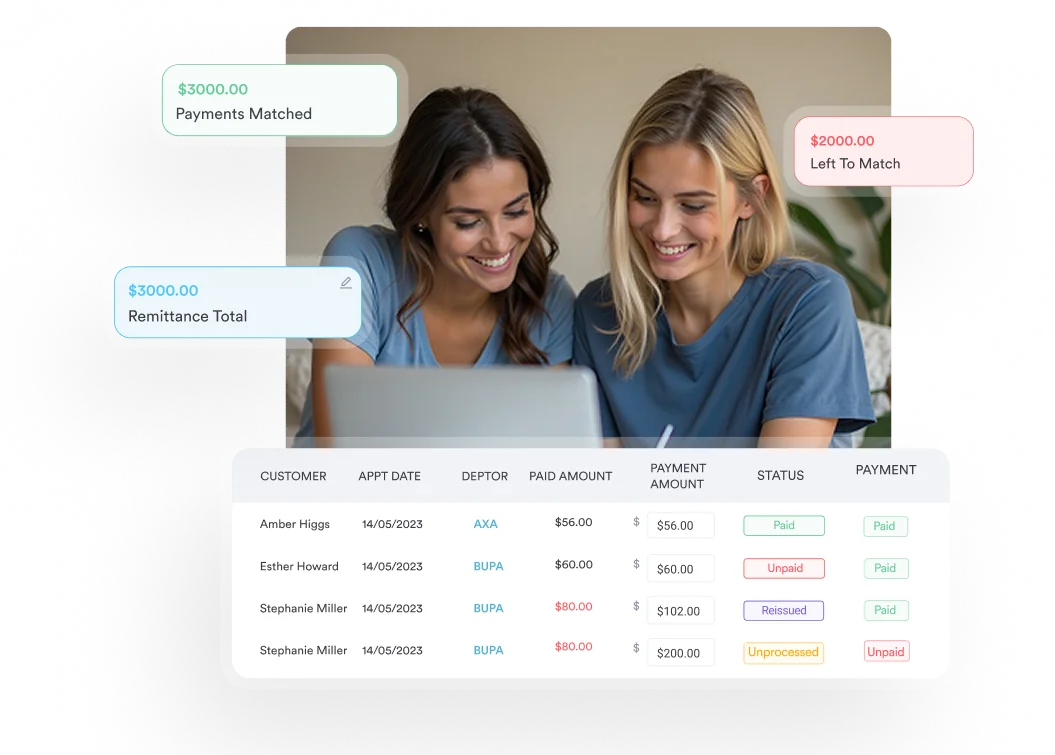
Keeping documentation and claims in one system reduces manual re-entry between the operative note and the claim. That pays off for practices building repeatable medical billing workflows around knee arthroscopy.
With superbill generation, the CPT code attached to the service and the ICD-10 codes from the patient’s problem list are pre-filled on the claim.

Pabau’s claims management tools pre-fill claims from the record, validate required claim fields before you send, and run US real-time eligibility checks via Claim.MD. You spend less time on appeals and more time on patient care.

CPT 29873 is narrow by design. It pays for one arthroscopic release on the lateral side, and payers read the operative note to confirm that’s what happened. When a medial release joins it, or another knee code shares the session, stop and check before the claim goes out.
The fix is rarely a better appeal. It’s a stronger operative note template, an NCCI check on every multi-code scope, and a prior authorization check at scheduling. Put those three in place and fewer 29873 claims come back.
Pabau supports that routine with claims pre-filled from the record, code lookup libraries, and required-field validation. Claims then go out through Claim.MD with eligibility checks and status tracking. Book a demo to see how pre-filled claims fit your knee arthroscopy billing.

Need a framework for managing claim denials across your practice? Denial management in healthcare covers how to build a structured workflow for tracking, appealing, and preventing denials by code and payer.
Want to understand how the clearinghouse fits into your billing cycle? Medical claims clearinghouse overview explains how electronic claim submission works and what to look for in a clearinghouse partner.
Looking for guidance on keeping billing documentation audit-ready? Medical billing compliance outlines the documentation and audit trail standards that protect practices during payer reviews.
Coding the diagnostic scope that often comes first? CPT code 29870 covers diagnostic knee arthroscopy and how it bundles with surgical knee scopes.
Billing a meniscectomy in the same knee? CPT code 29881 explains single-compartment meniscectomy coding and its NCCI pairings.
Diagnoses showing lateral patellar compression or maltracking support it best. Common choices are M22.2X- (patellofemoral disorders), M22.1- (recurrent subluxation of patella) and M22.4- (chondromalacia patellae), with the final character for laterality. Pick the code the operative note and imaging back up.
Usually not, because NCCI bundles 29877 with 29873 in the same knee. If the note shows chondroplasty in a separate compartment, commercial payers may accept 29877 with modifier 59. Medicare uses G0289 for that scenario instead.
In most cases, yes. Payers generally expect RT or LT to identify the knee. For a release on both knees, check whether the payer wants modifier 50 or two lines with RT and LT.
It may need to be reported with 29999. Confirm with the payer or MAC before submission. If you use 29999, attach the operative report, a letter of medical necessity, and 29873 as the comparison code.
Often not separately. When the release is an incidental step in a stabilization or reconstruction, payers usually treat it as included. Report 29873 only when the note documents its own indication, and check the current NCCI edit pair first.
No. CPT 29873 carries a 90-day global period, so the surgeon’s routine post-operative visits in that window are included in the payment.



