



CCSD code G5100: Bypass of duodenum billing guide
CCSD code G5100 bills a bypass that leaves the duodenum in place CCSD code G5100...

Last Updated: Oct 16, 2026

CPT code 29848 reports endoscopic wrist surgery with release of the transverse carpal ligament, the code for endoscopic carpal tunnel release (ECTR).
CPT 29848 carries a 90-day global surgery period, so routine post-operative visits inside that window are bundled and cannot be billed separately.
Always attach a laterality modifier (RT or LT) to CPT 29848. Missing laterality is the most common reason these claims come back denied.
Medical necessity comes from the G56.0x carpal tunnel syndrome codes, not G54.2, and the side coded must match the side in the operative note.
Practice management software like Pabau attaches CPT 29848 to the procedure record and submits the claim through a Claim.MD clearinghouse integration.
CPT code 29848 reports endoscopic wrist surgery with release of the transverse carpal ligament. Your practice uses it when the surgeon treats carpal tunnel syndrome (CTS) through an endoscope rather than an open incision.
This reference covers the official descriptor, 2026 Medicare reimbursement, RVUs, modifiers, and the ICD-10 crosswalk. It also covers global period rules, place of service, related codes, and the documentation errors that cause denials.
CPT 29848 sits at the end of the 29800-29848 wrist endoscopy and arthroscopy range in the AMA CPT code set. It is the only code in that range that describes release of the transverse carpal ligament (TCL).
Endoscopic carpal tunnel release (ECTR) is a minimally invasive treatment for carpal tunnel syndrome. In CTS, compression of the median nerve at the wrist causes pain, numbness, and weakness in the hand and fingers.
During ECTR, the surgeon makes one or two small portal incisions and inserts an endoscope into the carpal tunnel. The surgeon then visualizes the underside of the transverse carpal ligament and divides it to relieve the compression.
The procedure is usually performed under local or regional anesthesia in an ambulatory surgical center (ASC) or a hospital outpatient department. Payers often expect a documented trial of conservative treatment first, and a therapeutic carpal tunnel injection is reported separately with CPT 20526.
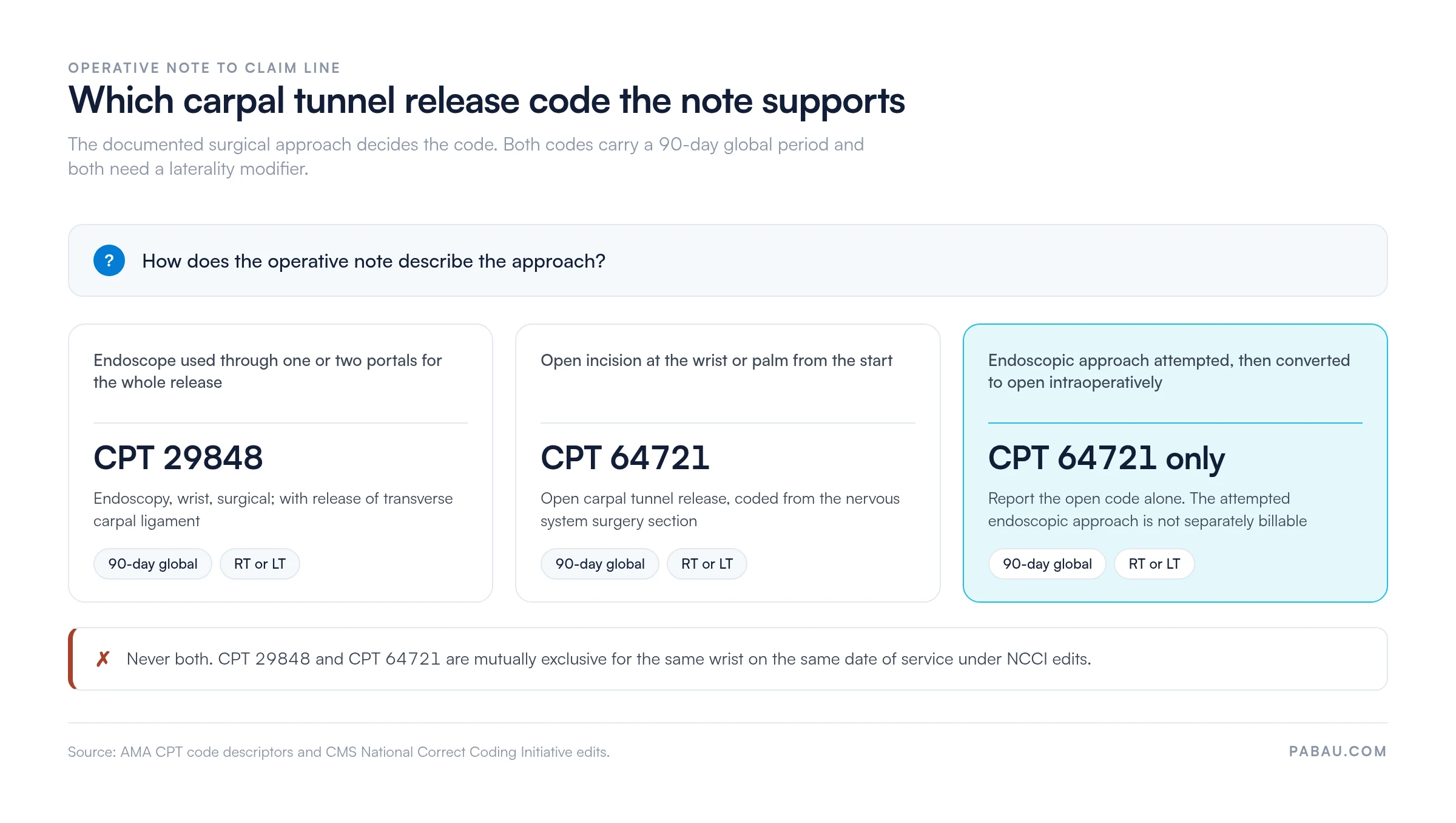
CPT 29848 captures the entire endoscopic approach. If the surgeon converts to an open procedure intraoperatively, switch to CPT 64721 for open carpal tunnel release. You cannot report both codes for the same wrist on the same day.
Outside the US the schedule changes completely. UK private practices bill insurers from the CCSD schedule, where an open release of both wrists is CCSD code A6580.
The approach the surgeon documents in the operative note is the deciding factor. The two codes are mutually exclusive for the same wrist on the same date of service. The CMS National Correct Coding Initiative (NCCI) edits enforce that restriction. The diagram below maps each documented approach to the code it supports.
Verify every RVU and dollar figure before you bill
The RVU values and payment ranges in this guide are indicative and illustrative only. Published third-party sources disagree with one another on these numbers. Check each figure for your own locality against the live CMS Medicare Physician Fee Schedule (MPFS) lookup tool. Do not rely on the tables below for billing, contracting, or compensation decisions until you have done that.
Caveat: the work RVUs in the table above are indicative figures that we could not confirm against a live CMS source. Treat them as illustrative and confirm both values in the MPFS lookup tool.
If the operative note documents an attempted endoscopic approach followed by conversion to open, report only CPT 64721. The attempted endoscopic work is part of the same session and is not separately billable.
Medicare reimbursement for CPT 29848 varies by geographic locality and place of service. The 2026 CMS Medicare Physician Fee Schedule lookup tool is the definitive source for locality-specific rates. Verify current figures there rather than relying on third-party aggregators.
Caveat: the dollar range above is an unverified indicative figure, not a rate you can quote. Pull your own locality’s payment amount from the CMS MPFS lookup tool before you use any number in a contract or a patient estimate.
Private payer rates are negotiated independently and can differ substantially from Medicare. Check each payer’s contract before submitting. For practices submitting through Pabau, the Claim.MD clearinghouse integration handles electronic claim routing to thousands of US payers and returns eligibility and ERA data.
Relative value units (RVUs) determine Medicare payment under the Resource-Based Relative Value Scale (RBRVS). The values below are indicative only. Verify them against the current AMA coding resources and the CMS MPFS, because RVUs are updated annually.
Caveat: we could not confirm these RVU values against a live CMS source, and third-party aggregators publish figures that conflict. Confirm each component in the CMS MPFS lookup tool before you use it for compensation modeling.
Work RVUs stay the same whether the procedure happens in a facility or a non-facility setting. The practice expense RVU is what shifts, which is why the office rate sits above the facility rate for the same work.
Modifier selection for CPT 29848 depends on laterality, procedure complexity, and whether other procedures happened in the same session. Incorrect or missing modifiers are a leading cause of rejection for this code.
Most payers require -RT or -LT on every claim for CPT 29848. Submitting without a laterality modifier is the single most common denial trigger for this code. A pre-submission modifier audit built into the workflow catches it.
Build a modifier checklist into your CPT 29848 claim workflow. Confirm laterality in the operative note, then attach RT or LT to the code. For bilateral cases, check payer policy before choosing modifier 50 over two separate line items. Run the check before every submission to cut preventable rejections.
Every claim for CPT 29848 needs an ICD-10-CM diagnosis code that establishes medical necessity. The table below lists the codes most often paired with this procedure. Confirm ICD-10-CM code validity through the CDC lookup tool before submitting, because codes change each October 1.
Some payers still accept G54.2 (cervical root disorders) for carpal tunnel syndrome on the strength of older crosswalks. That is incorrect. The G56.0x series with laterality is the appropriate coding for median nerve compression at the wrist.
Mismatching the diagnosis code to the procedure is a top denial reason. Tracking denial codes by reason code surfaces these mismatches within a billing cycle rather than at the end of the quarter.
CPT 29848 carries a 90-day global surgery period. The surgical fee is treated as covering all routine post-operative care for those 90 days. Billing a separate E/M code for routine follow-up inside that window is not permitted.
Billing routine post-op E/M visits without modifier -24 during the 90-day window is a common compliance audit trigger in hand surgery. Practices that track global periods inside audit-ready claims management software catch these before submission.
The place of service (POS) code on the claim decides which Medicare payment rate applies. Surgeons performing ECTR in an ASC or hospital outpatient department receive the facility rate. Those with an in-office endoscopy suite may bill the non-facility rate.
Check that the POS code matches where the procedure actually happened. A mismatch between the POS code and the facility’s own billing is a common audit flag. It is easy to introduce when the surgeon operates at more than one site.
CPT 29848 is the terminal code in the wrist endoscopy and arthroscopy family. The table below helps coders pick the right code when the procedure performed is narrower or broader than a transverse carpal ligament release.
Note that 29840 to 29846 are arthroscopy codes describing work inside the wrist joint. CPT 29848 is an endoscopy code describing work in the carpal tunnel. They share a numeric range but not an anatomical space.
Four failure patterns account for the bulk of CPT 29848 denials and audit flags in hand surgery billing. Each one is preventable at the documentation stage, before the claim is ever built.
Submitting CPT 29848 without -RT or -LT is the single most common denial trigger. Most payers require laterality on every claim for a unilateral wrist procedure. The operative note must state “right wrist” or “left wrist” explicitly, because “the patient’s dominant hand” is not sufficient documentation.
Using G54.2 instead of G56.0x is a legacy error carried over from older coding habits. G56.01 and G56.02 are the correct laterality-specific codes for carpal tunnel syndrome. Unspecified G56.00 usually passes, but it invites extra documentation requests from payers.
The operative note must document three things:
A note that reads only “endoscopic carpal tunnel release performed” may fail medical necessity review. That matters most when modifier -22 is on the claim.
Codes paid by the time unit set a harder documentation bar. HCPCS code K0740 bills repair labor in 15-minute units rounded down, so a 50-minute job supports three units, not four. The record must show start and end times rather than an estimate.
Billing both CPT 29848 and CPT 64721 for the same wrist on the same date is an NCCI edit violation. If an endoscopic approach was attempted and converted to open, bill only 64721. Repeated attempts to bill both draw an automatic edit denial and can trigger a payer audit.
In most hand surgery practices the coder works across three screens. The operative note sits in the clinical record. The code and modifier go into a separate billing tool. The 90-day global period lives in a spreadsheet somebody has to remember to update.
Pabau closes that loop. The CPT code, the laterality modifier, and the G56.0x diagnosis attach to the procedure record itself. The claim is then built from the note rather than retyped from it. The global period is dated from the procedure. A follow-up booked inside that window is flagged before anyone bills an E/M code against it.
Claims go out through our Claim.MD clearinghouse integration and the remittance comes back into the same claims dashboard. A rejected laterality modifier surfaces as a status change on the claim you already have open. The correction takes minutes rather than a reconciliation exercise at month end.

Pabau attaches CPT codes, laterality modifiers, and diagnosis codes to the procedure record, then submits through our Claim.MD clearinghouse integration. Global period tracking runs off the same record, so post-op billing errors get caught before submission.

CPT 29848 pays well for a short procedure, and that is exactly why payers scrutinize it. Almost every denial on this code traces back to a detail decided in the operating room. That detail then gets lost on the way to the claim form.
So the work is upstream. Get the side into the operative note in plain words, and pair it with the matching G56.0x code. Then date the global period from the day of the procedure. Do that and the modifier question answers itself every time.
The trade-off worth remembering is that none of this survives a handoff between disconnected systems. Book a demo to see how Pabau keeps the operative note, the code, and the claim on one record for hand surgery practices.

Need to understand how claims clear before payment? Medical claims clearinghouse guide explains how clearinghouses validate, route, and track claims before they reach payers.
Tracking down why a 29848 claim was rejected? Superbill documentation guide covers what must appear on a superbill to support clean submission for surgical procedure codes.
Credentialing with Medicare for hand surgery? Insurance credentialing guide walks through enrollment steps for physicians submitting surgical procedure codes to Medicare and commercial payers.
Want fewer 29848 rejections in the first place? Clean claim guide sets out what a payer needs on the first submission so the claim is not returned for correction.
Denials already piling up? Denial management in healthcare shows how to work a denial queue by reason code instead of claim by claim.
CPT Code 29848 reports endoscopic wrist surgery with release of the transverse carpal ligament (TCL). That is the minimally invasive procedure used to treat carpal tunnel syndrome (CTS). It is the correct code when the surgeon performs the entire procedure using an endoscope inserted through one or two portal incisions. It should not be used when the procedure is performed through an open incision, which is coded as CPT 64721.
CPT 29848 describes the endoscopic approach to carpal tunnel release, while CPT 64721 describes the open surgical approach. The operative technique documented by the surgeon determines which code applies. They cannot be billed together for the same wrist on the same date of service, because NCCI edits bundle them as mutually exclusive.
CPT 29848 carries a 90-day global surgery period. Routine post-operative care for 90 days after the procedure date is included in the surgical fee and cannot be billed separately. E/M services for unrelated conditions during the global period may be billed with modifier -24. Return trips to the OR for related complications require modifier -78.
The primary ICD-10-CM codes linked to CPT 29848 are G56.00 (carpal tunnel syndrome, unspecified upper limb), G56.01 (right upper limb), and G56.02 (left upper limb). Laterality-specific codes are preferred when the operative documentation specifies the affected side. G54.2 is cervical root disorders and is not a valid diagnosis for carpal tunnel syndrome.
Yes, Medicare covers CPT 29848 when the G56.0x diagnosis documentation establishes medical necessity. The procedure must also meet the Local Coverage Determination (LCD) criteria for the MAC jurisdiction. Coverage requirements vary by region, so verify with your specific MAC before assuming coverage for a given patient.
Published sources put the work RVU for CPT 29848 at roughly 5.77 and the total facility RVU at roughly 9.44. We could not confirm those figures against a live CMS source, and third-party aggregators disagree with each other. Treat them as indicative only. Confirm the current values in the CMS Medicare Physician Fee Schedule lookup tool before making compensation or contracting decisions.



