

CCSD code G5100: Bypass of duodenum billing guide
CCSD code G5100 bills a bypass that leaves the duodenum in place CCSD code G5100...

Last Updated: Oct 16, 2026
K0740 is the HCPCS Level II code for repair or nonroutine service for oxygen equipment requiring the skill of a technician, labor component, per 15 minutes.
Repairs to oxygen equipment are already paid for inside the monthly rental allowance. They stay the supplier's responsibility for the life of the equipment.
Let Pabau's smart automation suggest the right codes, reduce claim denials, and keep your practice compliant—effortlessly.
Automate repetitive tasks and focus on what matters most—your patients.
Reduce coding errors and ensure compliance with the latest regulations.
Clean claims, fewer denials, and faster reimbursements.
Powerful insights and reporting to help your practice thrive.
HIPAA compliant SOC 2 certified GDPR-compliant Trusted by 4,000+ clinics worldwide

HCPCS Code K0740 reports the technician labor for nonroutine repair or service of oxygen equipment, in 15-minute increments.
Medicare does not pay K0740. CMS instructs contractors to deny it, because oxygen equipment repairs are already paid for inside the rental allowance.
K0739 is not a lower-skill version of K0740. Both codes require the skill of a technician, and K0739 covers equipment other than oxygen equipment.
After the 36-month rental cap, suppliers bill a maintenance and servicing visit on the equipment code with the MS modifier, not K0740.
HCPCS Code K0740 is a Level II code maintained by the Centers for Medicare and Medicaid Services (CMS). It reports technician labor for repairing or servicing oxygen equipment on a nonroutine basis. K codes are temporary national codes used for durable medical equipment, prosthetics, orthotics, and supplies (DMEPOS) when no permanent code fits.
The nonroutine qualifier matters. K0740 never describes scheduled preventive maintenance. It describes an unplanned repair that needs a technician, on equipment a supplier is renting to a Medicare beneficiary.
No. Medicare has never paid K0740, and it was designed that way. Change Request 6296, issued as CMS Transmittal 443, created the code and instructed contractors to deny it. The wording is blunt. Contractors shall deny claims with dates of service on or after April 1, 2009 for HCPCS code K0740.
The reason sits in how Medicare pays for home oxygen. The supplier keeps title to the equipment, so the beneficiary is renting it rather than owning it. Repair costs therefore belong to the owner, and the rental payments already account for them.
The same logic reaches beyond labor. CMS also directs contractors to deny replacement parts billed with E1399 and the RB modifier when the part goes into oxygen equipment. Loaner equipment supplied during the repair is not payable either, and suppliers are told not to bill K0462 for it. The timeline below sets out how the payment picture changes across the equipment’s life.
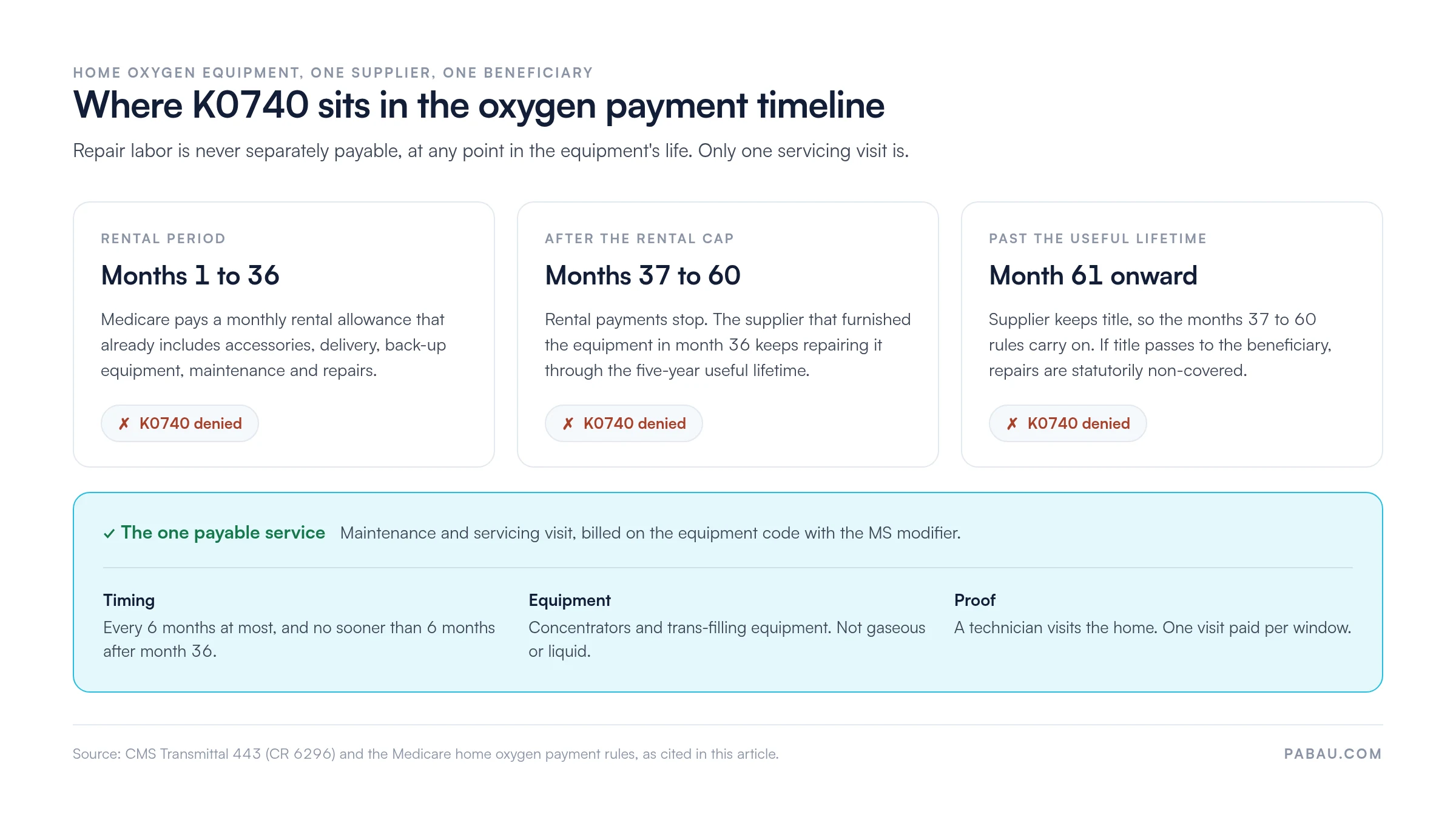
If a K0740 line is sitting in your accounts receivable waiting to be paid, it will not be. Work the denial rather than the appeal. The only oxygen servicing Medicare pays separately is the maintenance and servicing visit described below, and it is billed on the equipment code.
The difference is the equipment, not the difficulty of the job. Both codes require the skill of a technician. K0739 covers durable medical equipment other than oxygen equipment, and K0740 covers oxygen equipment. That single distinction also decides whether the labor gets paid.
Plenty of coding summaries describe K0739 as the code for work that does not need a technician. Read the official descriptor on the AAPC listing for K0739 and the phrase requiring the skill of a technician is right there. Skill level was never the test.
There is one separately payable service in the oxygen servicing picture, and it is not a repair. Medicare pays for a maintenance and servicing visit after the rental cap, on tight terms.
Use K0739 for the labor on beneficiary-owned equipment that is not oxygen equipment. Repair of a beneficiary-owned augmentative communication device routes to V5336 instead. When a unit is beyond repair, replacement runs on the equipment code with the RA modifier. Add that modifier in the initial rental month, with a narrative explaining the reason.
K0740 carries pricing indicator 00, so no fee schedule amount exists for it. There is no national rate, no local rate, and no by-report review to submit a charge into. A K0740 line has no price because Medicare assigns it none.
Unit math still matters even where the code is not payable. Secondary payers, state Medicaid programs, and private plans set their own rules, and several of them price repair labor per 15 minutes. Log the technician’s start and end time either way.
Most of the modifiers that get attached to K0740 belong somewhere else on the claim. The table below sorts the ones suppliers reach for, and where each one actually applies. Guessing here is a common source of denial codes in medical billing.
Two contractors handle every DMEPOS claim in the country. Noridian administers Jurisdictions A and D. Jurisdictions B and C go to CGS. Whichever one covers the beneficiary’s address publishes the supplier billing articles worth reading before your first oxygen claim goes out.
A non-payable code is not a paperwork holiday. The CMS oxygen policy article requires suppliers to keep detailed records of every repair, and those records get requested during audits of the rental claims. Four categories carry the weight.
These records also protect the rental payments themselves. A contractor reviewing a long-running oxygen rental will look at whether the supplier met its obligation to keep the equipment in working order.
Third-party code summaries have muddied this group badly. Two of the codes below turn up on billing blogs as suction pump repair labor codes. Neither one is a repair code at all.
The lesson generalizes past this handful of codes. Check any K-series descriptor against the current CMS HCPCS release file rather than a summary page. The K series is where deleted and repurposed codes cluster.
Because the supplier absorbs repair costs, the repair-or-replace call is a margin decision rather than a billing one. Medicare pays the same monthly amount whichever way it goes, so the cost of a failing concentrator lands entirely on the supplier.
Suppliers that track failure history by serial number spot the pattern earlier. A unit generating three technician visits a year is costing more than the rental line brings in, whatever the individual repair invoices say.
The scope here needs stating up front. Practice management software like Pabau is built for practices that bill payers for their own services, and it is not a DMEPOS billing system. It does not submit claims to a Medicare DME contractor.
The prescribing practice still sits inside this workflow, though. Every oxygen rental claim a supplier submits depends on records the practice holds. That means the standard written order, the qualifying blood gas test, and any repeat testing Medicare requires between days 61 and 90. When a supplier or a contractor asks for proof, the request lands on the practice.
Pabau keeps those orders, test results, and follow-up notes on one patient record. A staff member can find and send the right document the same day, rather than pulling a paper chart.
For the practice’s own insurance work, Pabau’s claims management software submits claims electronically and flags missing details before they turn into rejections.

Practice management software like Pabau keeps orders, test results, and follow-up notes on one patient record. Your team can find the right document in seconds rather than hunting through paper files.

K0740 is a reporting code that identifies oxygen equipment repair labor. It is not a revenue line, and no amount of documentation will make it one. Suppliers chasing K0740 denials are working a claim CMS instructed contractors to reject on the day the code went live.
The practical move is to treat oxygen repair labor as a cost of the rental. Bill the maintenance and servicing visit when the timing rules allow it, and keep the repair records CMS requires. Then verify any K-series descriptor against the current CMS file before you build a workflow on it.
Practices that prescribe home oxygen carry the other half of this paper trail. Book a demo to see how Pabau keeps orders, test results, and follow-up notes retrievable when a supplier or contractor asks for them.

Need a clearer overview of the claims lifecycle? What is medical billing covers the path from service delivery through remittance, and where coding decisions fit in.
Worried about rejections before they happen? Clean claim submission practices outlines the documentation and formatting standards that prevent first-pass denials.
Sitting on a stack of denied claims? Denial management in healthcare walks through root-cause analysis and the appeal workflow worth running.
HCPCS Code K0740 reports the labor for nonroutine repair or service of oxygen equipment when the work requires the skill of a technician. It is measured in 15-minute increments and covers labor only, never parts or replacement equipment.
No, and it never has. CMS created K0740 in Change Request 6296 and told contractors to deny it. The instruction covers dates of service on or after April 1, 2009. Repairs to oxygen equipment are already paid for inside the monthly rental allowance.
The equipment, not the skill level. Both descriptors require the skill of a technician. K0739 covers durable medical equipment other than oxygen equipment, and K0740 covers oxygen equipment. K0739 is payable from the DMEPOS fee schedule, and K0740 is not.
No, and that claim appears on a lot of coding sites. K0742 is portable gaseous oxygen contents, one month’s supply, and CMS deleted it effective January 1, 2013. K0743 is a portable home suction pump for use on wounds, an equipment code added July 1, 2011.
Through the maintenance and servicing visit after the 36-month rental cap. Bill the concentrator or trans-filling equipment code with the MS modifier, no more often than every six months. A technician has to visit the home, and gaseous and liquid systems are excluded.
Per 15 minutes of technician labor, with the total rounded down. A 50-minute service is three units rather than four. Medicare will not pay those units, but secondary payers and state programs often want the same time-based count on their own claims.
CMS requires detailed records of the need for and nature of every repair. That includes a justification for each part replaced and the labor time taken to restore the item. Keep them with the beneficiary file, because contractors request them when reviewing the rental claims.



