

CCSD code G5100: Bypass of duodenum billing guide
CCSD code G5100 bills a bypass that leaves the duodenum in place CCSD code G5100...

Last Updated: Oct 16, 2026
J1931 is the HCPCS Level II code for injection, laronidase, 0.1 mg.
That one detail drives most of the work. A 50 kg patient on the approved 0.58 mg/kg dose needs 290 units on the claim line. The count moves whenever the patient's weight does.
Get the units, the NDC or the diagnosis wrong and a drug costing thousands per session sits unpaid for weeks.
Let Pabau's smart automation suggest the right codes, reduce claim denials, and keep your practice compliant—effortlessly.
Automate repetitive tasks and focus on what matters most—your patients.
Reduce coding errors and ensure compliance with the latest regulations.
Clean claims, fewer denials, and faster reimbursements.
Powerful insights and reporting to help your practice thrive.
HIPAA compliant SOC 2 certified GDPR-compliant Trusted by 4,000+ clinics worldwide

HCPCS code J1931 covers injection of laronidase, 0.1 mg, the enzyme replacement therapy sold as Aldurazyme for mucopolysaccharidosis I.
Units are weight-based. Multiply the weight in kilograms by 0.58, then divide by 0.1, so a 50 kg patient needs 290 units.
Three ICD-10-CM codes support the claim, and they are E76.01, E76.02 and E76.03. Any other diagnosis is denied.
Medicare pays J1931 under Part B at average sales price plus 6%, and every line needs either modifier JW or modifier JZ.
NDC reporting is not required on every Part B claim. Medicaid and most commercial payers do want it, so capture it at the chair.
HCPCS code J1931 is the Level II code for injection of laronidase, at 0.1 mg per unit. It sits in the J-code range, which the Centers for Medicare and Medicaid Services (CMS) uses for drugs given by any route other than oral. The code is active and valid for 2025 and 2026.
Laronidase is a recombinant form of human alpha-L-iduronidase, the enzyme that patients with MPS I are missing. Without replacement, glycosaminoglycans build up in tissue and organs and cause progressive damage.
MPS I is a rare disease, so payers look closely at these claims and want the confirmed diagnosis on file before the first infusion.
The approved dose of Aldurazyme is 0.58 mg/kg, infused once weekly. Because J1931 is billed in 0.1 mg increments, the unit count tracks the patient’s weight. This is where most of the money on the code is won or lost.
Formula: units billed = (weight in kg x 0.58) divided by 0.1, rounded to the nearest whole unit.
Weigh the patient at every infusion visit. Aldurazyme comes in 5 mL vials holding 2.9 mg, which is 29 units, so the weights above happen to land on whole vials.
Off those round numbers you will open a vial you cannot finish, and that is when the waste modifier starts to matter.
Medicare reimburses J1931 under Part B at average sales price (ASP) plus 6%. That holds in the physician office and in the hospital outpatient department alike.
The rate moves every quarter, so check the CMS Physician Fee Schedule lookup tool before each billing cycle rather than trusting last quarter’s figure.
Place of service decides which form you file. The rate stays the same. CMS defines POS 19 as off campus outpatient hospital. No place of service code is named “infusion center”, so pick the code that describes where the chair sits. Current definitions live in the CMS place of service code set.
Aldurazyme is one of the highest-cost enzyme replacement therapies on the Part B drug schedule. Medicare Administrative Contractors, the MACs, look harder at these claims than at most.
Keep the weight, the vials purchased and the infusion date together in the claim package. Then read the remittance line by line, because a per-unit adjustment on one session repeats on every session after it.
Check the CMS ASP drug pricing file every quarter before you bill laronidase. The rate for J1931 updates in January, April, July and October. Billing at a stale rate leaves you with an overpayment to give back, or an underpayment you cannot easily recover.
Three ICD-10-CM codes support a J1931 claim, one for each clinical form of the disease. E76.0 has exactly three billable children.
The diagnosis behind them has to be confirmed by enzyme assay or genetic testing. Any other diagnosis on the line is an automatic denial.
Point the line at the confirmed phenotype. Some commercial payers narrow coverage further to E76.01 and E76.02, so check the payer’s list at the prior authorization stage rather than at submission. The ICD-10-CM code index carries the rest of the E76 family if a neighboring diagnosis is in play.
Report the National Drug Code (NDC) on the J1931 line unless you know the payer does not want it. Traditional Medicare only requires an NDC on Part B claims for dual-eligible beneficiaries.
Medicaid programs and most commercial payers ask for it on every claim, which in practice means capturing it every time. A missing NDC is a common reason a J1931 claim rejects at the clearinghouse, before it ever reaches the payer.
Always use the 11-digit format. Convert the FDA’s 10-digit NDC by adding a leading zero to whichever segment is short, based on the labeler, product and package split.
Then check the number against the vial in front of you at each order. A packaging change can give the drug a new NDC without touching the J-code.
Aldurazyme runs on the buy-and-bill model. The practice buys the drug from the manufacturer or a specialty distributor, infuses it, then bills the payer with J1931.
Your money leaves before the claim is even written, which is what makes the order date worth watching as closely as the infusion date.
Specialty pharmacies that dispense Aldurazyme often run hub services, including prior authorization support and NDC documentation. Leaning on them takes work off a billing team, especially for a practice handling its first MPS I patient. The acquisition cost still sits with you until the claim pays, so plan cash flow from the order date onward.
One question decides the modifier. Was any drug left in an opened vial once the dose was drawn? If yes, the discarded amount goes on its own line with JW. If no, the single line carries JZ.
CMS wants one of the two on every J-code drug line, and some MACs now deny claims that carry neither. When there is waste, bill the administered units on the first line and the wasted units on a second.
Confirm your own MAC’s current position, because enforcement of this rule has tightened faster than most payer policies.
Rare-disease enzyme replacement claims attract above-average audit attention. Every item below belongs in the medical record before the claim goes out.
One missing piece is enough to trigger a pre-payment review or a post-payment demand.
A drug-specific note template beats a generic infusion note here. Prompt for the weight, the vial count, the lot number and the NDC on one screen.
The record is then finished before the patient leaves the chair. Practices running several infusion drugs are better off with a template per drug than one note that tries to cover all of them.
Medicare Advantage plans and most commercial payers require prior authorization before the first infusion. Traditional Medicare Parts A and B do not, though a MAC may apply a local coverage determination that asks for medical necessity documentation up front.
State Medicaid programs sit anywhere between the two. Confirm the requirement with each payer before the first session, and diary the renewal date the day approval arrives.
Every state Medicaid program covers FDA-approved treatments, and Aldurazyme is one of them. What varies is the authorization process, the covered diagnosis codes and the quantity limits.
Some states cap annual quantities, some want specialist attestation, and some ask for periodic proof that treatment is still working. Read your own state’s fee schedule and PA criteria rather than assuming coverage looks the same everywhere.
Six errors account for most first-pass denials on this code. All six are cheaper to catch before submission than to appeal afterwards, because the drug is already paid for.
It helps to see a correct line first, then look at what goes wrong on it.
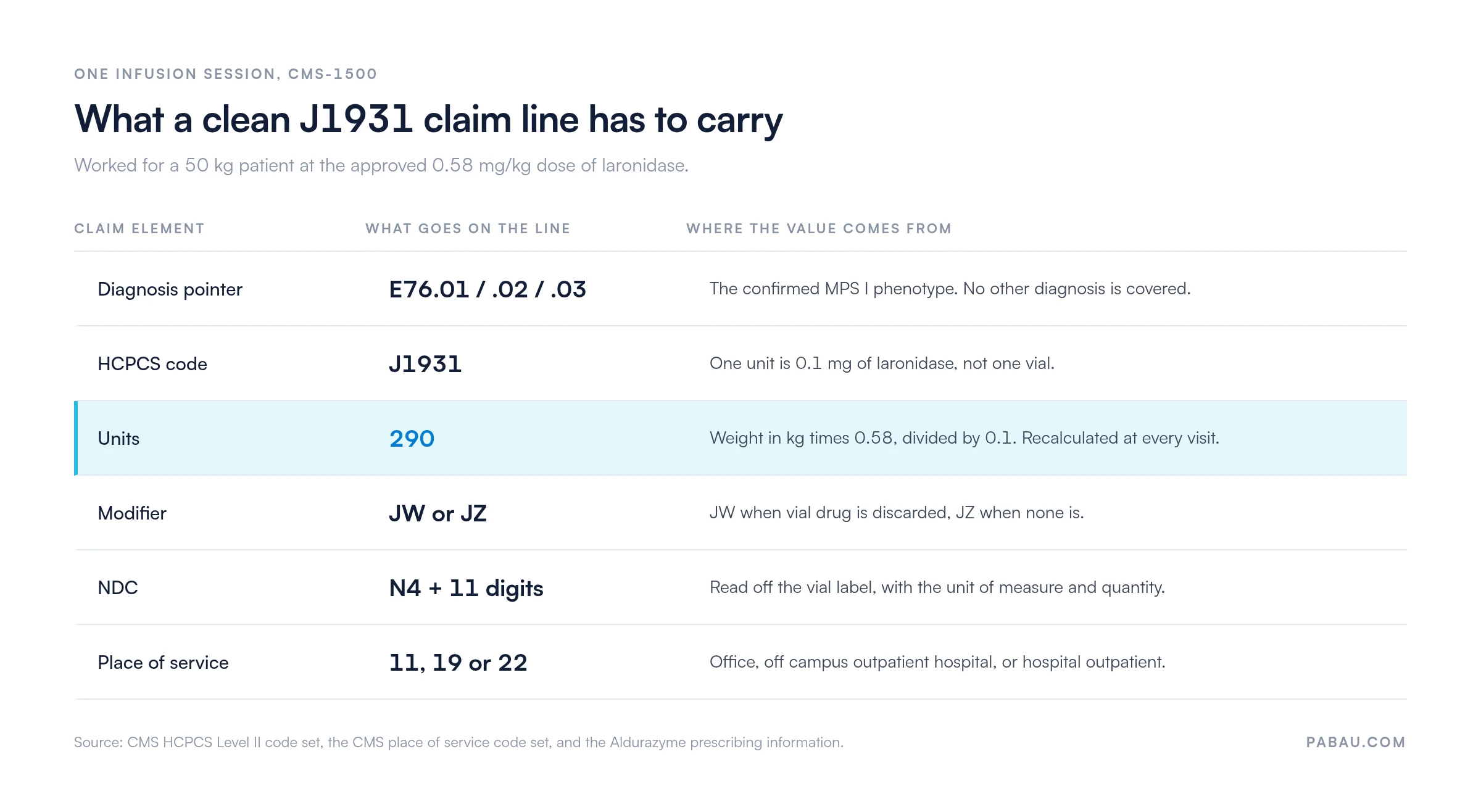
Good denial management on this code starts before submission, not after the remittance lands. Scrub the claim against the payer’s edits, and treat one adjusted unit as a pattern to investigate rather than a rounding difference. At this price per session, a single unrecovered unit adds up quickly across a year of weekly infusions.
Before a J1931 claim leaves the building, run five checks. Is today’s weight in the chart? Is the NDC read off the vial in front of you? Is JW or JZ on the line? Is the authorization number present and still valid? Is the diagnosis one of the three covered codes?
Plenty of infusion practices keep the note and the claim in separate systems. Someone reads the weight, the lot number and the NDC off a printout, then retypes them into a billing screen. A digit lost in that handoff becomes a denial three weeks later, long after the practice paid for the drug.
Practice management software like Pabau keeps the treatment note and the client record in the same place your biller works from. The weight captured at the chair is already on file when the claim is built, so nobody retypes it.
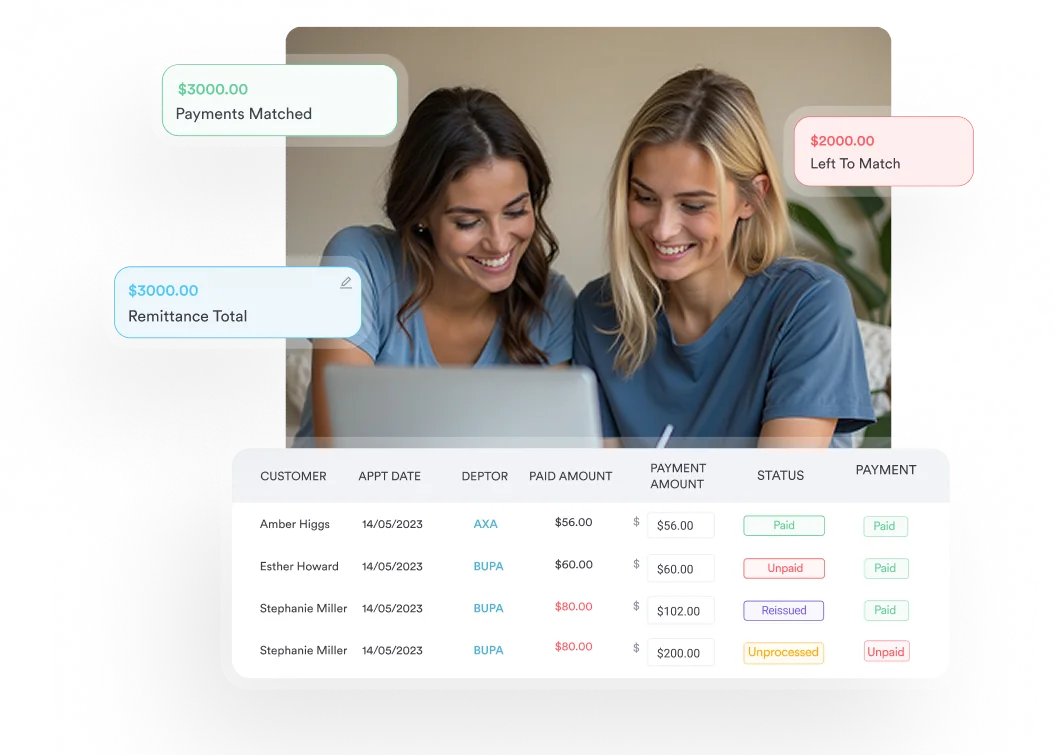
Pabau’s claims management software then submits the claim electronically and tracks its status, with validation checks running in the background before it leaves. A rejection shows up while you can still fix it.
Reporting closes the loop. You can see which payer keeps adjusting your J1931 units, and how often, so a pattern surfaces after two sessions instead of twenty. That matters more here than on most codes, because one session is worth thousands of dollars.
The clinical side feeds the same record. Pre-treatment instructions, confirmations and the treatment note all open from the appointment itself. The infusion detail your claim depends on gets written at the point of care.
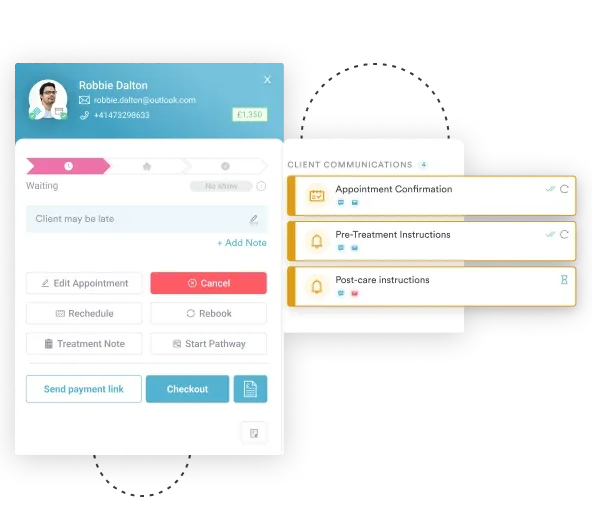

Pabau keeps the infusion note and the claim in the same system, submits it electronically, and tracks its status. Rejections surface while your team can still fix them.

Payment on a J1931 claim rests on one number that changes with the patient. Make the weigh-in part of your billing routine and most of the risk on this code goes away. The rest is habit, capturing the NDC from the vial in front of you and choosing JW or JZ before the claim leaves.
The trade-off worth remembering is timing. Every fix on this code is cheap before submission and expensive after it, because you have already bought the drug. Build the checks into the infusion visit and you stop funding a payer’s review cycle.
Pabau keeps the infusion note and the claim in the same system, so nobody retypes a figure between them. Book a demo to see how your team submits and tracks J-code claims from the chair to the remittance.

Need to know how the claim gets to the payer? Medical claims clearinghouse explains the route an electronic drug claim takes, and where it can reject.
Got a J1931 denial in hand? Denial codes in medical billing decodes the remittance adjustment reason codes and what each one asks you to do.
Want fewer claims coming back at all? What makes a clean claim sets out the checks that keep a first submission from bouncing.
Reading a remittance for per-unit adjustments? Electronic remittance advice shows how to read what a payer did to each line.
Yes. J1931 pays for the drug only. The chair time is billed separately with the IV infusion administration codes for the session, based on documented start and stop times. Both lines belong on the same claim.
Laronidase is infused once weekly, so a patient on continuous therapy generates roughly 52 claims a year. Some payers set an authorization window shorter than that, then ask for a renewal with evidence that treatment is still working.
Then you do not bill J1931 at all. When the payer ships the vials to you under the pharmacy benefit, the pharmacy bills the drug and you bill only the administration. Check which route the authorization approved before you order.
No. J1931 is the only HCPCS code for laronidase, and Aldurazyme is the only laronidase product on the US market. If a claim rejects, the problem is almost always the units, the NDC or the diagnosis.
Send four documents. You need the enzyme assay or genetic test confirming the diagnosis, plus the signed order stating the mg/kg dose. Add the weight recorded on the date of service and the infusion record. Together they answer most medical necessity denials on this code.



