CPT code 21011: Excision of soft tissue tumor of the face
CPT code 21011: Official descriptor and procedure overview CPT code 21011, as pu...

Last Updated: Oct 8, 2026
CPT Code 29075 is the billing code for application of a short arm cast, running from the elbow to the fingers. It immobilizes the wrist and distal forearm after fractures, sprains, and surgery. Medicare pays $97.53 for it in a non-facility setting and $58.79 in a facility, on a 0-day global period.
This reference covers the official descriptor, 2026 reimbursement, modifiers, ICD-10 pairings, global period rules, documentation requirements, and the errors that get the code denied.

CPT Code 29075 covers application of a cast from elbow to finger, known as a short arm cast.
The 2026 Medicare national payment is $97.53 in a non-facility setting and $58.79 in a facility.
The code carries a 0-day global period, so no preoperative or postoperative services are bundled into it.
Cast application is bundled into same-day definitive fracture care by the same provider, which is a frequent denial.
Practice management software like Pabau prompts for the LT or RT modifier before the claim leaves the practice.
CPT Code 29075 is defined by the American Medical Association (AMA) as “Application, cast; elbow to finger (short arm).” It sits in the Body and Upper Extremity Application of Casts category, codes 29000 to 29086. That family runs from the thorax down through the hand and fingers.
The procedure applies a fiberglass or plaster cast that begins at or just below the elbow and ends at the base of the fingers. It immobilizes the wrist and distal forearm while leaving the elbow mobile. That anatomical scope is what separates 29075 from the codes either side of it.
CPT 29075 is appropriate when a short arm cast is the clinically indicated immobilization method for wrist and distal forearm injuries. Medical necessity must be documented in the clinical record before billing. Common indications include:
This code is typically billed by orthopedic surgeons, hand surgeons, emergency physicians, and physiatrists. Payer policies vary on which specialties qualify as authorized providers, so check your local coverage determinations before billing.
Reimbursement for CPT Code 29075 comes from the CMS Physician Fee Schedule, which prices every code through relative value units (RVUs).
Rates vary by setting and by Medicare Administrative Contractor (MAC) locality. Check your own locality in the CMS Physician Fee Schedule Look-Up Tool before submitting, since the figures update every January.
The total RVU has three components: work RVU (wRVU), practice expense RVU (PE RVU), and malpractice RVU. Multiplying the total by the 2026 conversion factor of roughly $33.40 produces the national payment in the last row.
The 2026 Medicare national payment for CPT Code 29075 is $97.53 in a non-facility setting and $58.79 in a facility. Geographic Practice Cost Indices then adjust that figure by locality. High-cost areas such as San Francisco and New York pay above it, and rural localities pay below.
Almost the whole difference between the two settings sits in practice expense. The non-facility PE RVU of 2.03 pays for the casting materials and the staff time your practice carries. In a facility the hospital supplies both, the PE RVU drops to 0.87, and the payment falls by about 40%.
Commercial payer rates are negotiated separately and usually sit above Medicare. Verify contracted rates payer by payer rather than assuming Medicare equivalency, because a single cast code can vary by tens of dollars across three contracts.
Run a fee schedule comparison for CPT 29075 across your top three payers every year. A payer paying $20 less per cast costs you $4,000 across 200 cast applications, which is the number to take into a contract renewal.
Modifier selection for CPT Code 29075 directly affects claim acceptance. Applying the wrong modifier, or omitting one when it is required, is one of the most common causes of denial for cast application services. The table below covers the modifiers that apply to this code and the scenarios that trigger each.
Every CPT 29075 claim needs a supporting ICD-10-CM diagnosis code that establishes medical necessity. Payers cross-check the pairing, and a mismatch is a common denial source. The codes below are the diagnoses most often paired with a short arm cast.
Use the seventh character correctly: “A” for initial encounter, “D” for subsequent encounter, “S” for sequela. Submitting an initial-encounter code on a follow-up visit triggers medical review flags with most MACs.
CPT Code 29075 carries a 0-day global period. No preoperative or postoperative services are bundled into the payment. Each cast application encounter is billed on its own. Follow-up visits after the cast is applied are separately billable under evaluation and management (E&M) codes.
The bundling question that decides most claims is fracture care on the same day. Per CMS Article A52767, cast application is generally included in the global package of definitive fracture care codes. For the distal radius, those are 25600 to 25605. Billing 29075 separately on that date without modifier support triggers an automatic edit and denial.
When a cast is removed and reapplied in the same encounter, both codes can be billed together. 29075 covers the new cast and 29700 covers the removal. Modifier 76 on CPT 29075 tells the payer this is a repeat procedure by the same provider, though some payers ask for modifier 51 instead.
Documentation for a cast change must state the reason for removal and replacement. It also needs the clinical indication for the new cast, plus the type and material used.
Thorough documentation is the primary defense against claim denial and post-payment audit for CPT Code 29075. Each element below must appear in the clinical note before billing.
Most CPT 29075 denials trace back to five predictable mistakes. Addressing them in the billing workflow, rather than after the denial arrives, saves the most staff time. Billing teams can also check which denial codes for billers land most often on musculoskeletal claims, then work down that list.
Practices that validate every required field before transmission submit a clean claim far more often. Those checks catch these five errors before the payer ever sees them.
Configure your billing system to require LT or RT modifier selection before CPT 29075 can be added to a claim. This one gate prevents the most common denial trigger for cast application codes, and it takes under five minutes to set up.
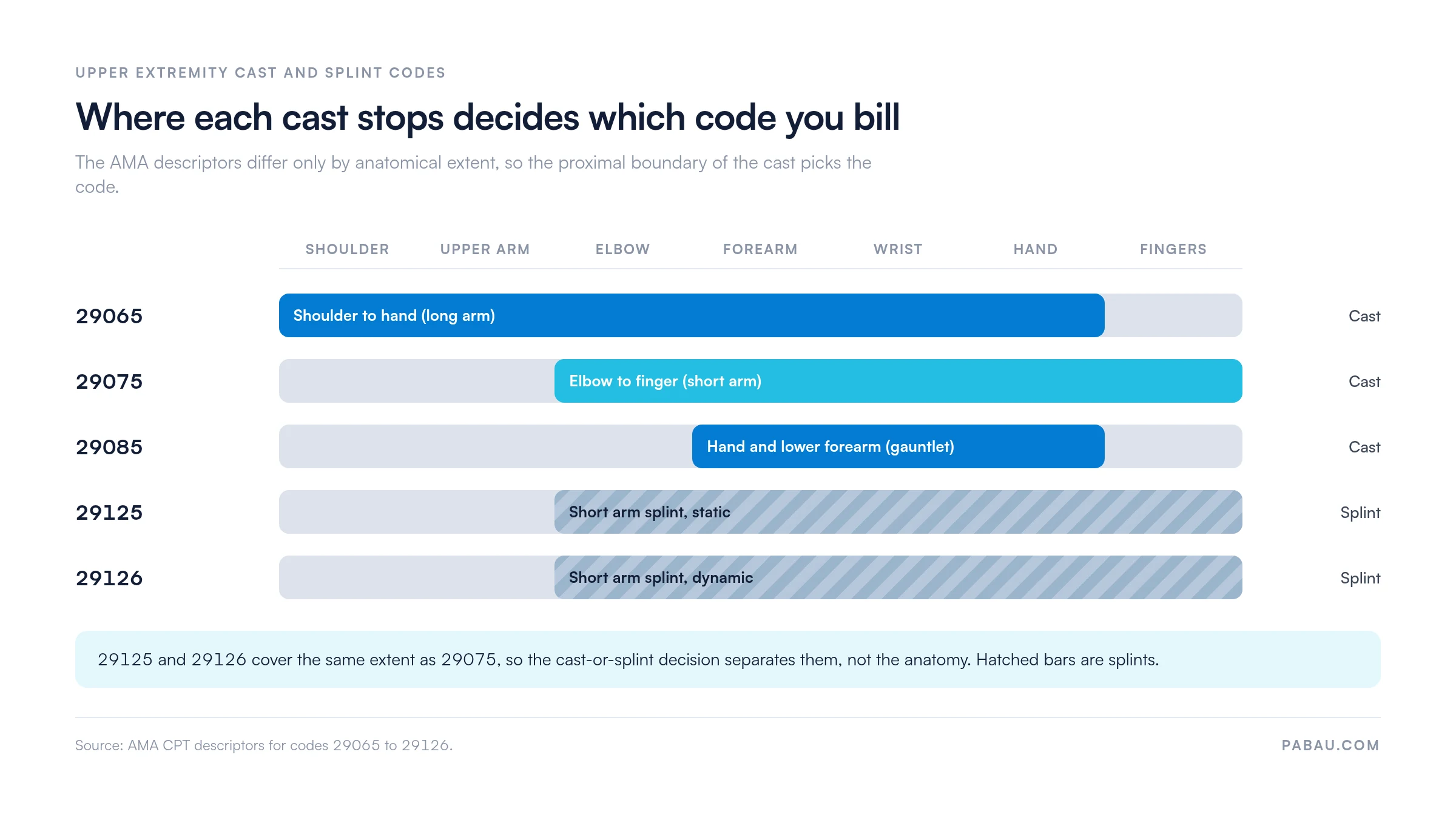
Choosing the right code from this family means matching the anatomical extent and the procedure type precisely. Billing 29075 when the scenario calls for a neighboring code affects payment and compliance alike. The chart below maps each code to the point where the cast or splint stops.
The same code-selection discipline applies to drug lines, where the product name decides the code. A ranibizumab biosimilar is never billed under HCPCS code J2778, because Byooviz takes Q5124 and Cimerli takes Q5128.
Coders look CPT Code 29075 up in a reference tool, then retype the code, the modifier, and the ICD-10 pairing into the billing system. Each handoff is a chance to drop a laterality modifier or pair the cast with the wrong diagnosis.
Practice management software like Pabau removes those handoffs. When 29075 is selected at the point of care, the modifier prompts surface with it. The diagnosis from the clinical note carries straight into the claim.
Our claims software for practices then validates the claim against NCCI edits, so bundling conflicts appear before transmission rather than on a remittance.
Pabau’s billing module also connects to Claim.MD, so electronic remittance advice posts against open claims automatically. Cast application payments reconcile without manual entry, which cuts the hours a billing team spends on rework each month.
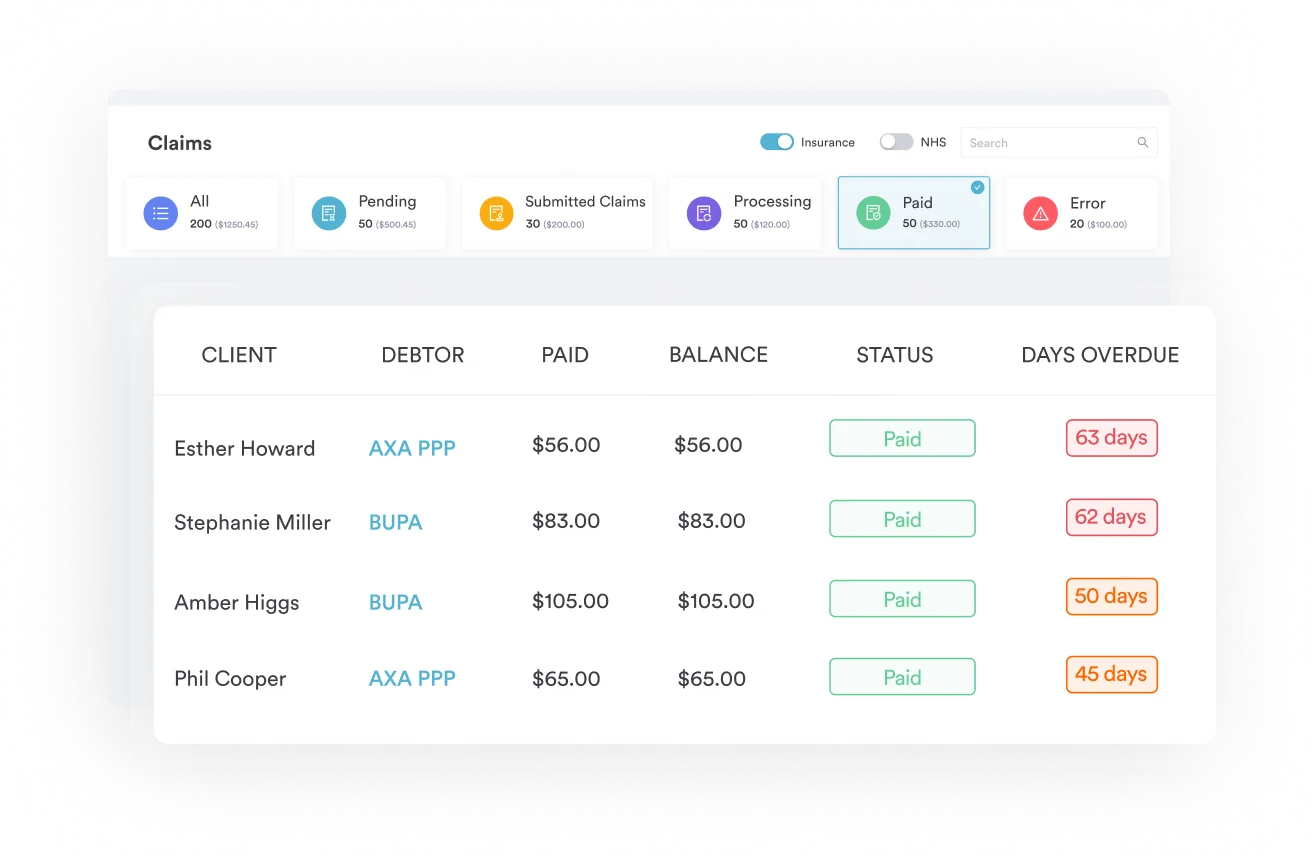

Pabau prompts for the modifier and the ICD-10 pairing when CPT 29075 is selected, so billing staff catch errors before submission.

Two decisions carry most of the money on a 29075 claim. The first is where the cast stops, which separates 29075 from 29065 and 29085. The second is who performed the fracture care, which decides whether the cast is billable at all.
Both are documentation decisions, made minutes before anyone opens the billing system. A practice that records the proximal boundary and the treating provider in the note rarely has to argue either point with a payer months later.
Book a demo to see how Pabau prompts for those details while the cast is still being applied.

Want to understand how medical billing claims flow end to end? What medical billing involves covers the full revenue cycle from charge capture through payment posting.
Need to handle claim denials more efficiently? Denial management in healthcare walks through denial categorization, appeal workflows, and root-cause tracking.
Looking for guidance on clean claim submission standards? Superbill documentation explains how accurate charge capture at the point of care prevents downstream billing errors.
Tracking where the money goes after the claim is paid? Revenue cycle management explains how charge capture, claims, and collections connect across a practice.
CPT Code 29075 is the billing code for application of a short arm cast, which runs from the elbow to the fingers. It immobilizes the wrist and distal forearm. It covers fiberglass and plaster casts for fractures, wrist sprains, carpal bone injuries, and post-surgical immobilization.
The 2026 Medicare national payment for CPT 29075 is $97.53 in a non-facility setting and $58.79 in a facility. That reflects a total of 2.92 RVUs and 1.76 RVUs respectively. Check the CMS Physician Fee Schedule Look-Up Tool for your own MAC locality.
The most commonly required modifier is LT or RT to indicate the treated extremity. Modifier 51 applies when 29075 is performed alongside another procedure on the same day. Modifier 58 applies during the global period of a related surgery. Modifier 76 is used when the cast is replaced by the same provider, typically alongside cast removal code 29700.
CPT 29075 covers a circumferential short arm cast from elbow to finger. CPT 29125 covers a static short arm splint over the same extent, which is not circumferential. Casts immobilize more rigidly, while splints leave room for swelling. Reimbursement for 29075 is higher, because the materials and technical work are greater.
Yes, when a cast is removed and a new cast is applied in the same encounter. Bill 29700 for the removal and 29075 for the new application, appending modifier 76 to 29075 for a repeat procedure by the same provider. Documentation must state the clinical reason for the cast change.
Yes, Medicare covers CPT Code 29075 when medical necessity is documented. Coverage requires a supporting ICD-10-CM diagnosis code that justifies circumferential immobilization. MAC-specific local coverage determinations may impose extra documentation requirements, so verify coverage policies with your own MAC before billing.
The note needs the clinical indication, with exam findings or imaging to support it. It also needs the cast type and material, and the extent documented as elbow to finger. Record who applied the cast, and add a supervising physician attestation when a non-physician applied it. Patient education on cast care belongs in the note too.