



CCSD code G5100: Bypass of duodenum billing guide
CCSD code G5100 bills a bypass that leaves the duodenum in place CCSD code G5100...

Last Updated: Oct 16, 2026

CPT code 28308 describes an osteotomy of the metatarsal other than the first, with or without lengthening, shortening, or angular correction.
Modifier LT or RT is required when billing for a single foot. Modifier 59 or XS may be needed to unbundle CPT 28308 from hammertoe code 28285.
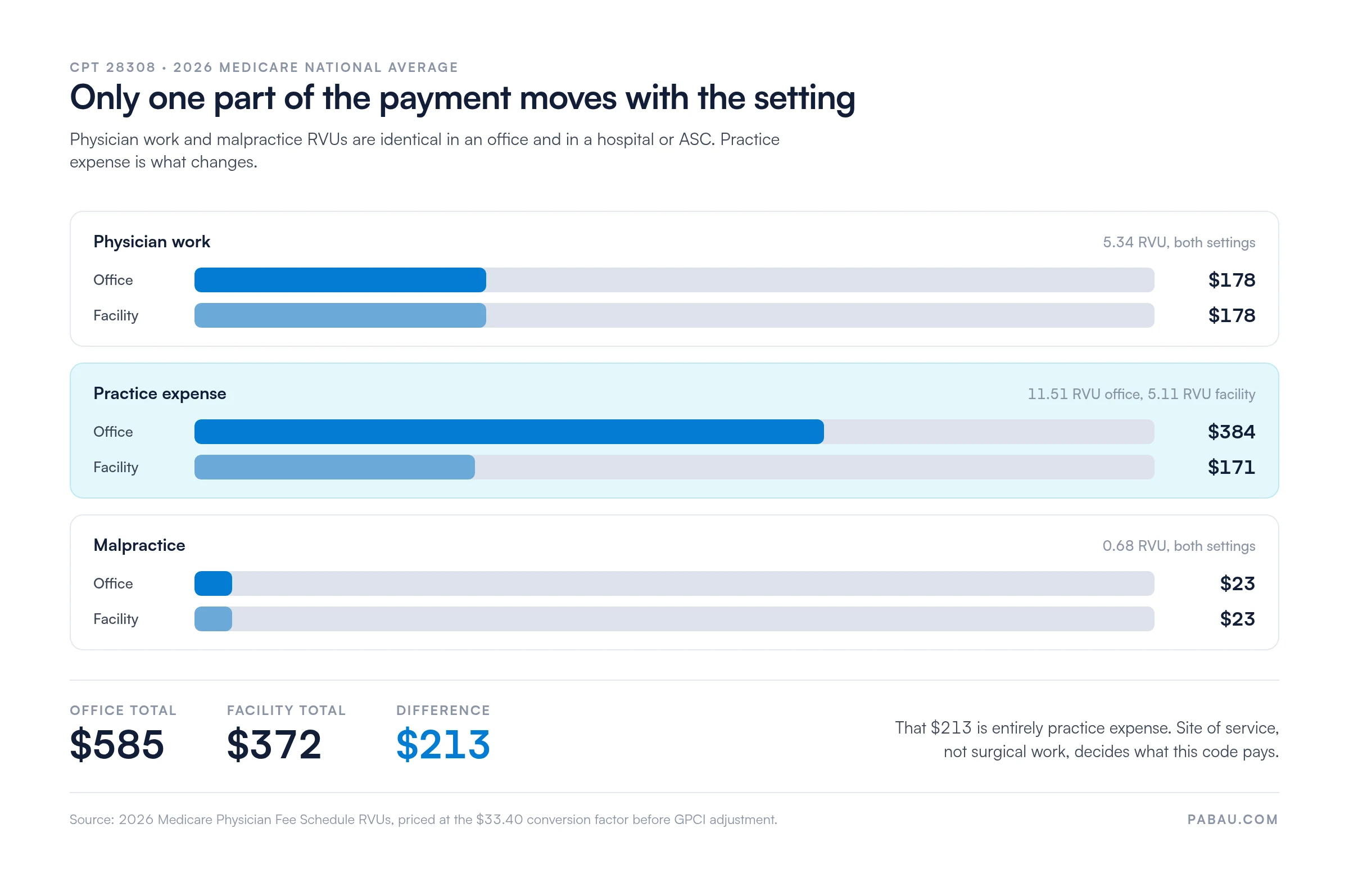
Medicare pays about $585 for CPT 28308 in an office and about $372 in a facility, before GPCI adjustment.
The 90-day global period means post-op visits, dressing changes, and routine follow-up care within that window cannot be billed separately under most payers.
Pabau’s claims management software streamlines metatarsal osteotomy billing by flagging NCCI edit conflicts and tracking claim status through your clearinghouse.
CPT code 28308 covers an osteotomy of the metatarsal other than the first metatarsal, with or without lengthening, shortening, or angular correction. The American Medical Association (AMA), which maintains the CPT code set, places this code within the Surgery section under Musculoskeletal System, Foot procedures.
The procedure involves surgically cutting one of the lesser metatarsals (second through fifth) and repositioning it to correct a structural deformity. Common indications include metatarsalgia, bunionette (tailor’s bunion), transfer lesions, and lesser-toe deformities that need metatarsal realignment. A bunionette treated by shaving the prominence off the fifth metatarsal head, with no bone cut, is CPT 28110.
CPT code 28308 applies per metatarsal treated, but only when a single lesser metatarsal is addressed. When two or more lesser metatarsals receive osteotomies in the same session, CPT 28309 is the correct code.
Selecting the right modifier is one of the most frequent sources of claim denials for CPT code 28308. Because osteotomies can be performed on either foot or on multiple toes, laterality and distinctness modifiers are both relevant.
Payer-specific rules govern which modifier resolves an NCCI bundle. Medicare currently prefers XS over 59 in most situations involving separate anatomical structures, but commercial payers may still require 59. Always verify the modifier policy with the individual payer before submitting. Never assume a modifier guarantees reimbursement: The operative note must independently support each code.
CPT code 28308 reimbursement varies by payer, geographic location, and facility type. The CMS Physician Fee Schedule lookup tool is the authoritative source for Medicare payment rates. Those rates are then adjusted by Geographic Practice Cost Indices (GPCI) for each locality.
The figures below are national averages for 2026, priced at the $33.40 conversion factor. Actual payment depends on the locality GPCI and on whether the service is performed in a facility or non-facility setting. Verify current rates using the FastRVU 2026 lookup tool or the CMS MPFS database.
The site of service moves the payment more than any other variable. Physician work and malpractice RVUs are identical in both settings, so the entire difference sits in practice expense. An office-based osteotomy pays roughly $585, while the same procedure in a hospital or ASC pays about $372.
RVU values and conversion factors are subject to annual CMS updates. Geographic GPCI multipliers can shift the final payment up or down by 15-25% depending on locality.
Commercial payers typically reimburse at a contractual multiplier of the Medicare fee schedule, usually 100% to 130%. Practice management software like Pabau gives billing teams end-to-end claims management. Each CPT 28308 claim is tracked from submission through ERA receipt, and underpayments surface automatically.
Accurate diagnosis coding is a prerequisite for medical necessity. Payers use diagnosis codes to decide whether the procedure is covered under their Local Coverage Determination (LCD) policies for foot surgery.
The ICD-10-CM codes below are the ones most often crosswalked with CPT code 28308. Coverage decisions are still governed by individual payer LCDs, not by the crosswalk list.
Use the CrossCoder CPT-to-ICD-10 crosswalk tool to verify which diagnosis codes align with CPT code 28308 under your MAC’s LCD. A crosswalk list is never a substitute for reading the payer’s own policy. Document the specific deformity, the affected metatarsal, and the functional limitations in the operative record.
Before submitting a CPT 28308 claim, confirm that the ICD-10 code reflects the specific metatarsal treated, laterality included. Then check that your operative note documents why conservative treatment failed. Payers routinely deny osteotomy claims when the record shows no prior attempt at orthotics, shoe modifications, or physical therapy.
Choosing between CPT 28308 and CPT 28309 is one of the most common coding decisions in podiatric surgery. The rule is straightforward in principle but frequently misapplied when multiple metatarsals are addressed in a single session.
A common error is billing CPT 28308 twice for two metatarsals on the same foot. That scenario requires CPT 28309, not two units of 28308. Confirm which metatarsals were surgically cut in the operative report before code selection, because unbundling violations carry audit risk.
Units mean something different on a drug line. HCPCS code J2700 is defined as up to 250 mg of oxacillin sodium, so a 1,000 mg dose is reported as four units.
CPT code 28308 sits within a family of foot osteotomy codes. Knowing where each code starts and stops is what prevents a misapplied code on a multi-procedure claim.
Hallux valgus has more than one surgical route, and the code follows the bone that is cut. When the correction is made by osteotomy of the proximal phalanx of the great toe, report CPT 28298 rather than a metatarsal osteotomy code. An Akin osteotomy performed on its own, with no bunionectomy on the same claim, is CPT 28310.
The most common billing challenge for CPT code 28308 is its interaction with CPT 28285 (correction of hammertoe with or without tenotomy). The National Correct Coding Initiative (NCCI) may bundle the two codes. Hammertoe correction and metatarsal osteotomy are sometimes treated as components of one surgical encounter on the same toe ray.
Soft tissue release at the operated metatarsal raises a similar question. Capsulotomy reported under 28270 is typically integral to the osteotomy, so check the pairing against the current quarterly edit file.
Before assuming both codes can be billed, check the current medical billing denial codes tied to NCCI edit violations for this pair.
NCCI edit tables are updated quarterly by CMS. What resolves a bundle in one quarter may not apply in the next. Verify the current edit status via the AAPC Codify CPT lookup or directly through CMS NCCI policy documentation before submitting.
Both codes can be billed in the same session when each procedure is clinically distinct and independently documented. The operative report must demonstrate:
Payer policies differ on which modifier resolves this NCCI edit. Medicare guidance currently favors the X modifiers (XS, XU, XP, XE) over modifier 59, but individual commercial payers may still require 59. Confirm with each payer before submission.
Missing documentation to support the unbundling is the single most common reason these claims are denied on audit review. The coding rules on the hammertoe side of the pair sit on the CPT 28285 reference page.
A defensible CPT code 28308 claim rests on the operative report. Coders cannot create documentation that does not exist. The report, the pre-operative workup, and the office notes must together support every element of the code descriptor.
The standard is the same across every surgical specialty. The operative note must match the code descriptor closely enough that an auditor would independently select the same code. Vague language such as “osteotomy performed on the foot” creates denial exposure, because it names neither the metatarsal nor the correction type.
Pre-authorization requirements for CPT code 28308 vary by payer. Many commercial plans require prior authorization for elective foot surgery. Contact the patient’s insurer to confirm requirements before scheduling.
CPT code 28308 carries a 90-day global period under the CMS Medicare Physician Fee Schedule, consistent with its classification as a major surgical procedure. Confirm this via the CMS MPFS database, since global periods can change with annual updates. Knowing what falls inside and outside that window prevents both underbilling and overbilling.
Flag the global period status on every post-operative visit in the schedule. That single field stops duplicate billing and tells the billing team when the 90-day window opens and closes. Reconcile each remittance against it, so global and non-global services are paid as billed.
Six errors account for most CPT code 28308 denials in audits and payer appeals. Each one is caught by a structured pre-submission review, so build these checks into the workflow before claims go out.
Three checks catch most of these errors before submission:
Run them as one step in the billing workflow, not as three optional habits.
Run a monthly audit of every CPT 28308 claim denied in the prior quarter. Sort the denials by reason code and see whether the pattern points to a modifier, a missing document, or an NCCI edit. Fixing one pattern at the source saves more time than appealing the same denial twenty times.
A lot of podiatry billing runs on one person’s memory. The biller knows CPT 28308 needs LT or RT, knows the 28285 edit exists, and knows which post-op visits fall inside the 90-day window. When that person is out, the denials arrive three weeks later.
Pabau holds the operative note, the diagnosis codes, the modifiers, and the claim in one record. The checks then run against the chart rather than a checklist taped to a monitor. Claims go out electronically, and each remittance comes back with the denial reason code attached to the claim line it belongs to.
The outcome is fewer avoidable denials on foot surgery codes, and a shorter appeal list for the billing team to work through. Every Pabau subscription includes claims management, reporting, and clinical records, so none of this sits behind a higher tier.

Pabau’s claims management connects to your clearinghouse to track CPT 28308 claims and catch NCCI edits before submission. Denial reasons come back attached to the claim line, so the billing team stops chasing payments.

The code choice on a metatarsal osteotomy is rarely the hard part. One lesser metatarsal is 28308, two or more is 28309, and the operative report settles which. Payment turns on what happens after the code is picked.
So the work worth doing sits upstream of the claim. If the operative note names the metatarsal, the laterality, and the correction type, the modifier follows and the audit defense is already written. If it does not, no modifier rescues the claim on appeal.
Set that pre-submission check once and it holds for every foot surgery code, not only this one. Book a demo to see how Pabau tracks a CPT 28308 claim from the operative note through the remittance.

Need a primer on clearinghouse claim submission for foot surgery codes? Medical claims clearinghouse overview covers how electronic claim routing works and what to look for in a clearinghouse for surgical specialties.
Coding a heel osteotomy in the same session? CPT 28300 covers calcaneal osteotomy billing, including the fixation rules that separate it from the metatarsal codes.
Looking to reduce claim rejections across your surgical billing workflow? Claim.MD vs. Office Ally comparison breaks down clearinghouse capabilities for practices managing high-volume surgical codes.
CPT code 28308 is an osteotomy of the metatarsal other than the first metatarsal, with or without lengthening, shortening, or angular correction. It applies to surgical cutting and repositioning of a single lesser metatarsal, meaning the second through the fifth. The goal is to correct a structural foot deformity such as metatarsalgia, bunionette, or lesser metatarsal malalignment. The code is reported per metatarsal treated. When two or more lesser metatarsals are corrected in the same operative session, CPT 28309 is used instead.
The laterality modifiers come first: LT for the left foot and RT for the right. Modifier 50 covers a bilateral procedure in one session, and modifier 51 applies when 28308 is billed alongside other procedures. Modifier 59 marks a distinct procedural service, which is how 28308 is unbundled from CPT 28285. Medicare prefers XS (separate structure) in that situation. Modifier 22 applies in unusually complex cases with substantial additional work. Always verify which modifier a specific payer accepts before submission, because payer policies differ from Medicare guidance.
The 2026 national average Medicare payment for CPT code 28308 is about $585 in a non-facility setting and about $372 in a facility or ASC. Both figures are pre-GPCI. They price 5.34 work RVUs and 0.68 malpractice RVUs at the $33.40 conversion factor. Practice expense adds 11.51 RVUs in an office and 5.11 RVUs in a facility. Actual rates vary by locality, so use the CMS Physician Fee Schedule lookup tool or FastRVU for your area. Commercial payers typically reimburse at a contracted percentage of the Medicare fee schedule.
Use CPT 28308 when one lesser metatarsal is corrected in a single operative session on one foot. Use CPT 28309 when two or more lesser metatarsals on the same foot receive osteotomies in the same session. Billing two units of CPT 28308 for two metatarsals on the same foot is an NCCI violation. CPT 28309 is the correct code for that scenario.
Yes, but only when each procedure is clinically distinct and independently documented in the operative report. NCCI edits may bundle CPT code 28308 with CPT 28285, which covers hammertoe correction. Modifier 59 or XS on the column-2 code may resolve the edit. The documentation has to confirm separate anatomical structures and separate surgical interventions. Verify the current edit status quarterly, as CMS updates NCCI tables four times per year.
CPT code 28308 carries a 90-day global period under the CMS Medicare Physician Fee Schedule, consistent with its classification as a major surgical procedure. During this window, routine post-operative office visits, wound care, and normal follow-up services are included in the global payment and cannot be billed separately. Services for a new or unrelated condition may be billed outside the global period, as may staged procedures. A complication requiring a return to the OR is billed with modifier 78 or 79. Confirm the current global period designation via the CMS MPFS database, as designations can change with annual updates.
Five ICD-10-CM codes carry most CPT code 28308 claims: M20.4x for acquired hammer toe, M77.4x for metatarsalgia, and M21.6x for other acquired foot deformities. M20.1x applies to hallux valgus when concurrent lesser metatarsal correction is required, and Q66.x covers congenital foot deformities. Always select the most specific code supported by clinical documentation. Then verify coverage under the relevant payer LCD for foot surgery.



