

CCSD code G5100: Bypass of duodenum billing guide
CCSD code G5100 bills a bypass that leaves the duodenum in place CCSD code G5100...

Last Updated: Oct 16, 2026
J2700 is the HCPCS Level II code for injection, oxacillin sodium, up to 250 mg.
Unit miscalculation is where the code most often goes wrong, and the wastage modifiers are a close second. Both come back to two numbers from the chart, the amount the vial held and the amount the patient received.
Let Pabau's smart automation suggest the right codes, reduce claim denials, and keep your practice compliant—effortlessly.
Automate repetitive tasks and focus on what matters most—your patients.
Reduce coding errors and ensure compliance with the latest regulations.
Clean claims, fewer denials, and faster reimbursements.
Powerful insights and reporting to help your practice thrive.
HIPAA compliant SOC 2 certified GDPR-compliant Trusted by 4,000+ clinics worldwide

HCPCS code J2700 covers an injection of oxacillin sodium, up to 250 mg per billing unit.
Each billing unit equals 250 mg, so a 1,000 mg administered dose bills as 4 units of J2700.
Medicare Part B pays J2700 at ASP plus 6%, and the rate updates quarterly in the CMS ASP pricing file.
Modifier JW reports discarded drug and has been mandatory since January 1, 2017, while modifier JZ has been mandatory since July 1, 2023.
Practice management software like Pabau captures J-codes, calculates units, and prompts for the right modifier before the claim goes out.
Oxacillin sodium is a beta-lactam antibiotic in the isoxazolyl penicillin subclass, engineered to resist the penicillinase enzymes that staphylococci produce. That resistance makes it the preferred agent for methicillin-susceptible Staphylococcus aureus (MSSA) infections, where it outperforms broader-spectrum alternatives.
The indications below are the ones that commonly justify J2700 billing. Each should be supported by a matching ICD-10 diagnosis code on the claim.
Oxacillin is not active against methicillin-resistant S. aureus (MRSA). Billing J2700 against an MRSA-specific diagnosis can trigger medical necessity edits during claim review. Document susceptibility results in the clinical record whenever they exist.
The single most common billing error with J2700 is unit miscalculation. Each billing unit covers up to 250 mg of oxacillin sodium. Divide the administered dose by 250 to get the number of units to report on the claim.
Bill only for the dose administered. When a single-dose vial holds more drug than the patient receives, apply modifier JW to report the discarded amount on a separate line. Apply modifier JZ instead when there is no wastage. Both modifiers are covered in the modifier section below.
Medicare Part B pays for physician-administered drugs like oxacillin under the average sales price (ASP) methodology. For non-excepted drugs given in a physician office, the allowable amount is ASP plus 6%. CMS updates ASP payment limits quarterly, so the rate for J2700 changes four times a year.
For current figures, use the CMS Physician Fee Schedule lookup tool or download the latest ASP Drug Pricing File from cms.gov. Checking your posted payments against that file each quarter catches rate drift before it accumulates.
Pull the CMS ASP Drug Pricing File at the start of each calendar quarter and cross-reference your billing system’s J2700 allowable amounts. Rate drift between quarters is a common source of underpayment on high-volume antibiotic billing.
Medicare Part B, most state Medicaid programs, and the majority of commercial plans all cover J2700. What differs is the paperwork each one wants before it pays. Confirming the patient’s drug benefit before the infusion prevents the most common coverage denials, and a commercial plan may want prior authorization on top.
An NDC (National Drug Code) crosswalk connects the oxacillin product dispensed to the billing code J2700. Most state Medicaid programs require the NDC on outpatient drug claims. A claim submitted without a valid NDC gets rejected in Medicaid adjudication.
Medicare Part B does not currently mandate NDC submission for physician-administered drugs. Including it anyway supports audit defense and medical necessity documentation.
Oxacillin sodium is made by several labelers, each with a distinct NDC. The NDC on a claim is typically 11 digits, in 5-4-2 format. Always report the NDC that matches the vial dispensed, never a generic lookup. Verify current oxacillin NDC codes against the FDA’s DailyMed database or your wholesaler’s product information, because they change when packaging changes.
On the CMS-1500 claim form: Report the NDC in Box 24, using qualifier N4 in the shaded area. Follow it with the 11-digit NDC, the unit of measure qualifier, and the quantity dispensed. UN is the usual unit qualifier for an injectable.
Every J2700 claim needs at least one ICD-10-CM diagnosis code that establishes medical necessity. The diagnosis has to reflect the condition being treated with oxacillin, not the fact that an injection was given. The codes below are the ones most often paired with oxacillin therapy, and the wider ICD-10-CM code set covers the rest.
Code to the highest level of specificity the record supports. Reaching for an unspecified site code when site-specific documentation exists is a documentation failure that auditors flag. The medical record has to support whichever diagnosis code appears on the claim.
Two modifiers govern drug wastage billing for the single-dose vials commonly used for oxacillin. Modifier JW has been mandatory on Medicare Part B claims since January 1, 2017. Modifier JZ was optional from January 1, 2023 and became mandatory on July 1, 2023, under CMS Change Request 13056 (Transmittal 12067). Leaving both off a single-dose vial claim triggers an edit.
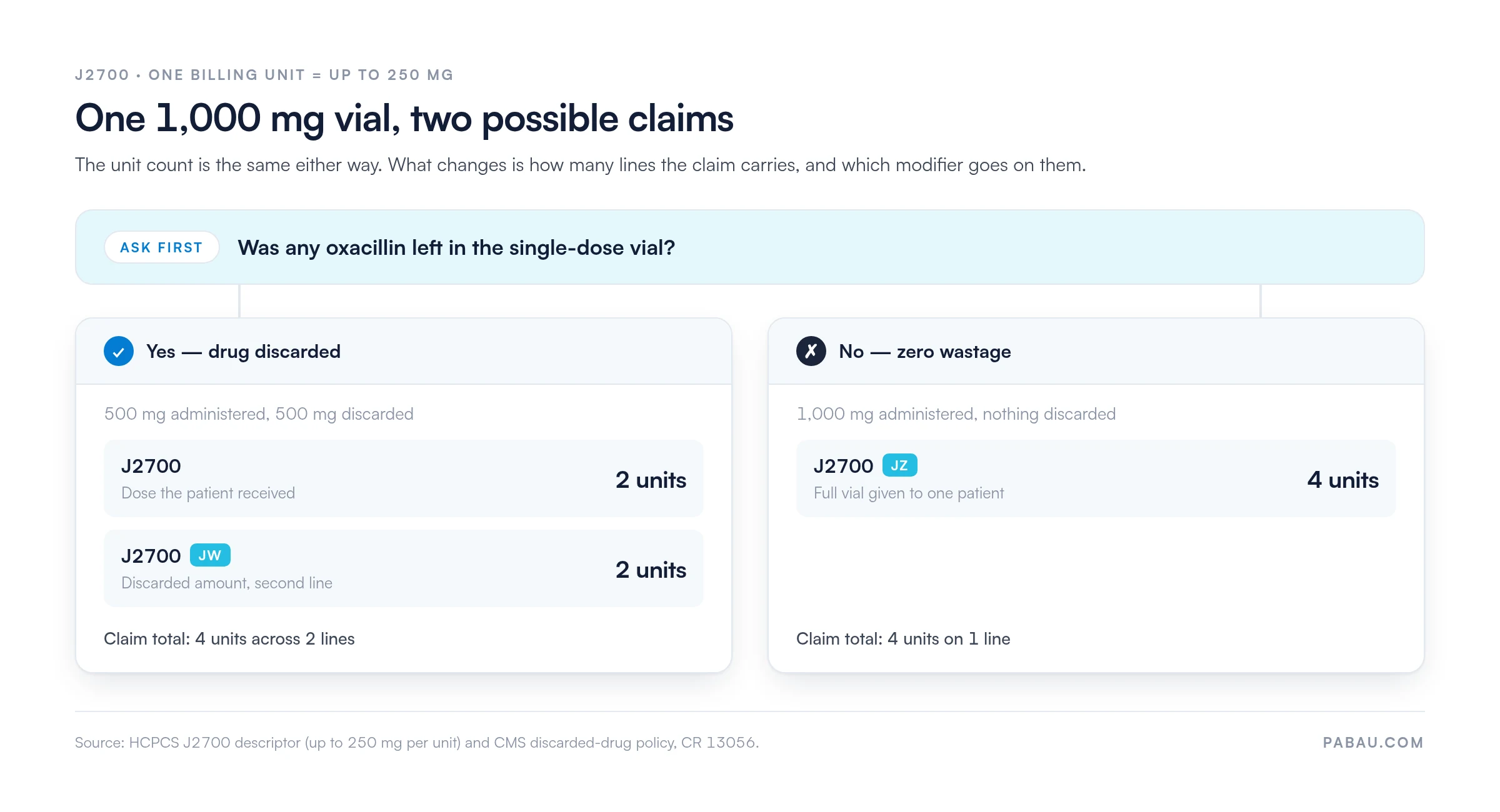
Practical JW/JZ workflow: A 1,000 mg single-dose vial is opened and only 500 mg is administered. Bill 2 units of J2700 for the administered dose, then a second line of 2 units with modifier JW for the 500 mg discarded. When the whole vial goes to one patient, bill 4 units with modifier JZ on a single line. The claim carries 4 units either way, as the diagram below shows.
Buy-and-bill is the model where the practice purchases oxacillin, administers it, then bills the payer for the drug and the administration. Getting the sequence right is what keeps claims out of the rework queue. Here is the workflow in order.
Picking the wrong antibiotic J-code is one of the easiest billing errors to prevent. Oxacillin, nafcillin, and ampicillin are all injectable beta-lactams, and each carries its own HCPCS code and its own unit size. Swapping one for another produces a mismatch that automated payer edits catch. For full descriptors, the AAPC HCPCS code lookup is free to search.
Manual J-code billing fails in predictable places. The unit count gets typed in wrong, the NDC field is left blank, or modifier JZ is forgotten on a full-vial claim. Each one adds rework time and pushes payment further out.
Practice management software like Pabau closes those three off at the source. Our cleaner claims management workflow captures the J-code during the clinical encounter. It converts the documented dose into units, so nobody divides by 250 by hand.
The NDC on the dispensed vial carries through to the crosswalk field. Pabau then prompts for JW or JZ based on what the note records about wastage. Claims route to your clearinghouse with those fields already filled, so the pre-submission edits have less to catch.
Audit your last 90 days of J2700 claims for modifier compliance. Look for claims where a single-dose vial was opened but neither JW nor JZ appears. These are easy OIG audit targets in antibiotic injection billing, and fixing them now costs far less than a post-payment recovery.

Pabau’s claims management software captures HCPCS codes like J2700 and calculates the billing units from the documented dose. Claims route through your clearinghouse with the modifier and NDC already in place.

J2700 is a low-value code that costs more to fix than it pays. A rejected antibiotic line takes the same staff time to rework as a claim worth far more. That is why it deserves attention it rarely gets.
That argues for catching the error at the point of documentation rather than in the remittance. The unit count and the wastage modifier both come from the treatment note. A workflow that reads the note is doing the checking for you.
The trade-off worth remembering is that NDC and modifier discipline costs a few seconds per administration, and a denial costs a few days. Book a demo to see how Pabau builds the J2700 line straight from the treatment note.

Need to understand how claims move from submission to payment? Medical billing fundamentals covers the full claim lifecycle from charge capture through remittance posting.
Getting denials on injectable drug claims? Denial codes in medical billing breaks down the most common CARC reason codes and how to respond to each one.
Want to streamline your clearinghouse workflow? Medical claims clearinghouse explains how electronic claim routing reduces rejection rates and speeds up payer response.
Not sure where the NDC goes on an electronic claim? The 837 claims file walks through the loops and segments that carry drug and diagnosis data.
Running too many appeals on drug claims? Denial management in healthcare sets out a process for catching preventable denials before they need an appeal.
HCPCS code J2700 bills an injection of oxacillin sodium, at up to 250 mg per billing unit. It applies in a physician office, outpatient hospital, or qualifying infusion setting, and covers Medicare Part B, Medicaid, and most commercial claims.
Divide the administered dose in milligrams by 250. A 500 mg dose is 2 units, a 1,000 mg dose is 4 units, and a 2,000 mg dose is 8 units. Bill only the dose administered, not the full vial contents.
Yes, Medicare Part B generally covers J2700 for physician-administered oxacillin sodium when medical necessity is documented. Payment follows the average sales price (ASP) plus 6% methodology, updated quarterly. The claim must carry a supporting ICD-10 diagnosis code and modifier JW or JZ.
Modifier JW applies when drug is discarded from a single-dose vial after administration, and modifier JZ applies when nothing is wasted. JW has been mandatory on Medicare Part B claims since January 1, 2017. JZ became mandatory on July 1, 2023, after an optional period that started January 1, 2023. The governing instruction is CMS Change Request 13056, Transmittal 12067.
Yes, for Medicaid claims in most states. The crosswalk links the dispensed oxacillin product, identified by its 11-digit NDC, to J2700. Medicare Part B does not currently mandate NDC submission for physician-administered drugs, but including it supports audit documentation.
J2700 covers oxacillin sodium at up to 250 mg per unit, and J2290 covers nafcillin sodium at 20 mg per unit. Both drugs are penicillinase-resistant penicillins used for MSSA infections. The unit sizes are very different, so a code swap also produces a wrong unit count. J2850 is not an antibiotic code at all, and its descriptor covers synthetic human secretin.



