Pabau Engage inbox

Pabau Engage is here: every patient conversation in one inbox.

Learn more
ICD-10-CM Code

ICD code S96.092A – Other injury of long flexor toe tendon

Billable Code Specific Code


Code Definition

S96.092A is the billable ICD-10-CM code for other injury of the long flexor toe tendon at ankle and foot level, left foot, initial encounter.

It covers a documented injury to the long toe flexor tendon, such as a tendon contusion, that is neither a strain nor a laceration. Strains take S96.012A and lacerations take S96.022A. The 6th character 2 sets the left foot, and the 7th character A marks active treatment.

Chapter
S00-T88 Injury, poisoning and certain other consequences of external causes
Category
S96 Injury of muscle and tendon at ankle and foot level
Group
S96.092 Other injury of muscle and tendon of long flexor muscle of toe at ankle and foot level, left foot
Billable
Yes
Code also known as
flexor tendon toe injury, long toe flexor tear, ankle flexor tendon trauma, toe tendon injury
Save time. Improve accuracy. Get paid faster.
Automate coding with Pabau

Let Pabau's smart automation suggest the right codes, reduce claim denials, and keep your practice compliant—effortlessly.

  • AI-powered code suggestions
  • Real-time compliance checks
  • Faster claims, fewer denials
Why practices choose Pabau
Save hours every week

Automate repetitive tasks and focus on what matters most—your patients.

Improve accuracy

Reduce coding errors and ensure compliance with the latest regulations.

Get paid faster

Clean claims, fewer denials, and faster reimbursements.

Grow with confidence

Powerful insights and reporting to help your practice thrive.

HIPAA compliant SOC 2 certified GDPR-compliant Trusted by 4,000+ clinics worldwide

Key takeaways

Key takeaways

S96.092A is a billable ICD-10-CM code for other injury of the long flexor toe tendon of the left foot, initial encounter. It does not cover strains or lacerations.

The 7th character A marks active treatment. Use D for subsequent encounters and S for sequela, since a wrong 7th character is the most common denial trigger.

The 6th character records the foot, not the toe: 1 is right, 2 is left, and 9 is unspecified. The record must document the left foot to support S96.092A.

Pabau’s claims management software scrubs every claim for missing or invalid details before submission, so fewer S96.09x claims come back unpaid.

ICD-10 Code S96.092A: Code at a glance

The table below captures every quick-reference field a coder or biller needs before submitting a claim. Confirm the code’s active status against the current fiscal year Tabular List using the CDC/NCHS ICD-10-CM web tool before each coding cycle begins.

FieldDetail
CodeS96.092A
Full descriptorOther injury of muscle and tendon of long flexor muscle of toe at ankle and foot level, left foot, initial encounter
Code statusBillable (7-character terminal code)
ICD-10-CM chapterChapter 19: Injury, poisoning and certain other consequences of external causes (S00-T88)
BlockS90-S99: Injuries to the ankle and foot
Parent categoryS96: Injury of muscle and tendon at ankle and foot level
7th characterA = initial encounter (this code); D = subsequent; S = sequela
LateralityLeft foot (6th character 2). Right foot is S96.091A and unspecified foot is S96.099A.

What S96.092A covers

S96.092A captures left-foot injuries of the long flexor muscle and tendon of the toe at ankle and foot level. The injury is neither a strain nor a laceration. “Other injury” in ICD-10-CM is a defined residual category. It holds documented pathology that doesn’t fit the more specific descriptors in the same subcategory.

In practice, this includes contusions to the tendon sheath and traumatic tendinopathy. The provider has documented an injury mechanism but cannot classify it as a strain. The structures captured are the flexor digitorum longus and flexor hallucis longus tendons, which flex the toes, as they pass through the ankle and foot.

  • Long flexor tendon of the toe: The code does not identify an individual toe. It covers the long flexor muscle and tendon serving the toes, whichever toe the note names.
  • At ankle and foot level: The injury site must be at or distal to the ankle mortise, not mid-shaft of the lower leg. Proximal tendon injuries use different code blocks.
  • “Other injury” vs. strain: Strain codes (S96.01x) require documentation of a stretch or overuse mechanism with intact but damaged tendon fibers. If the provider documents another injury type, such as a tendon contusion, S96.092A is the appropriate selection.
  • Left foot only: The 6th character 2 means the left foot. A right-foot injury takes S96.091A, and S96.099A applies only when the record does not state the side. Query the provider before choosing unspecified if the note is unclear.

Code hierarchy: S96 parent category and subcategories

Understanding where S96.092A sits in the ICD-10-CM hierarchy helps coders navigate adjacent codes quickly and select the correct level of specificity. The AAPC Codify ICD-10-CM lookup displays the full S96 hierarchy with cross-references to related ranges.

Code levelCodeDescriptionBillable?
CategoryS96Injury of muscle and tendon at ankle and foot levelNo
SubcategoryS96.0Injury of muscle and tendon of long flexor muscle of toe at ankle and foot levelNo
Code groupS96.09Other injury of muscle and tendon of long flexor muscle of toe at ankle and foot level (6th character sets the foot)No
Code (no 7th char)S96.092Other injury, left foot. Requires a 7th character extension.No
Billable codeS96.092AOther injury, left foot, initial encounterYes
Sibling: Right footS96.091AOther injury, right foot, initial encounterYes
Sibling: Unspecified footS96.099AOther injury, unspecified foot, initial encounterYes

S96.092 is a non-billable placeholder without the 7th character. Submitting S96.092 without a 7th character will result in an automatic code-validity rejection from the clearinghouse. The full 7-character code S96.092A is required for every initial-encounter claim.

Read the code left to right and each character answers one question about the injury, as the breakdown below shows.
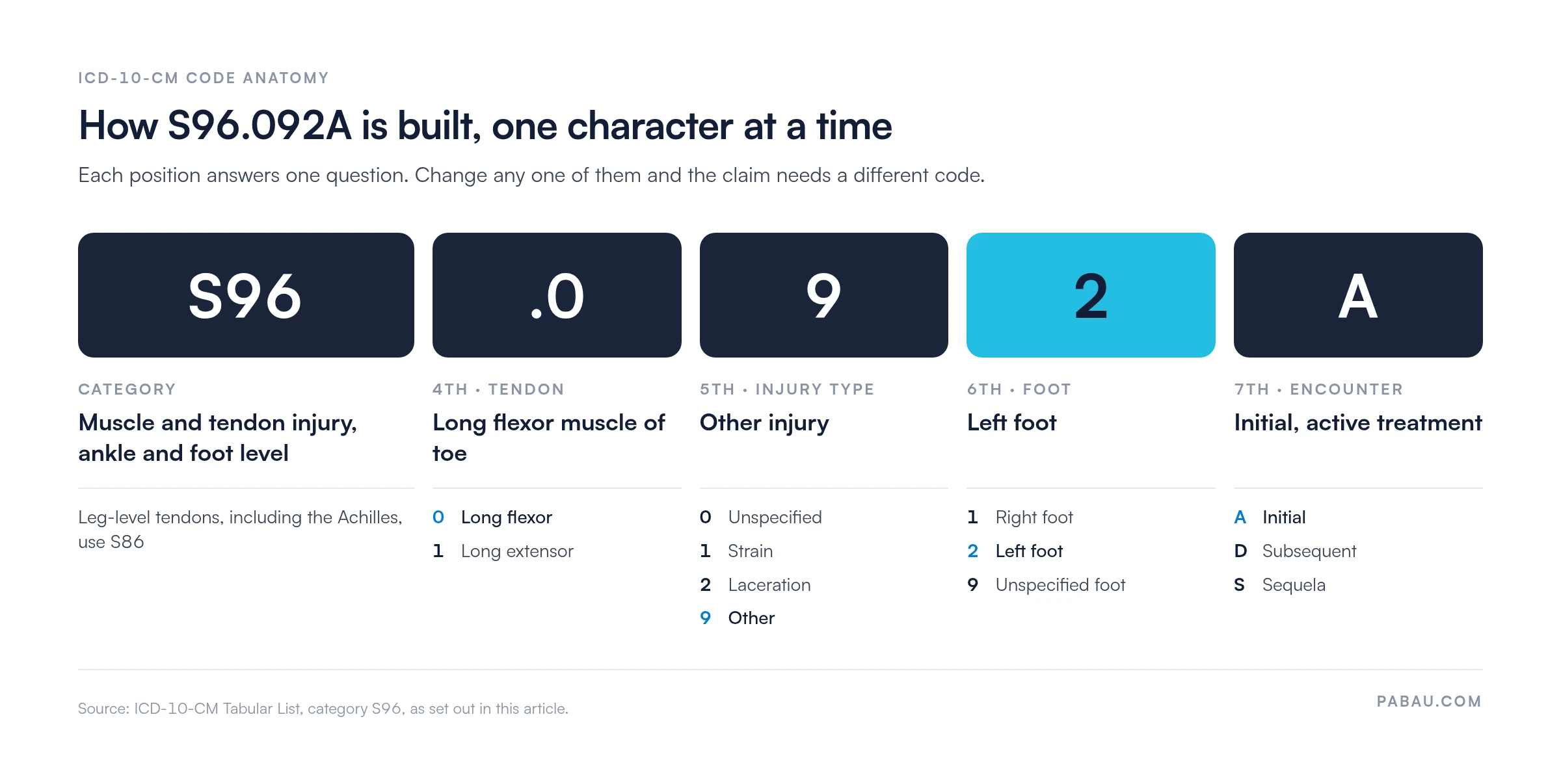
Diagram of ICD-10-CM code S96.092A by character.
Only the 6th character separates the left-foot code from S96.091A, so it is the position to check against the note. Structure from the ICD-10-CM Tabular List, category S96.

Laterality: How the 6th character identifies the left foot

In the S96.0 subcategory, the 6th character records which foot is injured, not which toe. The digit 1 means the right foot, 2 means the left foot, and 9 means the side is unspecified. S96.092A is therefore the left-foot code, and the record has to say so.

  • S96.091A: Other injury of the long flexor toe tendon, right foot, initial encounter.
  • S96.092A: Other injury of the long flexor toe tendon, left foot, initial encounter.
  • S96.099A: Other injury of the long flexor toe tendon, unspecified foot, initial encounter.

The same pattern runs through the strain (S96.01-), laceration (S96.02-) and unspecified injury (S96.00-) codes. Payers treat unspecified-foot codes as a documentation weakness, so query the provider whenever the note leaves the side unclear.

7th character options: Initial, subsequent, and sequela encounters

The 7th character is the single most common coding error on S96.092x claims. All three extensions follow a standard rule across the traumatic injury chapter (S00-T88). The character reflects the phase of care, not the time elapsed since the injury.

7th characterFull codeMeaningWhen to use
AS96.092AInitial encounterActive treatment – ED visit, first office evaluation, imaging, or surgery for the injury regardless of days since injury
DS96.092DSubsequent encounterRoutine follow-up, wound checks, physical therapy, or cast changes after the injury has received its initial definitive treatment
SS96.092SSequelaLate effect. Use when treating a complication, such as chronic tendon adhesion, caused directly by the original S96.092 injury.

Common error: Using A (initial encounter) for a physical therapy visit that follows a completed emergency department evaluation. Once active treatment is complete and the patient enters a routine recovery program, switch to the D extension. Coding A throughout a multi-month rehab course misrepresents the encounter type. It can also trigger post-payment audits.

Pro Tip

Flag every S96.09x claim for a 7th-character audit before month-end close. Pull all claims where the 7th character is still A and the date of service is 30+ days after the injury. These are likely mismatches, because the encounter is almost certainly a subsequent visit. Correcting them before submission prevents denials rather than requiring appeals.

Excludes notes and what ICD-10 Code S96.092A does not cover

The S96 category carries two Excludes2 notes and one “Code also” instruction. None of them stops S96.092A from sharing a claim with the listed codes when the record documents both conditions.

  • Excludes2 (may code together when both are documented): Injury of Achilles tendon (S86.0-). An Achilles injury is not part of S96.092A and takes its own code from S86.0-. When the record documents both injuries, report both codes.
  • Excludes2: Sprain of joints and ligaments of ankle and foot (S93.-). Ligament sprains are structurally distinct from tendon injuries, so S96.092A never describes one. If a note documents both an ankle sprain and a flexor tendon injury, code each one.
  • Code also (may code together when both conditions exist): Any associated open wound of ankle and foot (S91.-). If the tendon injury occurred through an open wound, code S96.092A plus the appropriate open wound code from S91. The “Code also” instruction means both codes belong on the same encounter.
  • Not covered by S96.092A: Lower leg tendon injuries proximal to the ankle mortise use the S86 range. Strains (S96.012A), lacerations (S96.022A) and right-foot injuries (S96.091A) also take their own codes.

Codes not to confuse with S96.092A

The S96.09x range shares an anatomical site with several strain and extensor codes. Every code below is the left-foot version, so the foot side matches S96.092A and only the injury type or tendon differs.

The ICD List code lookup shows each code’s full descriptor side by side, which helps during coding review.

CodeDescriptor (abbreviated)Key difference from S96.092A
S96.012AStrain of long flexor muscle of toe at ankle/foot, left foot, initialRequires documented stretch/overuse mechanism. Use when the provider explicitly documents a strain.
S96.022ALaceration of long flexor muscle of toe at ankle/foot, left foot, initialUse when the tendon has been cut or incised – typically traumatic open wounds or iatrogenic injury.
S96.112AStrain of long extensor muscle of toe at ankle/foot, left foot, initialExtensor, not flexor. Check whether the injured tendon runs dorsally (extensor) or plantarly (flexor).
S96.102AUnspecified injury of long extensor muscle of toe at ankle/foot, left foot, initialExtensor group, not flexor. Use only when the note specifies the dorsal/extensor side and injury type is unspecified.
S96.002AUnspecified injury of long flexor muscle of toe at ankle/foot, left foot, initialUse only when the injury type is not documented at all. S96.092A requires a documented injury type that is neither a strain nor a laceration.

CPT codes commonly paired with S96.092A

Medical necessity alignment between the ICD-10-CM diagnosis and the CPT procedure is a standard payer audit trigger. The rehab-phase codes need the most care here. Therapeutic exercise billed under 97110 belongs with S96.092D once active treatment ends, not with S96.092A.

CPT codeDescriptionPairing notes
99213 / 99214Office or other outpatient visit, established patientMost common pairing for follow-up evaluation during active treatment phase (7th character A)
73600 / 73610Radiologic examination, ankle (2 views / minimum 3 views)Imaging to confirm injury and exclude fracture – commonly ordered at initial encounter
76881Ultrasound, extremity, non-vascular, completeUltrasound to assess tendon integrity where MRI is contraindicated or unavailable
27680Tenolysis, flexor or extensor tendon, leg and/or ankleSurgical release for tendon adhesions – more commonly paired with S96.092S (sequela) than the initial encounter code
97110Therapeutic exercisesPhysical therapy – typically billed with S96.092D (subsequent encounter) once active treatment is complete
97012Application of a modality to one or more areas; traction, mechanicalModality used during rehab phase – pair with S96.092D, not S96.092A

Verify all CPT-to-ICD-10 pairings against current NCCI (National Correct Coding Initiative) edits before submission. NCCI edit tables change quarterly, so a pairing that was valid last quarter may carry a new unbundling edit this one.

Documentation requirements for S96.092A

Solid medical billing documentation is the foundation of a defensible S96.092A claim. Payers reviewing denials look for specific elements that justify both the diagnosis code and the encounter type.

  • Mechanism of injury: The record must describe how the injury occurred (e.g. forceful toe flexion against resistance, direct blow, sports collision). “Foot pain” without a documented mechanism does not support an injury code from Chapter 19.
  • Specific tendon named or implied: The treating provider must reference the long flexor tendon or flexor digitorum longus/hallucis longus. General “tendon injury” language without anatomical specification risks a code-validity query from the payer’s clinical review team.
  • Encounter type documentation: The note must confirm this is an initial evaluation of a new or acute injury. If the patient was seen elsewhere first, the provider should document any prior treatment and the injury’s current stage. That drives the 7th character decision.
  • Laterality notation: The record must state that the injury is in the left foot. The 6th character of S96.092A asserts the left side, so a note that names the right foot or no side does not support it. The ResDAC ICD coding guidance confirms unspecified codes are acceptable only when documentation cannot support more specificity.
  • Injury type descriptor: The record must support “other injury,” meaning the provider documented a pathology that is neither a strain nor a laceration. Clinical language such as “tendon contusion” or “traumatic tendinopathy” grounds that selection.

Payer requirements and prior authorization for S96.092A

Payer requirements vary by Medicare Administrative Contractor (MAC), commercial plan, and state workers’ compensation authority. The notes below reflect general patterns.

Always verify them against the specific payer’s Local Coverage Determination (LCD) and policy articles before submitting. CMS ICD-10 coding guidance provides the federal framework that MACs use when developing their local policies.

Payer typeTypical requirementsPrior authorization?
Medicare (Part B)Medical necessity documentation; LCD for foot and ankle tendon injuries where applicable; clinical notes supporting non-strain injury typeGenerally not required for E&M and imaging; may be required for surgical intervention
Commercial insurancePlan-specific medical necessity criteria; some plans require objective findings (imaging or ultrasound results) to support tendon injury codesVaries; imaging and PT commonly require authorization; confirm per plan
Workers’ compensationFirst Report of Injury (FROI); work-relatedness established in documentation; state-specific fee schedule; treating provider authorization from employer/carrierOften yes – most state comp systems require carrier authorization for specialist referral and imaging
MedicaidState-specific – varies significantly; some states carve out musculoskeletal injury claims to managed care plans with their own LCD equivalentsCheck state Medicaid portal; PT and surgical codes frequently require PA

Pabau, the practice management platform we build, sends S96.092A claims through Claim.MD to thousands of US payers. A real-time eligibility check confirms coverage before the visit. Electronic remittance advice then comes back into Pabau, tied to the claim it settles.

For workers’ compensation claims, confirm the state fee schedule rate for S96.09x codes. Reimbursement can differ substantially from Medicare rates, and some state comp systems apply separate modifier requirements.

Applying good medical billing compliance practices means keeping prior-authorization tracking separate from the coding record. A denied claim can then be traced to whether PA was obtained, as well as whether the code was correct.

Pro Tip

Build a payer-matrix spreadsheet for your most common S96.09x payers. Add columns for the prior-auth threshold (E&M, imaging or surgery), the documentation requirement and the LCD reference number. Updating it each quarter at the LCD update cycle takes under an hour. It prevents a denial cycle that takes 45-90 days to resolve.

Common S96.092A claim denial reasons and how to avoid them

Most S96.092A denials fall into five categories. Good denial management workflows address each at the point of claim creation rather than on appeal. That saves an average of 30-45 days per denied claim cycle. Practices using dedicated claims management software can automate checks for several of these before claims leave the practice.
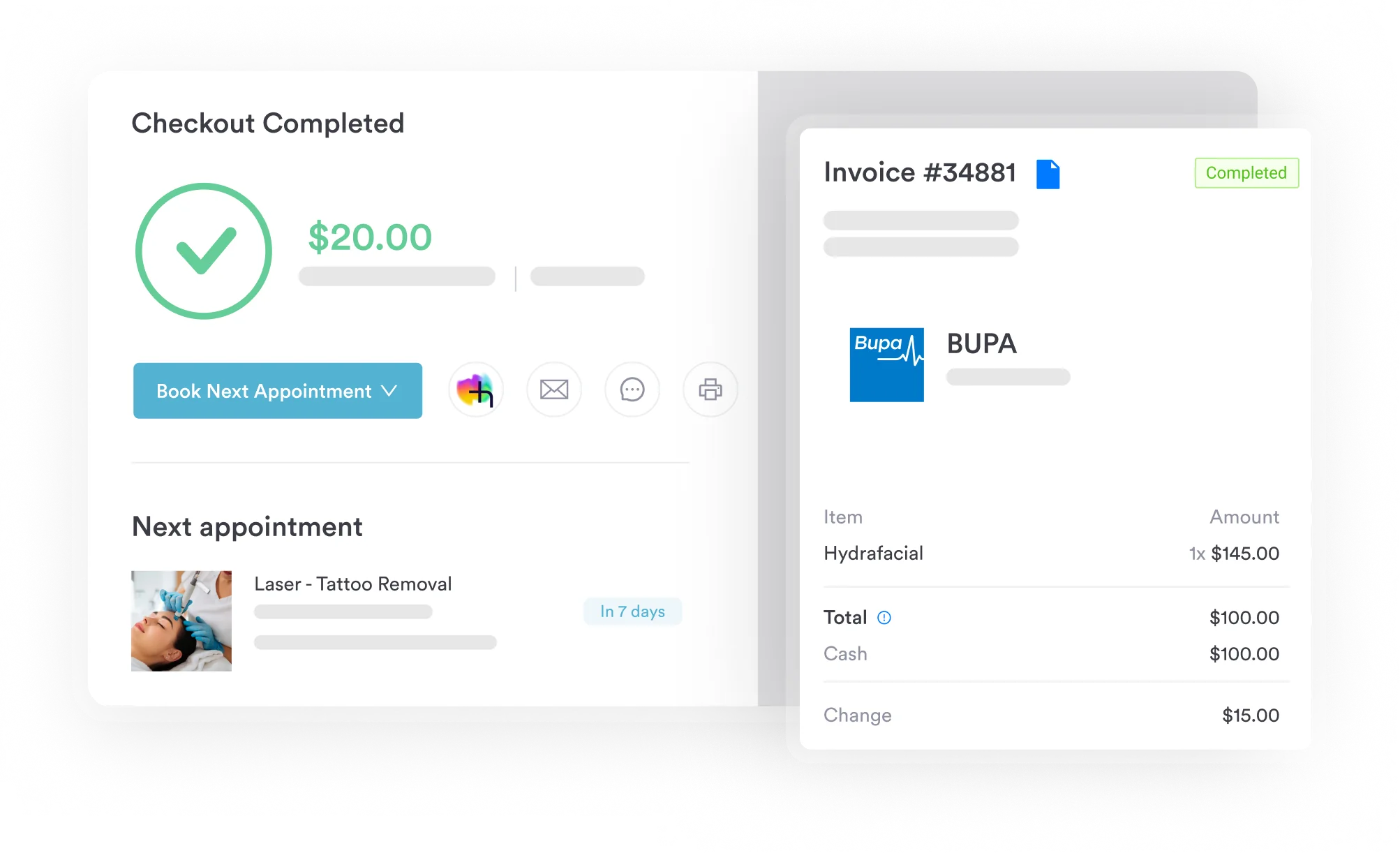
Pabau checkout screen beside a completed insurance invoice
Pabau generates the claim from the invoice raised at checkout, so the S96.092A claim leaves from the same record that holds the clinical note.
Denial triggerRoot causeCorrective action
Wrong 7th characterUsing A (initial) for PT visits weeks after initial treatment, or omitting the 7th character entirelyAudit all S96.092x claims where DOS is 14+ days post-injury; switch to D for routine follow-up
Missing injury mechanismClaim coded from Chapter 19 (injury codes) but clinical notes describe a chronic condition, not an acute injuryConfirm the provider documented an acute mechanism; if chronic, recode to appropriate M-chapter musculoskeletal code
Laterality mismatchS96.092A (left foot) billed when the note names the right foot or no side at allConfirm the note states the left foot. Use S96.091A for the right foot, and S96.099A only when the side is genuinely undocumented.
Mismatched CPT-ICD pairingPT codes (97110, 97012) paired with A instead of D. A surgical code can also be paired with a diagnosis that doesn’t support medical necessity.Cross-check 7th character against CPT type at claim build; PT modalities use D, surgical intervention may use A at initial surgery date
Missing prior authorizationImaging, physical therapy or surgery billed without the authorization the plan or comp carrier requiresTrack PA status apart from the coding record and confirm it before the claim is built

A clean claim submission for S96.092A requires all five of these checks to pass before the claim leaves the practice. A pre-submission checklist in the billing workflow costs far less than correcting claims after they are denied.

When a claim does come back, the payer’s denial codes name the reason, which tells you whether to correct and resubmit or appeal.

How Pabau prevents denials on S96.092A claims

Most S96.092A denials start with a coder rereading a clinical note to confirm the encounter type, the injury type and the foot. When those checks happen by hand at month-end, a wrong 7th character or foot side reaches the payer first.

Pabau keeps the clinical note, the diagnosis code and the claim in one patient record. The coder checks the code against the note without switching systems. Its claim validation scrubs every claim for missing or invalid details before submission.

The claim then goes out through Claim.MD, and a rejected claim comes back with its reason so you can correct and resubmit.

The result is fewer returned claims on foot and ankle tendon injuries. Your billing team also spends less time on appeals that a pre-submission check would have prevented.

Reduce denials on ankle and foot injury claims

Pabau’s claim validation scrubs every S96.09x claim for missing or invalid details before submission. Errors get fixed in your billing queue instead of on appeal.

Pabau claims management dashboard

Conclusion

S96.092A is only correct when the note documents a left-foot long flexor tendon injury that is neither a strain nor a laceration, treated actively. If any one of those facts is missing, the claim needs a different code or a provider query before it goes out.

Checking the foot side and the 7th character at the point of coding costs seconds, while an appeal costs weeks. Book a demo to see how Pabau scrubs S96.09x claims for missing or invalid details before they reach the payer.

Continue your research

Continue your research

Frequently asked questions

What does ICD-10 Code S96.092A mean?

ICD-10 Code S96.092A is the billable code for other injury of the long flexor toe tendon at ankle and foot level, left foot, initial encounter. It sits in Chapter 19 of ICD-10-CM, subcategory S96.09. It applies when the provider documents a left-foot tendon injury that is neither a strain nor a laceration, during active treatment.

What is the difference between S96.092A and S96.012A?

S96.012A is the left-foot strain code for the same long flexor tendon. Use it when the provider documents a stretch or overuse mechanism with the term “strain.” S96.092A applies when the provider has characterized the injury type, but the pathology is neither a strain nor a laceration. Using S96.012A without strain language in the record is a documentation mismatch that invites a clinical review request.

When should you use S96.092D instead of S96.092A?

Switch from A to D (S96.092D) once the injury has had its initial definitive treatment and the patient is in routine recovery or rehabilitation. The 7th character reflects the phase of care, not the number of days since injury. A patient at their third physical therapy session, six weeks after the ED visit, is coded S96.092D. The original injury does not change that.

Does S96.092A require an additional code for laterality?

No. Laterality is built into the 6th character, and the 2 in S96.092A means the left foot. The record must document the left foot to support it. Use S96.091A for the right foot, or S96.099A only when the record does not state the side.

Is S96.092A valid for workers’ compensation claims?

Yes, S96.092A is valid for workers’ compensation claims when the injury is work-related and the record documents the occupational mechanism. Workers’ comp payers also require a First Report of Injury filed with the carrier and treating-provider authorization, under rules that vary by state. Reimbursement follows the state fee schedule rather than Medicare rates. Some states mandate specific reporting forms before the first treatment visit.

What are the excludes notes for S96.092A?

The S96 category carries two Excludes2 notes. One covers injury of the Achilles tendon (S86.0-), and the other covers sprains of joints and ligaments of the ankle and foot (S93.-). Excludes2 means the condition is not part of S96.092A, but both codes can be reported together when the record documents both. A separate Code also instruction asks you to add any associated open wound of the ankle and foot (S91.-).

Avatar photo
Anja Dodevska
Content Writer

Anja Dodevska writes about healthcare, dermatology, and the day-to-day realities of running a medical practice for Pabau. She enjoys breaking down complex topics into clear, accessible content and has a soft spot for the often-overlooked aspects of clinic life. When she's not writing, she's exploring cafes, walking her dog, or spending time with friends and family.
×