

HCPCS Code L0472: Hyperextension TLSO billing guide
HCPCS code L0472: Official descriptor and device definition HCPCS code L0472 des...

Last Updated: Nov 5, 2026
27420 is the CPT code for reconstruction of a dislocating patella, such as a Hauser type procedure. The surgeon transfers the tibial tubercle medially so the kneecap tracks in its groove and stops dislocating.
The code sits in the femur and knee joint range of the musculoskeletal surgery section. Soft-tissue realignment, such as VMO advancement, is reported with 27422 instead, and patellectomy with reconstruction with 27424. These sibling codes are alternatives, so only one is reported per knee.
Let Pabau's smart automation suggest the right codes, reduce claim denials, and keep your practice compliant—effortlessly.
Automate repetitive tasks and focus on what matters most—your patients.
Reduce coding errors and ensure compliance with the latest regulations.
Clean claims, fewer denials, and faster reimbursements.
Powerful insights and reporting to help your practice thrive.
HIPAA compliant SOC 2 certified GDPR-compliant Trusted by 4,000+ clinics worldwide

CPT code 27420 covers reconstruction of a dislocating patella by a Hauser type procedure, which transfers the tibial tubercle to realign the kneecap.
Soft-tissue realignment, such as VMO advancement or a Campbell or Goldthwait procedure, is CPT 27422, and patellectomy with reconstruction is CPT 27424.
27420, 27422 and 27424 are alternative codes in one family, so report one of them per knee rather than stacking them.
Open lateral release (27425) is included in 27420, and missing or mismatched RT/LT modifiers are a leading cause of 27420 denials.
CPT code 27420 is “Reconstruction of dislocating patella; (eg, Hauser type procedure).” The code set is published by the American Medical Association (AMA), the leading body for CPT. It sits in the musculoskeletal surgery section and is a major surgical procedure.
Clinically, 27420 is a bony procedure. In the Hauser technique, the surgeon detaches the tibial tubercle with the patellar tendon attached and moves it medially. The tubercle is then fixed in its new position, which pulls the kneecap into better alignment in the groove.
Its two sibling codes share the same parent descriptor. CPT 27422 adds extensor realignment and/or muscle advancement or release, such as a Campbell or Goldthwait procedure. CPT 27424 covers reconstruction with patellectomy.
The 90-day global period means routine office visits after surgery within that window are bundled into the 27420 payment. Only services separate from the surgery, or those meeting specific modifier criteria (58, 78, 79), may generate separate claims during the global window.
27420 describes a tibial tubercle transfer for a kneecap that keeps slipping out. Recording exactly what was done in the surgery note is the base of a clean claim. A line like “patellar stabilization performed” is not enough to show which code in the family applies.
The surgery report should describe the bone cut, the direction the bone was moved and how it was fixed. Physical therapy and sports medicine practices that refer these patients help the claim by recording the failed non-surgical treatment before surgery.
Minimum surgery report items for clean 27420 claims:
One of the most common unbundling errors with CPT code 27420 involves lateral retinacular release. The AAOS Global Service Data Guide lists open lateral release (27425) among the services included in 27420. Billing 27425 for the same knee, with or without modifier 59, is incorrect coding.
VMO advancement follows a different rule. Muscle advancement is part of the 27422 descriptor, and 27420 is not reported with 27422 or 27424. When the surgeon only advances the VMO or realigns soft tissue, the case belongs on 27422 instead.
Two other techniques sit outside this code family. An anterior or anteromedial tubercle shift is coded from 27418, anterior tibial tubercleplasty. AMA CPT Assistant (February 2010) points the Fulkerson anteromedialization to 27418 with modifier 22. Medial patellofemoral ligament (MPFL) reconstruction is reported with 27427, not an unlisted code.
The distinction between CPT 27420 and CPT 27422 comes down to what the surgeon moved. CPT 27420 transfers the tibial tubercle, which is bone. CPT 27422 realigns the extensor mechanism through soft tissue, such as a tendon transfer or VMO advancement.
When one surgery includes both a tubercle transfer and soft-tissue realignment, do not report both codes for that knee. Code the surgery the note describes as the main repair, and check the current NCCI table for the date of service. The map below sorts the whole kneecap code family by what the surgeon did.
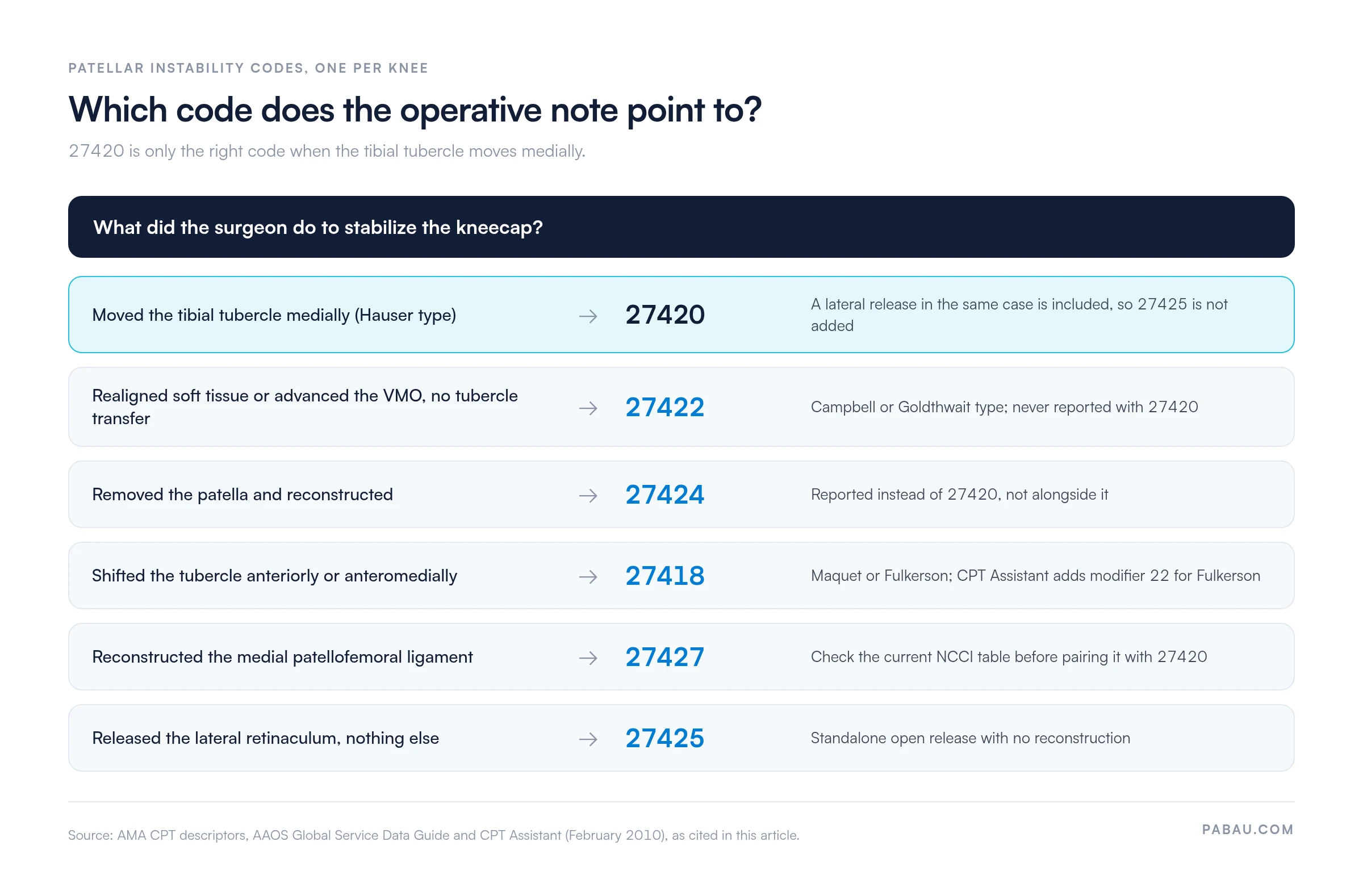
CPT 27425 describes an open lateral retinacular release. When the release is part of a 27420 repair, it is included and not billed on its own. When the surgeon performs the release alone, with no repair, 27425 is the appropriate code.
The NCCI procedure-to-procedure edits govern how these codes pair up, and they are updated quarterly. Payer policies may add stricter bundling rules. Check the specific payer before reporting 27425 alongside any kneecap repair code.
Before you release a 27420 claim, confirm that 27422, 27424 and 27425 are not on it for the same knee. Run any other code pair through the CMS NCCI edit tables, which are free and updated quarterly. Modifier 59 cannot override an edit that allows no modifier exception.
Medical necessity for CPT code 27420 must be established through an appropriate ICD-10-CM diagnosis code. Payers use their own Local Coverage Determinations to decide which diagnoses justify surgery. The medical billing workflow should include a pre-submission check confirming the diagnosis code is on the covered list for the billing payer.
Always use the code that names the side. Unspecified codes (M22.00, M22.10) fit only when the surgical records do not state the side, which is rare for elective bone surgery. A mismatch between the ICD-10 side and the claim modifier is a top denial trigger.
Modifier choice for CPT code 27420 follows the same logic as other major bone and joint procedures. Side and global period modifiers are needed most often. Missing or wrong modifiers drive many 27420 rejections, mainly with Medicare Advantage and commercial payers.
Prior authorization rules for CPT code 27420 vary by payer and change with each contract year. Most commercial payers and Medicare Advantage plans ask for pre-approval before elective bone and joint surgery. Traditional Medicare (Parts A and B) does not list 27420 as a standard prior authorization service, though some Medicare Advantage plans do.
Completing insurance eligibility verification before scheduling surgery prevents the most expensive denial type, a post-service approval denial.
What to include in a prior authorization request for 27420:
Always record the authorization number in the patient record and enter it on the CMS-1500 form before submission. Each approval covers one surgery and one payer. If the surgeon may switch to 27422 or 27418 during the case, ask the payer to include those codes too.
Medicare payment for CPT code 27420 comes from the Medicare Physician Fee Schedule (MPFS). It assigns Relative Value Units (RVUs) across three components: Work RVUs, practice expense RVUs and malpractice RVUs. The total RVUs are adjusted by the geographic practice cost index and multiplied by the annual conversion factor.
Rates change annually, so verify the current year using the CMS Physician Fee Schedule lookup tool or an RVU tool such as FastRVU.
CPT 27420 is a major surgical procedure with substantial work RVUs, reflecting the osteotomy and fixation involved. Commercial payers often negotiate rates as multiples of the Medicare fee schedule, which vary widely by payer and region.
Key payment details to document:
Denials on CPT code 27420 cluster around five root causes, most of which are avoidable with a pre-submission review. Understanding the denial codes and the CARC behind each cause speeds up appeals. A steady approach to denial management catches these before they become aged receivables.
A clean claim on 27420 comes from a coder review before release. That review checks the code against the surgery note, the modifiers against the diagnosis and the claim against the NCCI table.
Build a 27420 pre-submission checklist into your billing workflow. Confirm the authorization number is recorded and the ICD-10 laterality matches the RT or LT modifier. Check that the operative note describes a tibial tubercle transfer. Make sure 27422, 27424 and 27425 are not on the claim for the same knee.
Most 27420 denials start before the claim exists. An expired approval, a missing RT or LT modifier or a sibling code on the same knee all begin upstream. They start in the front office or the coding queue.
Pabau, the practice management platform we build, keeps prior authorization records, coded charges and claim history in one place. With orthopedic claims management in the same system as the schedule, your coders review each 27420 claim with the surgery details in front of them.
Claims go out through Claim.MD, Pabau’s US clearinghouse partner. Claim.MD submits the claim data your team entered and returns status updates and payment advice. That lets your billing team see each 27420 payment or denial as it posts.
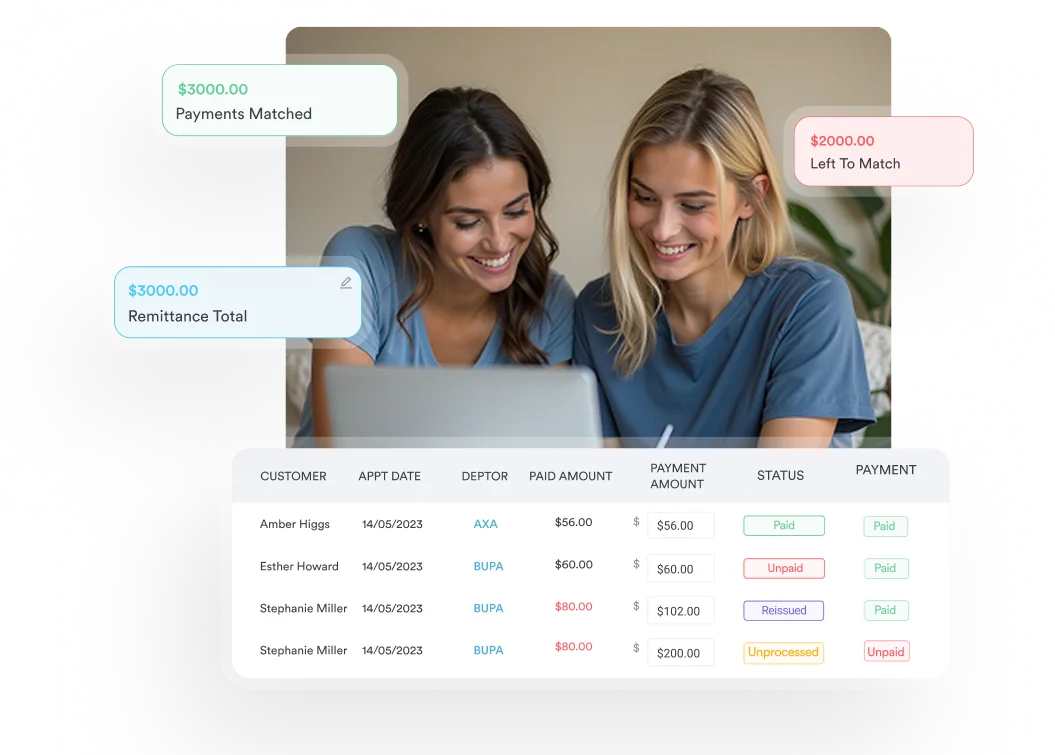

Pabau helps orthopedic and sports medicine practices keep prior authorization records, claim submission and remittances in one place. Claims go out through Claim.MD, and your team tracks each one until it is paid.

CPT code 27420 rewards a precise surgery note. It is the Hauser type tibial tubercle transfer, so soft-tissue work belongs on 27422 and a patellectomy on 27424.
Two habits protect most of the revenue on this code. Keep 27422, 27424 and 27425 off the claim for the same knee, and match the M22 laterality to the RT or LT modifier. Getting those right before submission costs far less than an appeal.
Pabau keeps your approvals, claims and Claim.MD clearinghouse remittances in one workflow. To see how it fits an orthopedic billing team, book a demo.

Want to know what a clearinghouse does with your claims? Medical claims clearinghouse guide explains how clearinghouses format, route and track claims between your practice and each payer.
Want to reduce claim denials across your entire billing cycle? Revenue cycle management overview covers the end-to-end process from eligibility to payment posting.
Billing surgical procedures for an orthopedic or sports medicine practice? Superbill guide for surgical practices walks through how to structure superbills that capture all billable procedure components.
CPT code 27420 is the code for repairing a kneecap that keeps slipping out, using a Hauser type procedure. The surgeon moves the tibial tubercle toward the middle of the knee to line up the kneecap. It applies when the patella dislocates over and over and non-surgical care has failed.
CPT code 27420 carries a 90-day global period under the CMS Medicare Physician Fee Schedule. Routine visits after surgery within those 90 days are bundled into the surgical payment. Use modifier 79 for separate services, modifier 58 for planned staged procedures and modifier 78 for unplanned returns to the OR.
Prior authorization rules vary by payer. Most commercial payers and Medicare Advantage plans ask for pre-approval for elective bone surgery including 27420. Traditional Medicare Parts A and B do not have a standard prior authorization rule for this code. Verify the payer’s rules before scheduling, and record the approval number on the CMS-1500 form.
No. Muscle advancement, including VMO advancement, is part of the CPT 27422 descriptor, and 27420 is not reported with 27422. When the surgeon advances the VMO without a tubercle transfer, report 27422 instead. Check the current NCCI table for any other code pair on the same knee.



