

HCPCS code E0198: Water pressure pad billing guide
HCPCS code E0198 is a water pad for a standard mattress HCPCS code E0198 is the ...

Last Updated: Oct 13, 2026
27422 is the CPT code for reconstruction of a dislocating patella with extensor realignment and/or muscle advancement or release. Campbell and Goldthwait type procedures are the classic examples. It covers open soft-tissue stabilization of a kneecap that keeps dislocating.
The code sits in the femur and knee joint range of the musculoskeletal surgery section. Assignment turns on the technique. A medial tibial tubercle transfer is reported with 27420, and an anterior tibial tubercleplasty with 27418.
Let Pabau's smart automation suggest the right codes, reduce claim denials, and keep your practice compliant—effortlessly.
Automate repetitive tasks and focus on what matters most—your patients.
Reduce coding errors and ensure compliance with the latest regulations.
Clean claims, fewer denials, and faster reimbursements.
Powerful insights and reporting to help your practice thrive.
HIPAA compliant SOC 2 certified GDPR-compliant Trusted by 4,000+ clinics worldwide

CPT code 27422 reports reconstruction of a dislocating patella with extensor realignment and/or muscle advancement or release, such as a Campbell or Goldthwait type procedure.
It is a soft-tissue procedure. A medial tibial tubercle transfer is coded 27420, and an anterior tibial tubercleplasty is coded 27418.
Pair it with M22.0x (recurrent dislocation) or M22.1x (recurrent subluxation). A first-episode traumatic dislocation code alone may trigger a medical necessity denial.
An open lateral release (27425) is included in 27422, and 27427 includes the work of 27422. Neither is billed alongside it for the same knee.
Pabau, the claims and billing platform we build, tracks prior auth status, modifiers and denial patterns on 27422 claims for orthopedic practices.
CPT code 27422 reports reconstruction of a dislocating patella with extensor realignment and/or muscle advancement or release. It is an open soft-tissue stabilization of the kneecap. The American Medical Association maintains it in the musculoskeletal surgery section of the AMA CPT code set.
The full official descriptor reads: Reconstruction of dislocating patella; with extensor realignment and/or muscle advancement or release (eg, Campbell, Goldthwait type procedure). The procedure note must describe work on the extensor mechanism, such as a tendon transfer, a muscle advancement or a release. A note that describes moving the tibial tubercle supports a different code.
RVU values and allowed amounts change with each annual Medicare Physician Fee Schedule update. Verify current figures using the CMS Physician Fee Schedule lookup tool before billing.
CPT code 27422 covers open realignment of the extensor mechanism to stop a patella that keeps dislocating laterally. The surgeon redirects the pull on the kneecap through soft tissue, with no cut through the tibial tubercle. The code suits sports medicine practices and orthopedic surgeons who treat patellofemoral instability.
The descriptor names two classic examples. In a Goldthwait (Roux-Goldthwait) procedure, the lateral half of the patellar tendon is split, detached and transferred medially. In a Campbell type procedure, a strip of medial capsule and fascia is used to reinforce the medial restraint.
The procedure note should show these operative steps for the claim to hold up to audit.
If the surgeon cuts and moves the tibial tubercle, the case moves to 27420 or 27418. If the patella is removed, 27424 applies. An isolated open lateral release is reported with 27425. The list below puts these checks in the order a coder should run them.
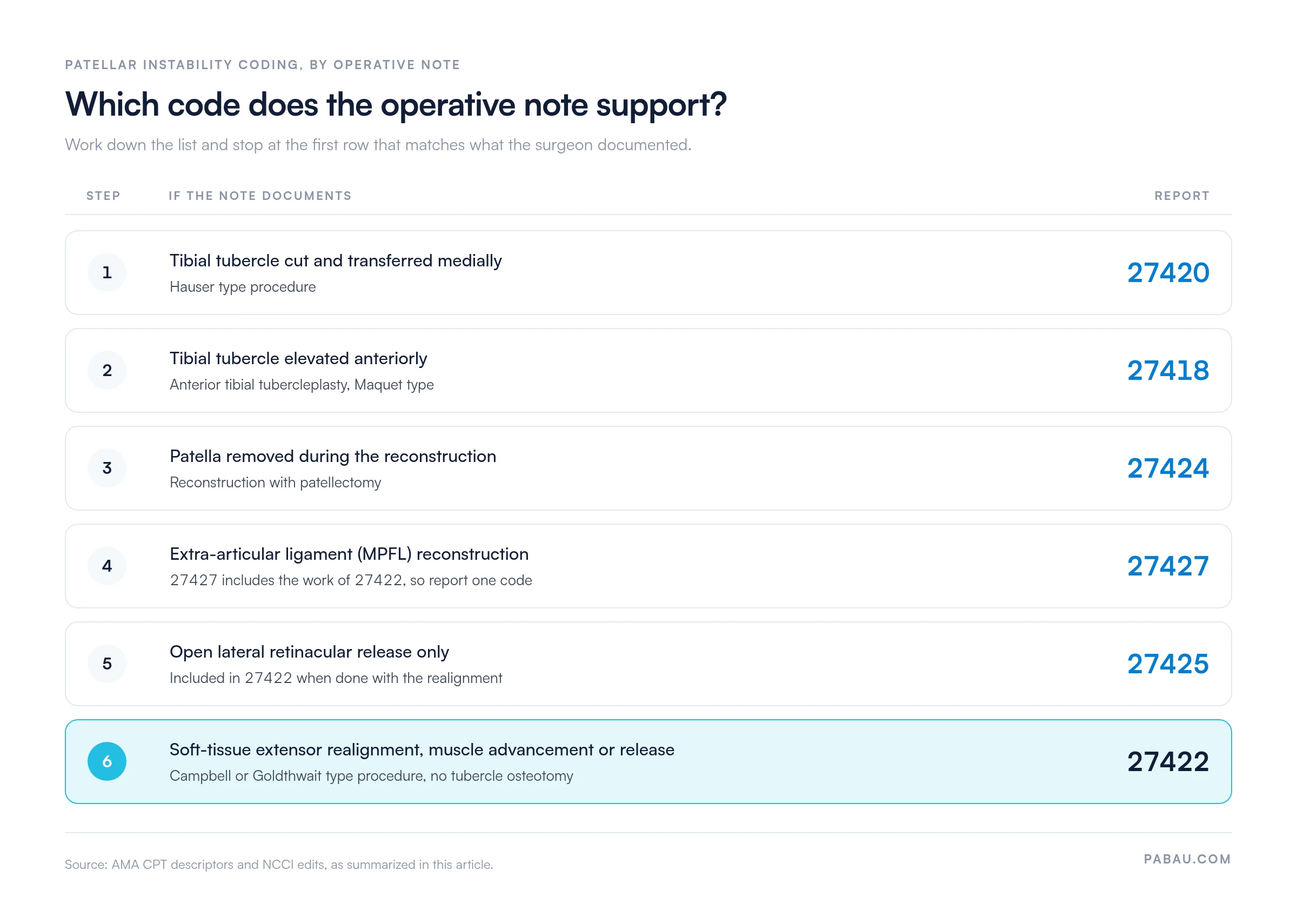
CPT 27422 is one of several codes for an unstable patella, and the operative technique decides between them. The closest neighbors are 27420, which moves the tibial tubercle, and 27427, which reconstructs an extra-articular ligament.
When a surgeon combines extensor realignment with an MPFL reconstruction, report one code for the knee rather than 27422 plus 27427. Choose the code that matches the documented technique and the payer’s policy. Final code selection for MPFL work varies with the documentation and the diagnosis.
Medical necessity for CPT code 27422 depends on pairing it with an ICD-10-CM diagnosis code that reflects recurrent or chronic patellar instability. A single first-episode traumatic dislocation code typically does not meet payer criteria for reconstructive patellar surgery unless conservative treatment has clearly failed.
ICD-10-CM codes update every October 1. Verify that each code above remains active for the current fiscal year using the CDC/NCHS ICD-10-CM web tool before submitting claims.
Traumatic first-episode codes from the S83.0x series (dislocation of patella) generally do not support CPT 27422 alone. Surgery after a first-time dislocation needs a documented reason. Record the anatomical risk factors explicitly in the operative and pre-operative notes.
A complete operative report is the strongest defense against a CPT code 27422 denial. The record must show the clinical rationale and the soft-tissue technique performed. Clean claims start before the date of service, with clean claim submission habits built into the pre-op documentation workflow.
Record the TT-TG distance and growth-plate status from pre-operative imaging in the operative note. A TT-TG value above about 20 mm often points surgeons toward a tubercle transfer. When 27422 is billed instead, a reviewer will look for the reason soft-tissue realignment was chosen, such as open growth plates.
Prior authorization requirements for CPT code 27422 vary by payer and plan year. Medicare does not universally require prior authorization for musculoskeletal surgery, though many Medicare Advantage plans and commercial insurers do. Check the applicable MAC Local Coverage Determination and payer policy before scheduling surgery.
Insurance eligibility verification before scheduling surfaces authorization requirements and confirms active coverage. Most commercial payers expect these clinical criteria before approving CPT 27422.
Submit the authorization request with the operative plan letter, imaging reports, therapy notes and visit records. Record each submission and approval in the patient’s chart with its reference number and effective dates.
The National Correct Coding Initiative (NCCI) publishes quarterly edits that decide which codes can be billed together. For 27422, also check the AAOS global service data, which lists the procedures included in the code. Confirm both before billing companion codes for the same knee on the same date.
NCCI edit tables update quarterly. A modifier indicator of 0 means the pair can never be unbundled. An indicator of 1 allows a modifier such as 59 or XS, with supporting documentation. Note the edition date of any table you rely on.
Medicare pays CPT code 27422 from the relative value units in the annual Physician Fee Schedule, adjusted by the geographic practice cost index (GPCI). In the 2026 schedule, 27422 carries 20.92 total facility RVUs and no non-facility rate.
For a locality-specific amount, use the FastRVU 2026 RVU lookup tool, which applies GPCI adjustments to CMS data. Rates change each January 1 and may also shift with mid-year conversion factor updates.
Denials on CPT code 27422 follow predictable patterns. A denial management workflow that tracks root causes by code shows billing teams where 27422 claims fail.
Run a pre-submission scrub on every 27422 claim. Confirm the laterality modifier, a recurrent ICD-10 code (M22.0x or M22.1x) and the prior auth number. Then check that no included code, such as 27425 or 27427, sits on the same knee. These four checks catch most preventable 27422 denials.
Most 27422 denials trace back to work done before the claim exists. An expired authorization, a missing LT or RT modifier, or an included code on the same knee all start upstream. They begin in the front office or the coding queue.
Pabau’s claims software for orthopedists keeps prior auth status, modifiers and claim history in one place. Orthopedic practices can spot bundling conflicts before submission and track denial patterns by procedure code.
Claims go out through Pabau’s integration with the Claim.MD clearinghouse, our US clearinghouse partner. It supports eligibility checks and 835 electronic remittance advice, so the billing team sees each 27422 payment or denial as it posts.

Pabau helps orthopedic and sports medicine practices manage prior auth tracking, claim submission and denials in one place. Your billing team spends less time chasing paperwork and more time getting paid.

CPT code 27422 rewards a precise operative note. Code the soft-tissue work the surgeon did, and move any tubercle osteotomy to 27420 or 27418.
Two habits protect most of the revenue on this code. Pair it with a recurrent M22 diagnosis, and leave 27425 and 27427 off the claim for the same knee. Getting those right before submission costs far less than appealing a denial.
Book a demo to see how Pabau helps orthopedic practices submit clean 27422 claims and track every authorization.

Need a framework for managing claim denials systematically? Denial management in healthcare covers how to build a root-cause tracking system that reduces recurring rejections.
Want to understand the clearinghouse behind your CPT claims? Claim.MD clearinghouse explains how electronic claim routing, ERAs, and eligibility verification work in practice.
Looking to streamline your entire revenue cycle? Revenue cycle management breaks down the end-to-end process from patient registration through final payment posting.
Reconciling the 835 files on your 27422 claims? Electronic remittance advice explains how to read ERA files and post payments and denials.
Scoped the knee before the open repair? CPT code 29870 covers diagnostic knee arthroscopy and when it can be billed separately.
CPT code 27422 reports reconstruction of a dislocating patella with extensor realignment and/or muscle advancement or release, such as a Campbell or Goldthwait type procedure. It is an open soft-tissue procedure in the musculoskeletal surgery section, with a 90-day global period.
CPT 27422 realigns the extensor mechanism through soft tissue, such as a patellar tendon split and transfer or a muscle advancement. CPT 27420 is the Hauser type procedure, which transfers the tibial tubercle medially. If the surgeon cuts and moves the tubercle, 27420 applies, and an anterior tubercleplasty is 27418.
No, not for the same knee. 27427 includes the work of 27422 (NCCI edit), so report one code. Choose the code that matches the documented technique and the payer’s policy.
Medicare fee-for-service does not universally require prior authorization for CPT 27422, but many Medicare Advantage plans and commercial payers do. Requirements vary by payer and plan year. Check the MAC Local Coverage Determination and payer policy before scheduling surgery.
Diagnostic arthroscopy is included in open knee procedures, so it is not billed with 27422. Loose body removal and an open lateral release are also included. A separate surgical arthroscopy may be reportable only when the current NCCI edit allows it and the operative note documents it separately.
The strongest pairings are M22.01 or M22.02 (recurrent dislocation of patella, right or left knee) and M22.11 or M22.12 for recurrent subluxation. Use laterality-specific codes wherever possible. Avoid an S83 traumatic dislocation code as the primary diagnosis unless the record documents the risk factors that justify reconstruction.



