CCSD Code V1730: Extraoral fixation of mandible
CCSD Code V1730: Definition and clinical description CCSD Code V1730 describes e...

Last Updated: Nov 24, 2026
CPT code 99452 pays the treating provider for asking a specialist's advice, without sending the patient anywhere. Its official descriptor reads: "Interprofessional telephone/Internet/electronic health record referral service(s) provided by a treating/requesting physician or other qualified health care professional, 30 minutes."
In practice, you need at least 16 minutes of preparing the request and talking with the consultant. The specialist bills 99451 or 99446-99449 instead, so mixing up the two sides is an easy denial. The sections that follow trace how the claim moves, what the chart must show and the checks to run before you submit.
Let Pabau's smart automation suggest the right codes, reduce claim denials, and keep your practice compliant—effortlessly.
Automate repetitive tasks and focus on what matters most—your patients.
Reduce coding errors and ensure compliance with the latest regulations.
Clean claims, fewer denials, and faster reimbursements.
Powerful insights and reporting to help your practice thrive.
HIPAA compliant SOC 2 certified GDPR-compliant Trusted by 4,000+ clinics worldwide

CPT code 99452 is billed by the treating or requesting provider, never the consultant, for preparing and sending an interprofessional consultation request.
You need at least 16 minutes of preparation and discussion time, and the descriptor’s typical time is 30 minutes.
Report 99452 no more than once in a 14-day period for the same patient.
Medicare Part B has covered 99452 since the 2019 fee schedule final rule, while Medicaid coverage varies by state.
Pabau, a practice management platform, sends CMS-1500/837P claims through Claim.MD and returns remittance data, so you can see how each 99452 claim paid.
CPT code 99452 belongs to the treating or requesting provider, the clinician who asks a specialist for advice.
Coding guidance from the American College of Allergy, Asthma & Immunology spells out the threshold. The code pays for 16 minutes or more of preparing the consult or talking with the consultant. The specialist on the other end bills 99451 or a code from 99446-99449.
The American Medical Association sets the official wording, quoted here in full.
Interprofessional telephone/Internet/electronic health record referral service(s) provided by a treating/requesting physician or other qualified health care professional, 30 minutes.
The 30 minutes is the code’s typical time, while 16 minutes is the floor CPT guidance sets for reporting it. Even so, the phrase that matters most is “treating/requesting physician.” Only the provider managing the patient’s care bills this code.
Any treating physician, nurse practitioner (NP) or physician assistant (PA) managing the patient’s care may bill 99452. They must start the consult themselves and meet the time and documentation rules.
Non-physician practitioners can bill it under Medicare, but enrollment rules vary by Medicare Administrative Contractor (MAC). So check with yours first.
The trigger is simple. You need specialist input, but the patient isn’t moving into the specialist’s care. Picture a primary care physician asking a cardiologist about an arrhythmia workup. Or think of an internist seeking nephrology advice on an acute kidney injury, with no in-person referral.
Four activities count toward the 16-minute floor. Without them, the requesting side has no billable interprofessional code, because 99446-99449 and 99451 pay the consultant’s time.
Time spent face to face with the patient doesn’t count. If you prepare the request during a visit, those minutes belong to that visit’s E/M, so never count them twice. Finally, write the total as one number of minutes, not a range.
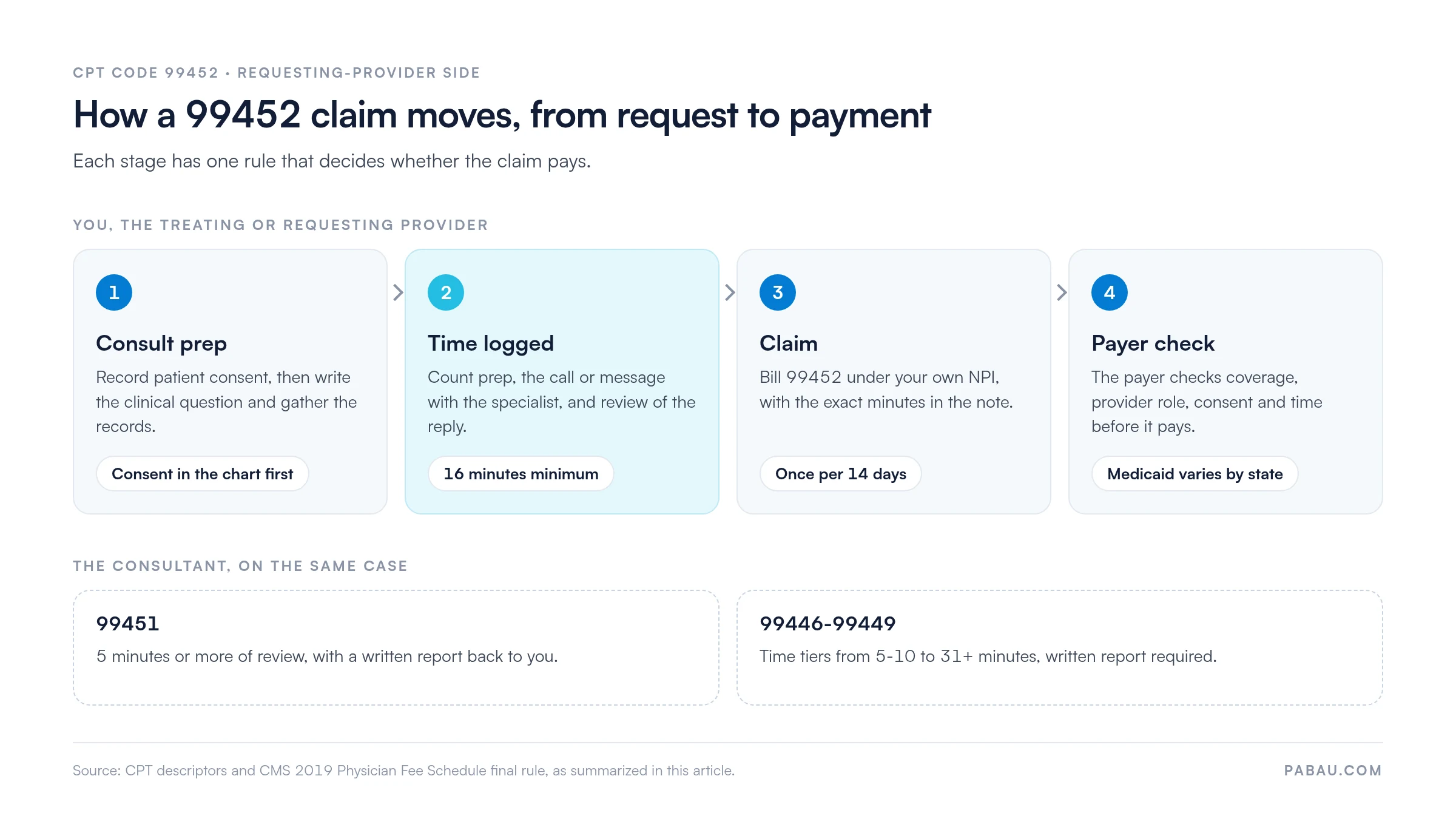
Here’s the path a 99452 claim takes, from the first note to the remittance. First, you record consent and prepare the clinical question. Next, you log every minute of prep and discussion. Then the claim goes out under your NPI, and the payer checks coverage, role and time. Meanwhile, the consultant bills their own code on the same case.
Missing documentation is a common reason 99452 claims fail. So check that the record holds these seven elements before the claim goes out.
One progress note that captures all seven is enough. Many practices use a structured consult request template, so no element gets skipped.
The referring physician bills 99452, and the consulting specialist bills 99451. Both codes can go out for the same case, but never from the same provider. If you’re the specialist answering the request, 99451 covers your side in detail.
Only one code in the family pays the requesting side, and that’s 99452. The 99446-99449 range pays the consultant by time, and 99451 covers consultant work of 5 minutes or more. Knowing the whole set helps you avoid upcoding when time lands near a threshold.
Before you select 99452, confirm you’re the treating provider, not the consultant. A specialist who bills 99452 instead of 99451 will face denials. So will the referring physician if both providers bill 99452 for the same case. Cross-check provider roles on the claim before you submit.
Medicare Part B covers 99452 under the Medicare Physician Fee Schedule (MPFS). CMS added coverage in the 2019 MPFS final rule. Payment is RVU-based and adjusted for location. Rates change with each annual update, so use the CMS Physician Fee Schedule lookup tool for your locality.
Historically, the national non-facility rate has sat between about $30 and $50. The exact figure depends on the conversion factor and the geographic practice cost index (GPCI). Pull the current year’s rate before you quote patients or payers. Afterward, electronic remittance advice shows the exact allowable applied to each 99452 claim.
Medicaid coverage varies by state. Some programs cover 99452 and the wider consultation family, while others don’t. Verify with the state Medicaid program before billing. For current RVU values, FastRVU’s 2026 lookup tool lists work, practice expense and malpractice RVUs.
A clean claim submission for 99452 means clearing each payer’s rules before the claim leaves the practice. Most major payers follow CMS guidelines, but local coverage policies differ by MAC region. If these terms are new to your team, medical billing basics cover the groundwork.
These three restrictions cause trouble even when the care was appropriate and the note is complete.
Same-day visits and the 14-day window: CPT doesn’t publish a blanket ban on billing 99452 and an E/M on the same date. Its 14-day limits sit on the consultant’s side instead.
The consultant can’t report 99446-99449 or 99451 if the consult leads to a transfer of care or a face-to-face visit within 14 days. The same applies if the consultant saw the patient in the prior 14 days. On your side, keep visit minutes and consult minutes apart.
Frequency limit: Report 99452 no more than once in a 14-day period for the same patient. CPT sets that limit, so a second claim inside the window is a common audit flag.
Provider role: Only the requesting or treating provider bills 99452. Sometimes a specialist starts a second consult with a subspecialist. In that case, the specialist may act as the requesting provider for that new request, but confirm the payer’s rules first.
These patterns show up again and again in denial management workflows for interprofessional consults.
For the CARC codes that usually come with these denials, see our guide to medical billing denial codes. One you’ll often meet is CO-97, used when the benefit is included in the payment for another service.
A clean 99452 claim starts before the consult happens. Follow these steps in order.
Here’s how the rules play out in an illustrative case. An internist spots rising creatinine on a patient’s Monday lab report. The patient isn’t due in, so she asks a nephrologist for advice through the EHR.
She documents the patient’s verbal consent by phone first. Then she spends 14 minutes reviewing labs and writing the question. Later that afternoon, she spends 8 more minutes reading the written reply and updating the plan.
Her total is 22 minutes, so 99452 applies. The nephrologist bills 99451 for the review and written report. If she needs advice for this patient again, she checks the 14-day window before billing.
Run through these six checks before any 99452 claim leaves the practice.
Once a month, sort your 99452 claims by patient and date of service. Any two claims for the same patient less than 14 days apart need a second look before they age into write-offs.
Interprofessional consult billing tends to break at two points. Either the note misses an element at the point of care, or the claim stalls after submission.
Pabau, a practice management platform, handles the claim side through Claim.MD, its US clearinghouse partner. Its simpler claims management sends CMS-1500/837P claims, runs eligibility checks and handles secondary claims.
Electronic remittance advice then comes back into Pabau, so you can see how each 99452 claim paid. And for practices that consult by video, Pabau also records telehealth consultations.
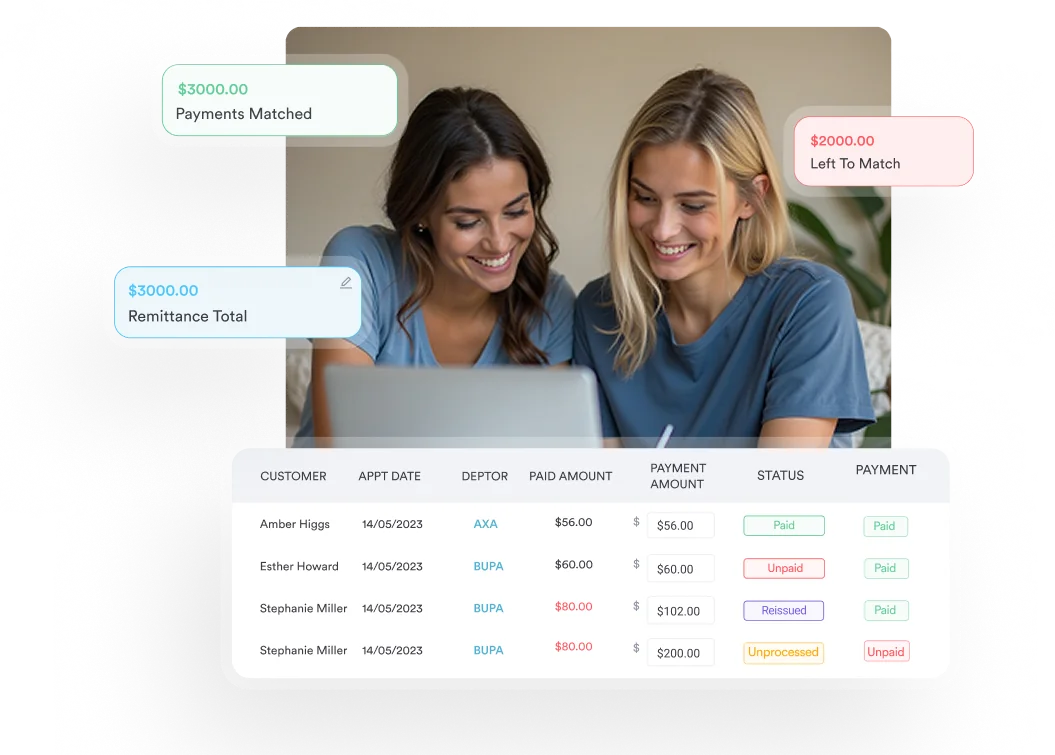

Pabau sends CMS-1500/837P claims through Claim.MD, checks patient eligibility and brings electronic remittance advice back into the same system. You see how every 99452 claim paid.

Get the provider role right and most 99452 problems go away. After that, protect two numbers in every note: at least 16 minutes, and no repeat inside 14 days.
The trade-off is a little documentation time. A few extra lines per consult cost far less than reworking a denied claim. So build the consent line, the clinical question and the exact minutes into your consult template now.
Book a demo to see how Pabau sends your consult claims through Claim.MD and shows what each one paid.

Answering the consult as the specialist? CPT code 99451 covers the consultant’s review and written report on the same case.
Billing consultant time by the minute? CPT code 99448 explains the 21-30 minute tier of the consultant-side codes.
Need a broader view of the claims lifecycle? Our Claim.MD clearinghouse guide explains how electronic claim submission works from 837P file to ERA receipt for CPT-coded services.
Trying to reduce your overall denial rate? Our clean claim guide covers the pre-submission edits that prevent the most common CPT billing denials across E/M and procedure codes.
Building a compliant billing workflow from scratch? Our medical billing compliance guide walks through the documentation standards that satisfy Medicare and commercial payer auditors for time-based codes.
Often, yes. Medicare Part B cost-sharing applies, which is why CMS requires the patient’s consent before the consult. Commercial plans set their own cost-sharing, so check the patient’s benefits first.
No. The descriptor covers time spent by a physician or other qualified health care professional. Time clinical staff spend gathering records doesn’t count toward the 16 minutes.
No. CMS treats interprofessional consultations as services between practitioners, not as Medicare telehealth services. The patient isn’t part of the consult, so no video visit is needed.
Use the ICD-10-CM code for the condition that prompted the consult. It has to support medical necessity, so match it to the clinical question you sent the specialist.