HCPCS Code E0215: Electric heating pad (non-moist) billing guide
HCPCS Code E0215: Official description and device definition HCPCS Code E0215 is...

Last Updated: Nov 16, 2026
27137 is the CPT code for revision of total hip arthroplasty, acetabular component only, with or without autograft or allograft. It applies when the surgeon replaces the acetabular cup or liner and keeps a functional femoral stem in place.
Coders often confuse it with 27134 (both components revised) and 27138 (femoral component only). Choosing the right code from this trio matters for correct reimbursement under Medicare and commercial payer medical-necessity policies.
Let Pabau's smart automation suggest the right codes, reduce claim denials, and keep your practice compliant—effortlessly.
Automate repetitive tasks and focus on what matters most—your patients.
Reduce coding errors and ensure compliance with the latest regulations.
Clean claims, fewer denials, and faster reimbursements.
Powerful insights and reporting to help your practice thrive.
HIPAA compliant SOC 2 certified GDPR-compliant Trusted by 4,000+ clinics worldwide

CPT 27137 covers revision of the acetabular component only, not both hip components (use 27134) or the femoral component only (use 27138).
Medicare applies a 90-day global period. A return to the OR within that window needs modifier 58, 78 or 79, depending on the reason.
Many payers expect a laterality modifier (RT or LT) and an ICD-10 code showing failure of the prior implant, such as T84.051A.
Pabau, our practice management software, tracks prior-authorization codes, dates and sessions on the patient’s case and submits US claims through Claim.MD.
CPT code 27137 reports a revision of total hip arthroplasty in which only the acetabular component is replaced.
The AMA CPT code set gives it this descriptor: “Revision of total hip arthroplasty, acetabular component only, with or without autograft or allograft.”
The code applies when the surgeon replaces the acetabular cup (socket) and leaves a functional femoral stem and head in place.
The descriptor phrase “with or without autograft or allograft” is significant for billing. It means bone grafting performed to restore acetabular bone stock during the revision is included in 27137 and cannot be billed separately under most circumstances. Coders who attempt to append a bone graft code alongside 27137 will typically face a National Correct Coding Initiative (NCCI) bundling edit.
What the code includes, based on AMA guidance:
Anesthesia is billed separately by the anesthesiologist. Implant costs are reported using revenue codes or cost-report mechanisms in facility settings; they are not captured within 27137 itself.
An operative report that cannot support 27137 leads to denials that were avoidable. The surgeon’s documentation must confirm which component was revised, why it failed and what was implanted. Read the operative report against the step sequence below to confirm 27137 and the elements payers require.
If the operative report describes revision of the femoral stem in the same session, the coder must determine whether 27134 (both components) applies instead. A report that mentions “retained femoral stem” or “stable femoral component, no revision required” is the documentation anchor for 27137.
The three revision hip arthroplasty codes cover distinct operative scenarios. Billing 27134 when only the acetabular component was revised is miscoding. So is billing 27137 when both components were replaced, and both expose the practice to audit risk. The table below clarifies when each code applies.
Can 27137 and 27138 be billed together? If both components were revised in one session but billed separately, NCCI edits are likely to bundle them into 27134. The payer may also deny one code as unbundled. If the clinical record supports both components being revised, 27134 is the correct single code to use.
CPT code 27130 covers the primary total hip arthroplasty, the first implantation of a total hip prosthesis on that hip. CPT code 27137 applies only when a prior THA is in place and its acetabular component has failed and needs revision. The chart below sets out both questions in the order a coder should ask them.
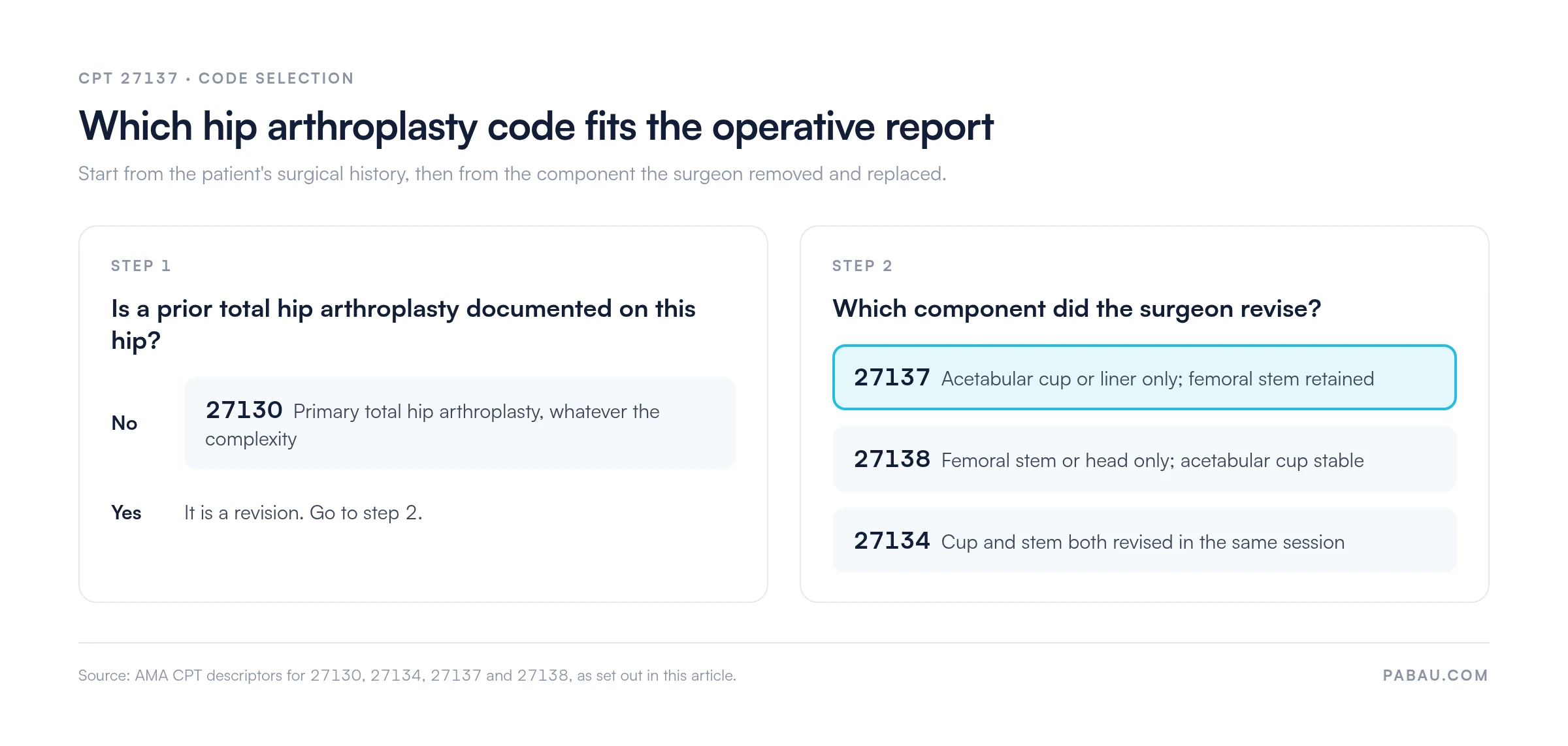
This distinction matters because a coder reviewing an operative report must confirm the patient’s surgical history before selecting 27137. If no prior THA is documented in the record, 27137 cannot be used. Medicare and most commercial payers will cross-reference ICD-10 diagnosis codes to validate that a prosthetic device was previously placed.
Key identifiers in the operative report that confirm revision (not primary) surgery:
If the operative report describes a first-time implantation, 27130 applies regardless of the complexity involved. 27137 is never appropriate for a primary procedure.
Under the 2026 Medicare Physician Fee Schedule (MPFS), CPT code 27137 carries a 90-day global period. Pre-operative and post-operative care within that window is bundled into the procedure payment. Claims management software can help billing teams keep track of global-period end dates.
Payment rates vary by Medicare Administrative Contractor (MAC) locality and geographic adjustment factor. The national non-facility rate is typically higher than the facility rate because the facility rate assumes the hospital or ASC absorbs overhead costs. Always verify current figures using the CMS Physician Fee Schedule lookup tool, as rates are updated each January.
Confirm active coverage and benefit limits before the procedure date. On a revision this complex, a denial issued after the surgery is difficult to reverse.
Run an eligibility verification the day before every scheduled hip revision, not just at scheduling. Medicare Advantage plans frequently have different authorization requirements than traditional Medicare, and benefit limits on implants or facility type can change mid-year. A check the day before surgery on CPT code 27137 surfaces those changes before the patient reaches the OR.
Medicare and commercial payer medical-necessity policies generally require documented clinical failure of the prior acetabular component before they approve CPT code 27137. The diagnosis documented in the operative record and claim must reflect a recognized indication for revision surgery. Vague documentation such as “patient requests new hip” or “pain without structural cause” will not support medical necessity.
Indications these policies generally accept include:
The clinical record must document the indication explicitly. Radiographic reports, prior operative notes from the original THA and the surgeon’s notes confirming failure all belong in the chart. Payers may ask to review them.
The ICD-10-CM codes linked to CPT code 27137 must match the documented reason for the revision. A mismatch between the operative finding and the submitted diagnosis code invites denials and audit flags.
Confirm the 7th character for the encounter type: “A” for initial encounter, “D” for subsequent encounter. Check each code against the current-year tabular list, because the code set is updated annually. The left-hip codes below each have a right-hip counterpart.
Many payers require RT or LT on joint arthroplasty codes. A missing or mismatched laterality modifier is a common cause of rejection, so check the payer’s policy. The table below summarizes the modifiers most relevant to hip revision billing.
Bilateral hip revision in a single session is rare but does occur. When it does, some practices submit two separate line items (27137-RT and 27137-LT) rather than modifier 50. Medicare generally accepts either format, but commercial payer contracts vary. Confirm the preferred submission format with each payer before filing.
Traditional Medicare (Parts A and B) does not require prior authorization for CPT code 27137 as a standard rule. Medicare Advantage plans work differently. Most MA plans require prior authorization for major joint revision surgery, and some require it for the facility admission as well as the physician procedure.
Never assume that a patient’s MA plan follows traditional Medicare’s authorization rules.
Commercial payers typically require pre-authorization for 27137. The clinical documentation package most payers request includes:
Authorization timelines vary by payer. Urgent cases can sometimes be authorized within 24 to 48 hours with direct physician-to-physician review, but elective revisions may require 5 to 10 business days. Plan around this timeline when scheduling.
An authorization number does not guarantee payment. Payers can still review medical necessity after the service if the documentation does not match the authorized indication.
Payers auditing revision hip arthroplasty claims check the operative report for specific elements. Missing any of the following routinely triggers additional documentation requests or outright denials.
A coder who notices the operative report does not explicitly state which component was retained should query the surgeon before filing. An ambiguous report that could support either 27137 or 27134 is a compliance risk regardless of which code is submitted.
Build a CPT 27137 documentation checklist into your pre-billing workflow. Before submitting, confirm five points in the operative report. It shows (1) a prior THA on record and (2) a revised acetabular component with a retained femoral component. It also states (3) the reason for failure, (4) the implant manufacturer and lot number, and (5) the side. This five-point check catches the audit findings listed above before the claim is filed.
Payers scrutinize medical-necessity documentation and code selection closely on revision hip arthroplasty claims. A solid denial management workflow for orthopedic practices should include pre-submission audits that catch these patterns before the claim goes out the door.
A clean claim for CPT code 27137 is one the payer accepts without a rejection. For orthopedic revision claims, that takes correct code selection and a matching laterality modifier. It also needs an ICD-10 code that reflects documented prosthesis failure, plus an authorization number where the payer requires one.
Verifying these four elements before submission helps the claim pass the payer’s electronic edits the first time.
Detailed guidance on medical billing documentation standards also covers how to structure the administrative record to withstand a retrospective audit.
A hip revision claim passes through several hands before it is filed. The coder reads the operative report, a billing lead chases the authorization, and someone re-checks coverage before the surgery date.
Pabau keeps those steps on the patient’s case. Staff record the prior-authorization code, dates and sessions there, and Pabau warns them when an authorization is missing. US practices check eligibility and submit CMS-1500 claims through Claim.MD, and ERA remittances come back into the same record.
A superbill for orthopedic procedures carries the diagnosis codes and modifiers, so the coder checks one document against the operative report. Fewer claims come back for a missing authorization or an unverified policy.

Pabau tracks prior-authorization codes, dates and sessions on each case and checks eligibility before claims go out through Claim.MD. Your billing team submits hip revision claims with coverage confirmed.

Bill 27137 only when the operative report names a revised acetabular cup or liner and a retained femoral stem. Anything less explicit is a query to the surgeon before filing. A wrong pick among 27134, 27137 and 27138 draws NCCI edits and payer audits.
Pair the code with a hip-specific T84 diagnosis that matches the operative finding, and add the laterality modifier the payer expects. Confirm authorization for Medicare Advantage and commercial plans before the surgery date. Revenue lost to a wrong code is hard to recover once the 90-day global period closes.
Pabau tracks prior-authorization codes, dates and sessions on the patient’s case and supports electronic claims through Claim.MD. Book a demo to walk a revision hip arthroplasty case from authorization to a filed claim.

Waiting on a payer before a hip revision? The prior authorization process walks through each step from request to approval, with the documents payers ask for.
Want to understand denial patterns across your claim volume? Denial codes in medical billing explains the most common CARC codes and how to build an appeal workflow around them.
Looking for a plain-English overview of how claims move through the system? What is revenue cycle management walks through the full claims lifecycle from patient intake to payment posting.
CPT code 27137 covers revision of total hip arthroplasty involving the acetabular component only, with or without autograft or allograft. It applies when the surgeon removes and replaces the acetabular cup or liner while the femoral component remains in place and functional. Bone grafting performed during the procedure is included and cannot be billed separately.
CPT 27134 covers revision of both the acetabular and femoral components in one session. CPT 27137 covers revision of the acetabular component only. If the surgeon revises only the cup and leaves the stem in place, 27137 is correct. Billing 27137 and 27138 together when both components are revised is incorrect; use 27134 instead.
Traditional Medicare does not require prior authorization for CPT 27137, but Medicare Advantage plans typically do. Most commercial payers also require pre-authorization. Requirements vary by plan, so verify authorization status at eligibility verification, not at scheduling, to avoid post-service denials.
For a left hip, common ICD-10-CM codes paired with CPT 27137 are T84.021A (dislocation), T84.051A (periprosthetic osteolysis) and T84.061A (wear of articular bearing surface). Use the right-hip equivalents (T84.020A, T84.050A, T84.060A) when the right hip is revised. The correct code depends on the operative finding, so confirm it against the current-year tabular list.
Common denial reasons include incorrect code selection, such as 27134 billed when only the acetabular component was revised. A missing or mismatched laterality modifier (RT or LT) is a common cause of rejection where the payer requires one. Diagnosis codes that do not document prosthetic failure and missing prior authorization for Medicare Advantage or commercial plans also cause denials. NCCI bundling edits deny claims where bone graft codes are appended alongside 27137.
The global period for CPT 27137 is 90 days under Medicare. Pre-operative services on the day of surgery and post-operative care for 90 days after the procedure are bundled into the base payment. Further surgery within that window takes modifier 58 for a planned staged procedure or 78 for an unplanned related return to the OR. Modifier 79 covers an unrelated procedure.