HCPCS Code V5095: Semi-implantable middle ear hearing prosthesis
HCPCS Code V5095: Definition and clinical descriptor HCPCS Code V5095 is the Lev...

Last Updated: Nov 25, 2026
78071 is the CPT code for parathyroid planar imaging with tomographic (SPECT) imaging. It covers a sestamibi parathyroid scan that pairs planar images with a SPECT acquisition in the same session. It is usually ordered to localize a parathyroid adenoma before surgery.
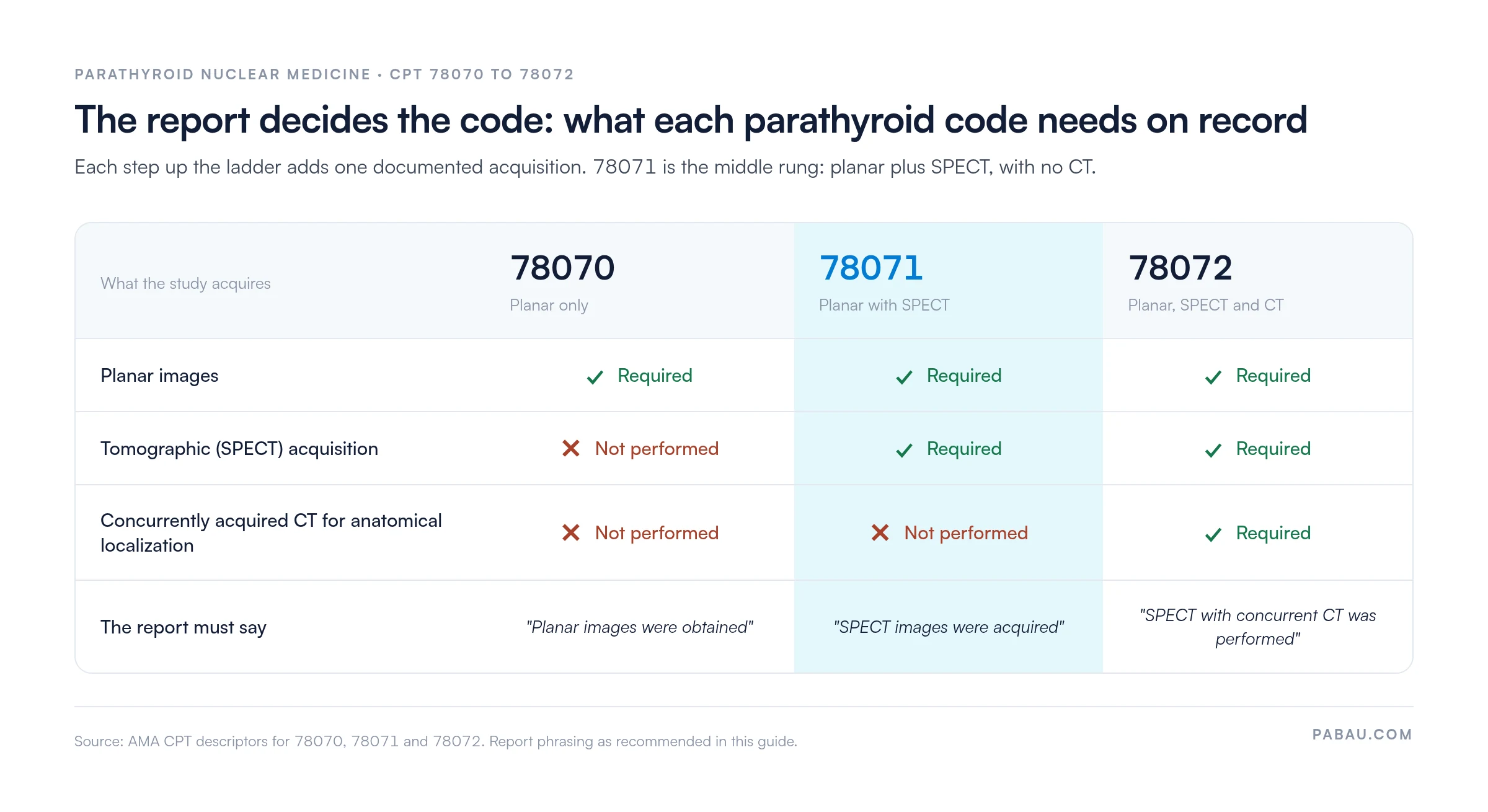
The documented SPECT phase separates it from its neighbors. Planar imaging alone is coded 78070, and adding concurrently acquired CT for localization moves the study to 78072.
Let Pabau's smart automation suggest the right codes, reduce claim denials, and keep your practice compliant—effortlessly.
Automate repetitive tasks and focus on what matters most—your patients.
Reduce coding errors and ensure compliance with the latest regulations.
Clean claims, fewer denials, and faster reimbursements.
Powerful insights and reporting to help your practice thrive.
HIPAA compliant SOC 2 certified GDPR-compliant Trusted by 4,000+ clinics worldwide

CPT Code 78071 covers parathyroid planar imaging with SPECT, while 78070 is planar only and 78072 adds CT.
Primary hyperparathyroidism, ICD-10 E21.0, is the diagnosis most often paired with CPT 78071.
The report must state that SPECT images were acquired. Without that wording, it supports only 78070 on audit and risks a downcode or denial.
Tc-99m sestamibi is billed separately under HCPCS A9500 and is not bundled into 78071.
Claims management software such as Pabau sends 78071 claims through Claim.MD and checks patient eligibility before submission.
CPT Code 78071 is a diagnostic nuclear medicine code that describes parathyroid planar imaging with tomographic (SPECT) imaging. It belongs to the AMA’s CPT code set, which the CPT Editorial Panel maintains and updates. Within that set, 78071 falls under diagnostic nuclear medicine, 78012-78999, in the endocrine system codes.
The official descriptor requires two acquisition phases, planar and SPECT. Both must be performed and recorded in the same imaging session for 78071 to apply. If SPECT acquisition starts but is not completed, because of equipment failure or patient tolerance, the claim reverts to 78070.
Parathyroid SPECT imaging follows a dual-phase acquisition protocol using Tc-99m sestamibi (technetium-99m sestamibi) as the radiotracer. The dual-phase design relies on differential washout. Normal thyroid tissue clears the tracer quickly, while hyperfunctioning parathyroid adenomas retain it longer. That retention difference makes the scan useful for preoperative localization.
Documentation tip: The SPECT acquisition step must be named in the report. Phrases like “tomographic imaging was performed” or “SPECT images were obtained” satisfy the requirement. A report that only mentions “planar scintigraphy” will not support 78071 on audit. The matrix below shows what each parathyroid code needs on record.
Primary hyperparathyroidism is the dominant indication for CPT Code 78071. The scan is ordered when elevated parathyroid hormone (PTH) and calcium levels confirm hyperparathyroidism. The surgeon then needs preoperative localization to plan a focused parathyroidectomy rather than a bilateral neck exploration. The Society of Nuclear Medicine and Molecular Imaging (SNMMI) recognizes preoperative localization as the primary clinical application of parathyroid scintigraphy.
Avoid E21.3 as a first-listed diagnosis when the clinical picture supports a more specific code. Payers that follow LCD-based medical necessity criteria routinely flag unspecified hyperparathyroidism for additional review, adding 15-30 days to the payment cycle. Hypercalcemia, E83.52, belongs in a secondary position behind the E21 code that explains it.
The three parathyroid nuclear medicine codes form a strict hierarchy. What the gamma camera acquires during the session, as the radiology report documents it, decides the code. Upgrading from 78070 to 78071 when SPECT was not performed is upcoding. Downcoding from 78072 to 78071 when SPECT-CT was performed creates an underpayment and misrepresents the procedure. Use the AAPC Codify CPT lookup to review current descriptor text before coding.
Critical rule: CPT 78071 and CPT 78072 cannot be billed on the same date of service for the same patient. National Correct Coding Initiative (NCCI) edits bundle them. When SPECT-CT is performed, bill 78072 only. Billing both generates an automatic CO-97 denial on the lower-value code.
Documentation failures cause more 78071 denials than incorrect code selection. A clean claim submission for CPT Code 78071 requires the following elements in the nuclear medicine report or combined radiology/nuclear medicine record.
Medicare distinguishes between facility and non-facility documentation requirements. At a hospital outpatient facility, the technical component (TC) and professional component (26) may be billed separately. At a free-standing imaging center billing globally, both must be in a single record. Confirm the billing model matches the modifier structure before submission.
Prior authorization for CPT Code 78071 is not universal. Requirements vary by payer type, state Medicaid plan, and commercial plan contract. Always verify with the individual payer before scheduling the study.
When submitting a PA to a commercial or managed care payer, include the ordering physician’s notes documenting elevated PTH and calcium. Add the planned surgical approach (focused vs. bilateral) and any prior imaging results (ultrasound, CT). Payers that follow AIM Specialty Health or eviCore nuclear medicine guidelines typically request this information in a standardized form.
Medicare reimburses CPT Code 78071 under the Physician Fee Schedule (PFS). Rates vary by geographic location based on the Medicare Geographic Practice Cost Index (GPCI) and are updated annually with CMS’s final rule. Before quoting a reimbursement amount to a patient or payer, verify the current year’s figures in the CMS Physician Fee Schedule lookup tool.
Radiopharmaceutical supply (HCPCS A9500 for Tc-99m sestamibi) is billed separately and is not included in the 78071 reimbursement. For current year RVU breakdowns, the FastRVU 2026 RVU lookup tool provides work, practice expense, and malpractice component values by modifier and setting.
Several codes are routinely billed alongside CPT Code 78071, while others are explicitly bundled. Knowing which is which prevents both underbilling and NCCI edit denials. For HCPCS Level II supply code verification, confirm the current status of A9500 annually, as supply codes update each calendar year.
Verify HCPCS A9500 coverage status with each payer annually. Some commercial plans require a separate injection administration code alongside A9500; others bundle the administration into the technical component of 78071. Check the payer’s nuclear medicine LCD or benefit manual before the study date, not at claim submission.
A 78071 claim pairs a coverage-sensitive procedure with a separately billed radiopharmaceutical, which gives payers two places to deny it. Structured denial management workflows cut the rework on these claims. Each of the five denial patterns below has a specific fix.
Appeal timelines vary by payer. Medicare Part B appeals must be filed within 120 days of the initial denial notice. Commercial payers typically require appeals within 60-180 days. Track denial ages actively, because a missed appeal window forfeits the payment. Our guide to medical billing denial codes lists the CARC and RARC codes you will see on the remittance.
Medicare Administrative Contractors (MACs) issue Local Coverage Determinations that define the covered indications, non-covered diagnoses, and documentation requirements for parathyroid scintigraphy in their jurisdictions. There is no single national LCD for CPT Code 78071, and coverage criteria vary by MAC region. The CMS ICD-10 codes and coding resources page links to the LCD database where current applicable determinations are published.
Key LCD compliance points that apply across most jurisdictions:
Most 78071 denials in this guide trace back to the paper trail. The usual culprits are a report missing the SPECT statement, an unspecified E21 code, or an unlogged prior authorization. Billing teams often find these only after the remittance arrives, then rework the claim by hand.
Pabau, a practice management platform with built-in claims management, moves those checks earlier. Practices submit CMS-1500 and 837P claims through Claim.MD, Pabau’s US clearinghouse partner, and run eligibility checks before the study date. Prior authorization codes, dates and sessions sit on the patient’s case, with a warning when one is missing.

Practices using streamlined claims management can also build LCD-aligned documentation checklists into their forms, so missing elements surface before the claim is generated. ERA remittances post back to the same record, which keeps denial follow-up in one place.

Pabau sends CPT 78071 claims through Claim.MD and checks eligibility before the study, so fewer nuclear medicine claims come back denied.

Billing CPT Code 78071 correctly comes down to one sentence in the report and one coding decision. The sentence confirms that SPECT images were acquired. The decision confirms that no concurrent CT was performed, which keeps the claim at 78071 rather than 78072.
Put both checks into the report template and the pre-submission review, not the appeal. A claim fixed before it leaves the practice can be paid on the first pass. A claim fixed after a denial waits on an appeal window instead.
Book a demo to see how Pabau keeps nuclear medicine claims, eligibility checks and remittances in one record.

Need a clearinghouse for nuclear medicine claims? Claim.MD clearinghouse guide explains how the Pabau-Claim.MD integration routes electronic claims across 4,000+ US payers.
Confused about medical billing fundamentals? Revenue cycle management overview walks through the end-to-end RCM workflow from encounter to payment posting.
Building a denial prevention process? Denial codes in medical billing covers CARC and RARC codes used in EOBs and 835 remittances to identify and correct claim errors.
CPT Code 78071 is the billable procedure code for parathyroid planar imaging with tomographic (SPECT) imaging, used to localize hyperfunctioning parathyroid tissue before surgery. It requires both a planar acquisition phase and a documented SPECT acquisition phase. Studies with planar imaging only are coded as 78070.
78070 covers parathyroid planar (2D) imaging only, and 78071 adds a SPECT (tomographic) acquisition. 78072 adds concurrently acquired CT (SPECT-CT) on top of both the planar and SPECT phases. Each upgrade requires explicit documentation of the additional acquisition modality performed; bill the code that matches what the radiology report confirms was done.
Traditional Medicare Part B does not generally require prior authorization for CPT 78071. Medicare Advantage plans, most commercial plans, and many state Medicaid programs do. Always verify with the individual payer before scheduling; prior auth requirements are plan-specific and can change with annual contract renewals.
The most broadly accepted diagnosis codes paired with CPT 78071 are E21.0 (primary hyperparathyroidism), E21.1 (secondary hyperparathyroidism), and E21.2 (other hyperparathyroidism). E83.52 (hypercalcemia) may be used as a secondary diagnosis. Avoid E21.3 (unspecified) as a first-listed code when a more specific hyperparathyroidism code is clinically supported.
No. NCCI edits prohibit same-date billing of CPT 78071 and CPT 78072 for the same patient. When SPECT-CT is performed, bill 78072 only; 78071 is automatically denied as a CO-97 bundle when both appear on the same claim.
The most common denial is CO-11 (diagnosis inconsistent with procedure). The usual cause is an unspecified code (E21.3) where a specific one was supported, or a diagnosis the MAC LCD does not cover. The second most common is a documentation mismatch, where the report does not explicitly document SPECT acquisition but 78071 was billed instead of 78070.