HCPCS Code V5095: Semi-implantable middle ear hearing prosthesis
HCPCS Code V5095: Definition and clinical descriptor HCPCS Code V5095 is the Lev...

Last Updated: Nov 25, 2026
73725 is the CPT code for magnetic resonance angiography, lower extremity, with or without contrast material(s). It reports MR imaging of the leg's arteries and veins, whichever contrast approach the radiologist uses.
Submitting 73721 (MRI of any joint of the lower extremity, without contrast) instead of 73725 reports the wrong modality and anatomy. A claim coded that way is likely to be denied.
Let Pabau's smart automation suggest the right codes, reduce claim denials, and keep your practice compliant—effortlessly.
Automate repetitive tasks and focus on what matters most—your patients.
Reduce coding errors and ensure compliance with the latest regulations.
Clean claims, fewer denials, and faster reimbursements.
Powerful insights and reporting to help your practice thrive.
HIPAA compliant SOC 2 certified GDPR-compliant Trusted by 4,000+ clinics worldwide

CPT Code 73725 reports MR angiography of the lower extremity vasculature, with or without contrast, and never MRI of a joint.
One code covers every contrast approach: without contrast, with contrast, or both in the same session.
Original Medicare has no active AUC claim requirement since CMS paused the program in 2024, while commercial payers set their own prior authorization rules.
Bilateral reporting is payer-specific, so check whether the payer wants modifier 50 or separate LT and RT lines.
Pabau, a practice management platform, tracks prior authorizations on each case and sends 837P claims through Claim.MD with eligibility checks and ERA remittances.
CPT Code 73725 is the AMA code for magnetic resonance angiography of the lower extremity, with or without contrast material. Medicare contractors pay it for leg vascular conditions, and Novitas lists 73725 in its MRA billing and coding article alongside diagnoses such as I70.201. The code sits in the Diagnostic Radiology section of CPT and covers imaging of the lower extremity vasculature.
The descriptor says nothing about one leg or two, so bilateral reporting is payer-specific. Check the payer policy before you bill MRA of both legs, using the methods covered in the modifiers section below.
73725 captures the acquisition and interpretation of MRA sequences covering the lower-extremity arterial tree. What matters for clean billing is knowing exactly where the code’s boundaries fall.
The lower-extremity imaging family spans both vascular and musculoskeletal codes. Submitting the wrong one is a common reason these claims are denied.
The clinical split between 73725 and the joint codes is simple. Vascular anatomy, meaning arteries and veins, goes to 73725. Joint anatomy, meaning cartilage, ligaments and bone, goes to the joint MRI codes. If the order says claudication or peripheral artery disease, 73725 is correct. If it says knee pain or a ligament tear, 73721 applies, and the chart below maps each order to its code.
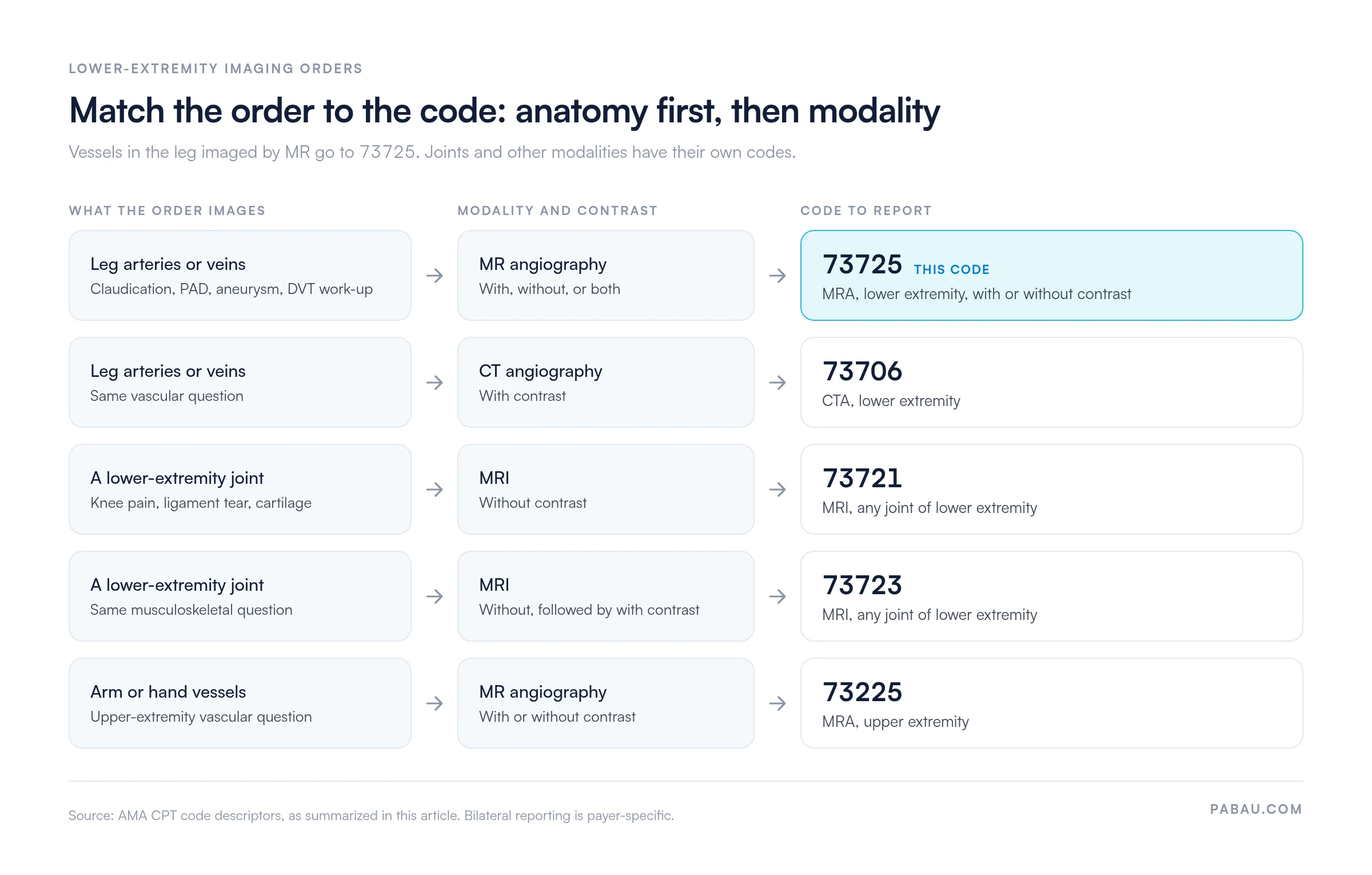
73725 is reported the same way whether or not contrast is used. Its descriptor reads “with or without contrast material(s),” so one code covers every contrast approach.
This means the same code applies whether the radiologist performs:
Payers do not require different codes per contrast scenario. What they do require is accurate documentation in the radiology report. The report must state whether contrast was administered, the name and dose of the contrast agent if used, and the injection route. Missing contrast documentation can lead to a documentation denial even when the code is correct.
Medicare LCDs and commercial payer policies tie 73725 reimbursement to covered ICD-10-CM codes. Submitting an unsupported diagnosis code is a common cause of denials. The table below lists widely used pairings for lower-extremity MRA.
Code to the highest specificity the documentation supports. I73.9 covers unspecified peripheral vascular disease, while the I70.2- codes name the site and stage of atherosclerosis.
This list is not exhaustive. Covered diagnoses are set by each MAC’s LCD and can change with annual policy updates. Verify the current LCD for your billing jurisdiction before you submit a claim, using the steps in the local coverage section below.
Before submitting a 73725 claim, run the ordering diagnosis through your MAC’s LCD search at the CMS Coverage Database. If the ICD-10 code is not on the covered-indications list, ask the ordering physician whether the indication can be coded more specifically. For a Medicare patient, issue an ABN when coverage is uncertain.
Medicare pays CPT Code 73725 from the annual Medicare Physician Fee Schedule (MPFS). Its relative value units (RVUs) are multiplied by the conversion factor and adjusted by geographic practice cost indices (GPCIs). Rates differ between facility and non-facility settings.
Because MPFS rates are updated annually and vary by locality, specific dollar amounts are not stated here. Use the CMS Physician Fee Schedule lookup tool to retrieve the current non-facility and facility rates for your MAC jurisdiction. For 2026 RVU values, the FastRVU 2026 RVU lookup provides a CMS-sourced reference without requiring a login.
Knowing the rate is half the job, because the claim still has to reach the payer cleanly. In Pabau, US claims go out as 837P files through the Claim.MD clearinghouse. Staff can check eligibility before the study, and ERA remittances post back once the payer responds.
Original Medicare has no active prior authorization or AUC claim requirement for 73725. CMS paused the AUC program and rescinded its regulations at 42 CFR 414.94, effective January 1, 2024. Providers should no longer include AUC consultation information on Medicare fee-for-service claims.
Commercial payers and Medicare Advantage plans set their own prior authorization rules. Many send lower-extremity MRA requests through a radiology benefit manager for review. Verify prior auth requirements with each payer before scheduling. Building revenue cycle management workflows that capture auth status at scheduling prevents the authorization mismatch that generates denials weeks after the study is completed.
A compliant radiology report for CPT Code 73725 is the foundation for submitting a clean claim. Missing any of the elements below can lead to a medical necessity denial or an audit finding.
Required report elements per ACR practice parameters and CMS LCD requirements:
Modifier selection depends on the billing context: Who owns the equipment, who performed the interpretation, and whether one or both extremities were imaged.
Bilateral reporting for 73725 is payer-specific, so check the payer policy before you bill. AAPC describes two accepted methods: two lines with modifier 50 on the second, or one line with modifier 50 and two units. Some payers ask for separate LT and RT lines instead.
Claims for 73725 are commonly denied for a small set of avoidable documentation and coding errors. Each denial reason below maps to a corrective action.
Structured denial management workflows track the denial reason codes (CARCs) on 73725 claims. Billing teams can then see which of these patterns recurs most in their practice and fix its root cause.
A Local Coverage Determination (LCD) is a written policy from a Medicare Administrative Contractor. It defines which indications are covered for a specific service within that MAC’s jurisdiction, and which are not. For 73725, the relevant policy is the MRA LCD your MAC maintains.
What LCDs for lower-extremity MRA typically specify:
LCDs are jurisdiction-specific. The same indication that is covered under one MAC may be non-covered or require additional documentation under another. Access the CMS Coverage Database and filter by your MAC to retrieve the current MRA LCD for your billing region before submitting any 73725 claim.
Most of the denial reasons above trace back to the billing workflow. The MRA was performed correctly, but the claim went out without the authorization, diagnosis or documentation it needed.
In Pabau’s claims management software, the auth code, dates and approved sessions are tracked on the patient’s case. Staff see a warning when an authorization is missing, so it can be chased before the claim goes out.
For US claims, Pabau connects to the Claim.MD clearinghouse. Your team checks eligibility before the visit and sends the claim as an 837P. ERA remittances post back when the payer responds, and secondary claims are supported too.


Pabau tracks prior authorizations on each case and flags a missing one. Claims go out as 837P files through Claim.MD, with eligibility checks before the visit and ERA remittances after.

Choosing 73725 is the easy part once the order names a vascular question in the leg. The protection for payment comes before the study: the payer’s authorization, a diagnosis on its coverage list, and a report that states the contrast used.
For bilateral studies, settle each payer’s method once and record it, instead of deciding claim by claim. Each denial then points to one missed step your team can fix on the next claim.
Book a demo to see how Pabau tracks prior authorizations and sends your radiology claims through Claim.MD.

Need a clearinghouse reference for 73725 claims? Our Claim.MD clearinghouse guide explains how the electronic claims workflow routes Medicare and commercial submissions with real-time eligibility and denial tracking.
Seeing claim denials pile up across your practice? Denial codes in medical billing breaks down the most common CARC codes and what each one requires you to fix before resubmitting.
Unsure which billing software fits a radiology or vascular practice? Best medical billing software for US practices compares platforms across clearinghouse integration, claim tracking, and denial management depth.
CPT code 73725 covers magnetic resonance angiography of the lower extremity, with or without contrast material, including the MRA sequences and the radiologist’s interpretation. It applies to imaging of the lower extremity vasculature and does not cover MRI of joints such as the knee or ankle.
CPT 73721 is MRI of a lower-extremity joint, imaging cartilage, ligaments and bone, while CPT 73725 is MR angiography of the leg’s arteries and veins. The clinical indication drives the choice. Joint pain points to 73721, and claudication or vascular disease points to 73725.
Original Medicare has no active prior authorization or AUC claim requirement for 73725. CMS paused the AUC program and rescinded its regulations effective January 1, 2024. Commercial payers and Medicare Advantage plans set their own prior authorization rules. Verify each payer’s requirements when you schedule the study.
Common ICD-10-CM pairings are I70.209 (unspecified atherosclerosis of native arteries of extremities, unspecified extremity) and I73.9 (peripheral vascular disease, unspecified). Others include I82.401 (acute deep vein thrombosis of the right lower extremity) and I72.4 (aneurysm of a lower-extremity artery). Covered diagnoses are defined by each MAC’s LCD and can differ by jurisdiction. Always confirm them against the current LCD for your billing region.
The most common modifiers for 73725 are 26 (professional component), TC (technical component), 50 (bilateral), LT and RT (laterality), and 59 (distinct procedural service). Bilateral reporting is payer-specific. Some payers want two lines with 50 on the second, others one line with 50 and two units, and some want LT and RT lines.
Common denial reasons are submitting the joint code 73721 instead of 73725, or a diagnosis missing from the payer’s covered-indications list. Other causes are a missing commercial prior authorization, incomplete contrast documentation, and bilateral imaging reported the wrong way for that payer.
Medicare pays CPT 73725 from the annual MPFS, using work, practice expense, and malpractice RVUs. Those are multiplied by the CMS conversion factor and adjusted by the GPCI for your locality. Because rates change annually and vary by area, retrieve current figures from the CMS Physician Fee Schedule lookup tool at cms.gov.
A compliant 73725 report includes the clinical indication, relevant history and the MRA technique, such as field strength, sequences and coil. It states the contrast agent and dose, or that no contrast was given. It also covers findings per vascular segment, any comparison studies, and a signed, dated radiologist attestation.