
Pabau Engage inbox

Pabau Engage is here: every patient conversation in one inbox.

Learn more
CPT Code

CPT code 24640 – Radial head subluxation closed reduction


Code Definition

24640 is the CPT code for closed treatment of radial head subluxation in a child (nursemaid's elbow), with manipulation. It covers the quick hands-on reduction a clinician performs after a pull on a toddler's arm slips the radial head under its ligament.

The most important billing fact is the global period. Medicare gives 24640 a 10-day global, so routine follow-up in that window is already paid. Getting that, the S53.03- diagnosis and modifier -25 right keeps a two-minute procedure from becoming a denial. The sections below compare 24640 with its elbow neighbors, then trace a claim from chart note to payment.

Section
10004-69990 Surgery
Subsection
20100-29999 Musculoskeletal system
Code range
24500-24685 Fracture and/or dislocation procedures on the humerus (upper arm) and elbow
Billable
No
Code also known as
nursemaid's elbow, pulled elbow
Save time. Improve accuracy. Get paid faster.
Automate coding with Pabau

Let Pabau's smart automation suggest the right codes, reduce claim denials, and keep your practice compliant—effortlessly.

  • AI-powered code suggestions
  • Real-time compliance checks
  • Faster claims, fewer denials
Why practices choose Pabau
Save hours every week

Automate repetitive tasks and focus on what matters most—your patients.

Improve accuracy

Reduce coding errors and ensure compliance with the latest regulations.

Get paid faster

Clean claims, fewer denials, and faster reimbursements.

Grow with confidence

Powerful insights and reporting to help your practice thrive.

HIPAA compliant SOC 2 certified GDPR-compliant Trusted by 4,000+ clinics worldwide

Key takeaways

Key takeaways

CPT code 24640 covers the closed reduction of a radial head subluxation in a child, the injury better known as nursemaid’s elbow.

Medicare gives 24640 a 10-day global period, so routine follow-up visits in that window are bundled into the procedure payment.

Pair 24640 with S53.031A or S53.032A, the nursemaid’s elbow codes, rather than S53.00- radial head or S53.10- ulnohumeral codes.

A same-day E/M needs modifier -25 on the E/M line, plus a note showing work beyond the decision to reduce.

Elbow dislocations go to 24600, 24605 or 24615 instead, and each of those codes carries a 90-day global period.

CPT code 24640 pays for one quick fix: nursemaid’s elbow

CPT code 24640 reports the closed reduction of a radial head subluxation in a child, the injury most people call nursemaid’s elbow. The AMA’s CPT code set describes it as closed treatment of radial head subluxation in child, nursemaid elbow, with manipulation.

Each part of that wording shapes the claim. “Closed” means no incision. “Subluxation” means a partial slip of the radial head, not a dislocation of the whole elbow joint. “Child” is the age qualifier payers check, and “with manipulation” confirms a hands-on reduction.

The injury itself is simple. A sudden pull on a toddler’s straightened, palm-down arm lets the annular ligament slide over the radial head. Lifting a child by the hand or swinging them by the arms are classic causes. The clinician then reduces it with supination-flexion or hyperpronation, usually without anesthesia.

A two-minute procedure can still produce a messy claim, though. So it helps to know exactly what the payment already covers.

What the 24640 payment already covers

Think of 24640 as a package. The payment covers the reduction and the routine work around it. Billing those pieces again triggers National Correct Coding Initiative (NCCI) edits.

Included in 24640:

  • The reduction itself, by supination-flexion or hyperpronation
  • A sling or splint applied by the same provider
  • The neurovascular check right after the reduction
  • The pre-reduction assessment that leads to the decision to reduce
  • Routine follow-up visits within the 10-day global period

Billed separately, with documentation:

  • Elbow X-rays, reported under the radiology code by whoever interprets them
  • Moderate sedation by a different provider (check NCCI edits if the same provider does both)
  • A significant, separately identifiable E/M service, with modifier -25 on the E/M line

Sedation is rare for a routine nursemaid’s elbow. If it shows up on the claim, the note should explain why this child needed it.

Nursemaid’s elbow or dislocation? The joint decides the code

Radial head subluxation and elbow dislocation are different injuries, and each has its own CPT code. Mixing them up is a common upcoding error, so start with the anatomy.

How the two injuries differ

FeatureNursemaid’s elbow (subluxation)Elbow dislocation
Typical age1-4 years (rarely up to 6)Any age; common in adults
MechanismLongitudinal pull on armFall on outstretched hand, direct blow
Anatomical findingAnnular ligament displacement over radial headComplete joint surface separation (ulnohumeral)
Reduction techniqueSupination-flexion or hyperpronation; no anesthesiaTraction-countertraction; often requires analgesia
Correct CPT code2464024600 (without anesthesia) or 24605 (with manipulation, requiring anesthesia)

How 24640 compares with 24600, 24605 and 24615

Four codes cover the elbow reductions coders see most. The global period is where the money sits, as this comparison shows.

CodeOfficial descriptor (abbreviated)Procedure typeAnesthesia requiredGlobal period
24640Closed treatment of radial head subluxation in child, nursemaid elbow, with manipulationClosed reductionNo10 days
24600Treatment of closed elbow dislocation, without anesthesiaClosed reductionNo90 days
24605Treatment of closed elbow dislocation, requiring anesthesiaClosed reductionYes90 days
24615Open treatment of acute or chronic elbow dislocationOpen reductionYes (general/regional)90 days

So 24640 bundles 10 days of routine follow-up, while the three dislocation codes bundle 90. A recheck three weeks after a nursemaid’s elbow reduction is billable. After a 24605, that same visit is already paid for. The diagram below sorts all four codes by injury and anesthesia.
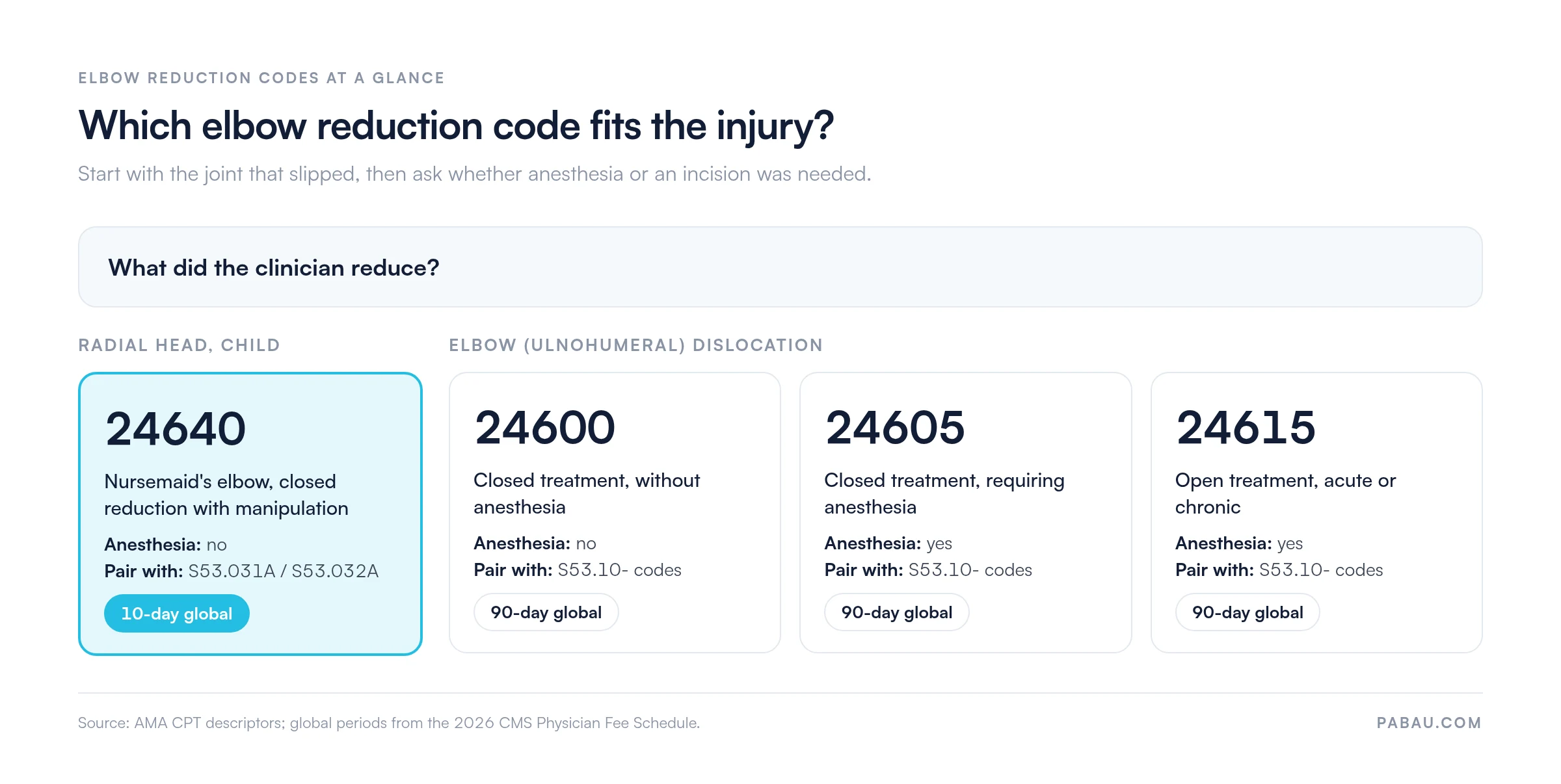
Decision diagram for elbow reduction codes
Only 24640 carries a 10-day global, so picking a dislocation code by mistake also changes which follow-up visits you can bill. Descriptors from the AMA, global periods from the 2026 CMS fee schedule.

The word “child” adds one more check. CPT doesn’t set an age limit, but some payers edit 24640 against the patient’s age. For an older child or adult with a confirmed subluxation, document the presentation and check the payer’s policy first.

The 10-day global changes how you bill follow-ups

Medicare assigns 24640 a 010 global period. It covers the day of the procedure plus the 10 days after it. Routine post-reduction care in that window is already part of the payment.

Here’s how that plays out over a typical case:

  1. Day 0: The child is seen, the elbow is reduced, and you bill 24640. A separate E/M goes on the claim only with modifier -25 and its own documentation.
  2. Days 1 to 10: A routine recheck is part of the global. Some practices log it as 99024, a no-charge post-op code, to track the visit.
  3. Day 11 onward: A new visit falls outside the global, so you bill it as a normal E/M.
  4. Any day in the window: An unrelated problem can still be billed, with modifier -24 on the E/M.

Because 24640 is a minor procedure, modifier -57 doesn’t apply. That decision-for-surgery modifier is for 90-day majors such as 24605 and 24615.

Pair 24640 with the nursemaid’s elbow codes, S53.03-

Every 24640 claim needs a matching ICD-10-CM code. The CDC/NCHS ICD-10-CM tool gives nursemaid’s elbow its own subcategory, S53.03-. Choose the side first, then the seventh character for the encounter type.

ICD-10-CM codeDescriptionUse with 24640?
S53.031ANursemaid’s elbow, right elbow, initial encounterYes, the primary code for a right-sided case
S53.032ANursemaid’s elbow, left elbow, initial encounterYes, the primary code for a left-sided case
S53.033ANursemaid’s elbow, unspecified elbow, initial encounterAvoid, unless the record doesn’t state the side
S53.031DNursemaid’s elbow, right elbow, subsequent encounterFor follow-up visits after the reduction (S53.032D on the left)
S53.101AUnspecified subluxation of right ulnohumeral joint, initial encounterNo, an ulnohumeral injury points to 24600, 24605 or 24615

Older templates still reach for S53.00-, the unspecified radial head subluxation codes. They name the right bone but not the nursemaid’s mechanism, so S53.03- is the better match. An ulnohumeral dislocation, by contrast, is S53.104A on the right.

Before you build a template note, confirm which pairings your main payers accept.

Modifiers for 24640: -25 does most of the work

Most 24640 claims need one modifier at most. Here’s when each common one applies:

  • Modifier -25: Goes on the E/M code, not on 24640, when a significant, separately identifiable E/M happens the same day. It’s the usual modifier for a 010-global code.
  • Modifier -57: Not used with 24640. It marks the decision for a 90-day major procedure.
  • Modifier -RT / -LT: Marks the side. Many payers want it on musculoskeletal codes, alongside the side in the ICD-10 code.
  • Modifier -50: Only for the rare case where both elbows are reduced at one visit. Document both reductions.
  • Modifier -52: Usually not needed after a failed attempt. CPT defines manipulation as an attempted reduction, so the attempt can still support 24640. Document it and check payer policy.

Can you bill an E/M with 24640? Yes, if it stands on its own

Yes. A same-day E/M is billable when it’s significant and separately identifiable from the decision to reduce. Payers look for three things:

  1. A separate problem: The E/M covers more than the elbow. Checking for other injuries or treating an ear infection at the same visit both count.
  2. Its own decision-making: The note shows the problems addressed, data reviewed and risk for the E/M itself.
  3. Modifier -25 on the E/M: The modifier goes on the E/M line, never on 24640.

The pre-reduction exam alone doesn’t qualify. That assessment is already part of 24640, so billing it with -25 adds audit risk without adding revenue.

Pro Tip

Write the E/M and the procedure as separate parts of the chart note. One combined paragraph covering both the assessment and the reduction won’t support modifier -25. An auditor wants two distinct clinical stories, one for the E/M decision and one for the reduction.

What the procedure note needs to show

A 24640 claim stands or falls on the note. These six elements support medical billing compliance and answer the questions an auditor asks.

  1. Presenting complaint: The mechanism (“pulled by right wrist while walking”), the onset time, and the child’s age in years and months.
  2. Exam: Arm held flexed and pronated, refusal to supinate, and tenderness over the radial head. Note the absence of swelling or deformity.
  3. Reduction: The technique, supination-flexion or hyperpronation, and how many attempts it took.
  4. Post-reduction check: The child using the arm again, full supination, and neurovascular status (radial pulse, capillary refill, sensation).
  5. Imaging: Findings and interpretation if X-rays were taken. A classic presentation doesn’t need them, and films are often normal.
  6. Discharge: Recurrence advice given to the caregiver and any follow-up plan.

How a 24640 claim moves from chart to payment

Once the note is signed, the claim follows the standard medical billing process. For 24640, the path looks like this:

  1. Coding: 24640 with -RT or -LT, S53.031A or S53.032A, and an E/M with -25 if one qualifies.
  2. Claim build: The lines go onto a CMS-1500 form or its electronic twin, the 837P.
  3. Clearinghouse: The clearinghouse checks the format and forwards the claim to the payer.
  4. Adjudication: The payer runs age, NCCI and diagnosis edits against each line.
  5. Remittance: An electronic remittance advice (ERA) returns with the payment or a denial reason code.
  6. Follow-up: Rechecks in the next 10 days are logged rather than billed, unless they’re unrelated.

Before you submit: A six-point check

Each check below maps to a common denial. Together, they turn a 24640 claim into a clean claim.

  • The diagnosis is S53.031A or S53.032A, not an S53.00- or S53.10- code.
  • The RT or LT modifier matches the side in the ICD-10 code.
  • The patient’s age fits the payer’s policy for “child”.
  • Any same-day E/M carries -25 and its own documentation.
  • No routine recheck inside the 10-day global is billed as an E/M.
  • The note records the mechanism, the technique and the post-reduction check.

Medicare values 24640 at 1.22 work RVUs

Medicare values 24640 at 1.22 work RVUs in 2026. Payment then shifts with setting and location, which the CMS Physician Fee Schedule lookup shows for your area.

RVU componentNon-facilityFacility
Work RVU1.221.22
Total RVU3.122.14
Global period10 days10 days
Prior authorization (Medicare)Not typically requiredNot typically required
Prior authorization (commercial)Varies by plan; verify per payerVaries by plan; verify per payer

The non-facility total is higher because an office absorbs the overhead that a hospital covers otherwise. These figures come from FastRVU’s 24640 entry, based on the 2026 CMS relative value file.

Few 24640 patients are on Medicare, of course. Medicaid and commercial plans often follow Medicare’s global period, but their rates are their own. Check each payer’s fee schedule.

Why 24640 claims get denied, and how to prevent them

Most 24640 denials trace back to six errors. Fixing them before submission costs far less than an appeal, which is the core idea behind denial management.

Denial reasonRoot causeCorrective action
Age-based denial24640 billed for a patient outside the payer’s age range for “child”Check payer policy for an age cutoff; document the presentation for older patients
ICD-10/CPT mismatchUlnohumeral (S53.10-) or unspecified radial head (S53.00-) code submitted with 24640Use S53.031A or S53.032A; keep S53.10- codes for 24600, 24605 and 24615
Missing lateralityNo RT/LT modifier, or S53.033A used when the side is knownAppend RT or LT; use S53.031A (right) or S53.032A (left)
E/M bundled without modifierSame-day E/M submitted with 24640 without modifier -25 on the E/M codeAppend -25 to the E/M code; document the separate decision-making
Billed inside the globalRoutine recheck within 10 days billed as an E/MLog it as 99024; use -24 only for an unrelated problem
Insufficient documentationNote lacks mechanism, reduction technique or post-reduction checkUse the six-element list above; build a note template in the EHR

Your remittance names the problem with a claim adjustment reason code (CARC). On 24640 claims, these four come up most:

  • CARC 4: The procedure code is inconsistent with the modifier used, or a required modifier is missing.
  • CARC 6: The procedure is inconsistent with the patient’s age.
  • CARC 11: The diagnosis is inconsistent with the procedure.
  • CARC 97: The service is bundled into payment for another service already adjudicated.

For the remittance remark codes that come with them, see our guide to denial codes in billing.

How Pabau keeps 24640 claims moving

Once the reduction is done, the slow part starts at the front desk. Claims go out from one tool, payer portals get checked in another, and a denial can sit unnoticed for weeks.

Pabau, the practice management platform we build, keeps the visit and the claim side by side. Its claims management software submits US claims through Claim.MD and tracks each claim’s status. Your team sees which 24640 claims are pending, paid or denied without another login.

That shortens the stretch between the visit and the payment, which is where a tight revenue cycle management process earns its keep.
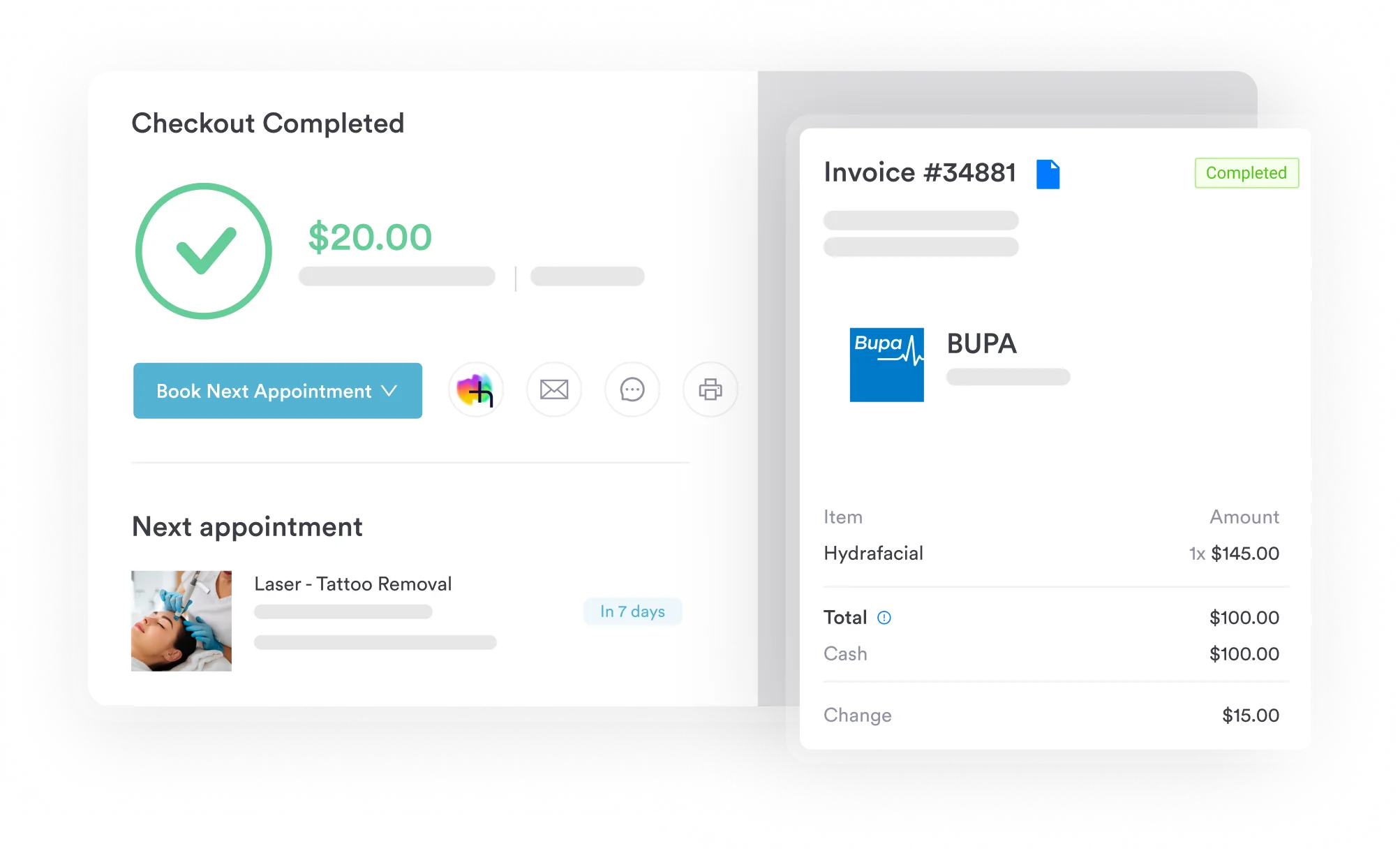
Pabau claims and billing screen
Pabau’s claims management sends each 24640 claim through Claim.MD and shows its status, so your team can catch a denial and resubmit quickly.

Track every 24640 claim to payment

Pabau submits US claims through its Claim.MD integration and tracks each one’s status, so your team spots a denied 24640 claim and reworks it fast.

Pabau claims management dashboard

Conclusion

Nursemaid’s elbow takes seconds to reduce, so the claim is easy to treat as an afterthought. Bill 24640 with the 10-day global in mind, pair it with S53.03-, and save -25 for E/M work that stands on its own.

Build those three rules into your note template once, and every clinician follows them by default. The cost is a few extra lines per visit, which is far cheaper than working an appeal.

Book a demo to see how Pabau tracks each 24640 claim from submission to payment.

Continue your research

Continue your research

Want to see where a 24640 claim stands? Pabau claims management software shows how claim submission and status tracking work through Claim.MD.

Handling a denial after a 24640 rejection? Denial codes in medical billing explains how to read CARC and RARC codes and plan an appeal.

Wondering how clearinghouses process your claims? Medical claims clearinghouses explained covers how 837P files are checked and routed to payers.

Filling in a paper claim for a pediatric visit? CMS-1500 form walks through each box on the professional claim form.

Frequently asked questions

Is CPT 24640 considered a surgical code?

Yes. 24640 sits in the Surgery section of CPT, under the musculoskeletal system, even though there’s no incision. That placement is why it carries a global period and follows surgical package rules.

Can you bill 24640 again if the elbow slips out a second time?

Yes, each new reduction is a new procedure. Inside the 10-day global, add a repeat-procedure modifier such as -76 and check payer rules. Code the diagnosis as a new initial encounter.

What if the X-ray shows a radial head fracture?

Then 24640 no longer fits. Closed treatment of a radial head or neck fracture is 24650 without manipulation or 24655 with it, paired with an S52.12- or S52.13- diagnosis.

Does CPT 24640 need prior authorization?

Medicare doesn’t typically require it, and nursemaid’s elbow is usually treated the day it presents. Commercial and Medicaid plans vary, so check the policy for payers you bill often.

Can a nurse practitioner or physician assistant bill 24640?

Usually, yes, within their state’s scope of practice. Medicare pays NPs and PAs 85% of the physician fee schedule amount, and commercial payers set their own rules.


Avatar photo
Monika Lazarevska
Content Writer

Monika Lazarevska writes content for owners and healthcare professionals who want clear, no-fluff content that actually helps them run their practice better. With a background in storytelling and SEO, she knows how to make even the driest topics worth reading. Off the clock, you'll find her in a café somewhere in Europe, probably with a good book and an even better coffee.
×

