CCSD Code H0480: Abdominal revision of restorative proctocolectomy
What is CCSD Code H0480? CCSD Code H0480 is the procedure code for abdominal rev...

Last Updated: Oct 15, 2026
24358 is the CPT code for an open elbow tenotomy with debridement of soft tissue and/or bone, lateral or medial, used to treat epicondylitis.
Coders often confuse it with CPT 24357 (percutaneous) and CPT 24359 (open debridement with tendon repair or reattachment). The surgical approach and whether the tendon is repaired or reattached separate the three codes. Claims for CPT code 24358 are denied most often for missing laterality modifiers, thin conservative-treatment records, or prior authorization not obtained before surgery.
Let Pabau's smart automation suggest the right codes, reduce claim denials, and keep your practice compliant—effortlessly.
Automate repetitive tasks and focus on what matters most—your patients.
Reduce coding errors and ensure compliance with the latest regulations.
Clean claims, fewer denials, and faster reimbursements.
Powerful insights and reporting to help your practice thrive.
HIPAA compliant SOC 2 certified GDPR-compliant Trusted by 4,000+ clinics worldwide

CPT code 24358 is an open elbow tenotomy with debridement of soft tissue and/or bone for epicondylitis, with no tendon repair or reattachment.
A laterality modifier (RT or LT) belongs on virtually every claim, and leaving it off is the most preventable denial in this code family.
Payers typically want 3 to 6 months of failed conservative treatment on file before approving 24358, such as physical therapy, NSAIDs, or corticosteroid injections.
CMS lists 14.97 total RVUs for 24358 in 2026, with the same practice expense RVU in facility and office settings.
Pabau, the practice management platform we build, submits 24358 claims through Claim.MD and posts remittances back against each claim, so a short payment surfaces early.
CPT code 24358 reports an open tenotomy of the lateral or medial elbow with debridement of soft tissue and/or bone. The tendon is not repaired or reattached. It sits in the Musculoskeletal System section of the CPT code set, under humerus and elbow repair and revision procedures. In addition, the American Medical Association maintains it as part of the 24357-24359 family, where each code describes a more involved elbow procedure.
The parenthetical “(eg, epicondylitis, tennis elbow, golfer’s elbow)” confirms that both lateral and medial epicondylitis are valid indications. The defining words are “debridement” and “open”. So, the operative note must show an incision and excision of degenerated tendon tissue or bone, with no tendon repair or reattachment afterward.
Knowing the surgical steps helps coders check that the operative note supports 24358 and not a simpler or harder nearby code. The procedure unfolds in four stages.
If the surgeon also repairs the tendon or reattaches it to the epicondyle in the same session, the correct code is 24359, not 24358. Because the two look alike, mixing them up is a common coding error in this family.
CPT 24358 applies when conservative management has failed and surgery is medically necessary. Also, payers use Local Coverage Determinations (LCDs) issued by Medicare Administrative Contractors to define what “failed conservative care” means for this procedure.
Practices that bill 24358 should attach the conservative treatment timeline to every prior authorization request. Also, keep a copy in the chart for audits.
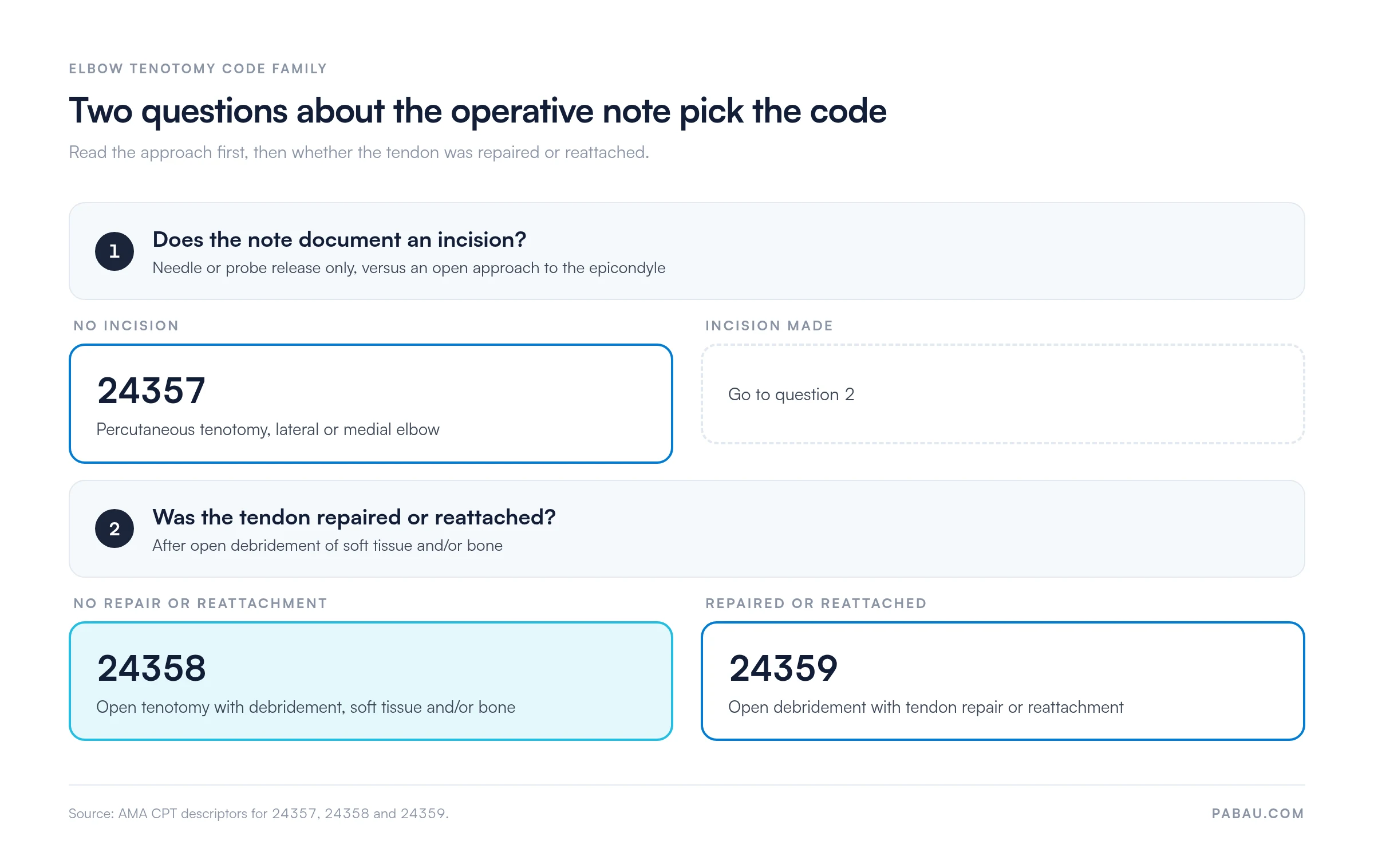
The 24357-24359 code family covers a spectrum of elbow tenotomy procedures. Picking the wrong code is a common audit finding because the procedures look alike but differ a lot in what the operative note must show.
The operative note is the deciding document, and two questions about it settle the code. A needle or probe inserted without an incision points to 24357. An incision with debridement of tendon tissue or bone and no tendon repair points to 24358. Once the surgeon repairs the tendon or reattaches it to bone, the code is 24359.
Every 24358 claim requires a diagnosis code that establishes medical necessity. The CMS ICD-10-CM tabular list specifies laterality at the 5th character for epicondylitis codes. So coders must select the site-specific code, not the unspecified default.
The diagnosis code’s laterality must match the CPT modifier (RT or LT). For example, a claim with M77.11 (right) and modifier LT is a clear mismatch that payers will deny automatically. Also, document the operative site in the preoperative note, the consent form, and the operative report.
CPT 24358 requires a laterality modifier on virtually every commercial and Medicare claim. As a result, filing without one is the single most avoidable denial cause in this code family.
When billing modifier 59, confirm the NCCI edit pairing before filing. However, incorrect use of 59 to override a valid bundle is an audit red flag and can trigger False Claims Act scrutiny.
Reimbursement for CPT code 24358 varies by location. The place of service doesn’t change it, because CMS lists the same practice expense RVU in every setting. The CMS Physician Fee Schedule lookup tool provides the national payment rates. So check current figures there before quoting reimbursement to a patient or payer.
The table below reflects the 2026 Medicare Physician Fee Schedule national values for CPT 24358. Next, each RVU component is adjusted by the geographic practice cost index (GPCI) for the practice location, then multiplied by the 2026 conversion factor. Finally, use the FastRVU lookup tool to work out the payment for your ZIP code.
The work RVU for 24358 is 6.49 in both settings. CMS also lists the same practice expense RVU of 7.20 for facility and non-facility claims, so the setting doesn’t change the physician fee. Values change with each annual fee schedule rule, so check the CMS lookup before quoting a dollar amount.
Before filing a 24358 claim, run eligibility and prior auth verification on the date of service, not the date of scheduling. Benefit structures change mid-year, and a pre-auth obtained 60 days before surgery may no longer reflect the patient’s current coverage.
CPT 24358 carries a 90-day global surgery package. As a result, routine postoperative care related to the surgery is bundled into the single surgical fee for 90 calendar days after the procedure date.
Billing a routine follow-up visit without a modifier inside the 90-day window creates an overpayment that payers will recover on audit. So, train billing staff to flag all visits for patients who had 24358 in the prior 90 days.
Most commercial payers and many Medicare Advantage plans require prior authorization before approving CPT 24358. Because authorization criteria are set by each payer’s LCD or medical policy and vary by MAC jurisdiction, there is no universal standard. So, medical billing compliance programs at orthopedic practices should build prior auth workflows into the scheduling process, not the pre-billing process.
Payers often ask for these records before they approve the surgery:
If authorization is denied, request the payer’s LCD or clinical criteria document. Then compare the patient’s chart against it line by line before filing an appeal. Moreover, an appeal that answers each criterion with a direct chart citation is far more persuasive than a generic letter.
Submitting a clean claim for CPT 24358 depends on whether the operative note supports both the code choice and the medical need. Auditors reviewing 24358 claims focus on two documents: the operative report and the pre-operative chart.
Pabau’s claims management software pre-fills each claim from the patient record, where the authorization details and clinical notes already sit. As a result, it cuts the back-and-forth that drives denials on surgical codes.
CPT 24358 claims face a predictable set of denial triggers. However, most are avoidable at the pre-billing stage with the right workflow controls. Denial management workflows for surgical codes should tackle each of these root causes before the claim leaves the practice. When a denial does come back, the denial codes on the remittance tell you which cause applies.
CPT 24358 is almost always done in a facility setting, either a hospital outpatient department (HOPD) or an ambulatory surgery center (ASC). Reporting the wrong place of service is a place-of-service error, not a switch to a different RVU. In addition, CMS lists the same practice expense RVU of 7.20 in every setting for this code.
Submitting POS 11 (office) for a procedure done in an ASC or HOPD is a place-of-service error. The physician fee for 24358 is the same either way. However, the claim misstates where the surgery happened and won’t match the facility’s own claim. The AAPC CPT code reference lists 24358 as a major surgical procedure that needs facility-level equipment and sterile technique. So, physician office billing is not appropriate. Finally, use electronic remittance advice processing to check that each payment posted matches the expected fee schedule amount.
Audit your POS codes quarterly for all CPT codes in the 24000 range. Where a code pays differently by setting, a systematic POS error builds into an overpayment that payers recover during routine claims audits.
Most 24358 denials trace back to records kept apart from the claim: the authorization number, the therapy timeline, and the operative note. For this reason, Pabau keeps those records on the patient file, next to the claim.
Next, claims go out through the Claim.MD clearinghouse, with an eligibility check you can run on the date of service. Finally, electronic remittance advice posts back against each claim, so a short-paid line stands out before it ages.

Pabau connects to Claim.MD to submit CPT 24358 claims electronically, check eligibility in real time, and process electronic remittance advice without manual rework. See how orthopedic and sports medicine practices use Pabau to reduce claim denials.

Once the operative note shows an open debridement with no tendon repair, choosing CPT code 24358 is the easy part. However, denials come from what surrounds it. Watch for a missing RT or LT modifier, an authorization that lapsed before surgery, or a follow-up visit billed inside the 90-day window.
So put those checks into scheduling rather than the denial queue. Confirm the conservative-care timeline and the authorization before the surgery is booked, then flag the patient for the next 90 days. In addition, Pabau’s medical billing workflows keep those checks on one patient record. Book a demo to see how Pabau keeps surgical claims clean from authorization to remittance.

Need to understand how claims move from submission to payment? Medical claims clearinghouse overview explains the role of clearinghouses in electronic claim submission and ERA processing.
Tracking down specific denial reason codes on a 24358 rejection? Denial codes in medical billing covers CARC and RARC codes with corrective action guidance.
Want to check eligibility before the surgery date? Insurance eligibility verification walks through real-time eligibility checks and how to read benefit responses for surgical codes.
CPT code 24358 covers an open tenotomy of the lateral or medial elbow with debridement of soft tissue and/or bone, most often for epicondylitis. First, the surgeon makes an incision, releases the tendon origin, and removes degenerated tissue without repairing or reattaching the tendon. Debridement is the defining service of the code, so it is not reported separately.
For lateral epicondylitis, use M77.11 (right elbow) or M77.12 (left elbow). Similarly, for medial epicondylitis, use M77.01 (right elbow) or M77.02 (left elbow). Avoid unspecified codes M77.10 and M77.00 on surgical claims, because payers flag them and often deny the claim.
Yes, bilateral billing is possible using modifier 50, but it is uncommon in practice because simultaneous bilateral epicondylitis surgery is rare. Payer rules for modifier 50 vary, and some require two claim lines with modifiers RT and LT instead. So, check the specific payer’s bilateral billing policy before filing.
The most common denial reasons are a missing RT or LT modifier, no prior authorization, and thin documentation of failed conservative treatment. In addition, unspecified laterality codes (M77.10 or M77.00) and a separate debridement code reported alongside 24358 are the other two. As a result, a pre-billing checklist covering all five areas prevents most avoidable denials.