CPT code 27506: Open femoral shaft fracture repair
CPT code 27506: Official descriptor and clinical overview CPT code 27506 reports...

Last Updated: Nov 2, 2026
24359 is the CPT code for open elbow tenotomy, lateral or medial, with soft tissue and/or bone debridement and tendon repair or reattachment. Surgeons report it for tennis elbow or golfer's elbow once conservative care has failed.
The code belongs to a three-code family. 24357 covers percutaneous tenotomy, and 24358 covers open debridement without repair. 24359 applies only when the operative note documents the tendon repair or reattachment, so that detail decides the code.
Let Pabau's smart automation suggest the right codes, reduce claim denials, and keep your practice compliant—effortlessly.
Automate repetitive tasks and focus on what matters most—your patients.
Reduce coding errors and ensure compliance with the latest regulations.
Clean claims, fewer denials, and faster reimbursements.
Powerful insights and reporting to help your practice thrive.
HIPAA compliant SOC 2 certified GDPR-compliant Trusted by 4,000+ clinics worldwide

CPT code 24359 covers open elbow tenotomy with soft tissue and/or bone debridement plus tendon repair or reattachment. Use 24358 for open debridement without repair and 24357 for percutaneous tenotomy.
The primary diagnosis codes are M77.11 (right) and M77.12 (left) for lateral epicondylitis, and M77.01 (right) and M77.02 (left) for medial epicondylitis. Unspecified laterality (M77.10) is a common denial trigger.
The CMS global period for CPT 24359 is 90 days. Routine post-op visits billed separately in that window without the correct modifier are rejected.
Pabau’s claims management software scrubs each claim for missing or invalid details before it goes out through Claim.MD. That cuts rework on surgical codes like 24359.
CPT code 24359 describes an open tenotomy at the lateral or medial elbow, with soft tissue and/or bone debridement and tendon repair or reattachment.
It sits in the musculoskeletal part of the AMA CPT Surgery section. The code falls under repair, revision, and/or reconstruction procedures on the humerus and elbow (24300-24498).
Orthopedic practices, sports medicine practices, and ambulatory surgery centers bill it for tennis elbow or golfer’s elbow after documented failure of conservative care.
The procedure involves an open approach, debridement of degenerative tendon tissue and any diseased bone, repair or reattachment of the tendon origin, and closure. On the lateral side, that is the common extensor origin. On the medial side, it is the flexor-pronator origin.
For coders, knowing what the operative note must document separates a clean first-pass claim from a denial. Bone debridement is part of the descriptor, so it does not call for a separate code.
The American Medical Association (AMA) maintains the official CPT descriptor for 24359. It reads: Tenotomy, elbow, lateral or medial (eg, epicondylitis, tennis elbow, golfer’s elbow); debridement, soft tissue and/or bone, open with tendon repair or reattachment. Check it against the AMA CPT codebook for the billing year, because descriptors can change in annual updates.
The operative note supporting this code must document the following elements:
Missing any of these elements, especially laterality and the description of the tendon repair, is a direct path to a documentation-based denial. A note that describes open debridement without repair or reattachment supports 24358, not 24359.
The 24357-24359 family covers tenotomy for epicondylitis at the lateral or medial elbow. Each code reflects a different approach and extent of repair. The operative report decides which one applies.
The critical distinction is tendon repair or reattachment versus debridement only. Code 24357 is done percutaneously, with no open debridement or repair. Code 24358 is an open debridement that leaves the tendon origin unrepaired. Code 24359 requires the surgeon to repair or reattach the tendon after the open debridement.
An open note describing debridement only maps to 24358, and a percutaneous release maps to 24357. Two documented facts settle the choice, as the decision path below shows.
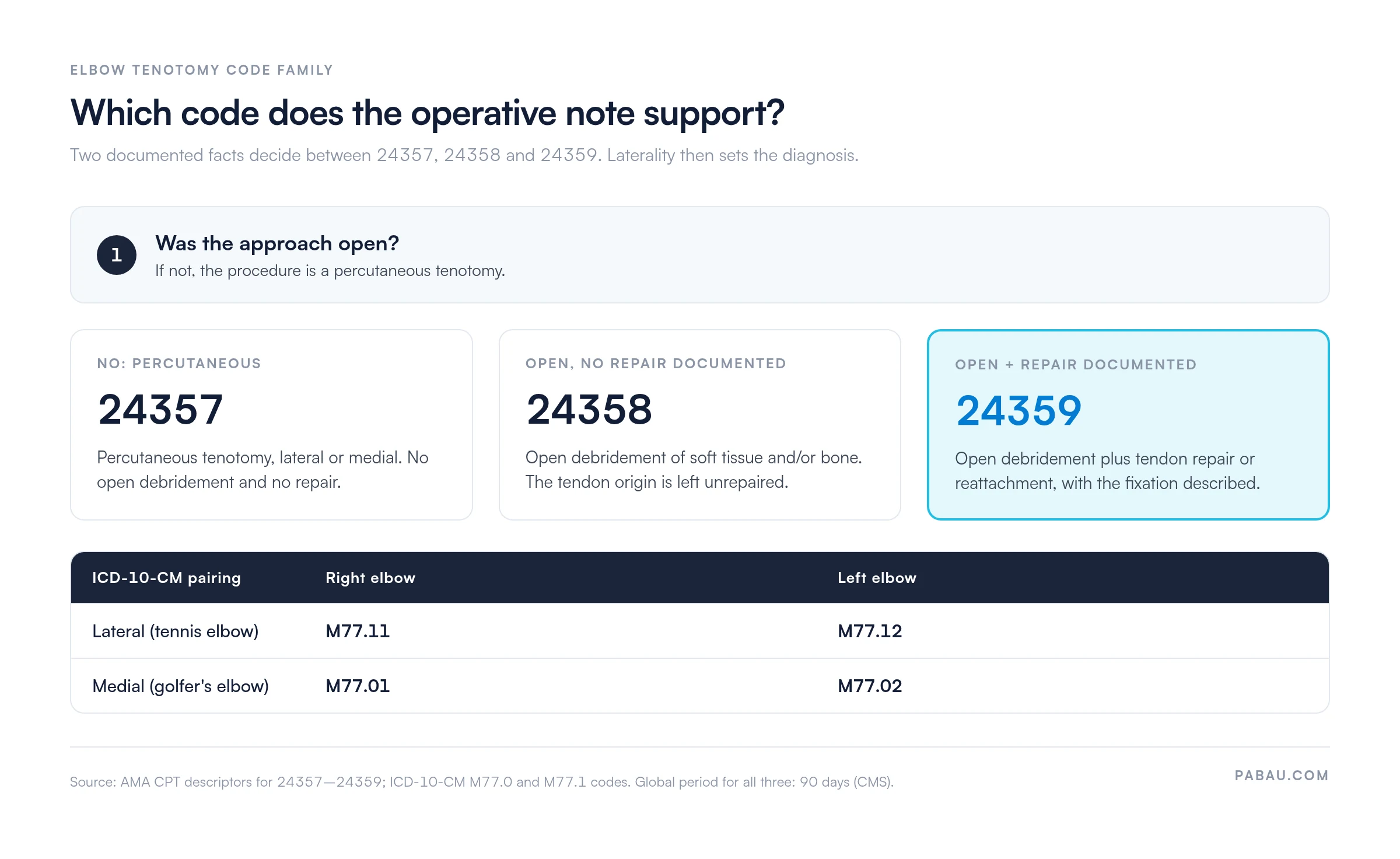
Payers require an ICD-10-CM diagnosis code that establishes medical necessity for CPT code 24359. Lateral repairs take the lateral epicondylitis codes under M77.1, and medial repairs take the medial epicondylitis codes under M77.0. Each one carries a laterality requirement.
Always use a lateralized code: M77.11 or M77.12 for lateral repairs, M77.01 or M77.02 for medial ones. Payers, including Medicare, can flag an unspecified code such as M77.10 on a surgical claim as a medical necessity concern.
The diagnosis code must also match the side documented in the operative report. A right-elbow ICD-10 code on a left-elbow operative note is a payer audit trigger.
Document conservative treatment failure in the pre-op assessment note before billing CPT code 24359. Most payers require at least 6-12 weeks of physical therapy, corticosteroid injections, or bracing documented in the chart before approving surgery for epicondylitis.
Medicare reimburses CPT code 24359 under the CMS Physician Fee Schedule (MPFS). Payment differs between facility (hospital outpatient, ASC) and non-facility (office) settings. It also varies by locality through the Geographic Practice Cost Index (GPCI). RVUs and the conversion factor change every year. Check the current amount in the CMS MPFS Look-Up Tool before you quote or post a rate.
The Look-Up Tool lists the work, practice expense, and malpractice RVUs for 24359, with facility and non-facility totals for your locality. It also shows the global period and the payment indicators for modifiers such as 50, 80 and 82. Commercial payers set their own rates by contract, so check each payer’s fee schedule separately.
Modifiers clarify the circumstances under which CPT code 24359 was performed. Selecting the wrong modifier, or omitting a required one, is a common source of claim rejections and audits. The table below lists the modifiers most relevant to 24359 billing.
Verify with each payer whether modifier 50 or separate line items with RT/LT are preferred for bilateral procedures. Medicare generally allows modifier 50 on musculoskeletal surgical codes, but commercial payers often have conflicting requirements. Check the payer’s billing guidelines before submission.
CPT code 24359 carries a 90-day global period under CMS, confirmed in the CMS Global Surgery data file. The payment for 24359 bundles the pre-operative visit on the day before or day of surgery and the intraoperative service. It also covers all routine post-operative care for 90 calendar days.
A common error with global packages is billing evaluation and management (E&M) codes for routine post-op visits inside the window. Under standard medical billing rules, those visits are already paid as part of 24359. Billed separately without a modifier, they are denied.
What is bundled into the global package:
What remains separately billable during the global period:
Set up a global period tracker for every 24359 case at the time of charge entry. Flag the 90-day end date in your practice management system. The billing team then knows when post-op E&M visits can be billed without a modifier. Missing this step is a common source of avoidable denials for elbow surgical codes.
Most commercial payers and Medicare Advantage plans require prior authorization before approving CPT code 24359. Medicare fee-for-service generally does not require PA for this code, but check current CMS requirements. Medicare still reviews medical necessity when the claim is adjudicated. Regardless of payer type, maintaining strong documentation of the conservative treatment pathway protects reimbursement.
Step-therapy protocols for epicondylitis surgery vary by payer, so check each one as part of your medical billing compliance routine. Most ask for the following before authorizing surgery:
When PA is required, submit the operative plan with the lateralized ICD-10-CM code and the CPT code (24359) together. A mismatch between the authorized code and the billed code is a straightforward denial that requires an appeal rather than a simple resubmission.
A clean claim submission for CPT code 24359 requires the operative report to address each of the following elements. Coders should review the note before charge entry, not after a denial is received.
An auditor will code a note as 24358 when it documents open debridement without describing repair or reattachment of the tendon origin. That holds whatever the surgeon intended. A percutaneous release supports only 24357, so precise operative language decides which code is defensible.
Denials for CPT code 24359 cluster around a predictable set of errors. Catching them before submission costs far less than working appeals after the fact. In orthopedic practices, denial management starts with front-end edits at charge capture.
Static code lookup tools identify what 24359 means. Orthopedic and sports medicine practices need a system that applies that knowledge before a claim leaves the building. Laterality mismatches, missing modifiers, and missed global periods cost far less to catch at charge entry than to appeal.
Pabau’s claims management software scrubs every claim for missing or invalid details before it leaves Pabau. For a code like 24359, a clean claim often turns on two checks. The ICD-10 laterality has to match the operative side, and the modifier has to be populated.
A rejected claim is marked “Needs action,” so your billing team can fix and resubmit it from one place. For the wider picture, see how revenue cycle management ties claims, payments, and denials together.
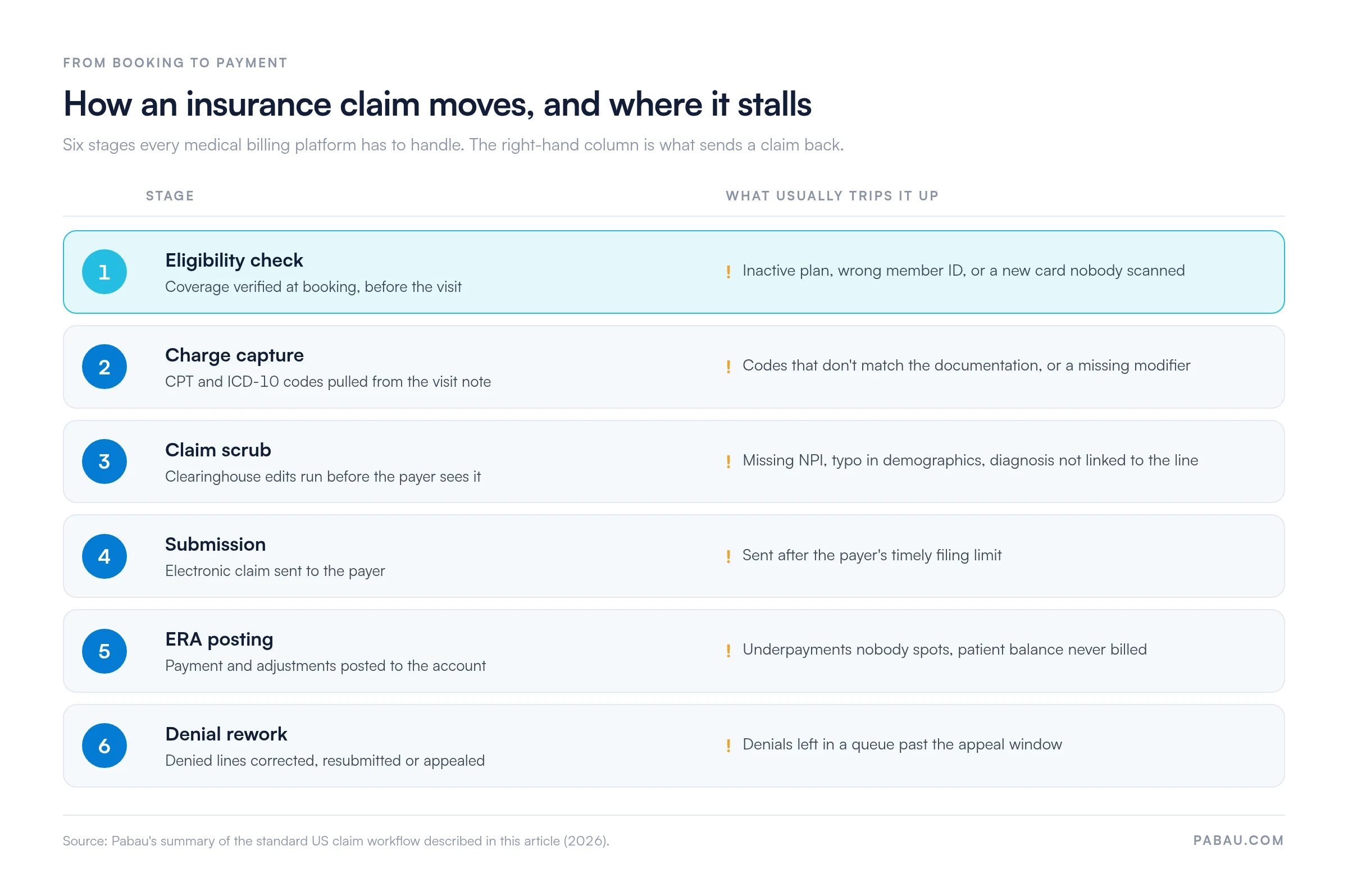
For Medicare and commercial payers, Pabau sends CMS-1500 claims through its Claim.MD integration and checks eligibility before the visit. Payments post straight from ERA files, so your team skips manual reconciliation across separate systems. When a payer does deny a 24359 claim, the remittance carries a reason code. Our guide to medical billing denial codes explains what each one means.

Pabau scrubs each claim for missing or invalid details before it leaves, then submits it through our Claim.MD integration. Your team spends less time on rework and more time on care.

Clean billing for CPT code 24359 starts with the operative note. When the surgeon describes the tendon repair or reattachment and names the side, the code, diagnosis and modifiers follow from it. When the note leaves the repair out, an auditor reads it as 24358, and no claim edit can change that.
So the change worth making is upstream. Agree a short operative-note checklist with your surgeons, then let charge capture check laterality and modifiers before each claim goes out. Book a demo to see how Pabau catches those errors on elbow surgical claims before they reach the payer.

Want to understand how clearinghouse integration reduces surgical claim errors? Claim.MD clearinghouse guide covers how 837P submission and ERA matching work in practice.
Need to understand what makes a claim clean before it reaches the payer? Insurance eligibility verification explains how real-time checks prevent downstream denials on surgical cases.
Looking for context on how the 837 file format supports elbow surgical billing? 837 claim file guide walks through the EDI transaction structure used for outpatient procedure billing.
CPT code 24359 covers an open tenotomy at the lateral or medial elbow, with soft tissue and/or bone debridement and tendon repair or reattachment. It is used for tennis elbow or golfer’s elbow after conservative care has failed. The tendon repair separates it from 24358 (open debridement only) and 24357 (percutaneous tenotomy).
CPT 24358 covers open debridement of soft tissue and/or bone at the elbow tendon origin, with no tendon repair. CPT 24359 covers the same open debridement plus repair or reattachment of the tendon. The operative note must describe that repair to support 24359. A note describing open debridement only maps to 24358, and a percutaneous release maps to 24357.
Medicare pays CPT 24359 under the Physician Fee Schedule, at different rates for facility and non-facility settings. The amount depends on that year’s RVUs, the conversion factor, and your locality’s GPCI. Look up the current rate in the CMS Physician Fee Schedule Look-Up Tool before you quote or post a payment.
The global period for CPT code 24359 is 90 days. All routine post-operative care within that window is bundled into the 24359 payment and cannot be billed separately. To bill an E&M visit during the global period for a new or unrelated condition, append modifier 24 to the E&M code. A staged related procedure requires modifier 58, and an unrelated surgical procedure requires modifier 79.
The primary ICD-10-CM codes are M77.11 (lateral epicondylitis, right elbow) and M77.12 (lateral epicondylitis, left elbow). Use M77.01 or M77.02 for medial epicondylitis repairs. Avoid M77.10 (unspecified) on surgical claims, as most payers require laterality specificity to establish medical necessity. The ICD-10 laterality must match the operative side documented in the surgical note.
A frequent denial cause is a code that does not match the operative note. Examples are 24358 billed for a repair, or 24359 billed without one. Others include M77.10 (unspecified laterality) in place of a lateralized ICD-10 code, and missing prior authorization. Thin documentation of failed conservative care also triggers denials. So does billing 24359 with 24357 or 24358 for the same elbow on the same date, which NCCI edits bundle.
RT and LT are used for laterality and are required by most payers. Modifier 50 applies for bilateral procedures performed in the same session. Modifier 51 is appended to secondary procedures when 24359 is billed with another surgical code in the same operative encounter. Modifiers 58 and 79 apply during the global period for related staged and unrelated procedures respectively.