



CCSD code G5100: Bypass of duodenum billing guide
CCSD code G5100 bills a bypass that leaves the duodenum in place CCSD code G5100...

Last Updated: Oct 16, 2026

CPT code 24152 covers radical resection of a tumor of the radial head or neck. It is a radius procedure, not a humerus one.
The code is filed under Excision Procedures on the Humerus (Upper Arm) and Elbow, a subsection that spans the whole elbow region.
Report 24150 for a shaft or distal humerus tumor, and 25170 for a tumor further down the radius or ulna.
CPT 24153 was deleted effective January 1, 2010. It once covered the autograft version of 24152 and is no longer billable.
The code carries a 90-day global surgical period, so most routine post-operative care is bundled into the base payment.
Practice management software like Pabau validates modifiers and reconciles ERAs through its Claim.MD integration, which keeps complex surgical claims moving.
CPT code 24152 describes radical resection of a tumor of the radial head or neck. Per the American Medical Association’s CPT code set, the official descriptor reads: Radical resection of tumor, radial head or neck. The bone involved is the proximal radius, at the elbow end of the forearm.
That surprises a lot of coders, because 24152 is filed under the CPT subsection headed Excision Procedures on the Humerus (Upper Arm) and Elbow. The subsection covers the whole elbow region, including the proximal radius and the olecranon. The heading names the humerus, but the individual descriptor is what governs code selection.
When the operative note describes a tendon rather than a tumor, the code moves to the repair subsection. Open reinsertion of a ruptured biceps or triceps tendon at its distal attachment is reported under CPT 24342.
Radical resection means en bloc removal of the bone tumor along with a cuff of normal surrounding soft tissue. That wide margin is what separates 24152 from curettage and from lesser excision codes on the same bone, such as 24120 and 24145.
The surgeon exposes the proximal radius, then removes the radial head or neck. A margin of healthy bone and soft tissue comes out around the tumor. The goal is margin control rather than clearance of the visible lesion alone. Reconstruction, prosthetic replacement, or graft placement is reported separately when performed.
Orthopedic oncology surgeons use the code most often. Typical indications include a primary bone sarcoma of the proximal radius or an aggressive benign lesion such as a giant cell tumor. A metastatic deposit that has destroyed the radial head also qualifies. A code this specific fails on small documentation details, which is where medical billing fundamentals earn their keep.
Reimbursement for CPT code 24152 varies by geographic location, payer, and facility type. Medicare payment is calculated using the Medicare Physician Fee Schedule (MPFS) and adjusted by the Geographic Practice Cost Index (GPCI) for each MAC region. Use the CMS Physician Fee Schedule lookup tool to retrieve current rates for your locality.
CPT code 24152 is billed under two rate categories, depending on where the procedure is performed. Facility rates apply in a hospital or an ambulatory surgical center (ASC). Non-facility rates apply in a physician office, though radical resection of the radial head is almost always done in a facility.
Verify the current year’s fee schedule amounts with CMS before quoting expected reimbursement. Rates change annually with each MPFS update.
RVUs determine how Medicare calculates payment. CPT code 24152 carries three RVU components. Work RVU covers physician effort and skill, practice expense RVU covers staff and supplies, and malpractice RVU covers professional liability. The CMS lookup tool above returns the current values for the code by locality.
CMS publishes the conversion factor each year in the MPFS final rule. Payment equals total RVU multiplied by the conversion factor, with GPCI adjustments applied. Radical resection codes such as 24152 carry substantial work RVUs, given the operative time and the margin planning involved.
Check your MAC’s local fee schedule rather than the national average. GPCI adjustments can shift payment by 15-20% between high-cost urban areas and rural localities. Submit the claim with the correct place-of-service code, 21 for inpatient and 24 for an ASC, so the right rate is applied.
Modifier selection for CPT code 24152 affects both reimbursement accuracy and audit risk. Each modifier needs documentation behind it. Applying one without matching operative note language is a top denial trigger for high-complexity surgical codes.
Check modifier -51 exempt status for CPT 24152 against current AMA CPT guidance and your payer’s own policy. Some payers apply their own rules independently of the AMA modifier -51 exempt list.
CPT code 24152 carries a 90-day global surgical period. Medicare and most commercial payers bundle routine post-operative care into the code’s base payment for 90 days after surgery. Billing an included service separately inside that window triggers an automated denial.
Modifier -24 covers an unrelated E/M during the post-operative period, and modifier -79 covers an unrelated procedure. Both need documentation showing the service is genuinely separate from the resection.
Every surgical claim for CPT code 24152 needs at least one ICD-10-CM diagnosis code that supports medical necessity. Because the radius is a long bone of the upper limb, the relevant neoplasm codes sit in the C40.0- and D16.0- families. Payers use the linked diagnosis to decide coverage, so specificity matters.
Laterality matters, and the convention is easy to check. Right-side codes in these families end in 1, and left-side codes end in 2. A claim that carries an unspecified laterality code when the operative report names the side is often flagged or denied.
Note that C40.1- covers short bones of the upper limb, meaning the carpals, metacarpals, and phalanges. It does not describe the radius, so it should not appear on a 24152 claim.
The National Correct Coding Initiative (NCCI) sets out which procedure codes cannot be billed together without documentation of a distinct service. For CPT code 24152, the usual Column 2 candidates are lesser procedures on the same bone, plus biopsies taken through the same approach.
NCCI tables update quarterly. The pairs below reflect common bundling patterns for major excision codes around the elbow. Verify the current tables in the CMS NCCI Policy Manual before you bill. Reading up on denial codes in medical billing helps when a bundling denial does land.
When modifier -59 unbundles an NCCI pair, the operative note must describe the separate anatomical location or the independent clinical reason for the second service. Applying -59 without that language is a compliance risk.
CPT code 24152 sits in a tight group of excision codes. They differ by which bone was cut, and by how much of it came out. Getting either one wrong sends the claim to the wrong code family.
Two questions settle the choice. Answer the bone first, then the extent. The sibling page on CPT code 24115 walks through the same decision on the humerus side of the family.
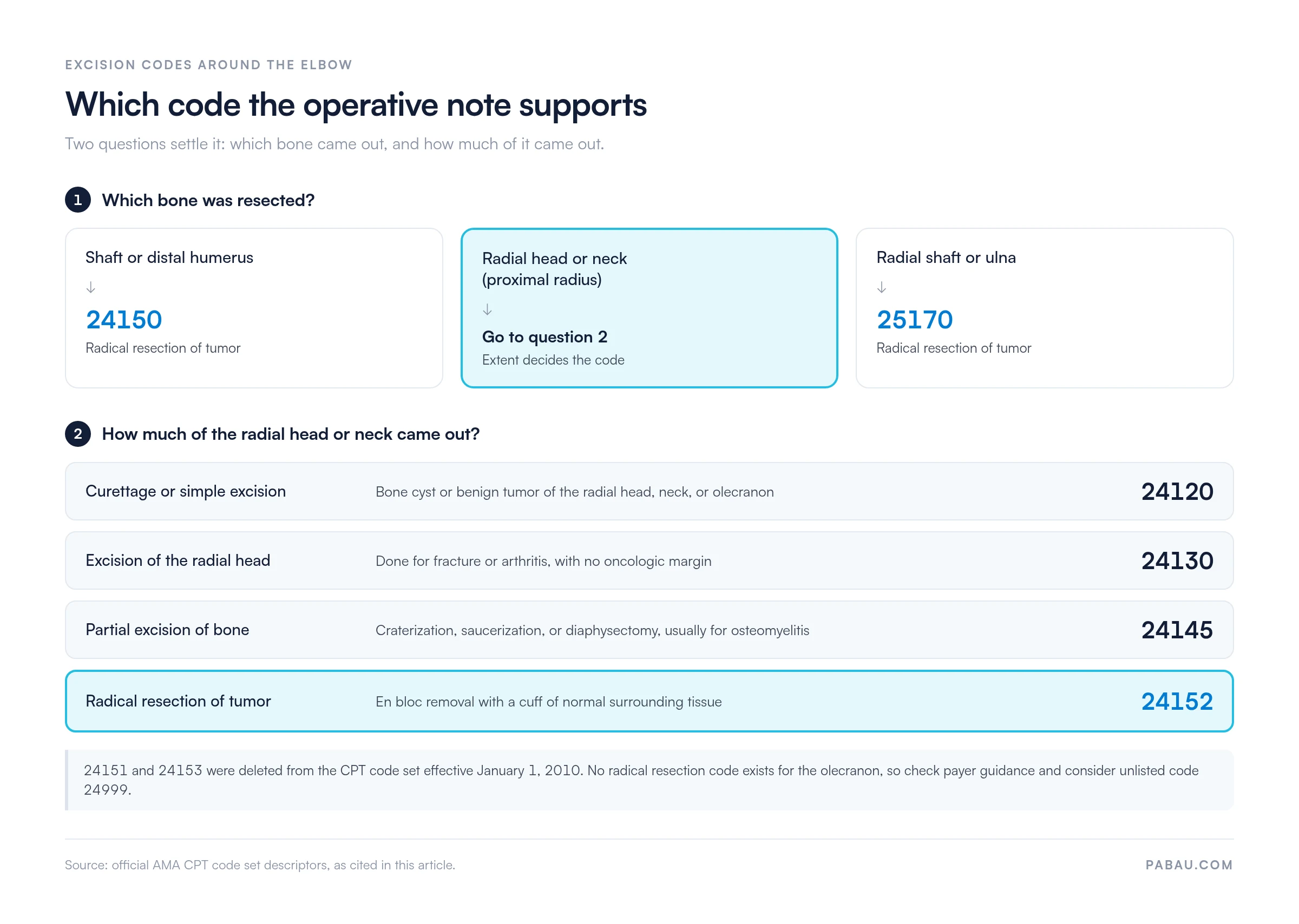
Two of these deserve a second look. CPT 24151 was deleted alongside 24153 on January 1, 2010, when the autograft variants across this family were retired. Neither code should appear on a claim today.
There is also no radical resection code specific to the olecranon process. The family offers 24147 for partial excision of the olecranon, but no code at radical extent. When a surgeon radically resects an olecranon tumor, check payer guidance and consider the unlisted procedure code 24999 with a full operative note.
Denials for CPT code 24152 cluster around a small set of recurring documentation failures. A pre-submission checklist built for radical resection codes prevents most of them.
Build a pre-submission checklist for radical resection codes. Confirm the note names the radial head or neck, and that it describes a wide margin. Match laterality across the note and the ICD-10 code. Attach the pathology report, and justify any -22 or -59. Running this before submission catches most preventable denials.
In a typical practice, the operative note lives in one system and the claim is keyed into another. The coder reads the note, picks 24152, then retypes the diagnosis, the laterality, and the modifiers. Each retype is a chance for the side to flip or a modifier to go missing.
Pabau is practice management software that keeps the clinical record and the claim in one place. The note, the diagnosis code, and the procedure code stay attached to one patient record. The coder works from the source rather than a copy.
From there, Pabau’s claims management software handles the submission side. Claims go out as 837P files through the Claim.MD integration, eligibility is checked before the visit, and ERAs post back against the original claim. That means fewer keying errors on high-value surgical codes, and a shorter path from surgery to payment.

Pabau’s claims management tools handle modifier validation, 837P submission via Claim.MD, and ERA reconciliation for complex orthopedic surgical codes. See how practices cut claim errors and get paid sooner.

CPT code 24152 is a radius code that lives under a humerus heading, and that single fact drives most of the miscoding around it. Read the descriptor, not the subsection title. Confirm the operative note names the radial head or neck, and that it describes a wide en bloc margin. Then match laterality across the note, the ICD-10 code, and the modifier.
Get those three right and the claim usually clears on the first pass. For practices handling high-complexity orthopedic billing, keeping the note and the claim in one platform removes the retyping that causes the rest. See how Pabau handles this by visiting book a demo.

Need a framework for understanding medical billing compliance? Medical billing compliance guide covers documentation standards, audit risks, and payer policy alignment for surgical claims.
Want to understand how clearinghouse submissions work? 837 file submission guide explains the 837P electronic claim format used for physician billing, including surgical procedures.
Managing revenue cycle workflows across your practice? Revenue cycle management overview covers how billing, coding, submission, and reconciliation connect from service delivery to payment.
Chasing denials on orthopedic surgical claims? Denial management in healthcare sets out how to triage, appeal, and prevent the denials that surgical coding generates.
CPT code 24152 is a surgical procedure code for radical resection of a tumor of the radial head or neck. The bone involved is the proximal radius, not the humerus. It is filed under the CPT subsection headed Excision Procedures on the Humerus (Upper Arm) and Elbow. That subsection covers the whole elbow region. Orthopedic oncology surgeons report it when the tumor is removed en bloc with a cuff of normal tissue.
No. CPT 24152 describes radical resection of a tumor of the radial head or neck, which is part of the radius. The confusion comes from the subsection heading, Excision Procedures on the Humerus (Upper Arm) and Elbow. That heading spans the whole elbow region, not the humerus alone. The humerus code at the same extent of resection is 24150, covering the shaft or distal humerus.
The global period for CPT code 24152 is 90 days. Routine post-operative care related to the resection is bundled into the base payment for those 90 days. It cannot be billed separately without an applicable modifier, such as -24 for an unrelated E/M or -78 for a return to the operating room.
The most common are -22 for increased procedural services and -51 for multiple procedures in one session. Modifier -59 unbundles an NCCI pair when separate-site documentation supports it. Co-surgery uses -62 and an assistant surgeon uses -80. Many payers also want -RT or -LT on limb surgery, and it must agree with the operative report.
The radius is a long bone of the upper limb, so the relevant codes sit in the C40.0- and D16.0- families. Common pairings are C40.01 or C40.02 for a primary malignant bone neoplasm, and C79.51 for metastatic disease. Use D16.01 or D16.02 for an aggressive benign lesion, and D48.0 for a giant cell tumor or uncertain histology. Right-side codes end in 1 and left-side codes end in 2.
NCCI bundles bone biopsy codes such as 20220 and 20240 into CPT 24152 when they are performed in the same session through the same approach. Lesser excision codes on the same bone, including 24120, 24130, and 24145, are also considered part of the radical resection. Modifier -59 can unbundle a pair when the second service was done at a distinct site. NCCI tables update quarterly, so verify current pairs in the CMS NCCI Policy Manual.
CPT 24150 covers radical resection of a tumor of the shaft or distal humerus, and CPT 24152 covers the radial head or neck. CPT 24153 no longer exists. It was deleted from the CPT code set effective January 1, 2010, and formerly described the autograft version of 24152. Report 24152 and code any graft work separately.
Use CPT 25170, radical resection of tumor, radius or ulna. That code sits in the forearm and wrist excision family and applies once the tumor is below the radial head and neck. CPT 24152 is limited to the proximal radius at the elbow, so the operative note has to place the lesion for you.
CPT code 24152 carries substantial work RVUs, reflecting the operative time and margin planning a radical resection needs. Total RVU combines the work, practice expense, and malpractice components, adjusted by GPCI and multiplied by the CMS conversion factor. Use the CMS Physician Fee Schedule lookup for the exact figures in the current year and your locality.



