

CCSD code G5100: Bypass of duodenum billing guide
CCSD code G5100 bills a bypass that leaves the duodenum in place CCSD code G5100...

Last Updated: Oct 16, 2026
24342 is the CPT code for reinsertion of a ruptured biceps or triceps tendon, distal, with or without tendon graft.
It sits in the Repair, Revision, and/or Reconstruction subsection of the musculoskeletal CPT codes, which runs from 24300 to 24498. Three problems cause most denials on this code. Coders omit the laterality modifier, pick the wrong adjacent code, or submit without an operative report confirming complete rupture.
Let Pabau's smart automation suggest the right codes, reduce claim denials, and keep your practice compliant—effortlessly.
Automate repetitive tasks and focus on what matters most—your patients.
Reduce coding errors and ensure compliance with the latest regulations.
Clean claims, fewer denials, and faster reimbursements.
Powerful insights and reporting to help your practice thrive.
HIPAA compliant SOC 2 certified GDPR-compliant Trusted by 4,000+ clinics worldwide

CPT Code 24342 covers open reinsertion of a ruptured biceps or triceps tendon at the distal site, not proximal or arthroscopic repairs.
Tendon graft sits inside the descriptor, so the operative report documents it but the code stays the same.
Modifier LT or RT belongs on every claim, and missing laterality is the top denial reason for this code.
The code carries a 090-day global period, so routine follow-up in those 90 days is already paid for.
A charge template that locks laterality and the approved diagnosis codes to 24342 prevents most denials before submission.
CPT Code 24342 is the procedure code for reinsertion of a ruptured biceps or triceps tendon at its distal attachment, with or without tendon graft. It belongs to the Repair, Revision, and/or Reconstruction subsection of the musculoskeletal chapter, which runs from 24300 to 24498. The table below carries the billing identifiers coders need before a claim goes out.
CPT Code 24342 covers open reinsertion of a completely ruptured tendon at its distal attachment point. That means the biceps at the radial tuberosity, or the triceps at the olecranon. The code applies whether the surgeon bridges the repair with an autograft or an allograft. Tendon graft sits inside the descriptor, so it generates no separate procedure code.
Fixation method is bundled too. Cortical button fixation, bone tunnel technique, and suture anchor fixation all count as part of the reinsertion when the approach is open. Billing a separate fixation code alongside 24342 typically triggers a National Correct Coding Initiative (NCCI) edit.
The descriptor reads “biceps or triceps”, so both tendons fall under the same code. When the operative report documents a triceps reinsertion, 24342 is still correct. No triceps-specific CPT code exists for this distal procedure.
CPT Code 24342 does not cover proximal biceps repairs, arthroscopic approaches, or procedures where the tendon was never avulsed from its distal attachment. Reaching for 24342 when one of the codes below describes the surgery is a common upcoding risk for orthopedic billers.
The 24340 versus 24342 decision is the most audit-sensitive one in this code family. CPT 24340 describes tenodesis of the biceps tendon at the elbow and carries a separate procedure designation. 24342 applies only where the tendon has completely ruptured and is reinserted at its distal attachment. If the operative report documents a tenodesis rather than a reinsertion, 24342 is the wrong code.
Every 24342 claim that reaches a clean claim submission standard needs an operative report confirming four things. Those are complete tendon rupture, the distal insertion site, the fixation method used, and whether a graft was harvested or procured. A missing element hands a Recovery Audit Contractor a straightforward basis for recoupment.
The charge itself should carry the CPT code, the laterality modifier, and the primary ICD-10-CM diagnosis code on a single line. Entering them as separate items raises the risk of modifier-linkage errors at the clearinghouse.
Flag your operative report template for distal biceps repairs to include a checkbox for laterality and graft source before the note is finalized. A missing laterality notation creates a modifier problem downstream that the billing team cannot fix without an addendum.
CPT Code 24342 requires a laterality modifier on every claim. Medicare and most commercial payers use it to confirm which arm was operated on and to track bilateral billing. The table below covers the modifiers most often applied to this code and when each one fits.
Modifiers explain the circumstances around a procedure. They never change what the procedure was, so each one needs documentation in the record that supports it.
Medical necessity for CPT Code 24342 rests on the linked diagnosis code, which has to document a complete tendon rupture at the distal site. The ICD-10-CM code library lists the laterality-specific options coders choose between. Pairing a sprain or partial-tear code with an operative report describing complete avulsion creates a medical necessity mismatch, and the claim is denied.
Acute traumatic injuries use the S46-series codes with the 7th-character encounter qualifier, A for initial and D for subsequent. Spontaneous degenerative ruptures use the M66-series codes instead. The split matters because some payers apply different medical necessity criteria to acute and chronic presentations. The diagnosis should describe the patient’s condition at the time of surgery, not the mechanism from weeks earlier.
Reimbursement for CPT Code 24342 under the Medicare Physician Fee Schedule (MPFS) varies by locality and setting. The values below are national averages, and actual payment shifts with the Geographic Practice Cost Index (GPCI) for your MAC jurisdiction. Verify current rates with the CMS MPFS lookup tool before quoting a figure to a patient.
RVU values and dollar conversions change with every annual MPFS update. Confirm the current conversion factor and the GPCI-adjusted rate for your locality before you post an expected payment against the charge.
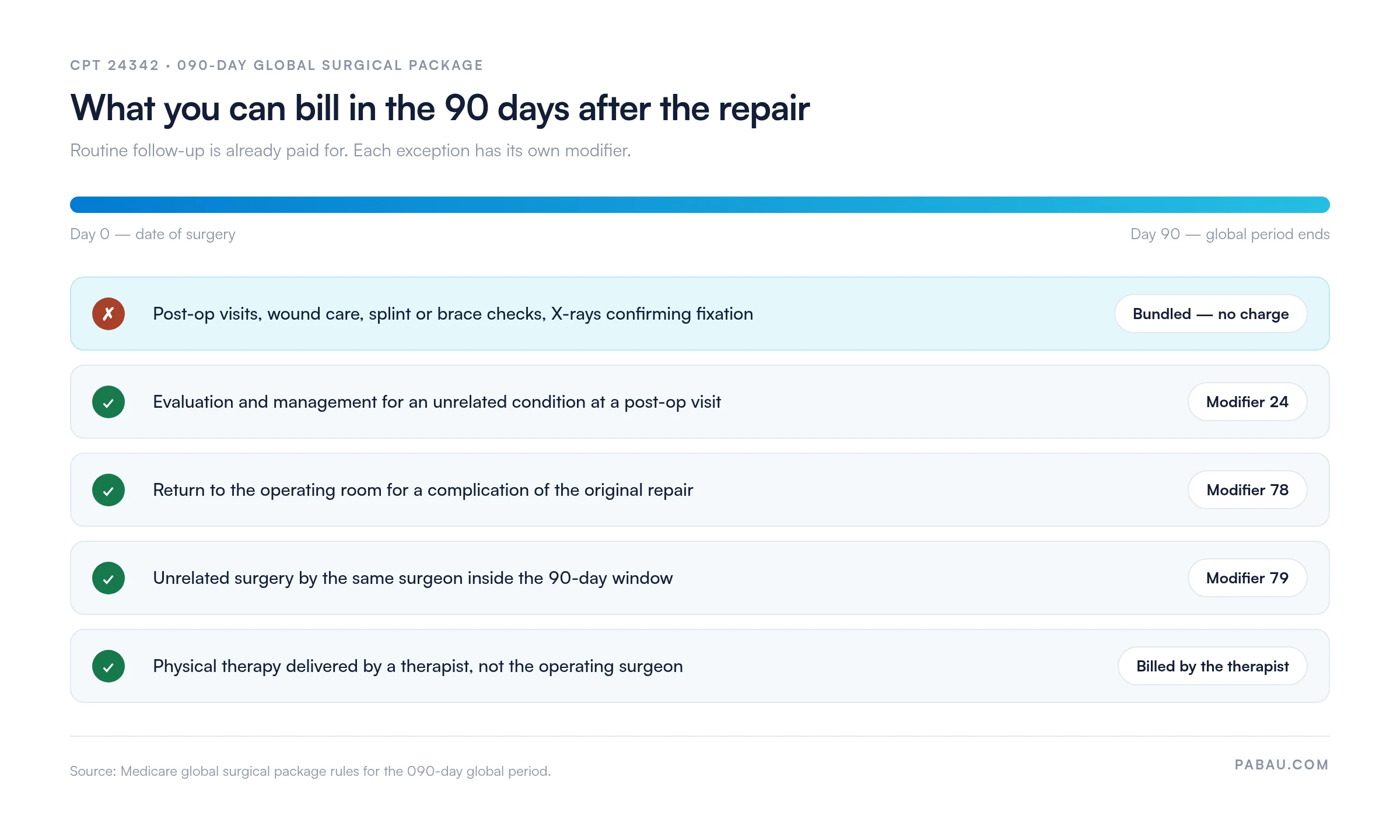
CPT Code 24342 carries a 090-day global surgical period. Routine post-operative care is bundled into the procedure payment for the 90 days following surgery. In that window the operating surgeon cannot separately bill office visits for wound checks, suture removal, or standard follow-up on the repair.
Physical therapy delivered by a therapist rather than the operating surgeon is billed separately as well. Each exception needs documentation showing it falls outside the original procedure, and the timeline below maps them across the 90 days.
Traditional Medicare fee-for-service does not require prior authorization for CPT Code 24342. Medicare Advantage plans and most commercial insurers do, and their requirements vary by plan. Verify them with each patient’s plan before the procedure is scheduled, not after.
Where authorization is required, the documentation package usually needs imaging that confirms complete tendon rupture, with the radiologist’s read attached. Add the surgeon’s notes on failed conservative management, where that applies to a non-acute presentation, plus the operative plan. Checking authorization rules at the eligibility step, before scheduling, is where these denials get prevented.
Claims for CPT Code 24342 are denied most often over preventable documentation and modifier errors. Each pattern below has a straightforward fix that belongs in the practice’s charge capture workflow rather than in the appeals queue.
Sorting denials by CARC code before working appeals shows which ones started at charge capture. A single coder chasing individual denials clears less than a charge template that stops the common errors leaving the practice at all.
Run a monthly audit of every 24342 claim submitted in the prior 60 days, filtered by denial CARC code. If modifier-related denials such as CARC 4, 16, or 97 appear more than once, fix the charge capture template rather than the appeal workflow.
Orthopedic and sports medicine practices that bill CPT Code 24342 regularly should configure their charge capture templates before the next claim is raised. The aim is to make the right modifier, the right diagnosis code, and the right fee schedule amount the default instead of the exception.
Practice management software like Pabau handles this configuration at the practice level. Its claims software for practices keeps CPT codes, diagnosis codes, and modifier rules on one charge capture screen. The values your team enters travel with the claim to submission, and the remittance advice comes back mapped to the original charge line. A standardized 24342 charge template then pays for itself in reduced denial rework.
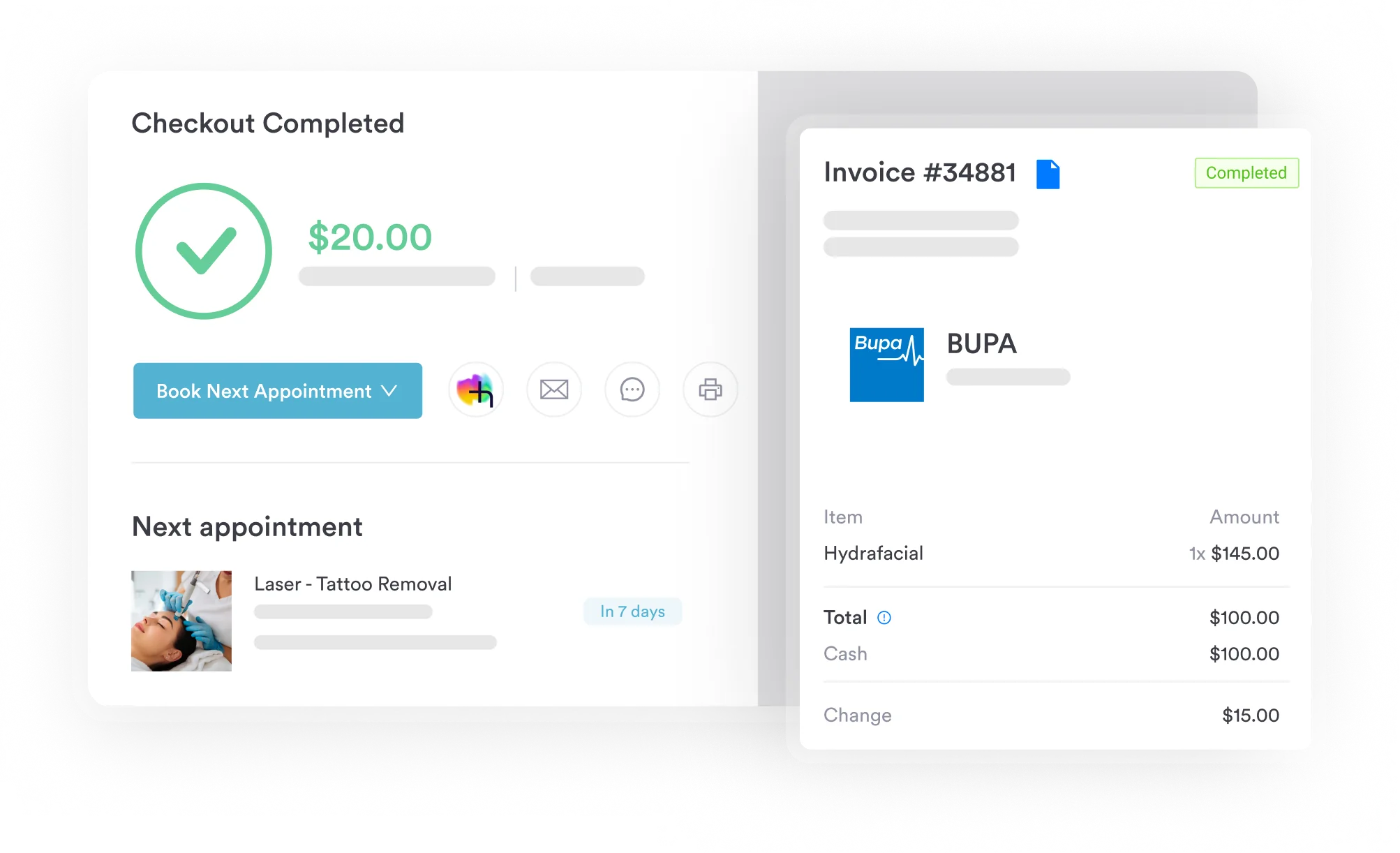

Pabau holds CPT codes, ICD-10 diagnoses, and modifier rules on one charge capture screen. Your team confirms the laterality modifier on a 24342 charge line before the claim is submitted.

CPT Code 24342 rewards precision in three places: the laterality modifier, the choice between 24340 and 24342, and the operative report that carries medical necessity. Practices that settle those at charge capture stop paying for them at appeal.
That work belongs upstream, in the charge template and the operative note. Book a demo to see how Pabau keeps modifiers and diagnosis codes attached to surgical charges before they reach the payer.

Need to understand how clearinghouse claim routing works? Medical claims clearinghouse overview explains how electronic claims reach payers and where edits fire.
Managing billing across multiple procedure types? What is medical billing covers the end-to-end workflow from charge capture to payment posting.
Want to check how claims reach your MAC jurisdiction? Claim.MD clearinghouse integration details how Pabau routes claims to US payers, regional MACs included.
CPT Code 24342 bills open reinsertion of a completely ruptured biceps or triceps tendon at its distal attachment, with or without tendon graft. It applies when the tendon has fully avulsed from the bone and must be surgically reattached using an open approach. The code covers the reinsertion and any graft augmentation within a single procedure code.
Traditional Medicare fee-for-service does not require prior authorization for CPT 24342. Medicare Advantage plans and most commercial insurers do require it, with requirements varying by plan. The authorization package usually includes MRI imaging confirming complete rupture, plus the surgeon’s clinical notes. Verify the requirements with each patient’s payer before the procedure is scheduled.
Yes. The official CPT descriptor explicitly covers “ruptured biceps or triceps tendon, distal”, so both tendons fall under the same code. There is no separate CPT code for distal triceps reinsertion. 24342 is correct for an open distal triceps repair, provided the tendon is completely ruptured.
Medicare reimbursement for CPT 24342 varies by geographic locality and setting. National average facility rates run about $850 to $1,100 for the surgeon’s fee, when the procedure is performed at an ASC or hospital. Non-facility rates are higher, at roughly $1,400 to $1,700. Verify current rates using the AAPC code lookup or the CMS MPFS search tool, as the conversion factor changes with each annual fee schedule update.



