HCPCS code P9058: Red blood cells, leukocytes reduced, CMV-negative, irradiated
HCPCS code P9058: Official descriptor and key attributes HCPCS code P9058 report...

Last Updated: Oct 26, 2026
23600 is the CPT code for closed treatment of a proximal humeral (surgical or anatomical neck) fracture without manipulation. It covers fracture care with a sling or immobilizer when the provider does not reduce the fracture, and it carries a 90-day global period.
Coders most often confuse it with CPT 23605, which adds a manipulation step. If the note doesn't document a reduction, billing 23605 risks a denial or audit. It is a routine code in orthopedic, urgent care and emergency medicine practices.
Let Pabau's smart automation suggest the right codes, reduce claim denials, and keep your practice compliant—effortlessly.
Automate repetitive tasks and focus on what matters most—your patients.
Reduce coding errors and ensure compliance with the latest regulations.
Clean claims, fewer denials, and faster reimbursements.
Powerful insights and reporting to help your practice thrive.
HIPAA compliant SOC 2 certified GDPR-compliant Trusted by 4,000+ clinics worldwide

CPT code 23600 covers closed, non-operative treatment of a proximal humeral fracture with no reduction or manipulation performed.
The code carries a 90-day global surgical period that bundles routine follow-up visits, cast changes, and related E/M services.
Use modifier 54 when the treating provider performs fracture care only. Use modifier 55 when a second provider takes over all postoperative management.
Practice software such as Pabau helps you submit and track 23600 claims through the Claim.MD clearinghouse, while code choice and modifiers stay with your coder.
CPT code 23600 reports closed treatment of a proximal humeral fracture at the surgical or anatomical neck, without manipulation of the bone fragments. The table below gives the data points coders check first.
Always verify current RVU values and reimbursement rates in the CMS Physician Fee Schedule lookup tool before quoting amounts to payers or contracting teams. Rates change each January 1.
CPT code 23600 covers non-operative (closed) treatment of a fracture at the proximal end of the humerus. It applies when the treating provider makes no attempt to reduce or reposition the bone fragments. Both the surgical neck and the anatomical neck of the proximal humerus fall within scope.
The code fits when the fracture is at the proximal humerus, the approach is non-surgical, and the provider’s note documents that no reduction was performed. A typical case is an older adult who falls on an outstretched hand and arrives at the ED with shoulder pain. Imaging shows a minimally displaced two-part surgical neck fracture with alignment acceptable for conservative management.
A practice manager reviewing ED superbills can use this checklist. If every item is met, 23600 is the right code.
Getting the exclusions right prevents the most common wrong-code denials. CPT code 23600 does not include any of the following, and each one maps to a different code.
Shoulder and humerus X-rays are reported on their own radiology codes, such as 73060 for a two-view humerus series.
The proximal humerus fracture code family is compact, but the selection criteria are precise. The first decision point is whether manipulation was performed. A documented reduction moves the claim to 23605, and an open repair moves it to 23615.
The anatomical site is the second selection fork. Codes 23600 and 23605 apply to the surgical or anatomical neck of the proximal humerus, while 23620 and 23625 apply to the greater tuberosity. Confirm the fracture site in the radiology report before coding.
Payers require an ICD-10-CM diagnosis code that precisely matches the anatomical site and encounter type documented in the record. For CPT code 23600, the codes come from the S42.2 subcategory, which covers fractures of the upper end of the humerus. Confirm each code against the CDC/NCHS ICD-10-CM web tool for the current year before submitting.
ICD-10-CM has no S42.2 code specific to an anatomical neck fracture, so confirm the closest code in the CDC tool before you submit.
Use suffix A for the initial encounter, when fracture care is first provided and 23600 is billed. Suffix D covers subsequent encounters for routine healing. Inside the 90-day global window those visits are bundled. After day 90 they bill normally, and suffix D still applies. Suffix S is only for sequela, a visit that addresses a late effect of the fracture.
Always document laterality. A claim with a code for the right humerus and an operative note that says “left shoulder” invites a denial.
CPT code 23600 carries a 90-day global surgical period under the Medicare Physician Fee Schedule. The global package begins the day before the procedure and runs through the 90th postoperative day.
Most bundling errors happen when a routine follow-up visit is billed separately without a modifier that justifies it. The timeline below shows which services are bundled at each stage, and which modifier or ICD-10 suffix applies.
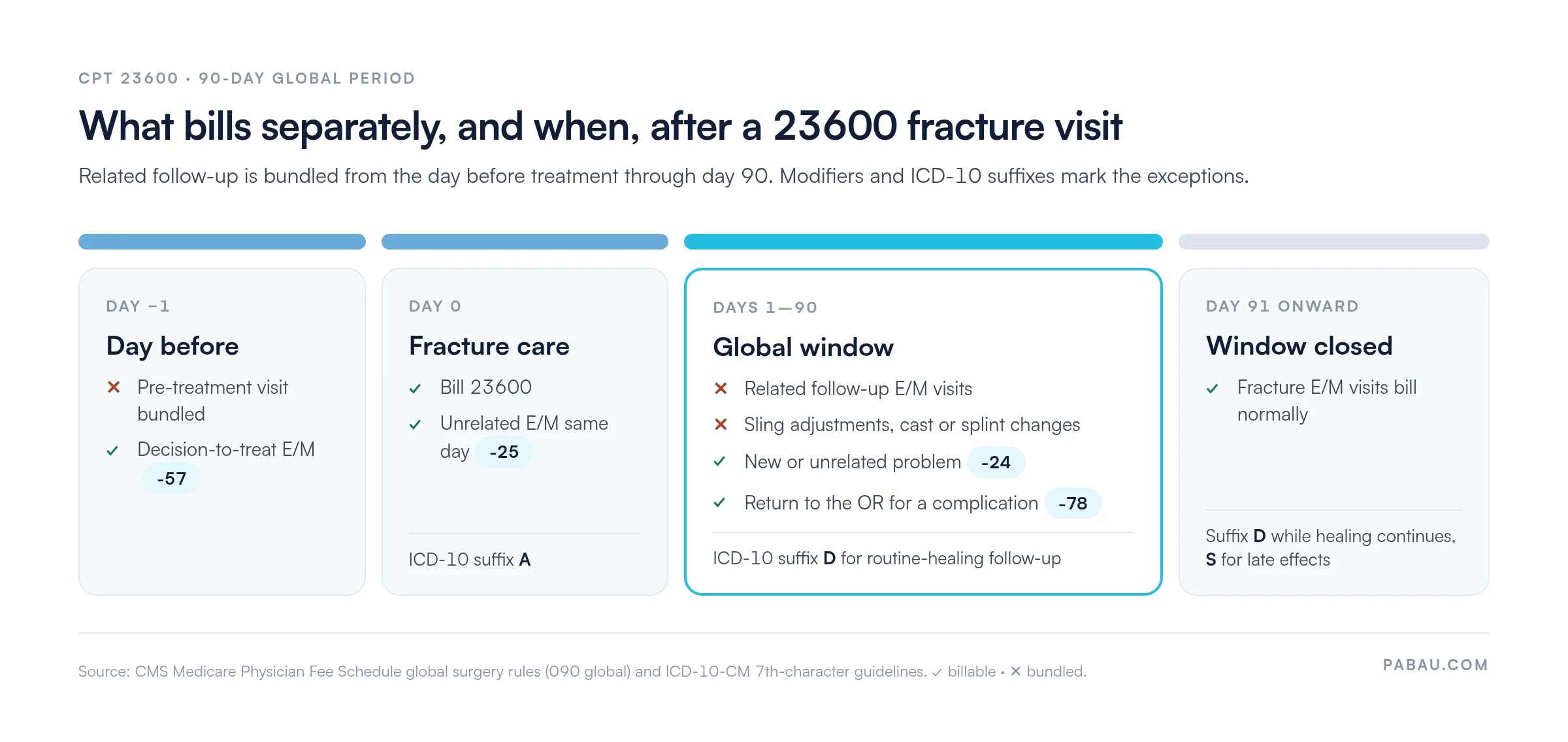
Log the global period end date on the day CPT 23600 is billed. Set a calendar reminder at day 85 so your team reviews any open E/M charges before the window closes. Catching a bundled visit before it hits the clearinghouse saves a denial and a corrected claim.
The correct modifier depends on who provides care and when. For CPT code 23600, four modifiers come up most often.
Modifier 54/55 split care is common when an ED physician starts fracture management and an orthopedic surgeon takes over follow-up. Under Medicare rules, the global fee for CPT 23600 is divided between the two providers by the share of the global package each one delivers.
CMS publishes the intraoperative and postoperative percentages for each code in the MPFS. They are updated annually, so check the current year’s figures in the fee schedule rather than relying on a fixed number.
A missing written transfer agreement is a frequent audit finding in split-care cases. A referral note alone isn’t enough. The record needs confirmation that the receiving provider accepted responsibility for postoperative management.
The 2026 Medicare Physician Fee Schedule gives CPT code 23600 a work RVU of 2.93 and a total non-facility RVU of 11.41. At the CY2026 conversion factor of $33.4009, that comes to about $381 nationally before GPCI adjustment. Verify current figures in the CMS MPFS search tool for your year and locality.
Commercial payer rates differ from Medicare and are governed by your individual contracts. The FastRVU lookup tool gives a quick cross-check of work RVU values and estimated reimbursement before contract negotiations. Geographic Practice Cost Indices (GPCIs) then adjust the final payment by location. That’s why a rural orthopedic practice in Mississippi receives a different amount than one in Manhattan for the same code.
Every CPT code 23600 claim needs a medical record that establishes medical necessity and confirms the procedure performed. A missing or vague note is one of the most common denial triggers for this code.
The phrase “without manipulation” needs to be explicit in the note. Payers running post-payment audits look for this language because 23605 reimburses at a higher rate and the upcode risk is well understood.
Claims for CPT code 23600 are denied for a predictable set of reasons. Each one adds a correction and resubmission cycle, so catching them before submission saves time. When a claim does come back, the payer’s claim denial codes tell you which of these triggered it.
A same-day E/M with CPT 23600 is billable only when it addresses a significant, separately identifiable problem unrelated to the fracture. Modifier 25 on the E/M code signals this to the payer. Without modifier 25, the E/M is bundled into the fracture care code under NCCI edits.
Document the separate problem clearly in its own section of the note. If the only reason for the E/M is the fracture evaluation leading to 23600, the E/M is not separately billable. Payer interpretation of “significant and separately identifiable” varies, so check individual LCD or payer policy before billing both codes routinely.
Before submitting CPT 23600 with a same-day E/M, confirm the E/M note documents a distinct problem with its own assessment and plan. A note that discusses only the fracture does not support a separate E/M charge, regardless of the modifier applied.
The denials above usually start with a mismatch between the note and the claim. Think of a missing “without manipulation” statement, the wrong laterality, or a follow-up visit billed inside the global window. Many practices still catch these by rereading the chart against the claim form before it goes out.
In Pabau, the clinical notes, forms, and uploaded documents for a fracture visit sit on the same patient record. The coder reviews the documentation in one place before billing. Its simpler claims management then helps you submit and track claims through the Claim.MD clearinghouse.
Code choice, modifiers, and the global-period calendar stay with your coder. What changes is that each claim’s status stays visible after submission, so a rejected 23600 claim gets corrected while the details are fresh. Our Claim.MD clearinghouse guide explains how that routing works.
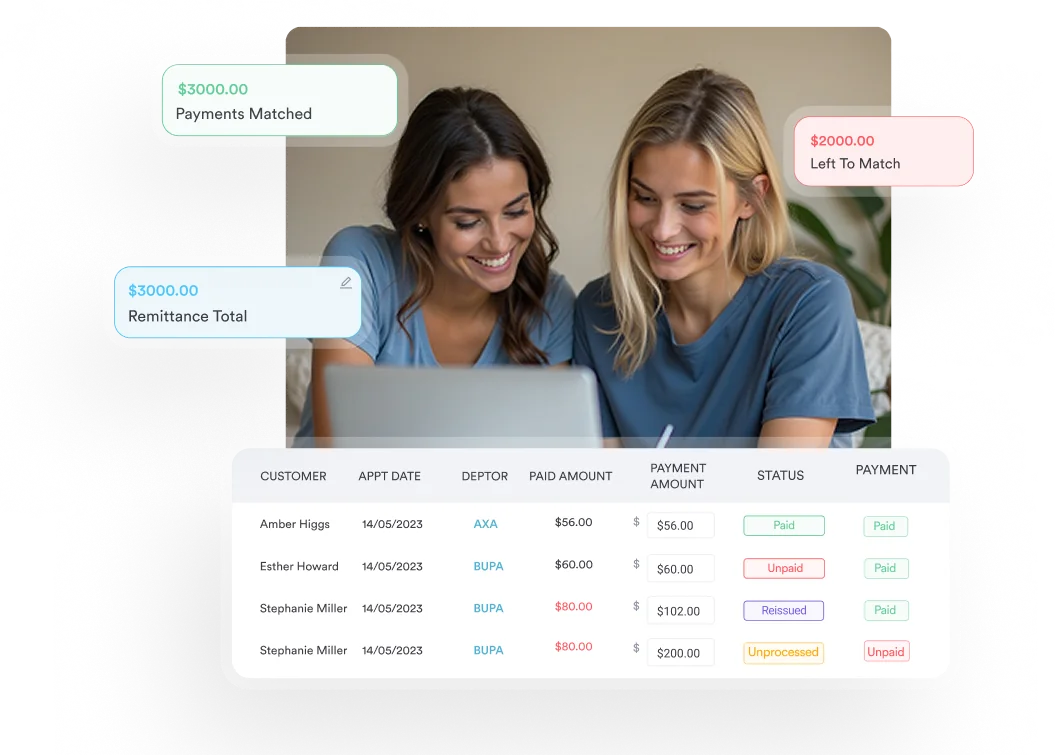

Pabau keeps fracture-care notes and documents on the patient record and helps you submit and track claims through the Claim.MD clearinghouse. Your billing team spends less time chasing claim status.

For CPT 23600, picking the code is rarely the hard part. The claim pays or denies on the note: the fracture site, the laterality, an explicit no-manipulation statement, and the right ICD-10 suffix.
So build those four elements into your ED or clinic note template instead of checking them claim by claim. The trade-off is a slightly longer note at the first visit, which costs far less than a 90-day bundle billed wrong.
Pabau helps you submit and track claims through the Claim.MD clearinghouse, with the supporting notes on the same patient record. Book a demo to see how it fits your fracture-care billing workflow.

Need to understand how claims reach payers? Medical claims clearinghouse overview explains how 837P files move from practice to payer and where edits are applied.
Want to reduce NCCI denial rates? Denial codes in medical billing covers CARC reason codes and how to address the most common adjudication rejections.
Capturing fracture care on ED superbills? Superbill template gives you a ready-made form for recording CPT and ICD-10 codes at the visit.
Does the payer need prior authorization? Prior authorization process walks through each step so fracture care isn’t denied for a missing approval.
Did the provider reduce the fracture? CPT code 23605 covers closed treatment with manipulation and its documentation rules.
CPT code 23600 covers closed, non-operative treatment of a proximal humeral fracture (surgical or anatomical neck) when no manipulation or reduction is performed. The fracture is managed with immobilization, typically a sling. The code includes the fracture care service and the 90-day global package of follow-up visits.
CPT 23605 is the correct code when the provider performs closed reduction with manipulation to reposition the bone fragments. CPT 23600 applies when the fracture is managed conservatively with no manipulation attempt. The operative note must explicitly state which approach was used. Billing 23605 when no manipulation was performed is an upcoding error.
CPT 23600 carries a 90-day global surgical period under CMS rules. The period begins the day before the procedure and runs through postoperative day 90. All related E/M visits, cast changes, and routine fracture follow-up during this window are bundled and not separately billable.
The initial treating provider bills 23600-54 (surgical care only). The second provider, who assumes postoperative management, bills 23600-55 starting on the date they accept care. Both claims reference the original date of service for the fracture treatment. A written transfer of care agreement must be documented in both providers’ records.