ICD-10 code S31.44XA: Vaginal and vulvar puncture wound with foreign body
ICD-10 code S31.44XA: Definition and billable status ICD-10 code S31.44XA is the...

Last Updated: Oct 12, 2026
Billable Code Specific Code
S42.002G is the billable ICD-10-CM code for fracture of unspecified part of left clavicle, subsequent encounter for fracture with delayed healing.
It belongs to the S42 shoulder and upper arm fracture category and applies at a follow-up visit after the initial injury encounter. The provider must document that the fracture is healing more slowly than expected. The two most common coding errors are using it on the wrong encounter type and confusing G with D (routine healing) or K (nonunion).
Let Pabau's smart automation suggest the right codes, reduce claim denials, and keep your practice compliant—effortlessly.
Automate repetitive tasks and focus on what matters most—your patients.
Reduce coding errors and ensure compliance with the latest regulations.
Clean claims, fewer denials, and faster reimbursements.
Powerful insights and reporting to help your practice thrive.
HIPAA compliant SOC 2 certified GDPR-compliant Trusted by 4,000+ clinics worldwide

S42.002G is a billable ICD-10-CM code for a fracture of an unspecified part of the left clavicle at a subsequent encounter with delayed healing.
The 7th character G means delayed healing. Routine healing takes D, nonunion takes K, and an initial visit for a closed fracture takes A.
The chart has to show the delay itself, such as slow callus formation or a persistent fracture line on follow-up imaging.
Aftercare Z codes (Z47.xx) are not used for fracture follow-up in ICD-10-CM. The subsequent encounter character does that job.
Pabau’s claims management software integrates with Claim.MD to streamline electronic fracture claim submission and denial tracking.
ICD-10 Code S42.002G is a valid, billable ICD-10-CM code in the FY2027 code set, effective October 1, 2026. Its full official descriptor is: Fracture of unspecified part of left clavicle, subsequent encounter for fracture with delayed healing.
Coders assign it at a follow-up visit when the provider documents that the fracture is healing more slowly than expected.
The code sits within the S42.00 subgroup, which covers fractures of an unspecified part of the clavicle. The parent code S42.002 is not billable on its own, because the full 7-character code is required on a claim. According to the CMS ICD-10-CM code set, every code in the S42 category needs a 7th character to be complete.
The 7th character G means the patient is back for a subsequent encounter and the fracture is healing more slowly than expected. That is delayed healing. The fracture is still expected to unite, but it is behind the usual timeline.
S42 follows the standard ICD-10-CM fracture convention used across Chapter 19. A and B cover the initial encounter, D covers routine healing, and G covers delayed healing. K, P and S cover nonunion, malunion and sequela. The full set for S42.002 is shown below.
Per ICD-10-CM Official Guidelines Section I.C.19.a, the subsequent encounter characters apply once active treatment has ended. The patient is then receiving routine care during the healing or recovery phase.
Which of D, G, K or P applies depends on what the provider documents about healing at that visit. The decision below walks through each question in order.
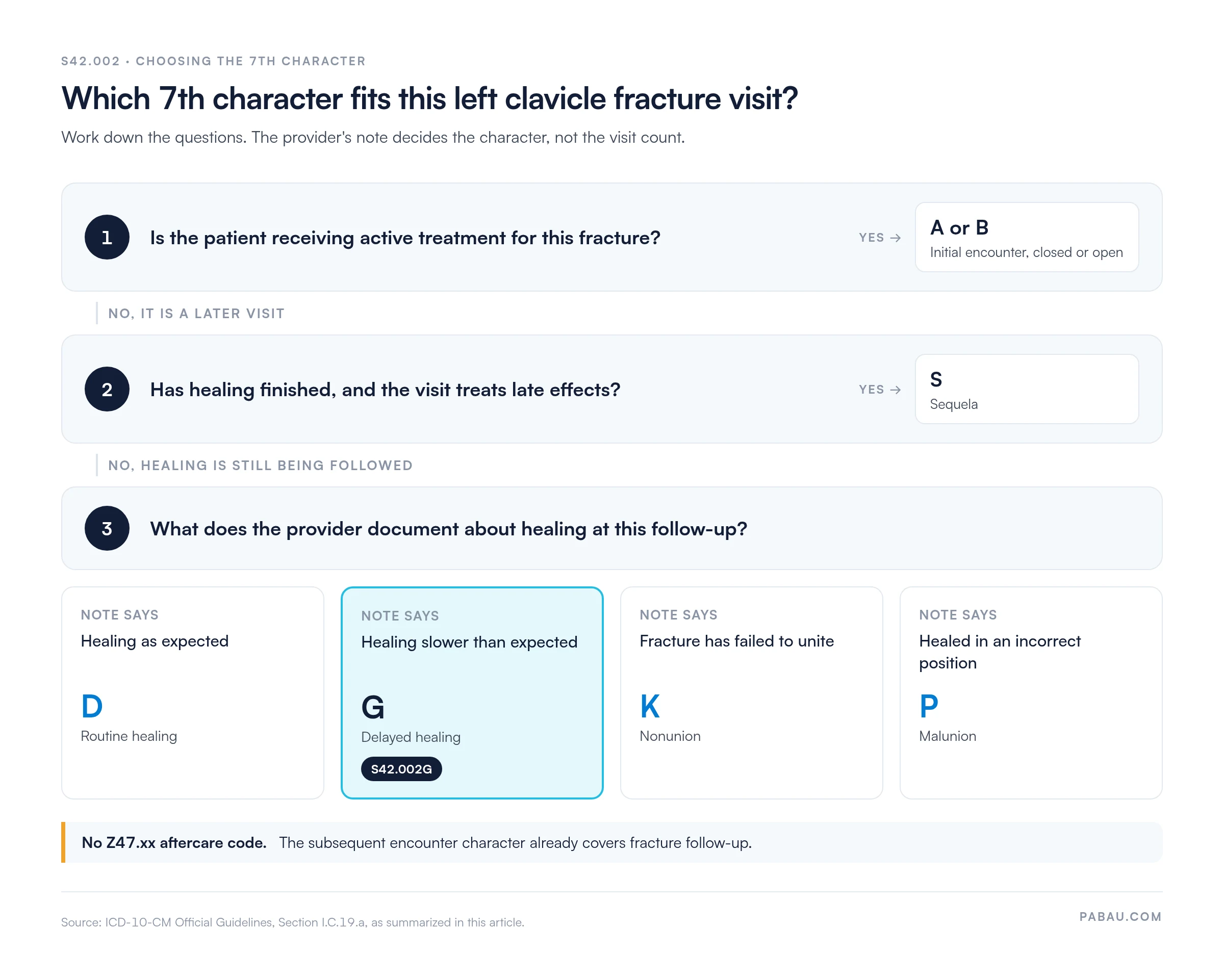
These three characters describe points on the same healing timeline, so the provider’s wording decides the code. Coders should not infer the healing status from the visit count or from pain alone.
A fracture can move between these characters over the course of care. A patient coded with D at the first follow-up may need G at a later visit if healing stalls. If the provider later diagnoses nonunion, K replaces G.
S42.002G covers a fracture at an unspecified part of the left clavicle. The clinical documentation does not say whether the break is at the sternal end, the shaft, or the lateral (acromial) end. When the fracture site is documented, a more specific code is available and should be used.
S42.002G also does not specify displacement. When displacement is documented, the coder should look to more specific S42 codes. The sternal end, shaft, and lateral end each have displaced and nondisplaced codes in the S42.01, S42.02, and S42.03 subgroups. Some payers flag the unspecified code when the note clearly states displacement.
The S42 category carries an Excludes1 note for traumatic amputation of shoulder and upper arm (S48.-). Excludes1 means the two conditions cannot be coded together for the same injury. Periprosthetic fracture around an internal prosthetic shoulder joint (M97.3) is an Excludes2 note. That condition is coded separately when both are present.
Most coding errors for left clavicle fractures fall into three categories: wrong healing character, wrong laterality, and wrong site specificity. The table below covers the codes most often confused with ICD-10 Code S42.002G.
Use the site-specific codes (S42.012G, S42.022G, S42.032G and their nondisplaced counterparts) whenever the provider documents the fracture location. Defaulting to S42.002G when the note supports a more specific code breaks the coding guidelines and may trigger a payer audit.
Supporting a clean claim submission with S42.002G requires four specific elements in the medical record. Missing any one of them gives a payer grounds to downcode or deny the visit. The documentation must establish all of the following:
Radiology reports play a central supporting role. A follow-up clavicle X-ray, billed as CPT 73000, is the strongest evidence for the G character when it compares healing with the previous film. Without imaging or an equivalent clinical finding, payers may question whether healing was assessed at all.
Medicare and commercial payers generally cover subsequent fracture management visits when medical necessity is established. The visit must show active monitoring of a fracture that is not healing on schedule. A return to the office alone does not meet that bar.
Medicare Local Coverage Determinations (LCDs) for fracture management vary by MAC jurisdiction. Most expect the record to state the clinical reason for each subsequent visit, so the fracture alone is not enough.
Practices billing Medicare for clavicle fracture follow-up should confirm their MAC’s LCD for musculoskeletal fracture management. Follow-up X-ray orders may need S42.002G as the supporting diagnosis.
Run an insurance eligibility check before every S42.002G follow-up visit. Delayed healing often adds visits, and some commercial payers cap covered fracture follow-ups within a set period. Catching those limits before the appointment prevents denied claims and unexpected patient balances.
Most S42.002G denials trace back to documentation problems or coding logic errors rather than coverage exclusions. Systematic denial management workflows that categorize rejections by root cause catch these patterns quickly. The six most common denial triggers are:
Matching the CARC and RARC on each remittance advice against a list of denial codes shows which trigger is active for a given payer. Denial patterns often differ between Medicare fee-for-service and commercial plans.
S42.002G is a subsequent encounter code. The CPT codes that pair with it are office visit E/M codes, imaging codes, and therapy evaluation codes, not fracture treatment codes.
Understanding medical billing fundamentals for musculoskeletal follow-up means recognizing where each code belongs. CPT 23500 (closed treatment of clavicular fracture, without manipulation) and CPT 23515 (open treatment with internal fixation) pair with S42.002A, not with S42.002G.
Fracture treatment codes such as 23500 and 23515 carry a 90-day global period. Routine follow-up visits by the same provider inside that window are bundled into the treatment fee. Verify CPT and ICD-10 pairings against NCCI edits and the global period before submitting.
Aftercare Z codes are not used for injuries in ICD-10-CM, and that includes fractures. This rule comes from the Official Guidelines, and it trips up coders who learned the ICD-9 approach. Understanding it is central to sound revenue cycle management for orthopedic and musculoskeletal practices.
The subsequent encounter 7th characters (D, G, K, P) replace what aftercare Z codes covered under ICD-9. The decision tree is straightforward:
Visits for sling or cast removal follow the same rule. Guideline I.C.19.a lists cast change or removal and X-rays that check healing status as subsequent encounter care. A sling removal visit for a slow-healing left clavicle fracture is therefore still coded S42.002G.
Yes. S42.002G is a valid, active ICD-10-CM code for FY2027, covering encounters from October 1, 2026 through September 30, 2027. The code and its descriptor have not changed since ICD-10-CM took effect on October 1, 2015. Coders can confirm validity each year using the CDC/NCHS ICD-10-CM web tool or the AAPC Codify ICD-10-CM lookup.
ICD-10-CM codes are revised annually on October 1. For any date of service after September 30, 2027, recheck the applicable fiscal year’s tabular list before billing. CMS publishes the annual update files on its ICD-10 page alongside the full code set.
Review the CMS ICD-10-CM addenda for any S42 changes each summer, once the next fiscal year’s files are published. That leaves billing teams time to update encounter forms and charge capture workflows before October 1.
A delayed-healing case usually means more follow-up visits, more imaging, and more claims for the same fracture. Each one has to carry the right 7th character, or the payer rejects it. Pabau’s claims software for orthopedics keeps that run of claims in one place.
Claims go out electronically through Claim.MD, which connects practices to over 4,000 US payers. Pabau handles 837P electronic submissions, ERA/835 remittance posting, and denial tracking for musculoskeletal claims. Real-time eligibility checks run before each follow-up appointment.
The result is fewer rejected follow-up claims and a clear record of which visits are paid. Billing teams can see denial patterns by CARC code and fix the cause rather than resubmit the same error.

Pabau integrates with Claim.MD to handle 837P submissions, real-time eligibility checks, and ERA posting for musculoskeletal claims. See how it works for orthopedic and physical therapy practices.

S42.002G is the right code only when a left clavicle fracture of unspecified site is healing more slowly than expected at a follow-up visit. The healing character is where this code is won or lost. Code D when the provider says healing is on track, G when the note documents a delay, and K once nonunion is diagnosed.
Practices that train providers to state the healing status in every follow-up note will defend this code on audit. That one habit also stops avoidable D, G and K mix-ups before they reach the payer. Book a demo to see how Pabau keeps fracture follow-up claims coded, submitted, and tracked in one system.

Want to understand how electronic claims reach payers? 837 file submission explains the EDI format used for professional claims, including the data elements payers validate for fracture codes.
ICD-10 Code S42.002G is a billable ICD-10-CM code for a fracture of an unspecified part of the left clavicle with delayed healing. It applies to follow-up visits where the fracture is healing more slowly than expected, not to initial injury visits.
Yes, S42.002G is a billable, specific ICD-10-CM code valid for FY2027 (October 1, 2026 through September 30, 2027). Its parent code S42.002 lacks the required 7th character, so only the full 7-character code can be submitted on a claim.
Both codes cover a follow-up visit for the same left clavicle fracture. S42.002D is for routine healing, when the fracture is healing as expected. S42.002G is for delayed healing, when the provider documents that union is slower than expected.
The record must show four elements. The visit is a follow-up, the left clavicle is specified, and the provider documents delayed healing. Slow callus formation or a persistent fracture line on imaging supports it. The fracture site must also be genuinely unspecified.
No. ICD-10-CM does not use aftercare Z codes for injuries, including fractures. Per Official Guidelines Section I.C.19.a, the subsequent encounter characters (D, G, K, P) cover fracture follow-up visits. Combining S42.002G with Z47.89 on the same claim will generate a payer edit or denial.
Common reasons are using G on an initial visit, missing laterality, or using the unspecified code when the site is documented. Other triggers are adding a Z47.xx aftercare code, coding G without documented delayed healing, and pairing a fracture treatment CPT code with a follow-up code.