

HCPCS Code E0272: Foam rubber mattress billing guide
HCPCS Code E0272: official descriptor and code overview HCPCS Code E0272 is the ...

Last Updated: Nov 6, 2026
CPT code 22902 covers excision of a soft tissue tumor of the abdominal wall, in the subcutaneous layer, measuring less than 3 cm. A small lipoma sitting in the fat above the fascia is the classic case.
Two facts decide the code: the layer the surgeon reached, and the tumor's size plus its narrowest margin. If the fascia was breached, the claim belongs to 22900 or 22901. Above the fascia at 3 cm or more, it's 22903. The operative note has to record both facts, and the guide below shows how to document, pair and bill 22902 cleanly.
Let Pabau's smart automation suggest the right codes, reduce claim denials, and keep your practice compliant—effortlessly.
Automate repetitive tasks and focus on what matters most—your patients.
Reduce coding errors and ensure compliance with the latest regulations.
Clean claims, fewer denials, and faster reimbursements.
Powerful insights and reporting to help your practice thrive.
HIPAA compliant SOC 2 certified GDPR-compliant Trusted by 4,000+ clinics worldwide

CPT code 22902 covers excision of a subcutaneous abdominal wall soft tissue tumor that measures less than 3 cm, margin included.
Once the dissection breaches the fascia, the claim moves to 22900 or 22901, which use a 5 cm cutoff instead of 3 cm.
For 2026, 22902 carries 15.49 total RVUs in an office and 9.92 in a facility, about $517 and $331 before GPCI.
Each 22902 starts a 90-day global period, so routine follow-up visits for the excision are not billed separately.
Most 22902 denials trace back to an operative note that leaves the tissue layer or the measured size unclear.
CPT code 22902 covers excision of a subcutaneous soft tissue tumor of the abdominal wall that measures less than 3 cm. The official American Medical Association (AMA) descriptor reads: Excision, tumor, soft tissue of abdominal wall, subcutaneous; less than 3 cm.
Two qualifiers in that descriptor do the work. The tumor must sit above the fascia, and its size must stay under 3 cm. As the American College of Surgeons explains, size means the tumor’s greatest diameter plus the narrowest margin needed to remove it. The surgeon measures it at excision, before the specimen shrinks.
Here, the abdominal wall means the anterior and lateral wall and its overlying tissue. Intra-abdominal organs, the retroperitoneum and the peritoneal cavity fall outside it. A lipoma in the subcutaneous fat is the classic 22902 case. Once a mass extends through the fascia into muscle, it belongs in the subfascial series (22900 or 22901).
Tumor type changes the diagnosis code, not the procedure code. Lipomas, fibromas and malignant soft tissue tumors all report as 22902 when the layer and size fit. When the surgeon performs a radical resection, usually for a sarcoma, the code becomes 22904 or 22905 instead.
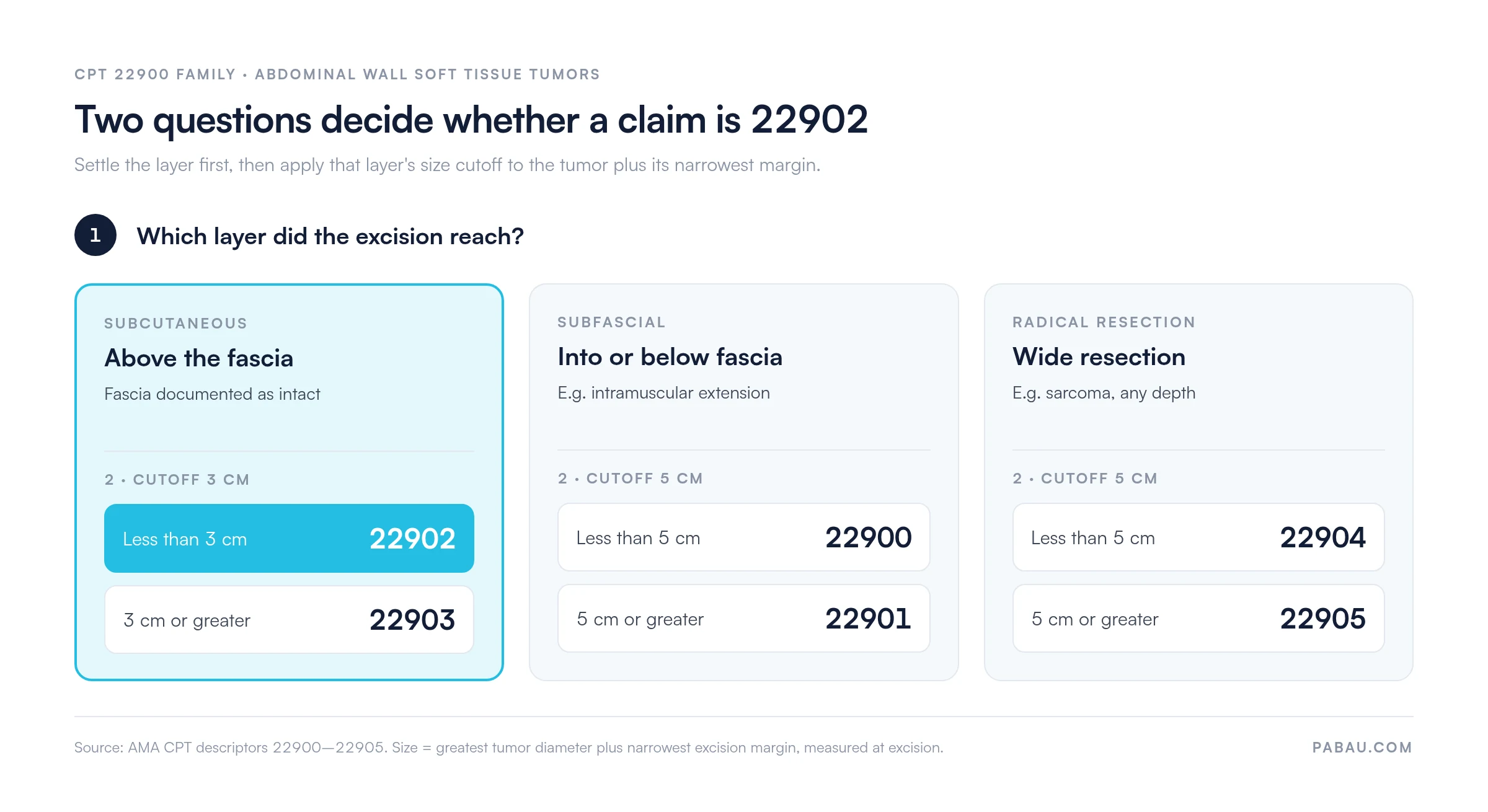
The 22900 family splits on layer first and size second. Get either one wrong and the claim comes back denied or downcoded.
Decision point 1, layer: Does the operative note confirm the fascia stayed intact? If it does, you’re choosing between 22902 and 22903. If the fascia was opened, or the tumor extended below it, use the subfascial codes (22900 or 22901).
Decision point 2, size: Now apply that layer’s cutoff to the tumor plus its margin. A lipoma that measures 2.8 cm with its margin is 22902. At 3.1 cm, the same lesion is 22903.
Watch the subfascial cutoff, though. It sits at 5 cm, not 3 cm, and coders who assume one breakpoint for both series get caught out. The diagram below maps all six codes in the family.
The operative note is what proves 22902. Imaging can’t show where the subcutaneous layer ends and the fascia begins, so the payer relies on what the surgeon wrote.
A defensible note for 22902 records six details:
Simple and intermediate repairs are included in 22902. A complex repair can be reported separately, but only when the note documents it.
Watch for phrases like “subfascial extension” or “fascia was incised.” They shift the code to 22900 (subfascial, less than 5 cm) or 22901 (subfascial, 5 cm or greater). Billing 22902 in that case is a miscode, whatever the surgeon meant.
Lipoma is the most common reason for a 22902 claim. The diagnosis code drives medical necessity review and prior authorization, so pair it with care.
For D17.1 and D21.4, most commercial payers accept medical necessity when the note records pain, growth or functional limitation. A malignant diagnosis like C49.4 usually triggers prior authorization. The payer may also want oncology notes first.
If pathology points to a different site, our ICD-10 lookups for coders list every D17 and C49 code.
Modifiers tell the payer how the procedure was performed. A missing or wrong one is a frequent reason a 22902 claim gets adjusted.
A modifier 22 claim needs more than a checkbox. Write one paragraph explaining why the excision took longer, and cite the finding that caused it, such as adhesions from a prior C-section scar. Payers deny vague modifier 22 requests often.
In 2026, CPT code 22902 carries 15.49 total RVUs in a non-facility setting and 9.92 in a facility. At the 2026 conversion factor of $33.4009, that’s about $517 in the office and $331 in a hospital outpatient department or ASC, before GPCI.
Facility rates run lower because the facility bills its own overhead separately. Rates reset every January 1, so check the CMS Physician Fee Schedule lookup before you budget. The FastRVU lookup tool shows the same components with a geographic adjustment.
Commercial rates vary widely by contract and region. Surgical practice claims software that tracks allowed amounts by payer makes 22902 underpayments easier to spot when you post remittances.
It depends on the payer and the plan year, so check at the plan level before you schedule. That habit sits at the heart of medical billing compliance.
Traditional Medicare: Generally no prior authorization for 22902. Your Medicare Administrative Contractor’s Local Coverage Determinations (LCDs) may still set documentation rules, so review them before billing.
Medicare Advantage: These plans set their own rules, and some require prior authorization for 22902. Treat each plan like a commercial payer.
Commercial insurers: Many require authorization for soft tissue tumor excision, especially for a lipoma (D17.1) without documented symptoms. Expect to send:
Asymptomatic lipoma removal is the request payers refuse most often. Put symptoms, functional impact or growth rate in writing, even when the indication seems obvious to the surgeon.
Here’s the path a typical 22902 claim takes, from booking to payment. Each step is part of the wider revenue cycle, and each one can stall the claim.
Denials on 22902 cluster around six causes. Each one has a fix you can build into denial management.
A clean claim process catches most of these before submission. The AAPC code range page lists every code in the 22900 family if you need to confirm a neighbor.
Run this list on every 22902 claim before it leaves the practice:
CPT code 22902 carries a 90-day global surgical package under CMS policy. Routine care tied to the excision is paid within the procedure, including wound checks, suture removal and minor complications that don’t need the operating room.
You can still bill separately in these cases:
Postoperative wound checks billed as E/M visits are a frequent finding in surgical superbill audits. The payer denies them as global care. If the visit only addressed the wound, it’s already paid.
Log the global end date for every 22902 case. A reminder around day 85 lets billing staff review upcoming visits before the window closes. That prevents missed unrelated E/M charges and stray wound-check claims.
Many surgical practices still re-key codes from the operative note into a separate billing tool. They then chase remittances by hand, so a wrong layer or a missing authorization surfaces weeks later.
Pabau, the practice management and billing platform we build, pre-fills the CMS-1500 from the patient record. The CPT code on the service lands on the claim line, and required fields like authorization numbers are checked before you send.
For US practices, Pabau submits claims through the Claim.MD clearinghouse to thousands of US payers. You get eligibility checks before surgery, claim status updates from the payer, and electronic remittance advice (ERA) posting.
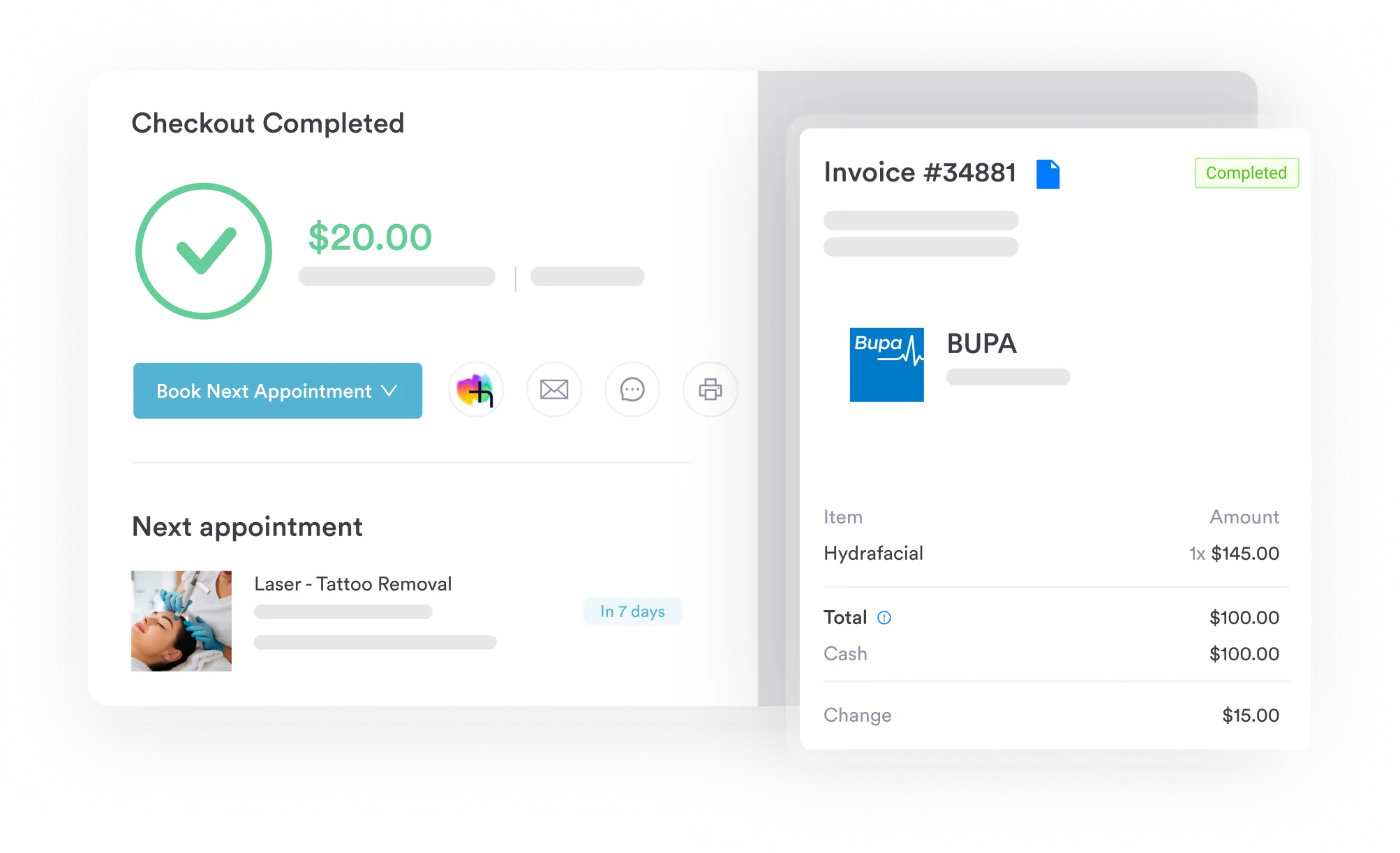

Pre-fill CMS-1500 electronic claims for 22902, check eligibility before surgery, and post electronic remittance advice (ERA) through Claim.MD and thousands of US payers.

CPT code 22902 pays on two lines of the operative note, the layer and the size. So fix the dictation template before you chase another denial.
When surgeons record fascia status and tumor-plus-margin size every time, coders stop guessing and payers stop downcoding. It costs about a minute of extra dictation per case, far less than one appeal.
Book a demo to see how Pabau carries a 22902 claim from a pre-filled CMS-1500 to claim status updates and flagged denials.

Coding a larger subcutaneous tumor? CPT code 22903 covers the same excision once the tumor and margin reach 3 cm.
Need to understand how medical billing errors are caught and corrected? Denial management in healthcare covers the end-to-end process for identifying, appealing, and preventing claim denials across surgical codes.
Submitting clean claims on the first pass? Clean claim submission breaks down the checklist every billing team should run before a claim is released to the payer.
Want to understand how clearinghouses process surgical claims? Medical claims clearinghouses explains how 837P files are validated and routed to payers for CPT codes like 22902.
Traditional Medicare generally doesn’t require it. Medicare Advantage and commercial plans often do, especially for an asymptomatic lipoma. Check each plan before scheduling, and document symptoms in the request.
Only when 22902 is the secondary procedure on the same day and the payer asks for it. Medicare applies the multiple procedure reduction itself, while many commercial payers still want 51 on the claim.
Use D17.1, benign lipomatous neoplasm of skin and subcutaneous tissue of trunk. A non-lipomatous benign mass takes D21.4, and a malignant tumor takes C49.4.
It’s 90 days. Routine follow-up for the excision, including wound checks and suture removal, is paid within the procedure. Unrelated visits need modifier 24 or 25.
Yes, when the surgeon removes two separate tumors, one under 3 cm and one at 3 cm or more. Document each lesion separately, and never bill both codes for one lesion.
Simple and intermediate repairs are included in 22902. A complex repair can be reported on its own, but only when the operative note documents it.




