CPT code 21011: Excision of soft tissue tumor of the face
CPT code 21011: Official descriptor and procedure overview CPT code 21011, as pu...

Last Updated: Oct 8, 2026
22903 is the CPT code for excision, tumor, soft tissue of abdominal wall, subcutaneous; 3 cm or greater. It covers removal of a tumor that sits below the skin but above the deep fascia, measuring at least 3 cm with its margin.
Its smaller sibling, 22902, covers subcutaneous tumors under 3 cm. A tumor that reaches below the deep fascia moves to 22900 or 22901, which use a 5 cm threshold instead.
Let Pabau's smart automation suggest the right codes, reduce claim denials, and keep your practice compliant—effortlessly.
Automate repetitive tasks and focus on what matters most—your patients.
Reduce coding errors and ensure compliance with the latest regulations.
Clean claims, fewer denials, and faster reimbursements.
Powerful insights and reporting to help your practice thrive.
HIPAA compliant SOC 2 certified GDPR-compliant Trusted by 4,000+ clinics worldwide

CPT Code 22903 covers excision of a subcutaneous abdominal wall soft tissue tumor measuring 3 cm or greater, above the deep fascia.
Tumors under 3 cm go to 22902, while tumors below the deep fascia go to 22900 or 22901 on a 5 cm threshold.
Size is the tumor’s greatest diameter plus the narrowest margin required, recorded at the time of excision.
22903 carries a 90-day global period, so a later procedure in that window needs modifier 58, 78 or 79.
Pabau’s claims management software pulls record data into a pre-filled claim and tracks it through Claim.MD from submission to remittance.
CPT Code 22903 is the code for excision of a subcutaneous soft tissue tumor of the abdominal wall measuring 3 cm or greater. The American Medical Association lists it in the Musculoskeletal System section, under excision procedures on the abdomen (22900-22999).
Subcutaneous means the tumor sits below the skin but above the deep fascia. The surgeon performs a simple or marginal resection, and simple or intermediate repair of the wound is included in the code.
The 3 cm threshold applies only to subcutaneous tumors. Subfascial tumors in the same family use a 5 cm threshold. A 4 cm tumor therefore codes as 22903 above the fascia and as 22900 below it.
The surgeon makes an incision over the abdominal wall mass and dissects through the subcutaneous fat around it. The tumor is removed with a margin of surrounding tissue, without opening the deep fascia. The specimen goes to pathology, and the wound is closed, usually in layers.
Dissection or elevation of tissue planes to reach the tumor is part of the excision and is not reported separately. Three criteria must be met for CPT Code 22903 to apply:
Medical necessity documentation usually includes the clinical exam and any imaging, often ultrasound. It also notes symptoms such as pain, growth, or interference with clothing or movement. A documented reason for removal matters, because many payers treat an asymptomatic subcutaneous lipoma as cosmetic.
Two questions decide the code in this family. Did the tumor sit above or below the deep fascia, and how large was it with its margin? Depth picks the code pair, and size picks the code within the pair.
Size is the tumor’s greatest diameter plus the narrowest margin the surgeon needed, recorded at the time of excision. A pathology measurement of the fixed specimen can come back smaller, so it should not be the only figure in the chart.
A coder cannot decide depth or size alone. If the operative report is silent on either, query the surgeon before the claim goes out rather than assuming 22903.
The work RVUs show why the fascial line matters. A 4 cm subcutaneous tumor billed as 22903 carries 6.23 work RVUs, while the same tumor below the fascia supports 22900 at 8.11.
Depth and size are the last step, though. Three earlier checks can move a lesion out of this family entirely, as the decision path below shows.
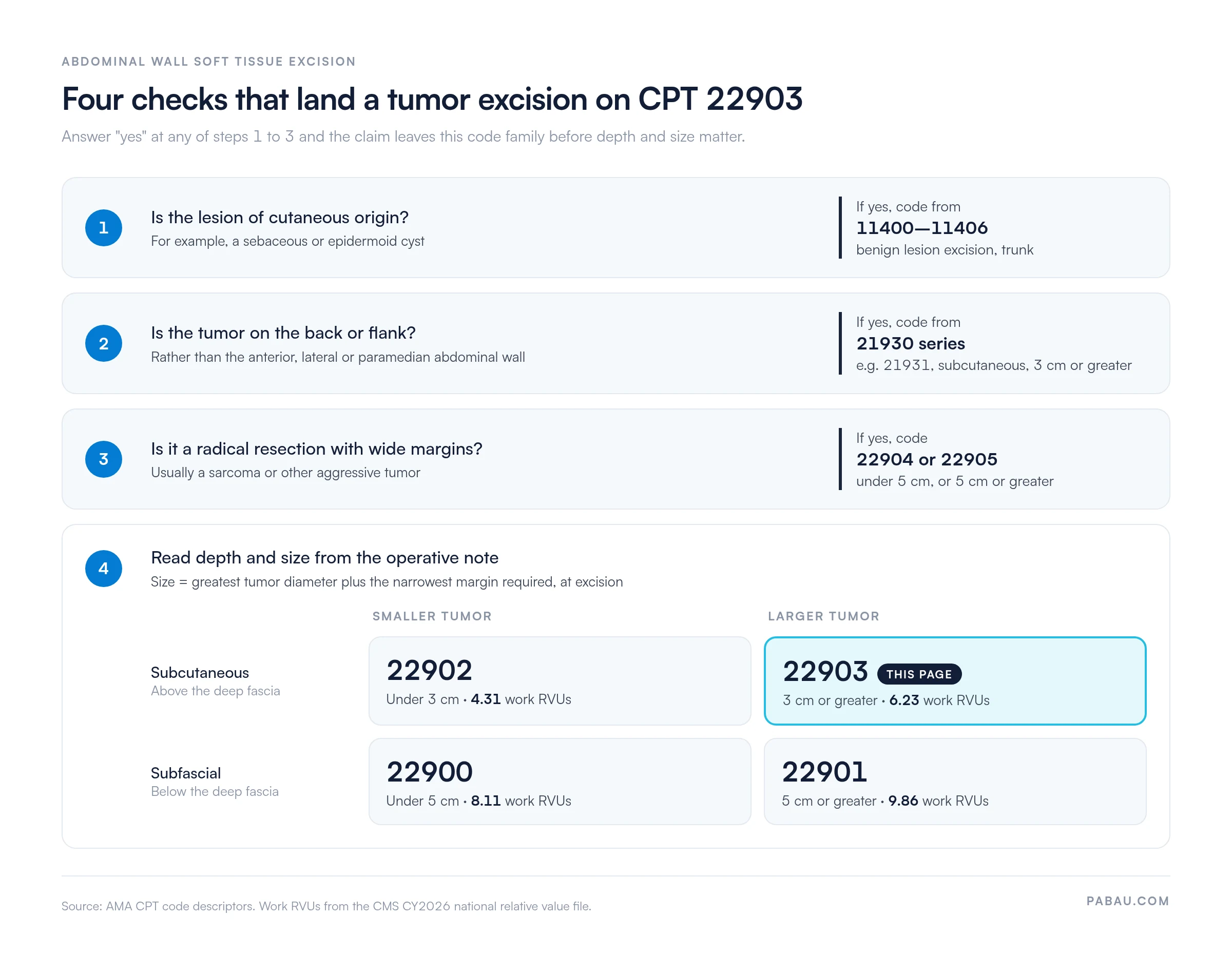
CPT 22903 shares its family with two radical resection codes, and the back and flank have a parallel series. Lesions of cutaneous origin and complex closures use other code ranges.
CPT 21931 is the neighbor most often confused with 22903, because depth and size match. The site decides it, so use 21931 only when the operative report places the tumor on the back or flank.
The diagnosis must explain why the tumor needed removal. The table lists common ICD-10-CM pairings for a subcutaneous abdominal wall tumor. The physician’s documented finding and the pathology report decide the final code.
Assign the most specific code the record supports. If the pathology report is back before coding, report a confirmed lipoma as D17.1 rather than the R22.2 mass code. D17.5 does not fit this procedure, because it describes lipomas of intra-abdominal organs.
Modifier selection follows AMA CPT and National Correct Coding Initiative (NCCI) rules. The 90-day global period makes the global surgery modifiers as important as the bundling ones.
Medicare’s bilateral surgery indicator for 22903 is 0, so modifier 50 and the 150% bilateral adjustment do not apply. Two separate tumors excised in one session are reported as two lines with XS or 59. RT and LT do not change payment on this code, so add them only where a payer’s policy asks for them.
Check the current-quarter NCCI edit table on cms.gov before appending 59 or XS. Edits change every quarter, so verify each pairing in the live table rather than from memory.
When appending modifier 22 to CPT Code 22903, document what made the case harder than typical. Name the cause, such as an unusually large tumor, dense adhesions, or operative time well above the norm. Payers routinely deny modifier 22 claims without that narrative. Attach the operative report so the reviewer can see the extra work.
Medicare pays CPT Code 22903 under the Medicare Physician Fee Schedule. The figures below come from the CMS CY2026 national relative value file, July release. Locality adjustments change the final amount, so check the CMS Physician Fee Schedule lookup tool before quoting a rate.
CMS publishes no non-facility practice expense value for 22903, so there is no separate office rate. CY2026 is the first year with two conversion factors. The higher one applies to qualifying participants in advanced alternative payment models (APMs).
The 090 global period bundles the preoperative visit the day before surgery, the procedure, and routine follow-up for 90 days. Commercial rates vary by contract, and many are negotiated as a multiple of the Medicare rate.
Original Medicare generally does not require prior authorization for 22903, but many commercial payers and Medicare Advantage plans do. Check each plan before scheduling, because an assumed exemption often ends in a post-service denial.
For subcutaneous lipomas, the bigger risk is a cosmetic determination. Many commercial policies cover removal only when the record shows symptoms, growth, or diagnostic doubt. Typical requirements include:
An authorization denial for lack of medical necessity is appealed through the payer’s pre-service channel, before the procedure. Build 22903 into your prior authorization process for every commercial case.
A vague depth note or a missing size causes most 22903 downcodes and denials. Auditors ask one question: does the note prove the procedure matches the code billed? For submitting a clean claim under 22903, the operative report should contain each element below.
If the note says only that an abdominal mass was excised, a payer cannot confirm the code and may deny it or request records. Review the medical billing compliance framework for your practice, and add a pre-submission documentation check for surgical excision claims.
Most denials on CPT Code 22903 fall into five predictable categories. Each has a workflow fix a coding team can apply before the claim leaves the practice. When one slips through, the CARC and RARC denial codes on the remittance show which category it falls into.
Effective denial management workflows for CPT Code 22903 start before the claim is submitted. A pre-submission check of depth, size, diagnosis specificity, and authorization status catches most of these categories before they become accounts receivable problems.
Build a CPT 22903 denial report that segments denials by reason code and by surgeon. If size or depth denials cluster around one surgeon, an operative note template update fixes the source faster than appealing each claim.
Most 22903 denials start with a missing measurement or a vague depth note. They often surface weeks later as a rejected claim, and the team rebuilds the case from paper notes and payer portals.
In Pabau, our practice and billing software, the operative note, the diagnosis, and the billing record sit on one patient file. Its medical claims management tools pull that record data into a pre-filled claim and submit it through Claim.MD, our US clearinghouse integration.
Claim.MD runs real-time eligibility checks, tracks each claim’s status, and posts electronic remittance advice back to Pabau. Your team sees a denied 22903 claim and its reason code without logging in to each payer’s portal.


Pabau’s claims management software pulls record data into pre-filled claims, submits them through Claim.MD, and tracks each one through remittance. Built for surgical and general surgery practices.

Code 22903 rests on two facts a coder cannot supply. One is where the tumor sat relative to the deep fascia, and the other is its size with the margin. Get both into the operative note, and the choice between 22902, 22903, 22900 and 22901 follows directly.
The trade-off is a minute of extra surgeon time per case against fewer queries, downcodes, and cosmetic denials later. A required size-and-depth field in the operative template is the cheapest fix available.
Read medical billing fundamentals for the wider workflow, or book a demo to see how Pabau keeps surgical records and Claim.MD claims in one place.

Need to understand clearinghouse submission for surgical claims? Claim.MD clearinghouse overview explains how electronic claim transmission and remittance work for CPT-coded procedures.
Want to reduce claim rejections before they reach the payer? 837 electronic claim file guide covers the EDI transaction format that carries CPT 22903 claims from your practice management system to the clearinghouse.
Looking for denial code definitions after a 22903 claim comes back rejected? Denial codes in medical billing maps CARC and RARC codes to actionable appeal steps.
CPT Code 22903 covers excision of a soft tissue tumor in the subcutaneous tissue of the abdominal wall, measuring 3 cm or greater. Subcutaneous means below the skin but above the deep fascia. Size is the tumor’s greatest diameter plus the narrowest margin required, and simple or intermediate repair is included.
Modifier 22 applies when the work substantially exceeds the typical procedure. Modifier 51 covers multiple procedures, and 59 or XS separates 22903 from a code an NCCI edit would bundle. Within the 90-day global period, use 58, 78 or 79 for a later procedure. Modifier 50 does not apply.
Original Medicare generally does not require prior authorization for CPT 22903, but many commercial payers and Medicare Advantage plans do. Some commercial policies also treat an asymptomatic subcutaneous lipoma as cosmetic. Verify with each plan, and document symptoms or clinical concern before scheduling.
The most common pairing is D17.1, benign lipomatous neoplasm of skin and subcutaneous tissue of trunk. Others include D21.4 for a benign soft tissue tumor of the abdomen, R22.2 for a trunk mass before pathology, and C49.4 for a sarcoma. D17.5 does not fit, because it covers lipomas of intra-abdominal organs.
The most common causes are a missing size measurement, a cosmetic or medical necessity determination, and missing prior authorization. Coding a subfascial or back tumor as 22903 also triggers denials, as do NCCI and global period conflicts. A size-and-depth line in the operative note prevents the most frequent problems.